
Bruges Beguinage: houses around a shared courtyard
Read the white houses and seasonal garden alongside the history of Beguine women, keeping a visited courtyard distinct from the homes around it.
Bruges Old TownObservation essay
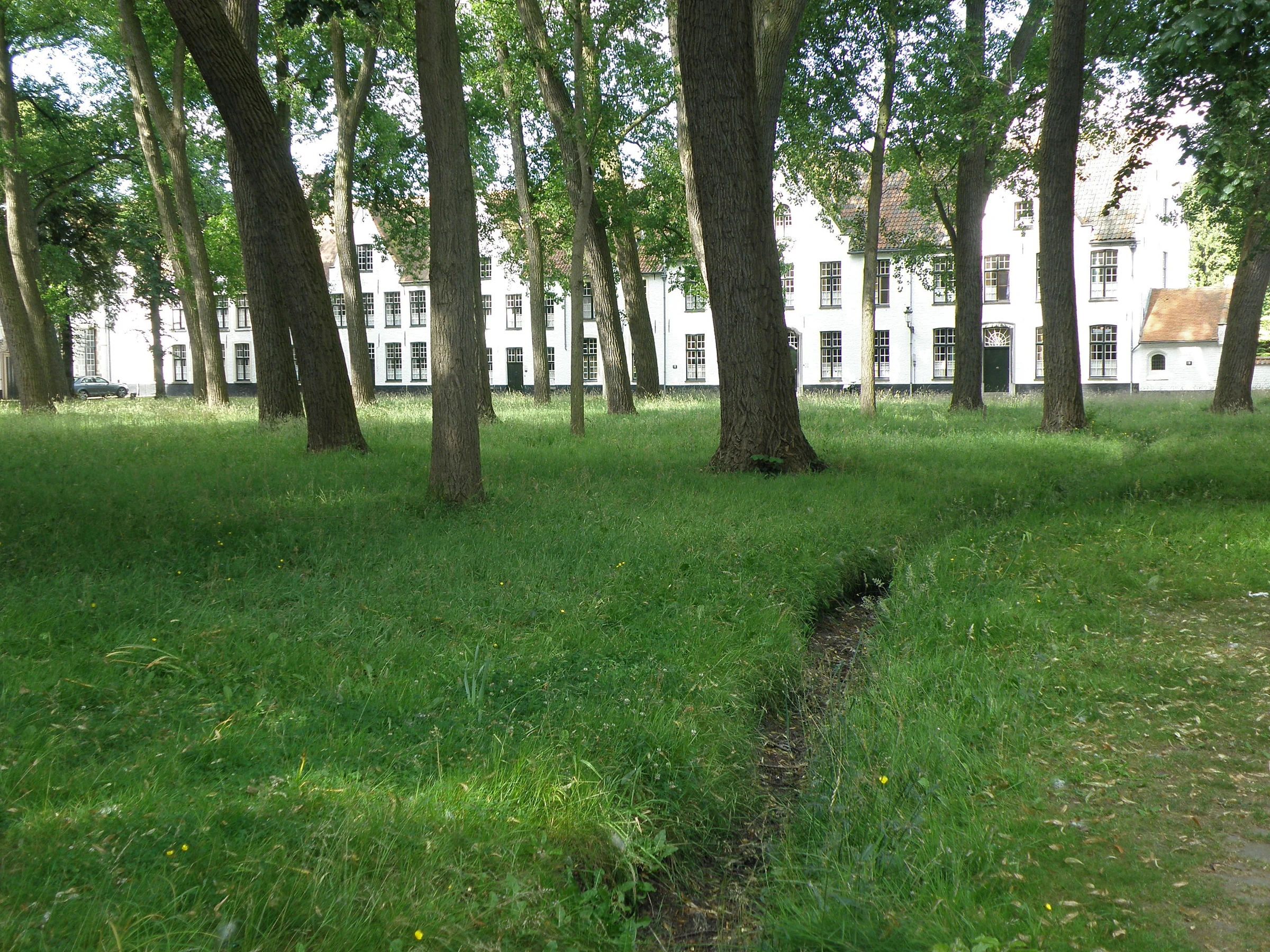
Look at the houses before the flowers
In the June photograph, trunks divide the distant white frontage into sections. Repeated windows and dark doors remain visible beyond a large stretch of grass. Those entrances give an apparently park-like view a domestic scale.
An empty frame does not establish an empty community. It says nothing about who is indoors or when people pass. Consider instead where each doorway leads: out of a private room or house and towards ground shared with others.
Beguines were not simply another name for nuns
UNESCO describes women devoted to God without withdrawing from the world. Their communities addressed material as well as spiritual needs, bringing houses, churches, ancillary buildings and green spaces together. A single religious building cannot represent that whole arrangement.
Visit Bruges explains that Beguines were not bound by formal perpetual vows and could retain property. These distinctions make the history more precise than a general label of convent. They do not establish identical lives for every resident or every period.
Shared ground still has separate doors
Within the white frontage, gable heights, window arrangements and entrances vary. A unified distant appearance gives way to individual buildings as the viewer moves closer.
Community life also needs that smaller scale: space behind a door and encounters beyond it. The photographs do not document how earlier inhabitants allocated rooms, managed domestic work or cared for one another. Such questions deserve further evidence rather than invented scenes inside each house.
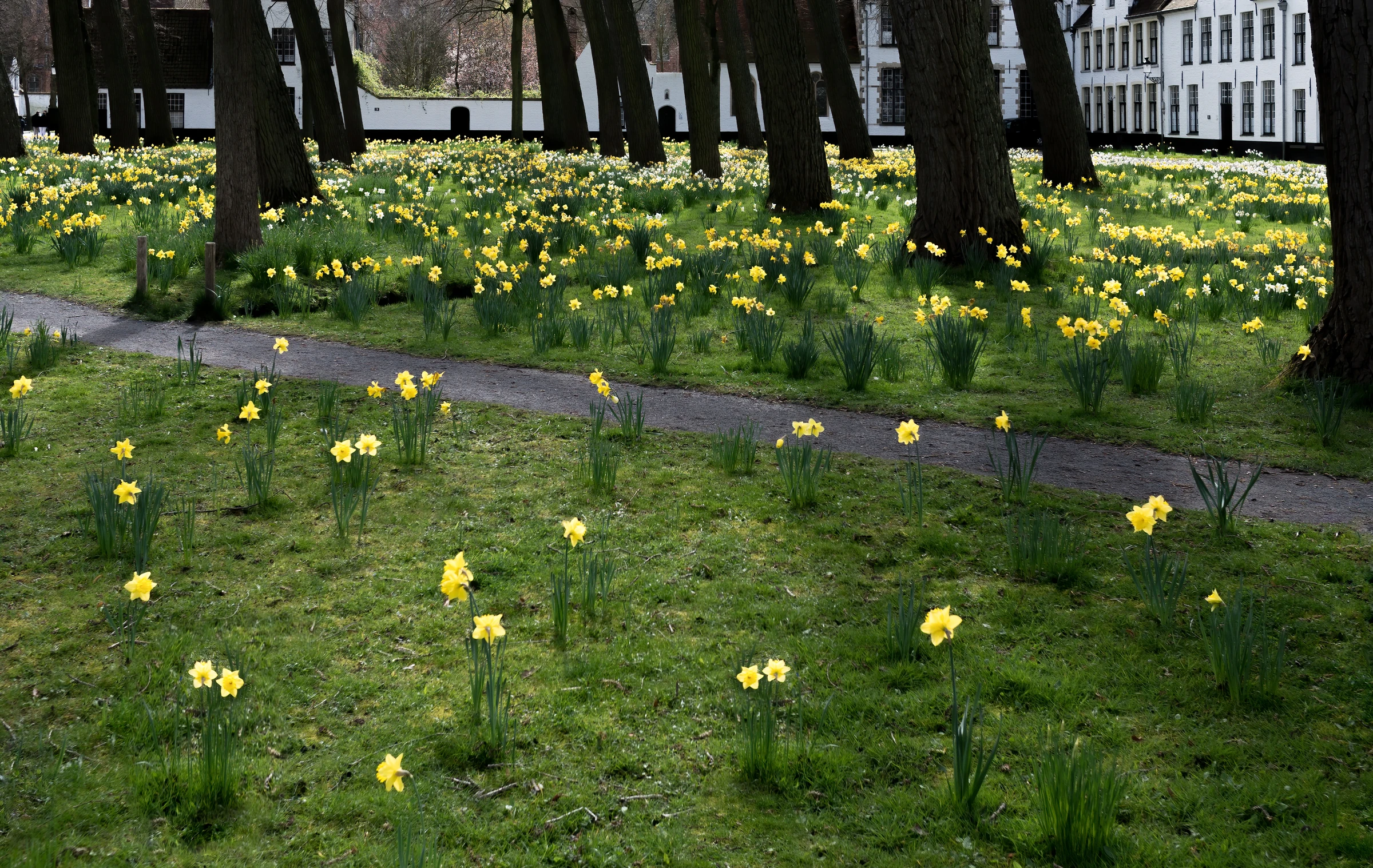
Daffodils change the emphasis
In the second photograph, yellow flowers scatter between trunks and a path crosses the foreground. They draw attention towards the ground before the eye returns to the windows behind. The June view gives more weight to green space; the spring image introduces small bright interruptions.
These are separate occasions, not successive frames or a reliable calendar for future flowering. Seasonal photographs can turn a brief condition into a destination’s expected appearance. Without flowers, the distances between houses, paths and trees remain worth examining.
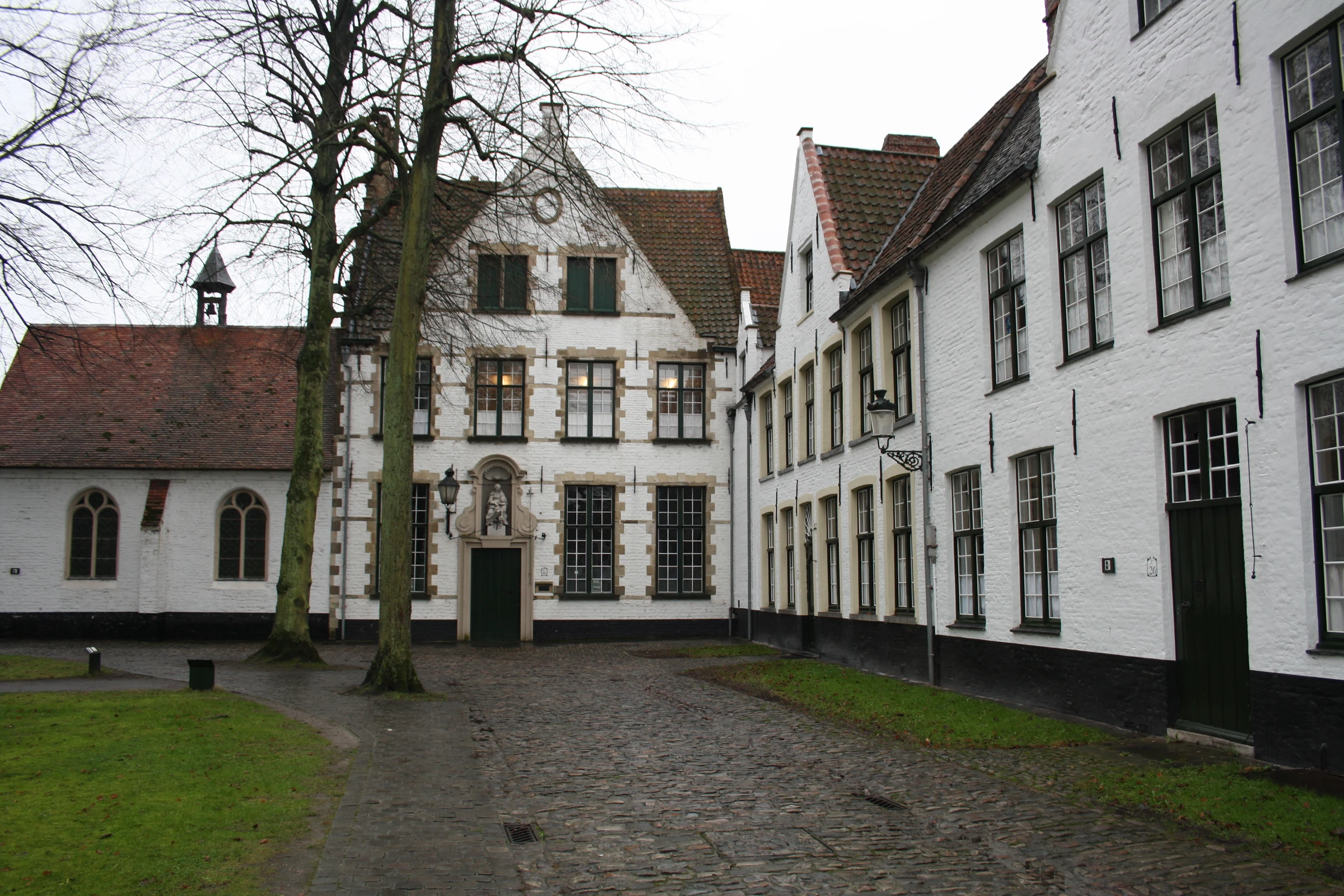
Near a doorway, visiting has limits
The third view moves closer to cobbles, brick texture, roof tiles and window divisions. Grass occupies less of the composition. Entrances become easier to read at the scale of someone passing along the path.
Visit Bruges says the site remains inhabited by nuns and women choosing a quiet life. A publicly visited path therefore needs to be distinguished from a residential threshold. Observe from permitted positions without looking closely into windows or treating an open door as an invitation.
Quiet does not imply an unchanged history
The local historical account records the last Beguines joining a community following the Benedictine rule in 1927. The inherited place-name and later residents’ identities belong to related but distinct histories. Continued use does not mean an unchanged organisation.
The photographs date from 2018, 2014 and 2011. Check current access arrangements and follow entrance notices when visiting. Before leaving, look once more at how the houses address the courtyard: shared ground brings people near one another, while individual doors preserve separate space.
References
These sources inform the essay’s historical and local context. Its observations and interpretations are original to WalkThere.
UNESCO World Heritage Centre
Flemish BéguinagesContext for Beguine women and communities combining homes, religious buildings and green space.
Visit Bruges
Beguinage as a UNESCO World Heritage SiteLocal account of living arrangements, the 1927 transition and continued residential use.
More journey background
Related journey sources
- History of Bruges — Visit Bruges
- Markt (Market Square) — Visit Bruges
- Markets in Bruges — Visit Bruges
- Belfort (Belfry) — Visit Bruges
- Historium Bruges and the former Water Hall — Visit Bruges
- Stadhuis (City Hall) — Visit Bruges
- Burg Square, Holy Blood Basilica and Dijver in the official visitor guide — Visit Bruges
- Rozenhoedkaai (Rosary Quay) — Visit Bruges
- Rosary Quay in the Visit Bruges City Film Office guide — Visit Bruges City Film Office
- Groeningemuseum — Musea Brugge
- Gruuthusemuseum — Musea Brugge
- Bonifaciusbrug (Boniface Bridge) — Visit Bruges
- O.L.V.-kerk Museum (Museum of the Church of Our Lady) — Visit Bruges
- Begijnhof (Beguinage) — Visit Bruges
- Minnewater (Lake of Love) — Visit Bruges
- Historic Centre of Brugge — UNESCO World Heritage Centre