
Kanazawa: garden, castle gate, market and tea-house streets
A four-stop Kanazawa visual journey, from Kenrokuen to Higashi Chaya. Compare dated documentary photographs, then plan your own visit with current information.
Explore 3 reviewed views along the routeGuided visual journey
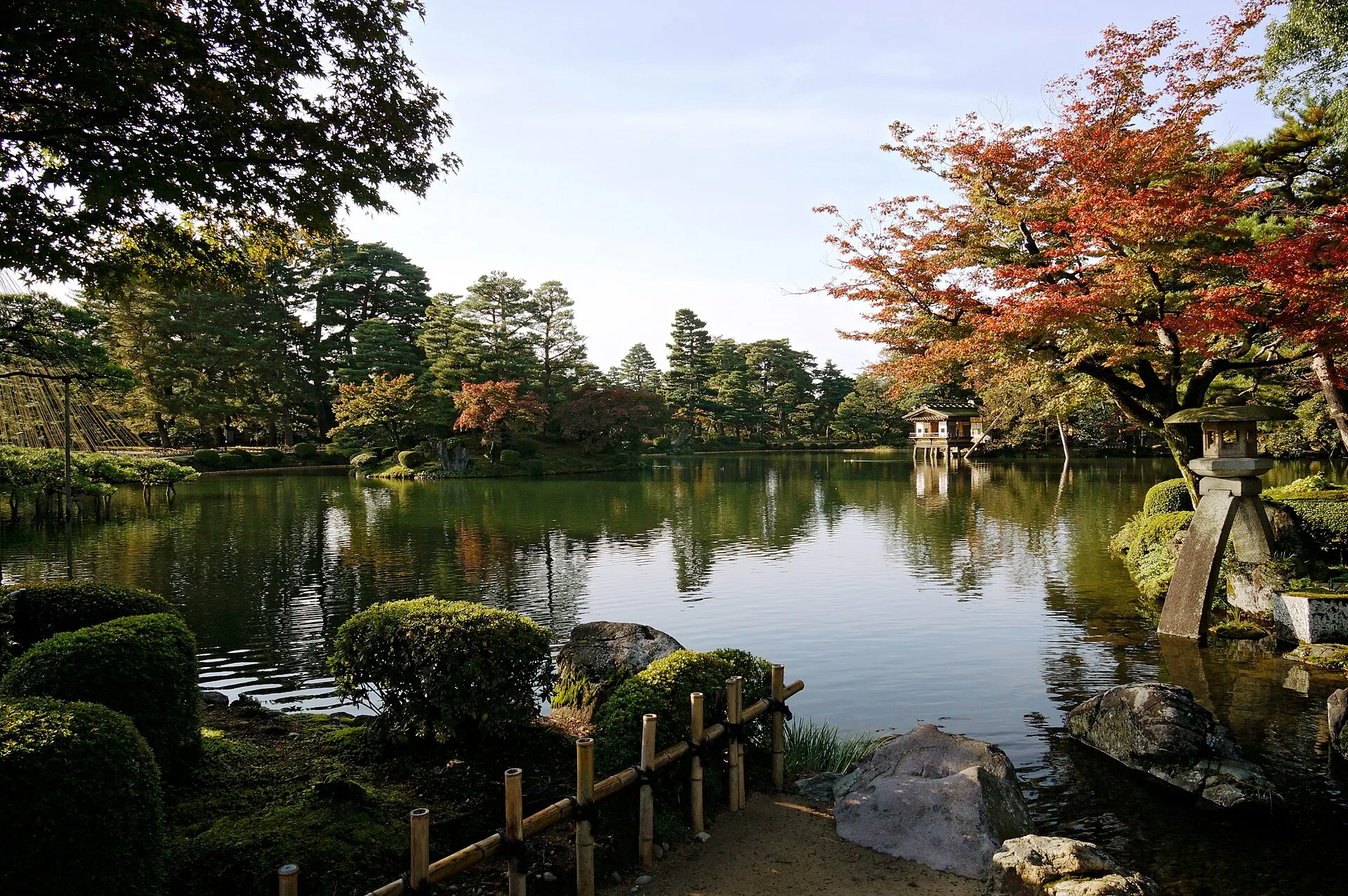
Kasumigaike Pond and autumn trees in Kenrokuen · 663highland · CC BY 2.5
Reading mode
Place stories to read at your own pace
Chapter 1 · A garden built to be walked
Begin beside Kenrokuen’s water
Begin with the pond rather than a checklist of famous viewpoints. In the November 2013 photograph, Kasumigaike holds the sky and a small building in its reflection; a stone lantern and autumn leaves give the bank its scale. The companion picture shows yukitsuri, the conical ropes that support pine branches against winter snow. They are practical engineering as well as one of Kanazawa’s most recognisable seasonal forms. Neither image predicts the colour of the leaves or the weather on the day you visit.
The city’s official guide explains Kenrokuen’s name through six qualities of an ideal garden: spaciousness, quiet, artifice, age, water and views. They are not six items to tick off at a single camera position. The Maeda family developed the garden over generations beside their castle; walking around the pond lets foreground, water and trees repeatedly rearrange the scene. The guide also recounts an interpretation of Horai Island in the pond as a symbol of longevity. Treat that as garden symbolism, not as an event the photograph or the island can prove.
Pause at the water before crossing toward Ishikawamon. The gate is near the garden, but the photographs do not document the connecting path or the entrance you will actually use. Kenrokuen is an admission-controlled garden; check the prefectural office’s current entry times, fee and accessible-entrance information before travelling. This first stop helps you decide whether you want an unhurried garden visit or simply a short look between other city sights.
Real-travel note
Allow time for the garden rather than treating it as a pass-through. Check current admission, accessible entrances and seasonal opening with the official garden office; wet paths and snow change the visit.
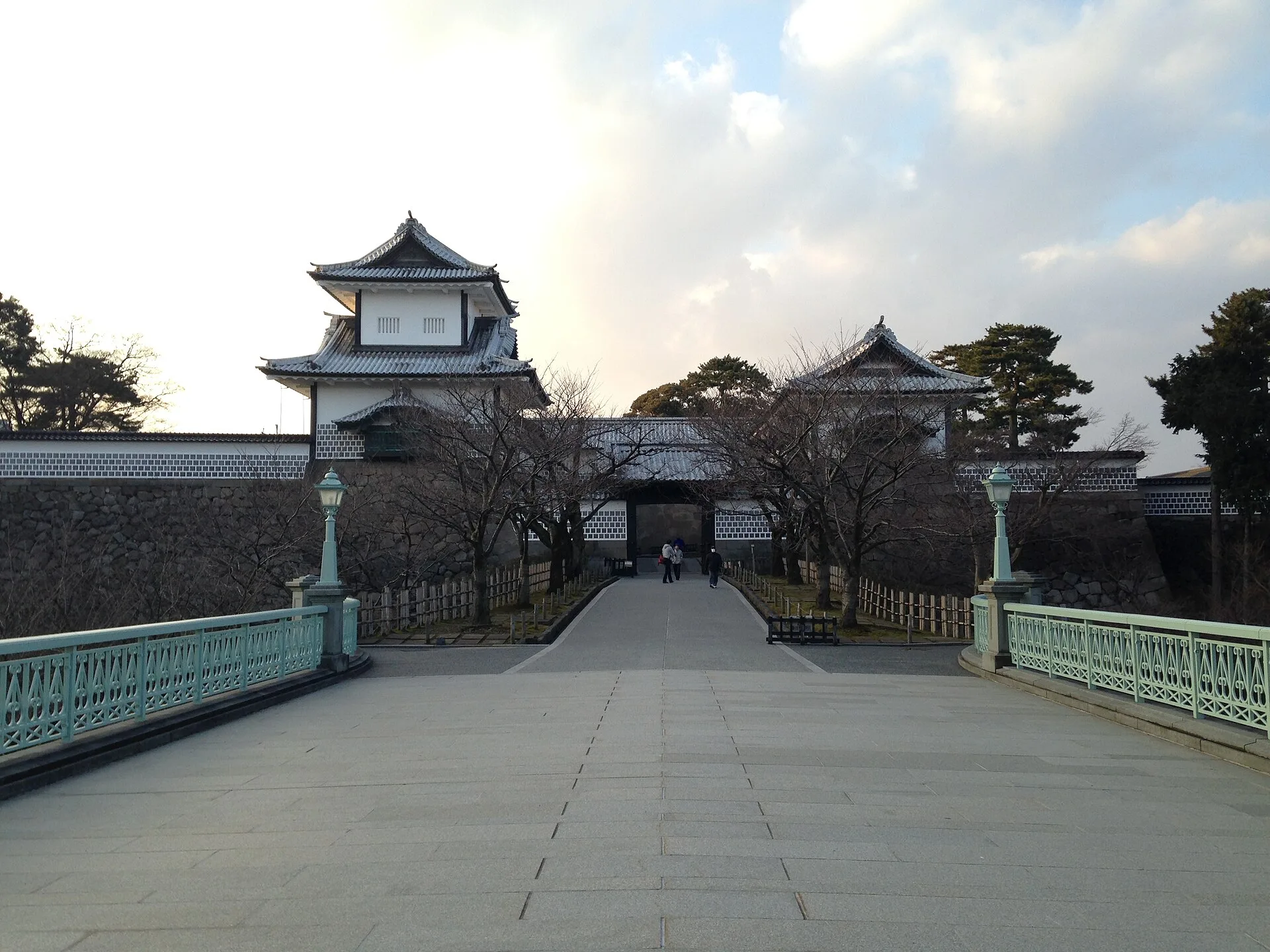
Exteriors from 2015 and 2024 frame the gate differently; the 2019 timber interior adds another layer. These are separate visits, not a continuous passage.
Chapter 2 · What survives of the castle
Cross to Ishikawamon Gate
From the garden side, Ishikawamon gives the castle a clear threshold: bridge, stone base, pale walls and roofs announce that you are leaving a designed garden for a fortified precinct. The first photograph was taken in January 2015 and looks toward the gate from outside. A second image, made four years later, shows timber beams and a passage within the gate. Switching between them changes what you can notice, but it is not a continuous movement through the structure.
Kanazawa’s official guide identifies Ishikawamon as an Important Cultural Property and says the gate was rebuilt after a great fire. That is an important correction to the instinct to call every visible wall “original”. The wider castle park mixes preserved fabric, reconstruction and open grounds. A third photograph, taken outside in 2024, gives a later look at the wall and roofs. Even where a building looks old, its present form may reflect repair and later use. Look at the stonework and the gate’s defensive layers, then remember that a photo of an interior does not guarantee every room is open today.
The next chapter moves to Omicho Market, shifting from lordly landscape to the working food economy of the town. The city’s transport guide gives a short walk between the market and a castle entrance, but this page has not surveyed every crossing from Ishikawamon. Decide the path with a current map and on-site signs. The three gate images are especially useful for a real-world decision: if you have little time, does architecture and restoration interest you enough to stay inside the castle park, or would you rather spend it at the market?
Real-travel note
Check current castle-park and gate access before entering. The two dated photographs do not prove today’s open rooms or a step-free route to the market.
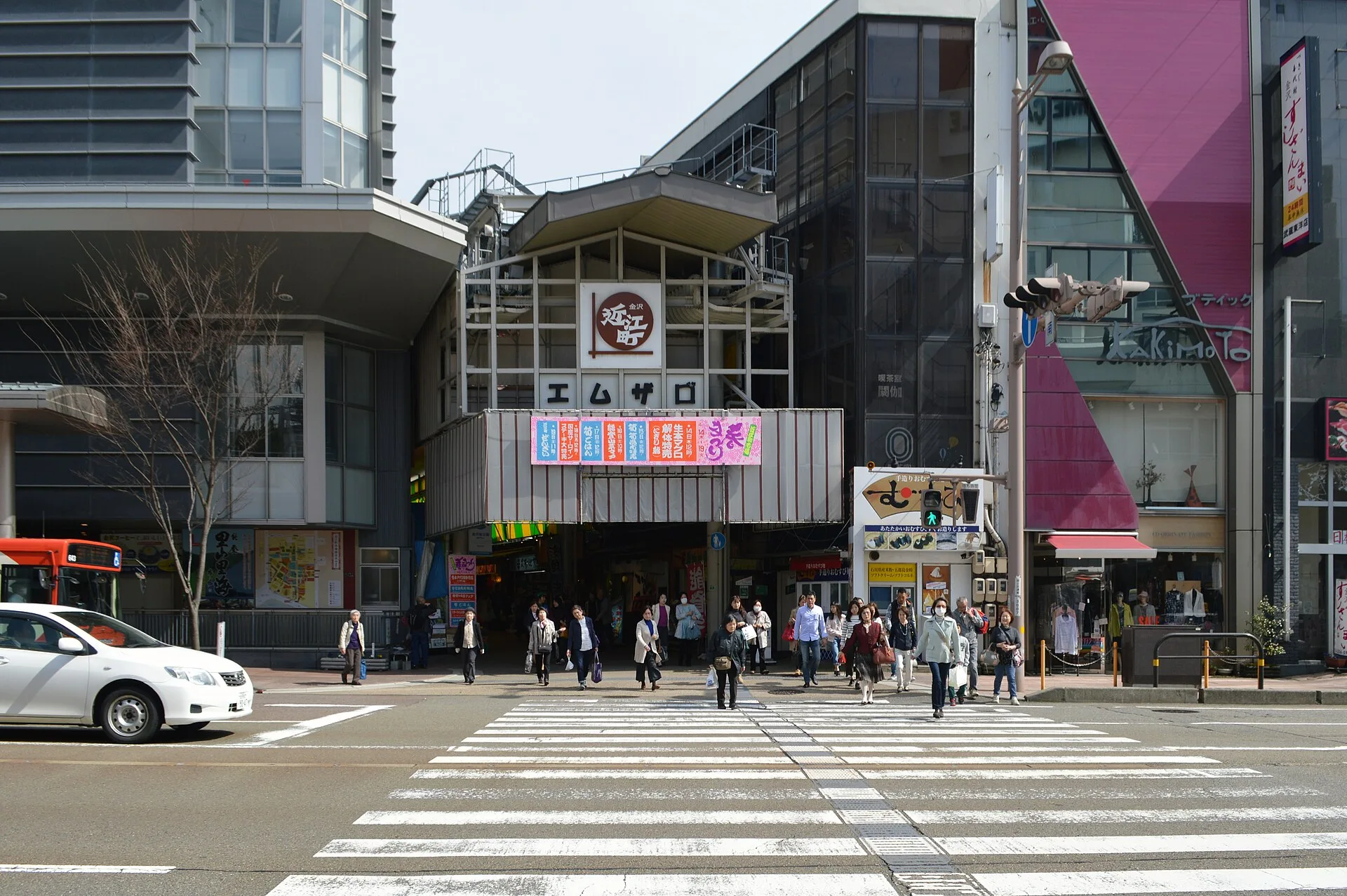
Five separately dated views move from the western entrance to fruit, fish, crab and dried seafood. The order is editorial, not a walk through today’s market; visible prices are historical.
Chapter 3 · The city’s kitchen
Step into Omicho Market
The market begins at an ordinary crossing, not a theatrical gate. Our 2016 photograph shows the western entrance from across the road, with traffic and pedestrians still part of the scene. Once inside, the 2019 fruit photograph and a 2023 fish-stall view bring the eye close to food, labels and the work of selling it. Those pictures come from different years and different cameras. They show the variety of a market, not a guaranteed sequence you can follow or what is in stock today.
The city’s official guide places Omicho’s beginnings in the Edo period and describes more than 170 shops, among them fishmongers, produce sellers and restaurants. It is tempting to reduce the place to a seafood meal. The fruit image is a useful counterweight: this is also a place where everyday groceries, regional produce and shopkeepers’ routines matter. Two additional photographs from 2011 show crab and dried-seafood counters, making the difference between a whole market and a single signature dish clearer. The prices visible in old photographs are historical details, not current prices. Do not infer the origin of a particular fish or melon from its appearance alone.
Markets reward curiosity but also require care. Make room for people buying or carrying goods, ask before photographing a stallholder, and eat where the shop permits rather than blocking an aisle. Individual shops keep different hours, so a single published market window is not a promise that your chosen counter will be open. If food is your main reason to visit Kanazawa, this chapter may deserve more time than the garden or gate. The last chapter changes pace again, ending among the wooden streets of Higashi Chaya; these still photographs cannot navigate the walk between them.
Real-travel note
Check the market and individual vendors’ latest opening information. Expect busy aisles and variable stock; use a live map for the move to Higashi Chaya.
Chapter 4 · A living historic district
Finish in Higashi Chaya
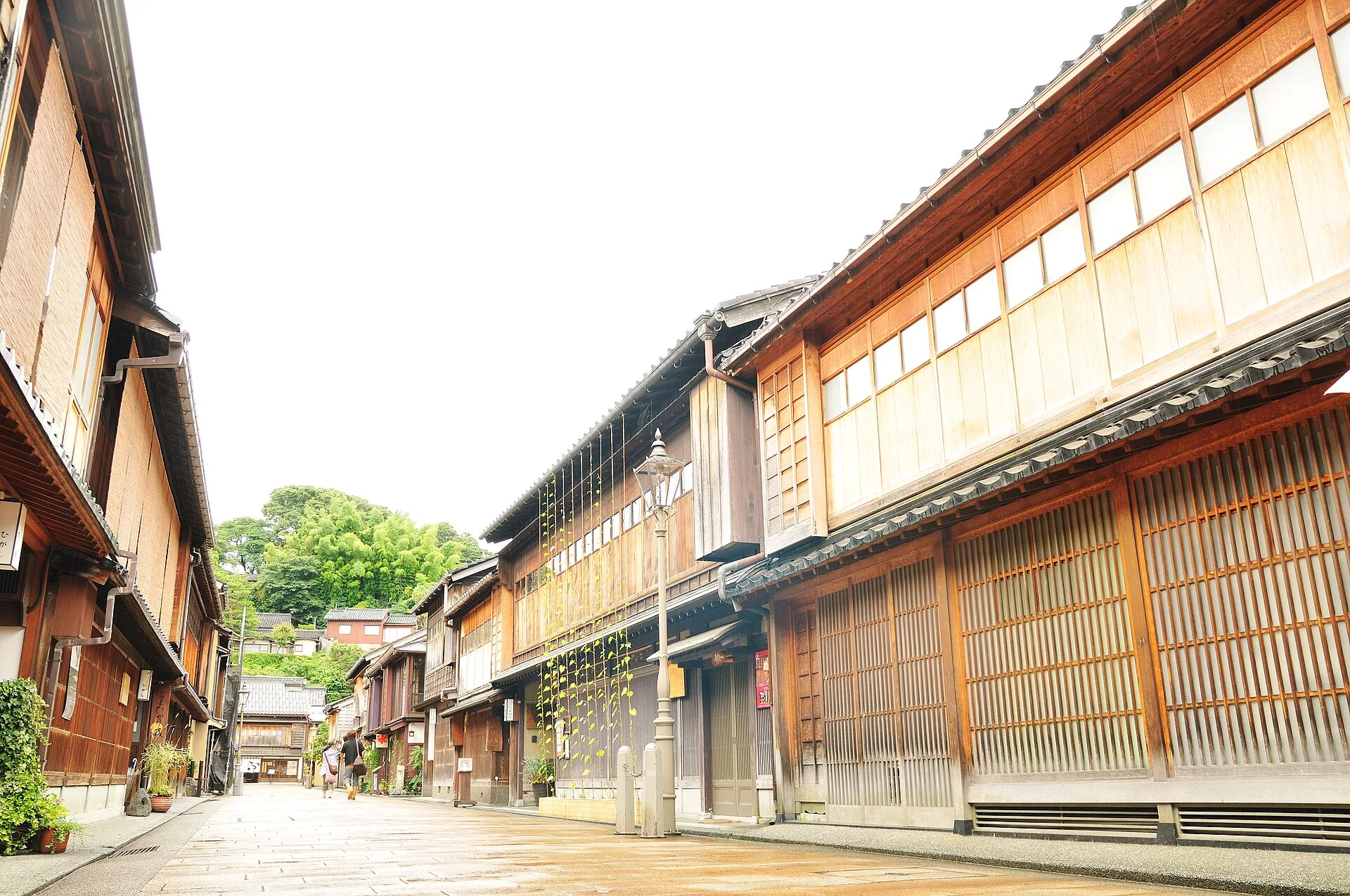
End on a street where the buildings are the invitation to slow down. The broad 2011 photograph follows the line of wooden townhouses and lattices; a 2013 view looks along another stretch, while a 2019 image comes closer to one shopfront. Together they let you compare rhythm, materials and street scale. They do not show an unbroken walk from the market, nor do they promise that the same businesses still occupy every façade.
The official Kanazawa guide explains that Higashi Chaya became one of the city’s designated entertainment districts in 1820. Traditional chaya were places of performance and hospitality, not simply cafés in the modern sense. The lattice at street level and rooms above are part of the district’s distinctive architecture. Today many buildings are adapted as shops, restaurants or other uses, while the streets remain part of a lived neighbourhood. The older photograph is valuable precisely because it can be compared with the newer one instead of being passed off as the present view.
This is also where a romantic story about “stepping back in time” needs a little restraint. The preservation of a streetscape does not turn residents into performers or give visitors access to private interiors. The city’s visitor guide asks people not to eat while walking in most of the district; follow current signs, respect doorways, and ask before photographing people. If the district is why you came, allow time to move beyond a single busy street and perhaps compare nearby Kazue-machi across the river. Before you book or set out, verify hours for any specific house you hope to enter. The four chapters are an editorial introduction, not a mapped continuous route.
Real-travel note
The streets themselves are public, but individual venues differ. Check current opening and photography rules; avoid eating while walking where prohibited and leave residents’ doorways clear.
3 reviewed experiences
Explore along the route
Step into the places along this journey. Choose a view independently of the story chapters.
Explore at your own pace; these views do not count toward chapter completion. Short sequences cover only the reviewed section. Imagery availability may change.
Sources
- Kenrokuen Garden — VISIT KANAZAWA
- Kenrokuen Garden Visitor Guidance — Ishikawa Prefecture
- Kanazawa Castle Ishikawamon Gate — VISIT KANAZAWA
- The Kanazawa Area Guide — VISIT KANAZAWA
- Omicho Market — VISIT KANAZAWA
- Higashi Chaya District — VISIT KANAZAWA
- Beginner’s Guide to Higashi Chaya District — VISIT KANAZAWA
- Getting Around in Kanazawa — VISIT KANAZAWA
- 131109 Kenrokuen Kanazawa Ishikawa pref Japan01s3.jpg — Wikimedia Commons
- 131109 Kenrokuen Kanazawa Ishikawa pref Japan05s3.jpg — Wikimedia Commons
- View of Ishikawa Gate of Kanazawa Castle.JPG — Wikimedia Commons
- Kanazawa Kanazawa-jo Ishikawa-mon Innen 2.jpg — Wikimedia Commons
- 2024-10-26 Kanazawa Castle, Ishikawa-mon.jpg — Wikimedia Commons
- Omicho covered market western entrance, Kanazawa, 2016.jpg — Wikimedia Commons
- Kanazawa Omicho Market, Japan (48876956676).jpg — Wikimedia Commons
- Kanazawa fish market.jpg — Wikimedia Commons
- OMC01.jpg — Wikimedia Commons
- Omc02.jpg — Wikimedia Commons
- Higashi Chaya District, Kanazawa - Jul 19, 2011.jpg — Wikimedia Commons
- 20131007 36 Kanazawa - Higashi Chaya District (10477160465).jpg — Wikimedia Commons
- Higashi Chaya District (50153812728).jpg — Wikimedia Commons


.jpg)


.jpg)
.jpg)
Your journey, remembered.
The keepsake unlocks when you reach this section.