
St Anne’s in Vilnius: fine lines built from brick
Compare St Anne’s façade, apse brickwork and neighbouring Bernardine church, with material history and digital documentation from Go Vilnius and CyArk.
Vilnius Old TownObservation essay
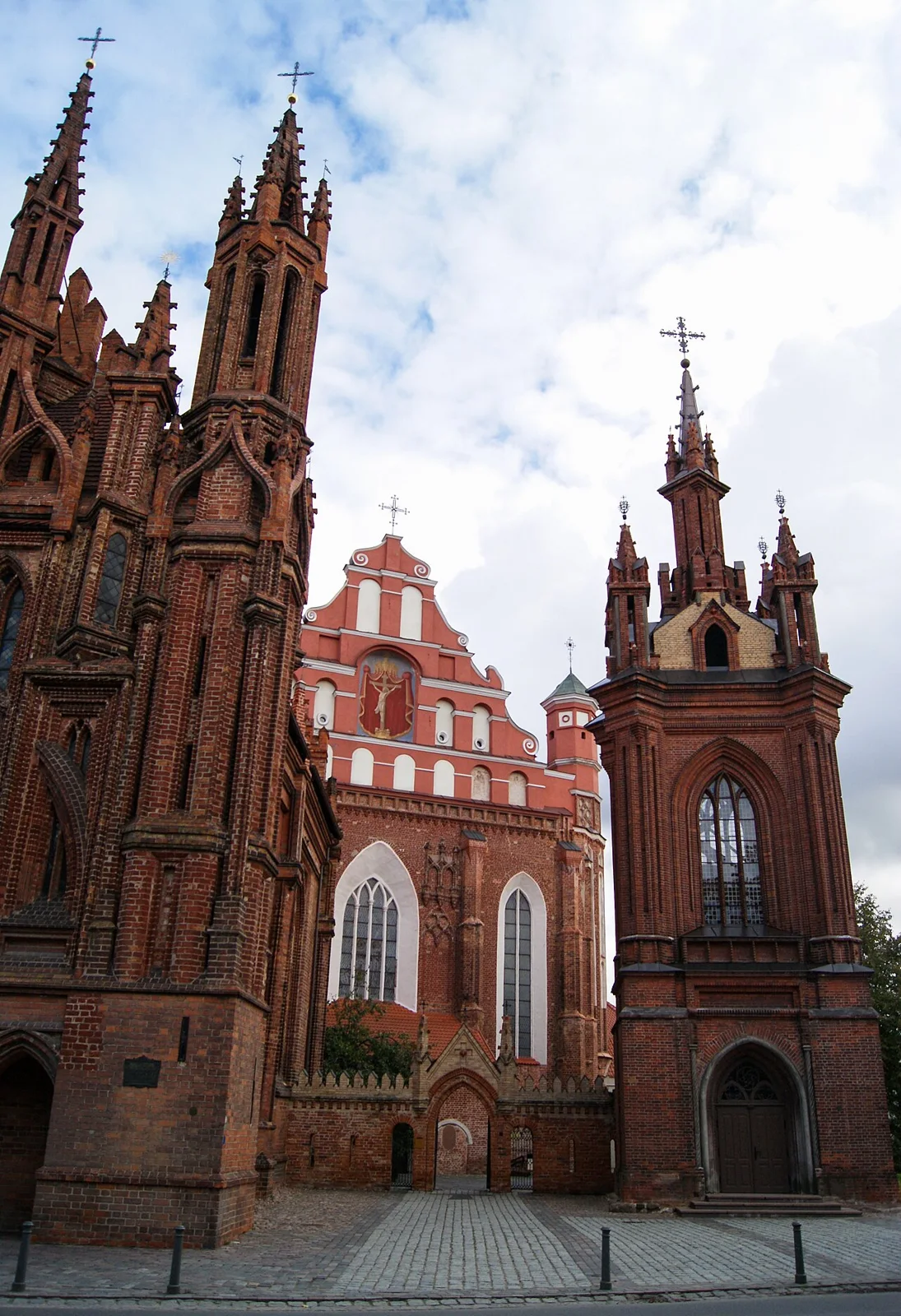
Colour arrives before the lines
The façade first registers as a red surface. Looking longer separates heavier vertical parts from finer edges and the sky between them. The elaborate upper outline and substantial door openings offer different scales for the eye to follow.
Brick often suggests repeated units in a wall, yet this frontage contains many turns. Choose an edge and follow where it divides or gathers. Its visual density changes across the elevation rather than spreading evenly over every surface.
What thirty-three kinds can mean
CyArk’s project introduction describes thirty-three kinds of clay brick in the exterior. That is a statement about variety, not a count of the total bricks or something a distant photograph lets someone verify independently. It gives the complex surface a material starting point.
The apse photograph invites a closer comparison of openings and vertical elements. Identifying particular profiles or separating shaped units from their assembly would require more detailed architectural documentation. Shadows alone should not be assigned to a specific brick section.
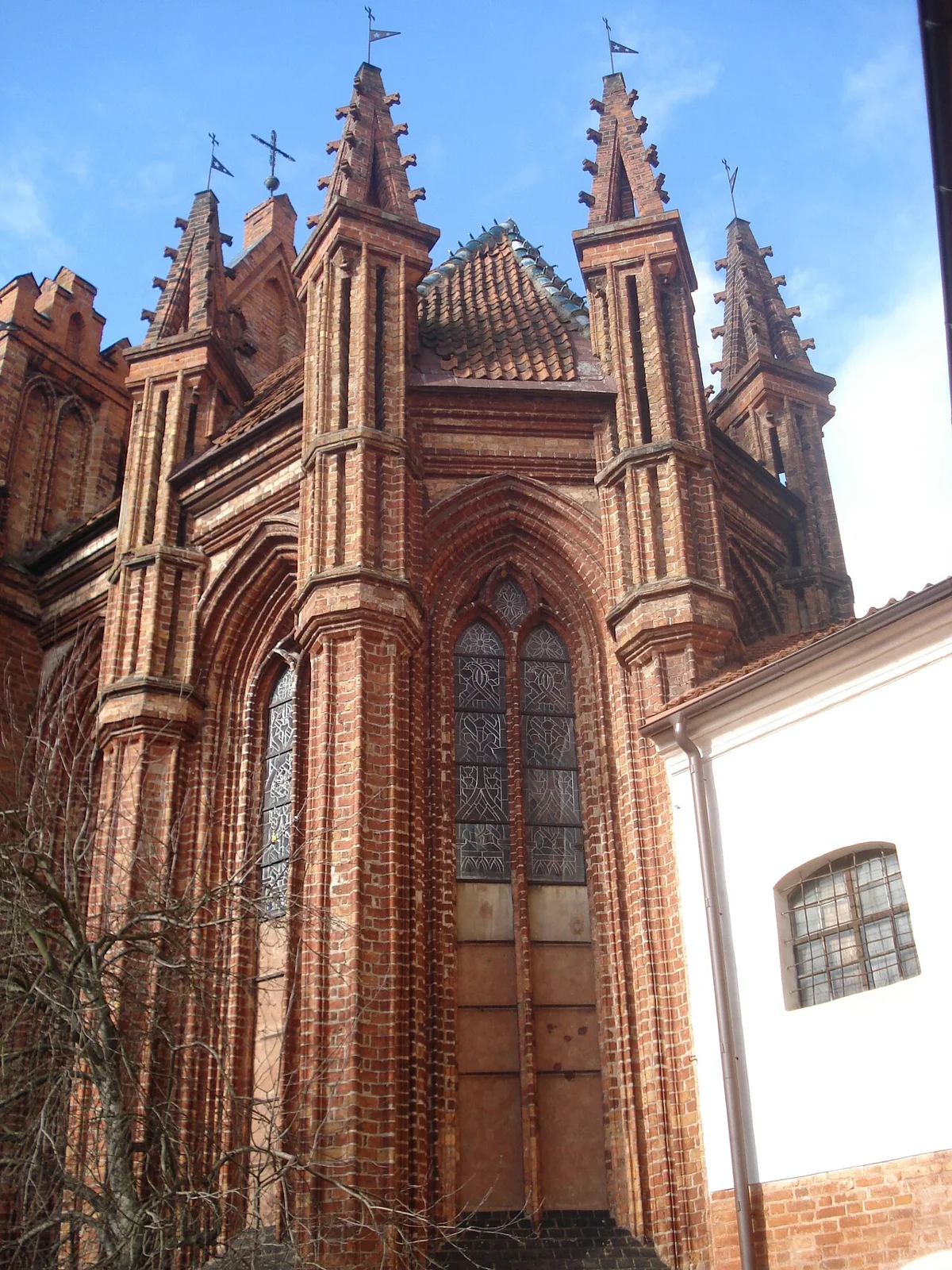
The apse changes the comparison
The second image explicitly records the apse. Away from the recognisable front, openings and wall surfaces can be compared without the principal silhouette controlling every impression. Smaller elements sit beside larger volumes, with intervals between repetitions.
This photograph dates from March 2008; the other two date from October 2012. They do not document one circuit of the church or establish a repair sequence. Differences in surface colour cannot, by themselves, supply the missing construction records.
A neighbour supplies scale
The third image includes the larger Bernardine church beside St Anne’s. Width, height and overlap become easier to judge when the smaller building is returned to its surroundings. Proximity does not make their names interchangeable.
Go Vilnius places the churches and monastery within the ensemble’s history. A visitor interested in continuing inside should identify each intended space separately. A shared tourism description does not establish identical functions or access arrangements behind all the doors.
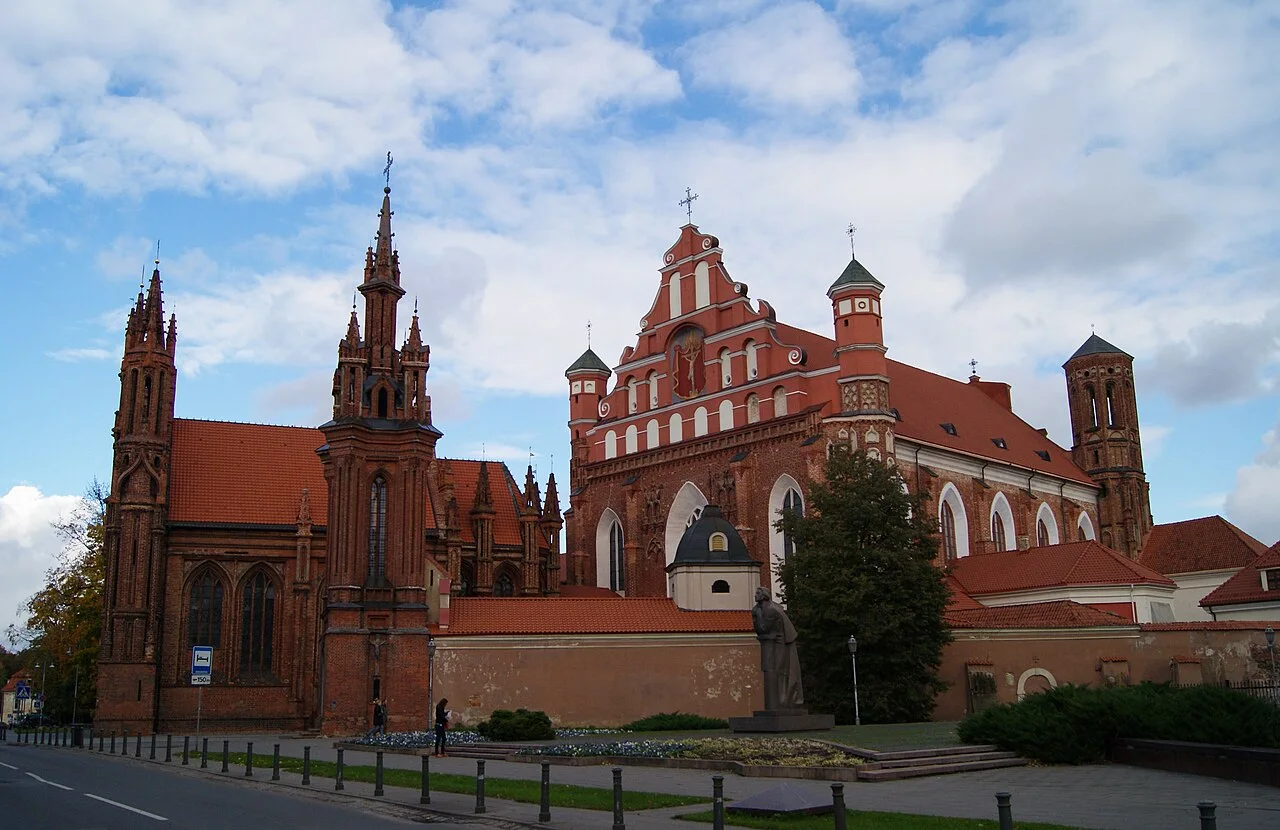
A portable church, and a recorded one
The city’s tourism account labels Napoleon’s supposed wish to carry the church to Paris in his palm a legend. It is memorable and suits an impression of delicacy, but it should retain that status rather than become a documented quotation.
CyArk records another, verifiable way of sharing the building at a distance: its partner scanned the church in summer 2010. Survey data and these fixed photographs provide different forms of documentation. Any digital resource still needs to be read with its stated coverage and limits.
The bell tower has its own date
The bell tower appears beside the church in the opening image. Go Vilnius dates this Gothic-style neighbour to the nineteenth century. Adjacent forms can appear related without belonging to the same building campaign.
For a short exterior visit, begin with the façade’s lines and then compare neighbouring volumes. Check current information separately for admission or worship, leaving entrances clear. More detailed brick identification, repair history and interior use remain subjects for further reading beyond these photographs.
References
These sources inform the essay’s historical and local context. Its observations and interpretations are original to WalkThere.
Go Vilnius
St Anne’s: brickwork and the Gothic silhouetteCity account of the ensemble, nineteenth-century bell tower and Napoleon legend.
CyArk
St. Anne’s Church: digital documentation projectDigital heritage project account of thirty-three brick types and the 2010 scan.
More journey background
Related journey sources
- Cathedral Square: a city in several scales — Go Vilnius
- Presidential Palace: a changing seat of power — Go Vilnius
- Town Hall: architecture facing a public square — Go Vilnius
- Gates of Dawn: defence and devotion — Go Vilnius
- Gediminas’ Tower — Go Vilnius
- Vilnius University — Go Vilnius
- Užupis: a Republic Inside Vilnius — Go Vilnius
- Vilnius: a UNESCO World Heritage City — Go Vilnius