
Tenryū-ji’s Sōgen Pond: where the garden meets the mountain
Read the pond edge, rocks and walking path to see how a Kyoto garden brings Arashiyama into its composition, one change of viewpoint at a time.
Kyoto ArashiyamaObservation essay
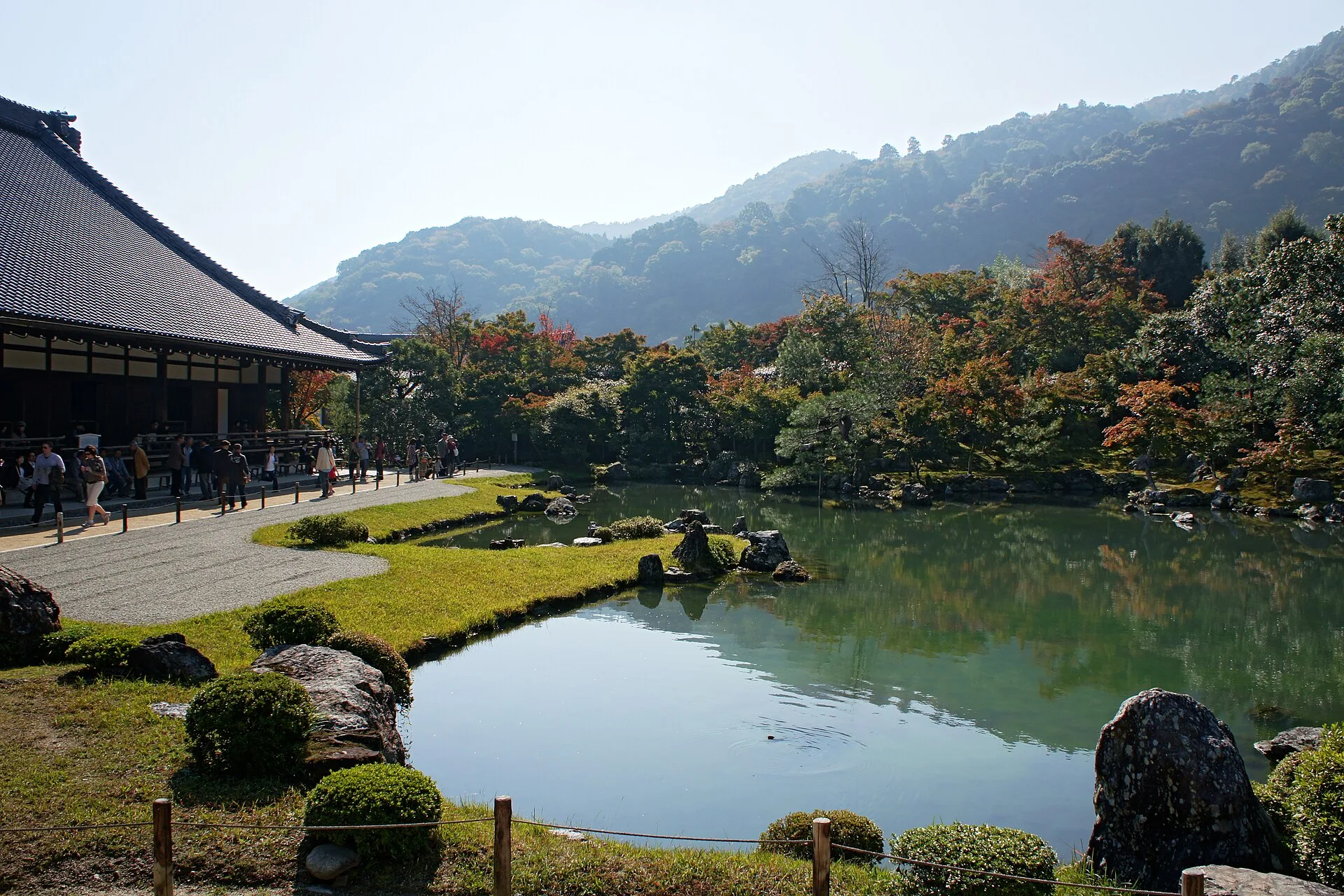
Find the bank before the ridge
In the garden photograph, the mountain catches the eye before the pond does. Bring your attention back to the bank: a projecting rock, a low shrub and a tree trunk interrupt its outline. These small changes in the foreground make an entrance for the much larger landscape behind them.
Cover the upper half of the photograph, then uncover it. The mountain adds depth without marking an obvious boundary. The temple calls this use of surrounding scenery shakkei, or borrowed scenery. The useful question is quite practical: how does the near ground make the distant slope belong in the view?
A view becomes a circuit
The temple attributes Sōgen Pond Garden to Musō Soseki and describes a strolling pond garden with a path around the water. Looking from the building side helps separate the layers of pond, rocks and hillside. Walking changes which parts of those layers conceal one another.
Choose a tree near the water as a reference point. From another position, does it reveal more pond or hide more mountain? There is no need to identify every symbolic stone first. A small comparison between positions shows something a stack of nearly identical photographs might miss: the path helps compose the garden.
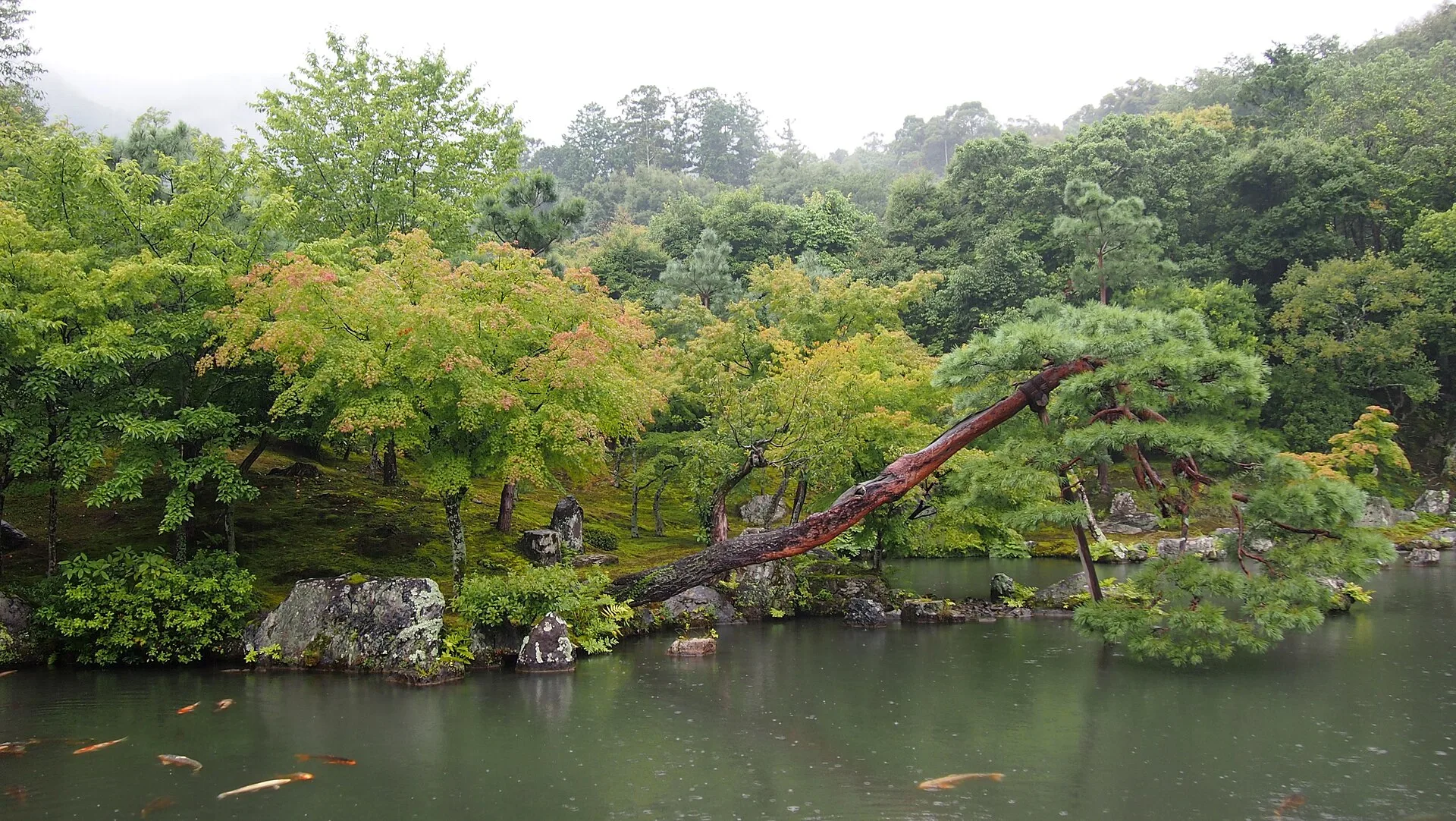
A story enters through stone
The official guide connects the rocks seen from the centre of the Hōjō veranda with Dragon Gate Falls and explains a nearby carp stone through the carp’s transformation into a dragon. A story associated with China enters this Kyoto garden through an arrangement of physical forms.
After reading the explanation, return to their shapes. Which stone stands high, which sits low, and where does water join the gaps? Someone unfamiliar with the legend can begin there. Treating the interpretation as another layer leaves room to look, rather than making the garden a diagram with answers to locate.
An old garden has more than one age
Tenryū-ji was founded in 1339, with Musō Soseki as founding abbot. Its own history also records repeated fires and rebuilding. The building, planting and rocks in a present photograph should not be assumed to be a complete ensemble frozen at a single date.
Continuity can reside in relationships as well as materials. Trees grow; branches need attention; wind changes a reflection. Looking only for the oldest surviving object can obscure the ordinary work that keeps a landscape legible. One photograph records a particular encounter, not all the years of growth and care behind it.
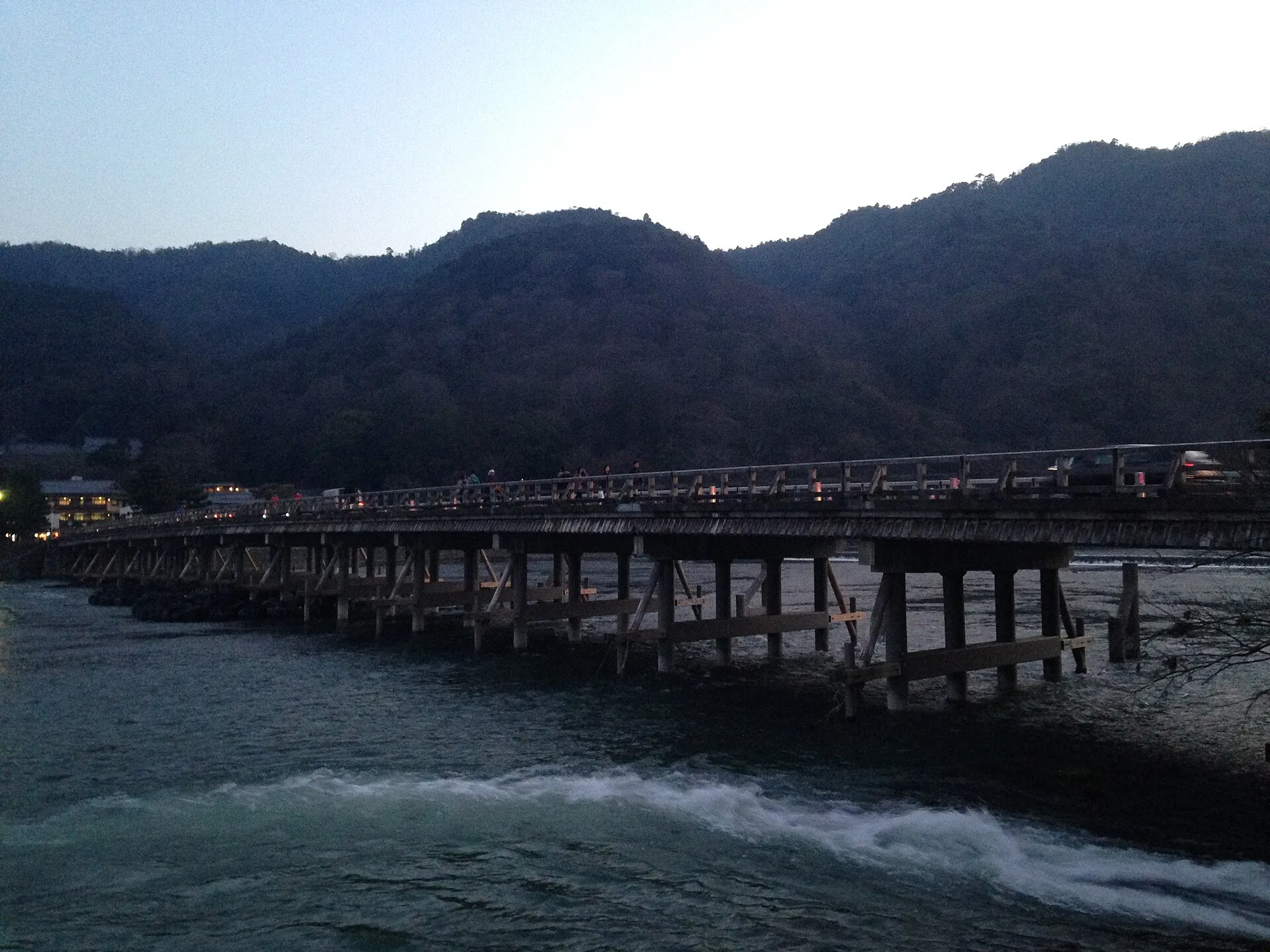
The mountain beyond the garden
The third photograph shows Togetsukyō Bridge and Mount Arashiyama at dusk, outside the garden. It is neither another view across Sōgen Pond nor evidence of its exact borrowed vista. The broader river scene offers a comparison of how the surrounding landscape enters an open public view.
The bridge extends sideways while the slope rises behind it. The garden divides distance through a smaller water surface and a more intricate foreground. If visiting both, remember a section of mountain outline and compare the scale around it. Street openings and treetops will start to look like choices about how much distant scenery to admit.
Keep the method when the season changes
The two garden photographs record different seasonal conditions. Their foliage is no guarantee for a future visit. Dense leaves close gaps between branches; changing colours can pull attention away from the mountain. Their differences are a reason to look afresh rather than reproduce one particular frame.
Before leaving, try to identify what first joined foreground and distance for you: low planting, a gap between rocks, or an unobstructed patch of water. The answer can be ordinary. Recognising that connection gives you something useful for another garden, or even a brief mountain view through a window.
References
These sources inform the essay’s historical and local context. Its observations and interpretations are original to WalkThere.
Tenryū-ji
Temple PrecinctsThe temple’s account of the pond circuit, borrowed scenery and Dragon Gate rocks.
Tenryū-ji
About Tenryū-jiDocuments the 1339 foundation, Musō Soseki and successive fires and rebuilding.
More journey background
Related journey sources
- Saga-Arashiyama — Kyoto City Official Travel Guide
- Togetsukyo Bridge — Kyoto City Official Travel Guide
- 渡月橋 — Kyoto City Tourism
- Visitor information — Tenryū-ji
- 野宮神社 — Kyoto City Tourism
- 野宮神社 — Kyoto City School Trip Guide
- Things to keep in mind while exploring Kyoto — Kyoto City Official Travel Guide