
Seville’s Plaza de España: geography in tile
Read the provincial benches, tiled bridges and long arcade as an exhibition setting that turns geography into a pedestrian experience.
Seville Monumental RiverObservation essay
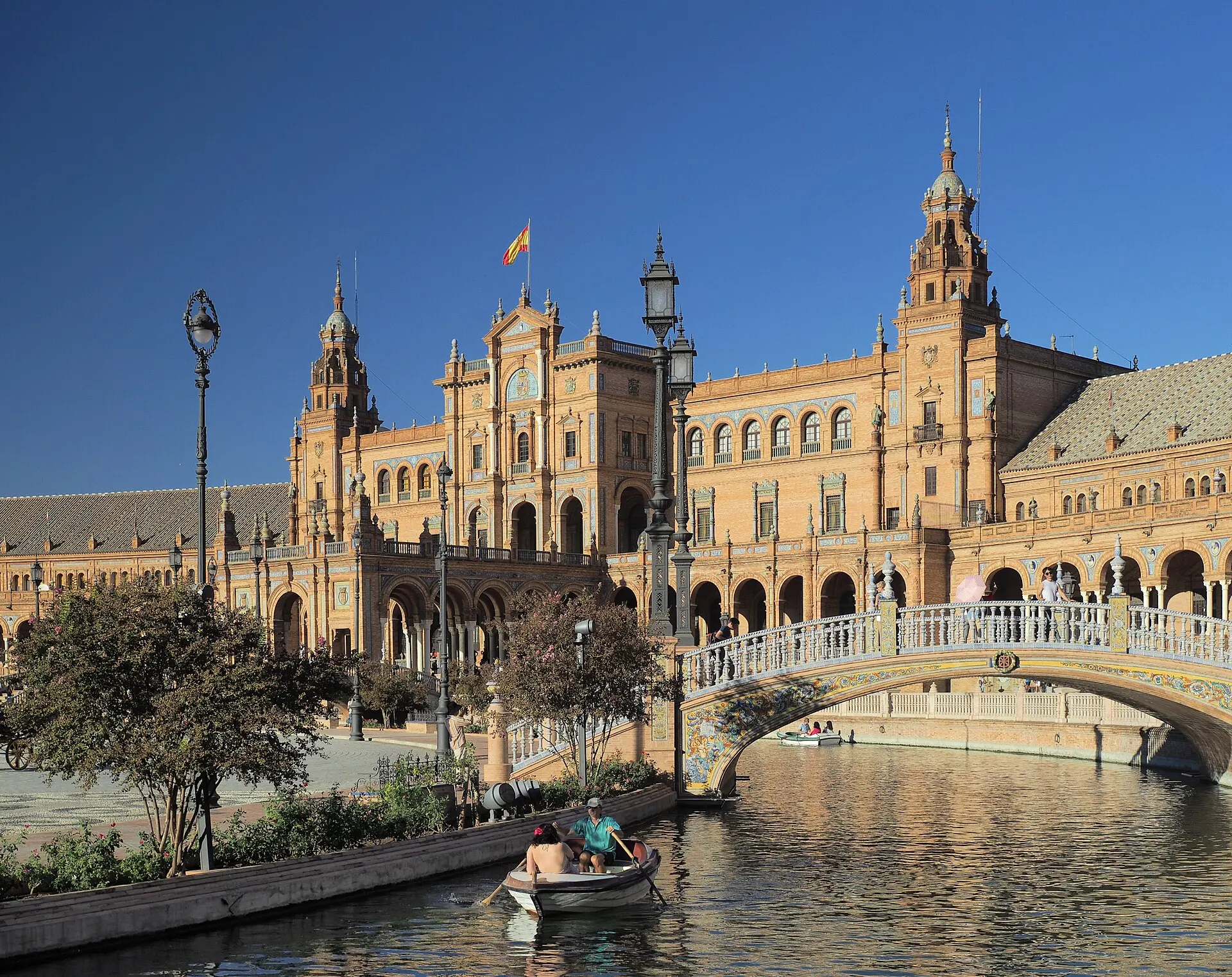
Begin with an exhibition date
The curve, canal and towers can make Plaza de España feel vaguely historic before its date is known. Seville’s tourism account identifies Aníbal González’s design with the Ibero-American Exhibition of 1929. An exhibition, rather than an undefined medieval past, is the useful starting point.
That context suggests different questions. Why curve such a long façade? Why put place names beside seats? An exhibition must distribute attention as well as display objects. Look at the building as an arrangement for moving and pausing before trying to assign it a stylistic label.
Place names reduce the scale
The tiled benches along the building represent Spanish provinces. From across the square they contribute to a continuous edge; closer up, individual names divide that edge into smaller destinations. A large architectural gesture becomes a sequence of places a person can read.
Start with one name, then examine the imagery rather than trying to identify every figure at once. Locate an unfamiliar province on a map and compare that location with its presentation here. Geography has been distributed along a walk, rather than confined to one large diagram.
A photograph can claim a position
Official tourism interpretation notes the practice of Spanish visitors seeking the bench associated with their province for a photograph. A name offers a personal foothold in an enormous composition. It also helps explain why particular points attract a pause.
The representation remains selective. A decorated panel cannot account for a whole province’s life. Ask what has been chosen for display and what falls outside the frame. That question allows the bench to become more than a backdrop without demanding that it stand for everything about a place.
A bridge brings decoration into the walk
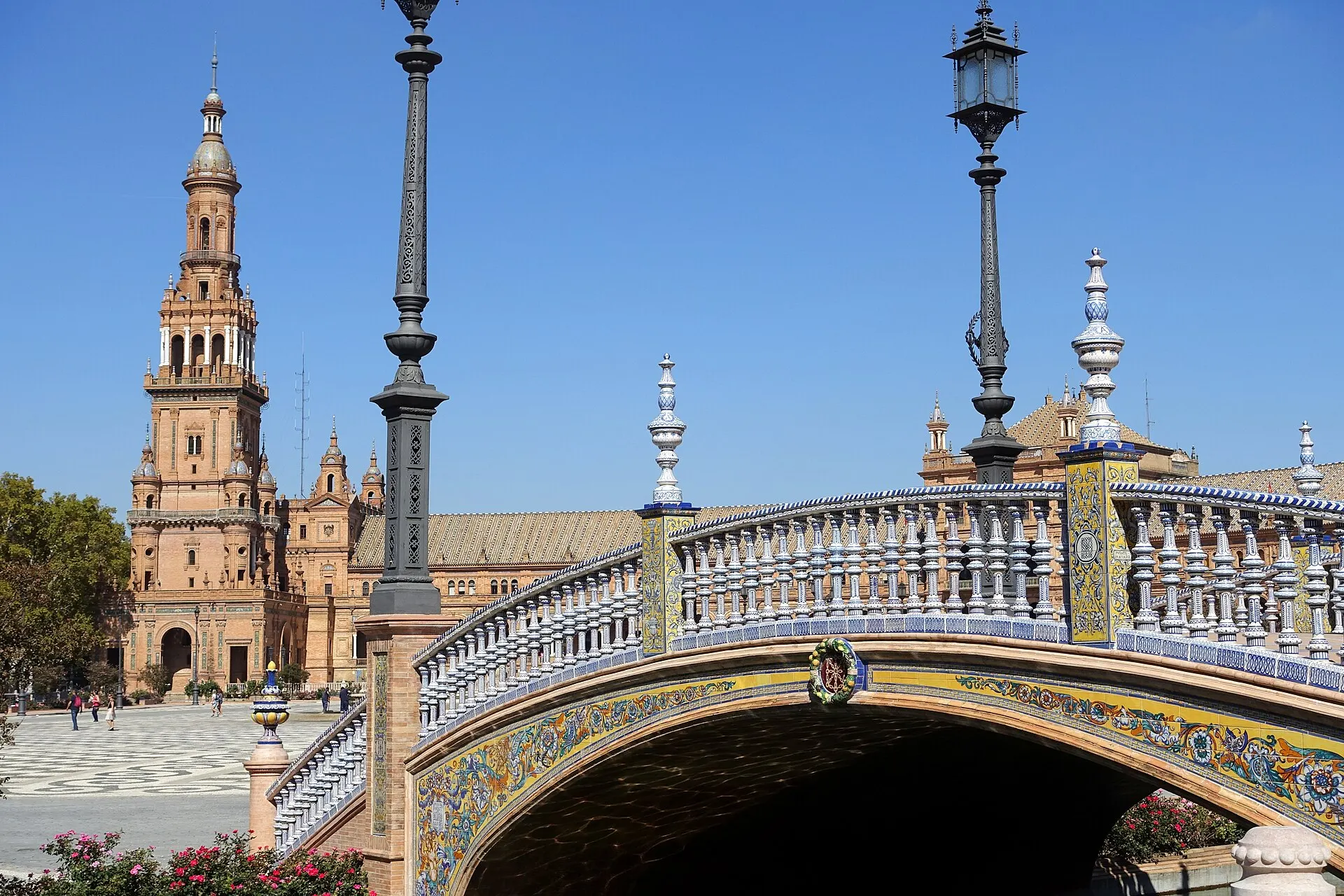
The second photograph shows a tiled bridge. Here decoration accompanies a change in position: railings, water and the narrowing approach concern the pedestrian as well as the camera. The canal’s continuous line is interrupted by opportunities to cross towards the building.
Compare the larger areas of brick with the smaller glazed details. This is a reading of their roles in the image, not a way to date individual tiles or establish restoration histories. A close view describes pattern; a wider one explains how that pattern belongs to an arrangement.
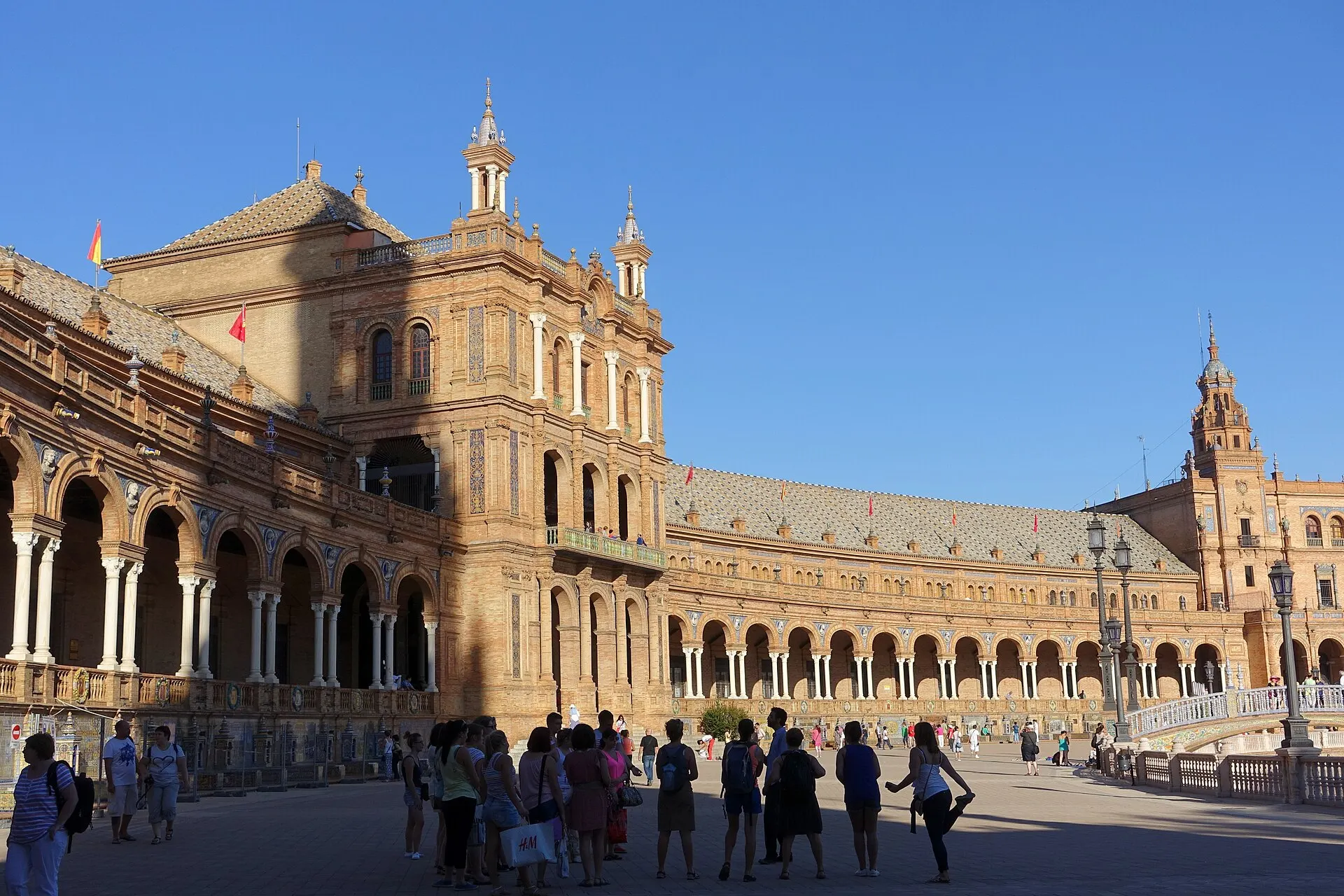
The arcade changes the viewing distance
Return to the broad image and follow the arcade along the curve. Individual stopping points become part of a longer route. A distant outline, a readable place name and the repeated openings offer different scales of attention within the same square.
The three photographs here record separate positions, not consecutive steps in a continuous filmed walk. Canal, bridge and closer architecture each explain a layer. Keeping those viewpoints distinct avoids pretending that the spaces between the cameras have also been documented.
Take one name beyond the square
Choose a province you have noted and find its position in Spain. A decorative detail then leads beyond the building into actual geography. The square leaves something more specific to pursue than a general memory of impressive architecture.
Keep 1929 in that memory too. This is a designed national presentation, not a substitute for contemporary life in the places represented. Considering why those places were assembled here, alongside how visitors use the setting now, gives the familiar panorama a more precise meaning.
References
These sources inform the essay’s historical and local context. Its observations and interpretations are original to WalkThere.
Spain’s official tourism website
Plaza de España SquareContext for the 1929 exhibition and provincial ceramic benches.
Seville Tourism
Plaza de EspañaBackground on the square’s architecture, brickwork and ceramic decoration.
More journey background
Related journey sources
- Puerta de Jerez — Visita Sevilla
- Cathedral, Alcázar and Archivo de Indias in Seville — UNESCO World Heritage Centre
- Catedral de Sevilla y Giralda — Visita Sevilla
- A monumental river — Visita Sevilla
- Torre del Oro — Visita Sevilla
- La Sevilla árabe — Seville Tourism