
Salzburg’s Getreidegasse: paths behind the shopfronts
Look beyond projecting signs and shop windows to the through-houses that connect this Salzburg street with the streets behind it.
Salzburg Old TownObservation essay
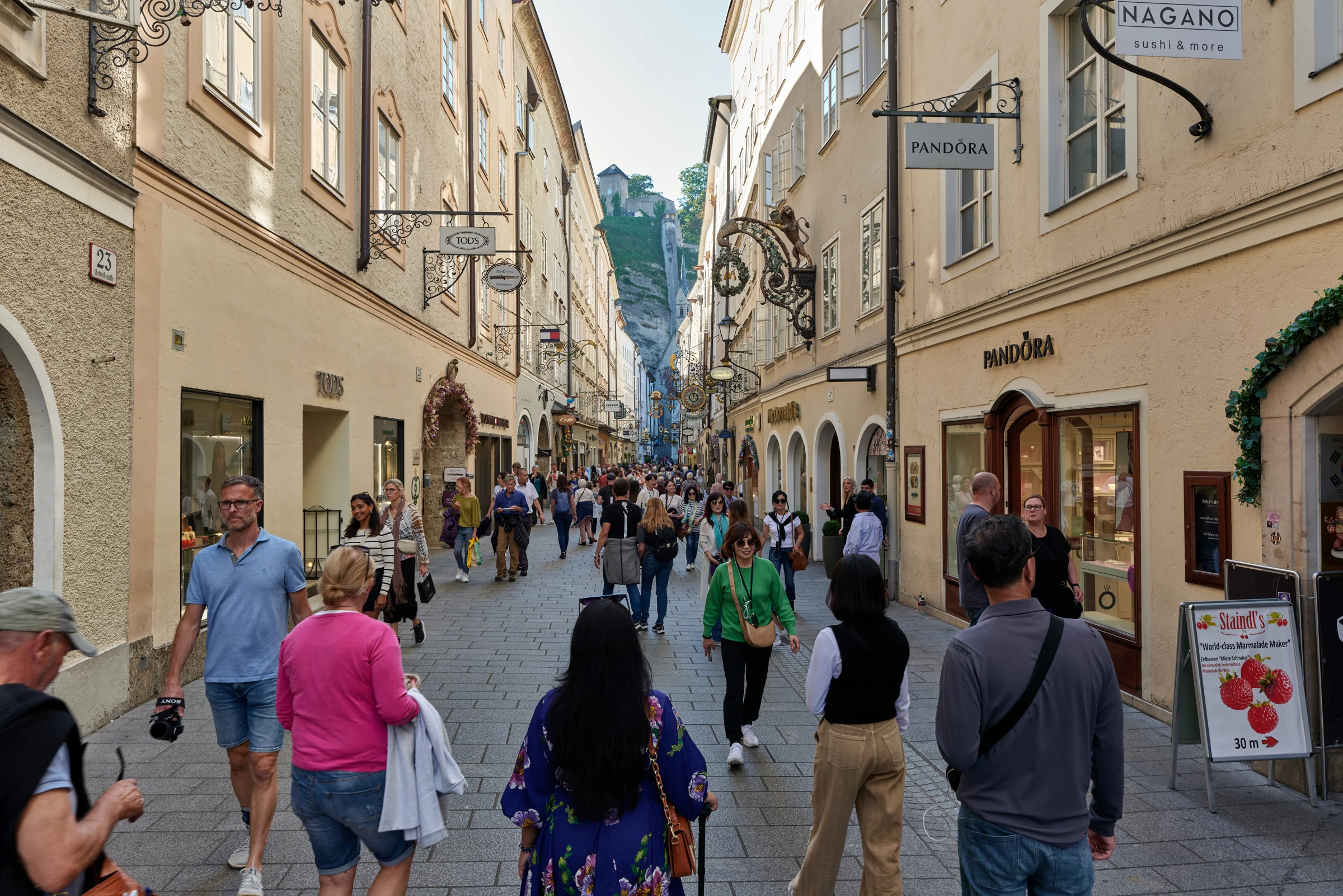
Watch where people pass
The opening photograph compresses sky between tall façades. Projecting signs occupy the upper view while pedestrians interrupt the lower windows. Looking at architecture involves glancing above shoulders, then returning to street level to find a door.
Windows, displays and iron brackets address different viewing distances. A sign suspended ahead can become legible before lettering against the wall. The street offers a clear onward direction; choosing an entrance requires closer attention.
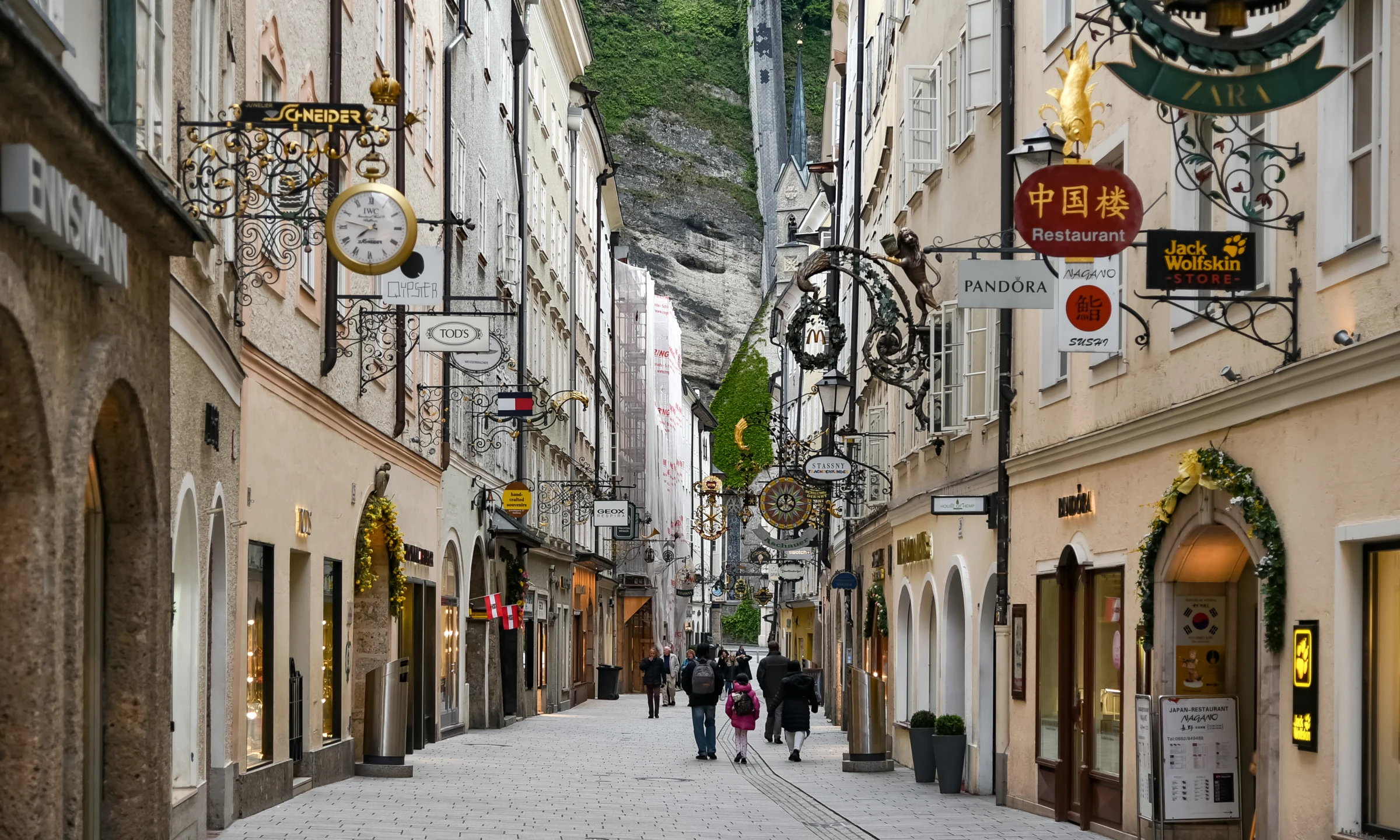
Signs have sides as well as faces
The second photograph layers a clock face, curled metalwork and modern brand names. Some signs face the camera, while others turn nearly edge-on. Their brackets occupy space above the route, leaving the ground for movement.
Recognisable chain-store lettering sits beside elaborate supports. A curled profile alone cannot date a fitting or establish that a business has occupied the premises for centuries. How a sign hangs and where it can be read are more useful things to examine than a general impression of age.
A doorway may lead to another street
Salzburg Tourism describes through-houses whose opposite fronts open onto different streets, linked by arcaded passages. This introduces a sideways route into what a frontal photograph presents as a continuous corridor of façades.
Its example at the Schatz House connects Getreidegasse 3 with University Square. These photographs do not document that passage interior, so no pictured doorway is identified as its entrance. On site, check signs and the permitted route before treating an open door as a public shortcut.
Number nine identifies one particular house
The Mozarteum Foundation gives the birthplace museum’s address as Getreidegasse 9 and records Mozart’s birth here in 1756. A specific address attaches that biography to one building. A museum visit and a walk past shop windows can be planned as separate pauses.
That leaves neighbouring buildings open to other observations, without assigning every arch a musical connection or assuming a common age and use. Consult the foundation for the exhibition and current visitor conditions. Street photographs establish surroundings, rather than documenting the objects inside.
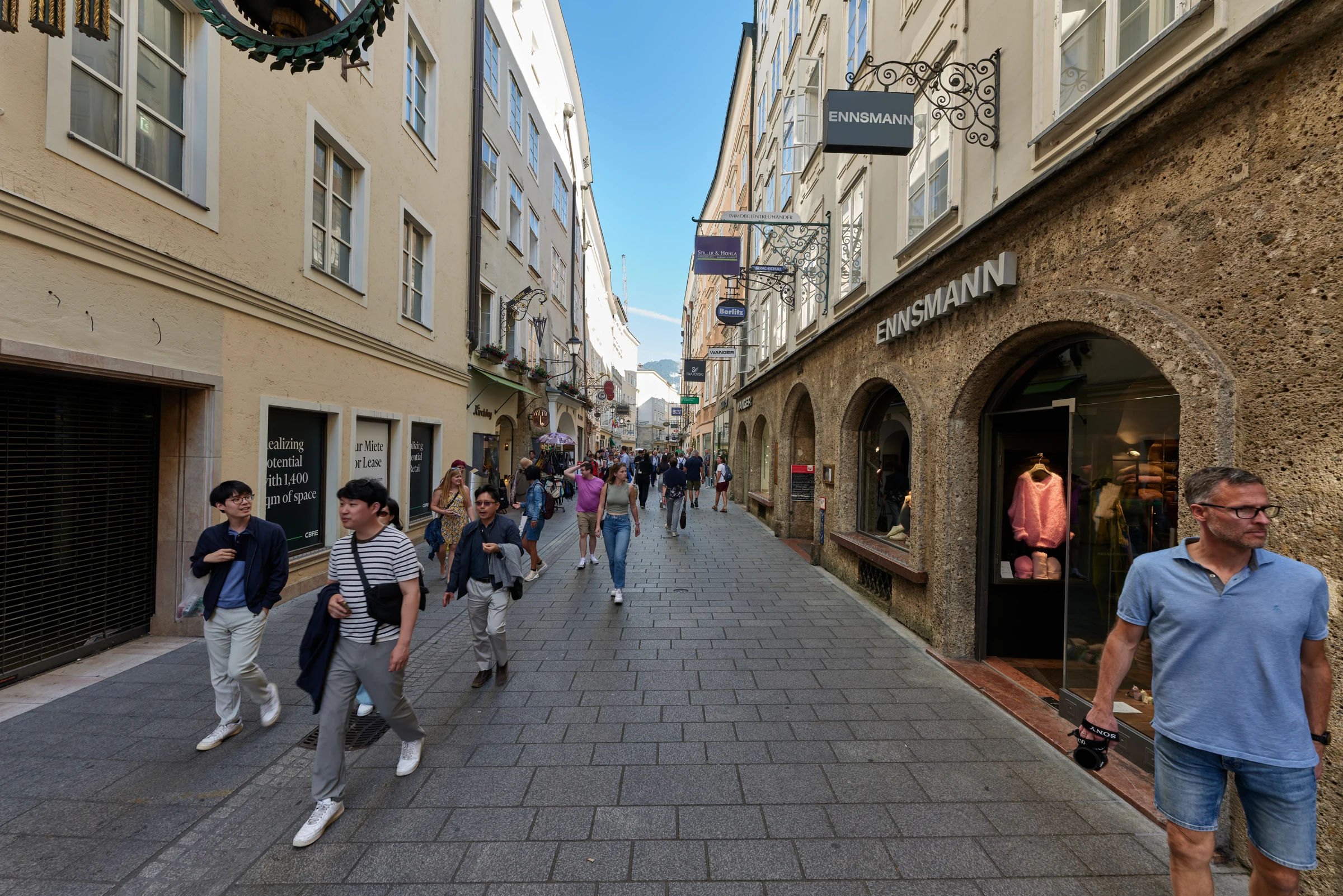
Turn around and the apparent width changes
The third view gives more weight to rough stone, arched display windows and pedestrians close to the camera. Empty premises and letting notices remain visible on the opposite side. Not every frontage in a tourist street is trading at every moment.
This image and the opening view were taken by the same photographer within moments of one another, but face different ways. Distant rock draws attention in one; nearby shopfronts dominate the other. Position, light and people all influence how narrow the street feels.
Make time for the sideways route
Walking past the shops introduces the main street. Noticing publicly accessible passages introduces the connections behind it. Crossing from one side of a building to the other can reveal space omitted by a familiar frontal view.
The photographs date from 2019 and 2023, so signs, tenants and access arrangements may have changed. Use them to consider direction and distance rather than as a current business directory. Pause clear of an entrance, look up at the signs, then notice where people enter and emerge.
References
These sources inform the essay’s historical and local context. Its observations and interpretations are original to WalkThere.
Salzburg Tourism
GetreidegasseVerify the through-houses and the passage from number 3 to University Square.
International Mozarteum Foundation
Mozart’s BirthplaceFoundation record of the number 9 address, birth year and current visitor information.
More journey background
Related journey sources
- Mirabellgarten — City of Salzburg
- Grünmarkt — Salzburg Tourism
- Domplatz & Mariensäule — Salzburg Tourism
- Kapitelplatz & Kapitelschwemme — Salzburg Tourism
- Ehrengrab Marko Feingold — City of Salzburg
- Alter Markt — Salzburg Tourism
- St. Peter’s Abbey — Salzburg Tourism