
Salzburg: gardens, lanes and cathedral squares
Read Salzburg through Mirabell, Getreidegasse and three old-town squares, with four optional discoveries.
Begin the visual journeyPlan a real visit to Salzburg Old TownExplore 5 reviewed views along the routeGuided visual journey
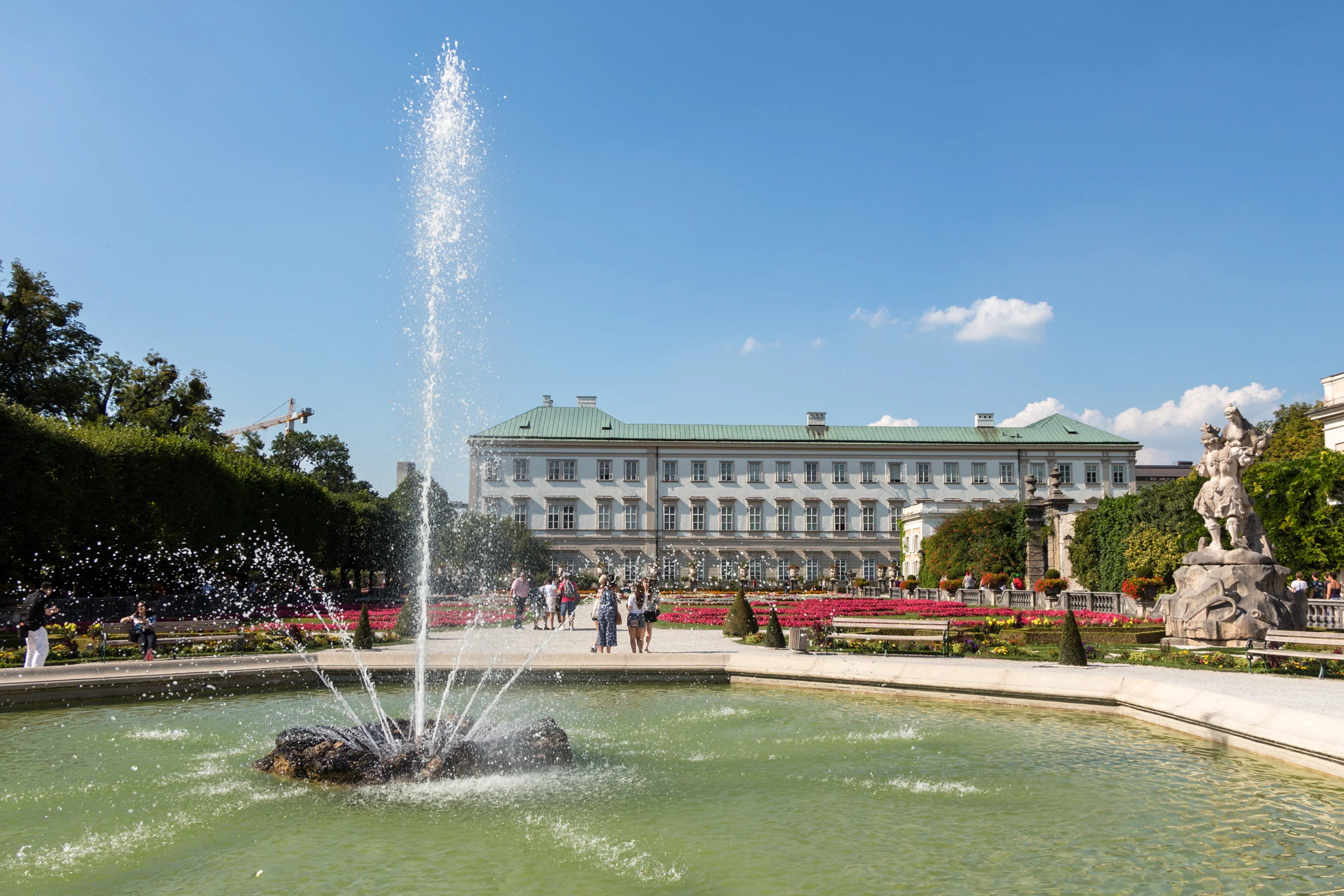
Mirabell Palace behind a fountain and formal gardens · Rafa Esteve · CC BY-SA 4.0 · Resized and converted to WebP
Reading mode
Place stories to read at your own pace
Compare three independent chapter photographs and an additional photo discovery along the route.
Chapter 1
Mirabell: a garden as a city foreground
Start Salzburg with the relationship between planted ground and built form. Mirabell offers a way to read a city through lines close to the camera before attending to buildings farther away. Paths and beds create a foreground that can feel carefully measured, while the skyline gives that order a larger setting. Let the eye travel across the photograph instead of immediately choosing its most recognisable landmark. The distance between two objects matters as much as either object alone.
The City of Salzburg describes Mirabell as a Baroque garden and dates the palace to 1606. Keep those statements distinct: a palace's foundation date does not date every planted bed, sculpture or surface in a later garden photograph. Designed landscapes continue to change through maintenance, planting and use. Their organisation can remain legible even when colours and vegetation differ from one season to another.
The wide photograph shows the fountain pool facing the palace; the detail records snow along a garden axis beside the building. The context image returns to flower beds, lawn and a smaller fountain. These contrasting seasons are independent observations. Compare the three photographs as separate studies of the garden. Look for the point where a path disappears, the balance between open ground and vegetation, and the way stone features interrupt softer textures. A closer photograph may isolate an element from the geometry that gives it meaning; the wider scene can restore some of those relationships. Photographs also flatten depth. A distant landmark can appear tightly attached to the garden although the intervening city is outside the frame. People, flowering beds and weather record particular occasions.
The optional Makartsteg discovery introduces the river as a different kind of foreground before the main sequence turns to Getreidegasse. That transition compares open views with the enclosure of a shopping street. Before continuing, return to the garden's edges and notice how they guide attention beyond the planting. The chapter presents independent views and a local scene, with any palace interiors and actual travel arranged separately. It supplies a starting point for visual comparison rather than a documented passage across Salzburg.
Real-travel note
Plan actual movement and indoor visits separately.
Compare three independent chapter photographs and an additional photo discovery along the route.
Chapter 2
Getreidegasse: signs above a narrow street
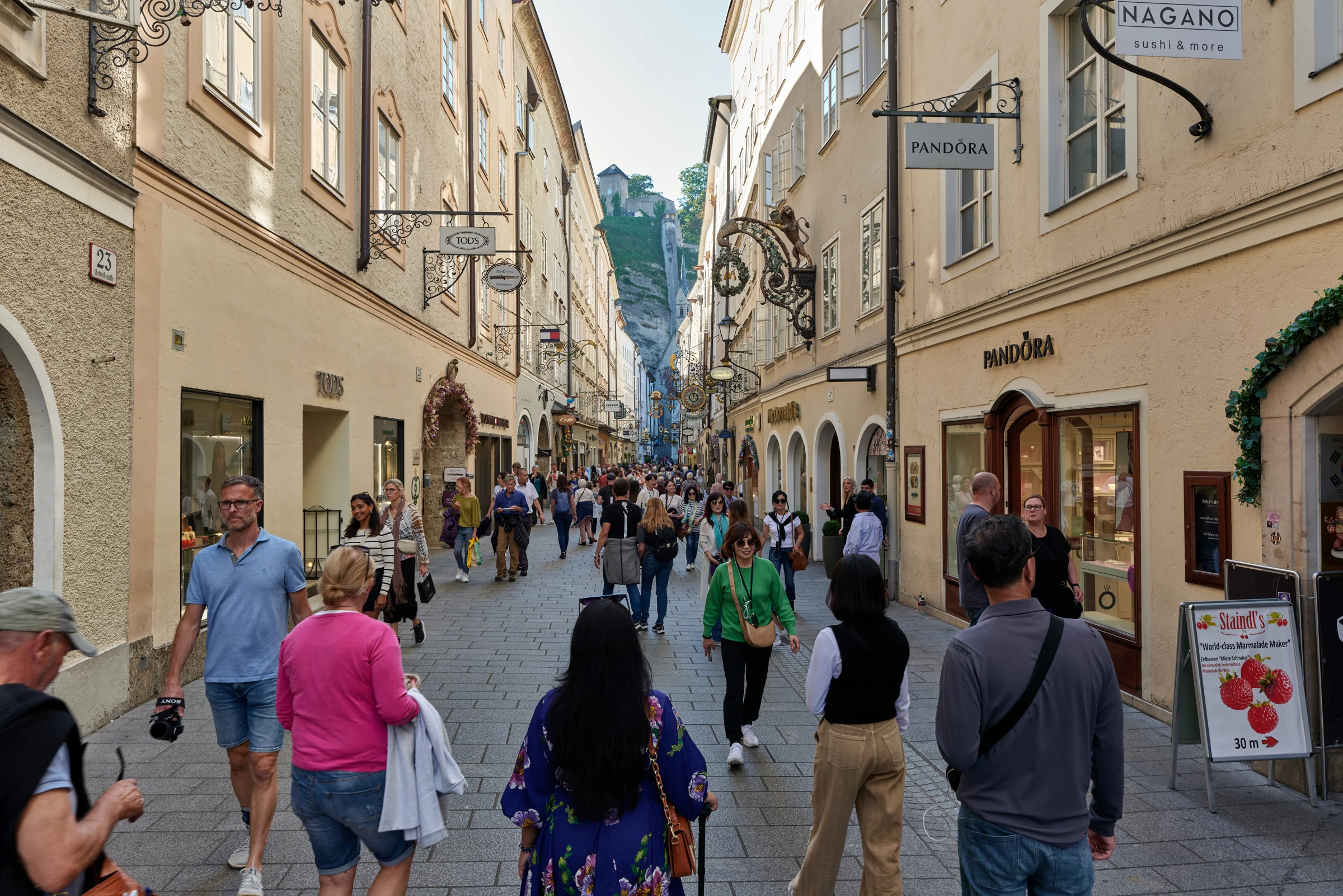
Getreidegasse changes the scale of the journey. After the garden's open foreground, the street asks the eye to work between close façades. Its name is commonly translated as Grain Lane, but Salzburg Tourism explains that the name evolved from older forms related to trotting rather than the grain trade. A familiar translation can be useful for finding a place while still being an unreliable account of its history.
The tourism office highlights projecting ornamental guild signs and the through-houses that connect different streets by passages through buildings. These are two different ways of using depth. Signs extend outward from the wall; passages lead inward behind it. Look at the street with that distinction in mind. Upper windows and roof edges establish a longer rhythm, while an opening at ground level can suggest an entirely different spatial scale.
The wide and context images look along the pedestrian street, while the detail image concentrates on the layered hanging signs. It remains a street view rather than an isolated study of one piece of ironwork. Compare the photographs for the relationship between signs, façades and the narrow strip of sky. Do the projecting objects become individual subjects, or do they overlap into a pattern? A close view can make metalwork feel dominant, whereas the surrounding street restores its size relative to the buildings. Distinguish a visible doorway from a verified public passage. The official account explains a characteristic building type; it does not establish access through every opening in a particular photograph. Store names, people and displays belong to their photographed occasions.
Mozart's Birthplace follows as an optional discovery, narrowing this broader street study to one identified address. The main sequence then turns toward Universitätsplatz and the relationship between commerce and a church. Carry the contrast between projecting signs and recessed openings into that chapter. These views do not document every turn between the street and the square, nor do they include museum admission. A local approach may reveal only part of the famous street. Treat the collection as complementary observations, and plan actual shopping, movement and building visits separately.
Real-travel note
Plan actual movement and indoor visits separately.
Compare three independent chapter photographs and an additional photo discovery along the route.
Chapter 3
Universitätsplatz: market ground and church frontage
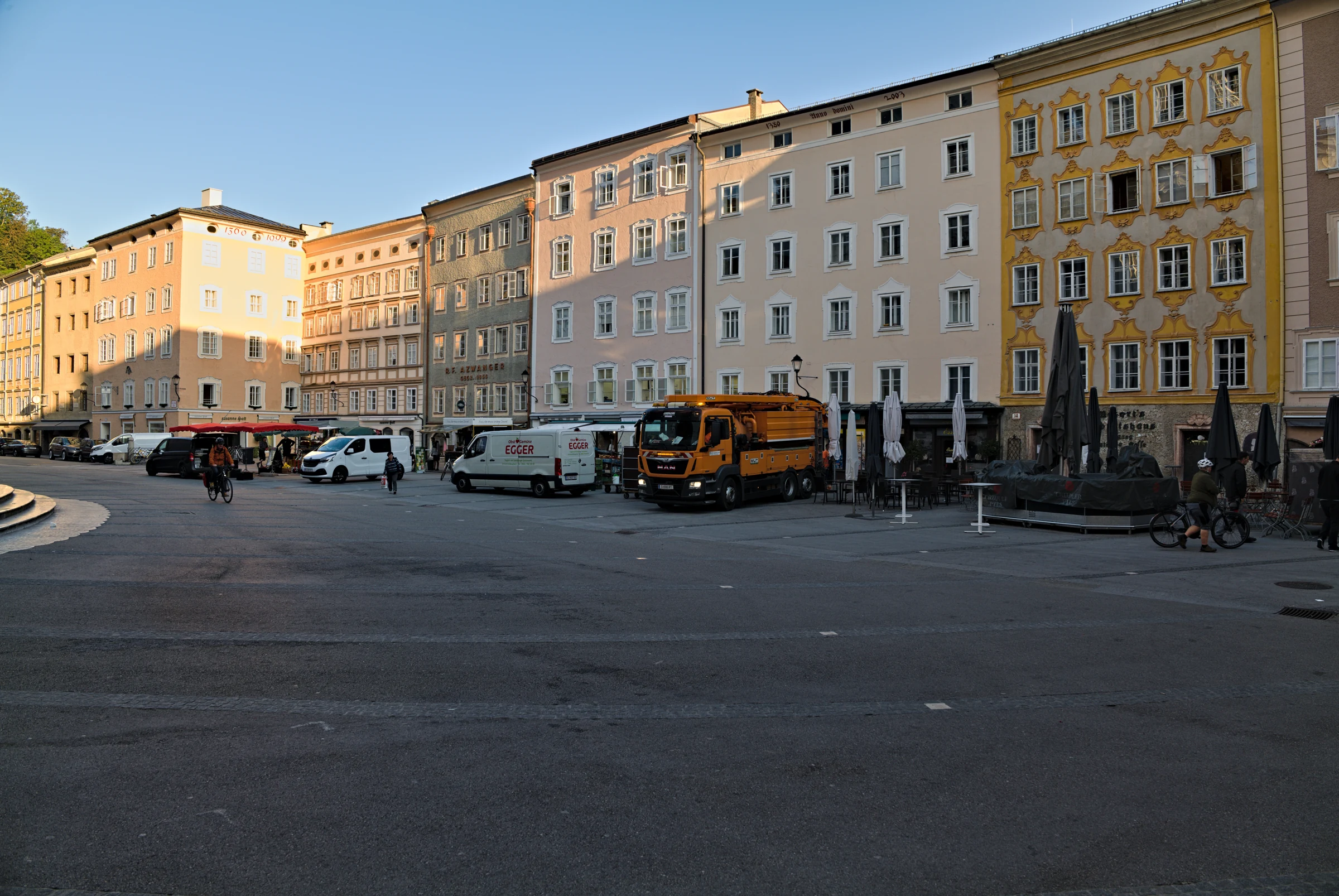
Universitätsplatz broadens the street into a different kind of urban room. Here the question is how everyday commerce and a substantial church share a foreground. Look first at the space available between buildings, then consider the height of the architecture facing it. An open area can make a façade easier to read, while temporary structures can divide that same area into much smaller places.
Salzburg Tourism locates the Grünmarkt at Universitätsplatz beneath the Kollegienkirche and traces the market tradition here to the nineteenth century. This provides historical context for the relationship between trade and church. It does not make every visible stall a permanent feature, or turn an independently photographed market into today's arrangement. A square can retain its identity through considerable changes in activity and occupation.
The wide and context photographs show the square’s coloured building frontages and market setting. The detail is a small religious relief set into a wall, not a close-up of produce or the church interior. Use the three photographs to examine the difference between durable and temporary edges. Building walls frame the larger space; market objects, where present, produce their own lower horizon. Notice how much of the ground remains visible and whether the camera looks upward or across. The same frontage can seem dominant in one crop and become background in another. A closer architectural study also changes the role of people: figures that seem small against a church may fill much of a street-level foreground. Neither view is a complete survey of the square.
Alter Markt is the optional discovery after this chapter. It offers another market setting before the main sequence moves to Domplatz, where institutional buildings define a more formal enclosure. Compare those kinds of public space without treating the editorial transition as a recorded route through particular passages. Before continuing, choose a single line in the image, perhaps a roof edge or the meeting of wall and ground, and follow it until the frame cuts it off. The exercise makes the photograph's limits visible. Actual market visits, purchases and church interiors require separate planning; local imagery establishes a viewpoint rather than current arrangements.
Real-travel note
Plan actual movement and indoor visits separately.
Compare independently captured photographs and viewpoints, each with its own date.
Chapter 4
Domplatz: a square held by architecture
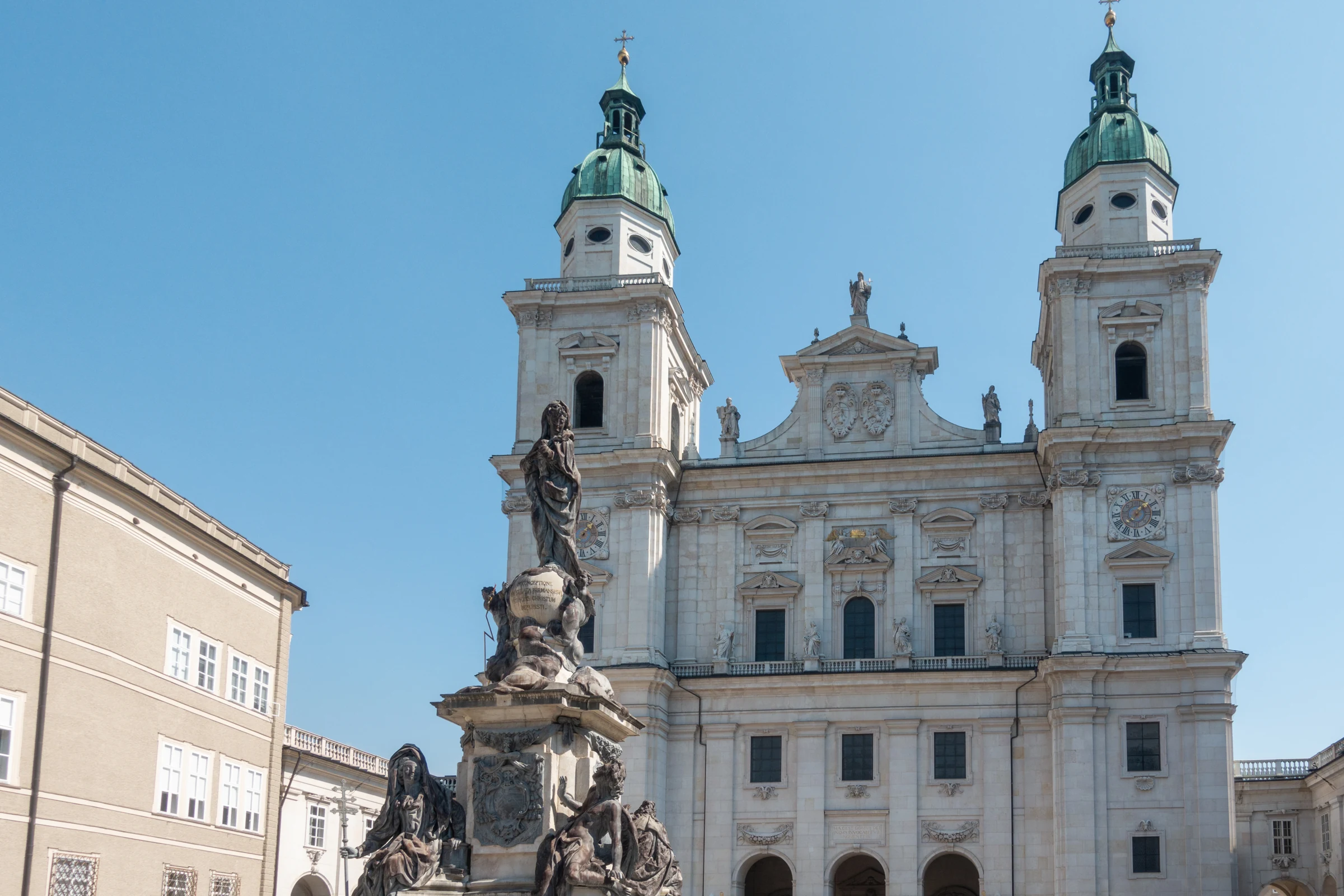
Domplatz makes enclosure the principal subject. A cathedral can attract almost all the attention in a photograph, yet the square depends on its other edges too. Begin by tracing where the surrounding buildings meet the ground. Then look at how an arch or opening changes the apparent solidity of that boundary. The composition is more than a single impressive frontage: it is a relationship among walls, thresholds and open space.
Salzburg Tourism identifies the cathedral, the archiepiscopal Residence and a wing of St. Peter's Abbey as the square's boundaries. It also describes the cathedral arches connecting this setting with neighbouring squares and streets. Those connections explain the layout without verifying a particular pedestrian itinerary. An arch can be understood as part of urban design even when the chosen view records only its local approach or sheltered interior edge.
The first photograph includes the Marian column before the cathedral; the second tightens the crop around the cathedral façade and towers. The context photograph looks across the square toward its other architectural edges and the column. Compare the three photographs for the balance between the cathedral and the surrounding enclosure. A closer subject may obscure how much open ground lies in front of it; a contextual view can make the edges easier to compare. Follow repeated windows and architectural divisions rather than assigning every surface to one construction date. The buildings have separate histories, and a coherent appearance does not mean the entire ensemble was made at once. If temporary installations or people occupy the foreground, read them as evidence of that photographic moment.
The final principal chapter is Kapitelplatz, where the relationship between open ground and the fortress setting becomes the closing theme. This transition also invites a comparison between spaces beside different faces of the cathedral. Before moving on, look once more at the openings: some are compositional accents, others suggest a connection beyond the frame, but neither automatically establishes access today. The journey includes no cathedral interior, festival performance or uninterrupted crossing through the arches. Plan those experiences independently, using official visitor information for arrangements that depend on the date of a real visit.
Real-travel note
Plan actual movement and indoor visits separately.
Compare three independent chapter photographs and an additional photo discovery along the route.
Chapter 5
Kapitelplatz: open ground beneath the fortress
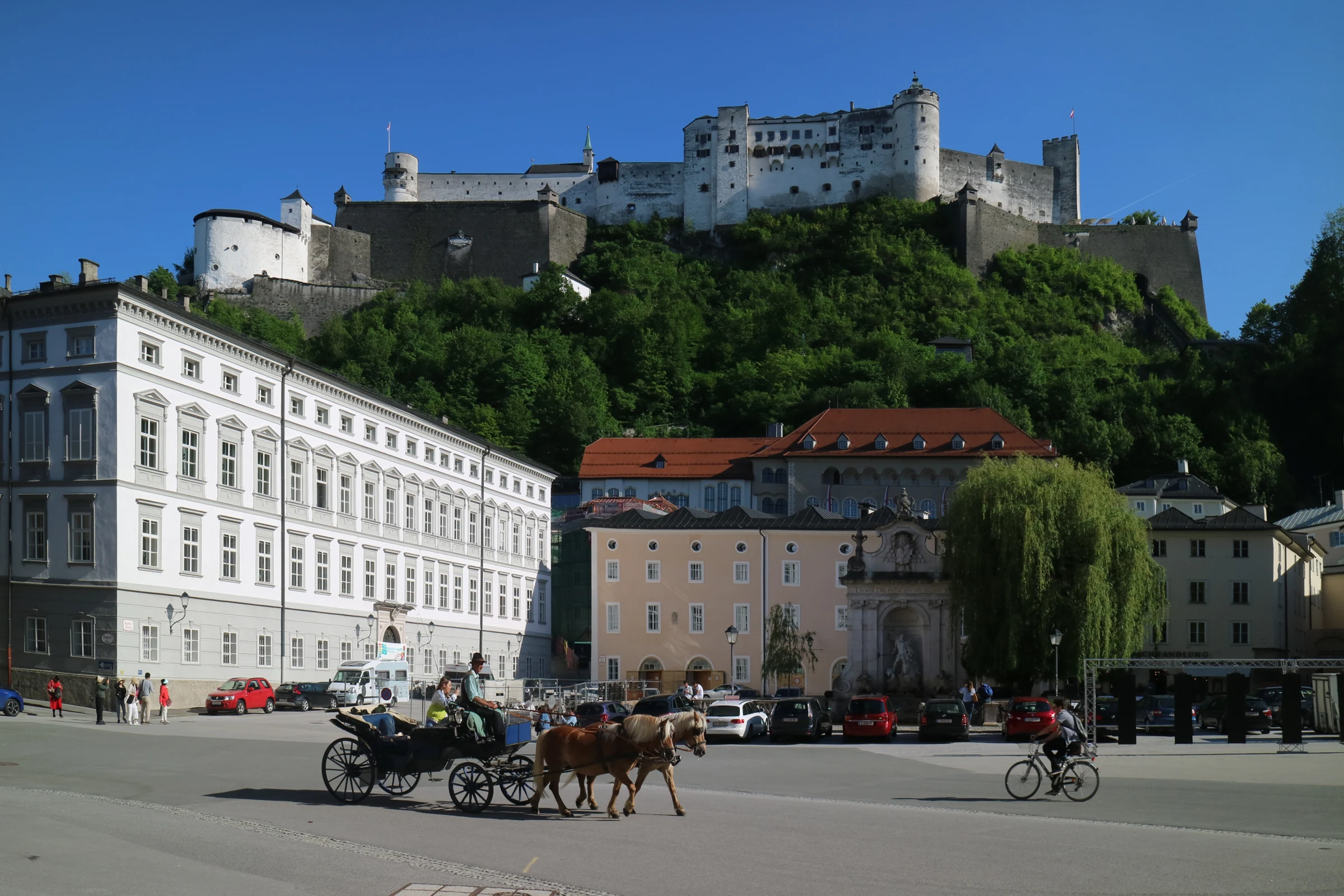
End with a square that sets nearby architecture against a larger topographical background. Kapitelplatz allows attention to move between the ground close to the camera and the heights beyond the old town. Rather than treating the fortress as an isolated destination, consider how an elevated landmark changes the meaning of an ordinary foreground. The eye can read depth even when the photograph compresses the intervening city.
Salzburg Tourism describes Kapitelplatz as a spacious square associated with the cathedral precinct and identifies the Kapitelschwemme as a reminder of the older practice of watering horses here. The account distinguishes the historic horse pond from its later form. This is useful context for looking at the square's water architecture without assigning one age to every visible feature. The surrounding precinct also connects the histories of the cathedral and St. Peter's Abbey.
The wide and context views show the fortress above the square. The detail instead centres on the large golden sphere and the neighbouring arcaded building; it does not depict the historic horse pond. Compare the three photographs for the amount of ground, architecture and skyline in each frame. A wide image gives room to understand scale, while a selected feature changes the centre of attention. Look at the relationship between foreground objects and the buildings behind them. Perspective can make an object look much larger than its setting, or reduce it to a small interruption in an open area. A contextual photograph supplies another position rather than completing a seamless panorama. Events, temporary objects and figures belong to their separate photographic occasions.
The optional St. Peter discovery after this chapter shifts attention toward the adjacent religious precinct and its layered history. It provides a quieter architectural comparison after the expansive finale. Return to the square once more and notice how many kinds of edge it contains: building, water feature, rising ground and the photograph's own boundary. This concludes the editorial sequence. It does not include a fortress ascent, cemetery circuit, cathedral interior or verified continuous walk from Mirabell. Arrange those experiences separately, keeping the pleasure of looking distinct from the practical decisions of an actual visit.
Real-travel note
Plan actual movement and indoor visits separately.
5 reviewed experiences
Explore along the route
Step into the places along this journey. Choose a view independently of the story chapters. Free previews do not count toward chapter progress. Return to the journey above to continue through its stops.
Mirabell: a garden as a city foreground Short observation sequence
2017-08 · 5 connected local positions and return. Garden path beside clipped hedges, flower beds and stone ornament, captured August 2017; no palace interior. Capture-date archive; current access and arrangements may differ.
Reviewed 2026-11-15 · Nearby viewpoint
Explore at your own pace; these views do not count toward chapter completion. Check each point's coverage note before navigating provider imagery. Availability may change.
Sources
- Mirabellgarten — City of Salzburg
- Getreidegasse — Salzburg Tourism
- Grünmarkt — Salzburg Tourism
- Domplatz & Mariensäule — Salzburg Tourism
- Kapitelplatz & Kapitelschwemme — Salzburg Tourism
- Ehrengrab Marko Feingold — City of Salzburg
- Mozart’s Birthplace — International Mozarteum Foundation
- Alter Markt — Salzburg Tourism
- St. Peter’s Abbey — Salzburg Tourism
- Mirabell Palace behind a fountain and formal gardens — Rafa Esteve
- Palace facade beside a winter garden water channel at Mirabell — Richard Symonds
- Rose beds, garden fountain and Mirabell Palace — Michael Burgholzer
- Pedestrians and historic shopfronts on Getreidegasse — Leonhard Lenz
- Wrought iron shop signs above Getreidegasse — Jorge Franganillo
- Stone paved Getreidegasse between historic facades — Leonhard Lenz
- Universitätsplatz and its pastel building facades — Leonhard Lenz
- Decorative relief between windows on Universitätsplatz — Eweht
- Market awnings beneath the buildings of Universitätsplatz — Zairon
- Salzburg Cathedral facade and Marian column on Domplatz — Kent Wang
- Twin towers and carved stone facade of Salzburg Cathedral — Kent Wang
- Domplatz looking across the square toward the Residenz — Leonhard Lenz
- Kapitelplatz with Hohensalzburg Fortress above the rooftops — Clemens Stockner
- Golden Sphaera sculpture on Kapitelplatz — Isiwal
- Hohensalzburg Fortress above Kapitelplatz — Strubbl
- Marko Feingold footbridge, formerly Makartsteg, across the Salzach — Flocci Nivis
- Yellow facade of Mozart’s birthplace on Getreidegasse — Diego Delso
- Cafe terraces and historic facades around Alter Markt — H.Helmlechner
- Fountain and church tower in St Peter’s Abbey courtyard — GFreihalter


Your journey, remembered.
Explored 0 of 5 stops. Explore every stop to unlock your keepsake.
5 stops to your keepsakeExplore every stop to share or download your keepsake.
Plan separate Salzburg visits
Compare gardens, lanes and cathedral squares; arrange actual movement and indoor visits separately.
Official sources checked:
Editorial sequence
Mirabell, Getreidegasse, Universitätsplatz, Domplatz and Kapitelplatz form five principal chapters. The bridge, Mozart’s Birthplace, Alter Markt and St. Peter are optional discoveries. Independent photographs and local interactive scenes use editorial transitions.
Visiting arrangements
Local scenes may show approaches or arcades rather than a building tour. Check palace, church, museum, fortress and cemetery visits separately; imagery establishes no present opening, prices or step-free access.