
Sainte-Chapelle: see the light before reading the glass
Begin with one mullion and a patch of colour, then place the upper chapel’s crowded windows within the royal palace and its divided spaces.
Paris Île de la Cité & SeineObservation essay
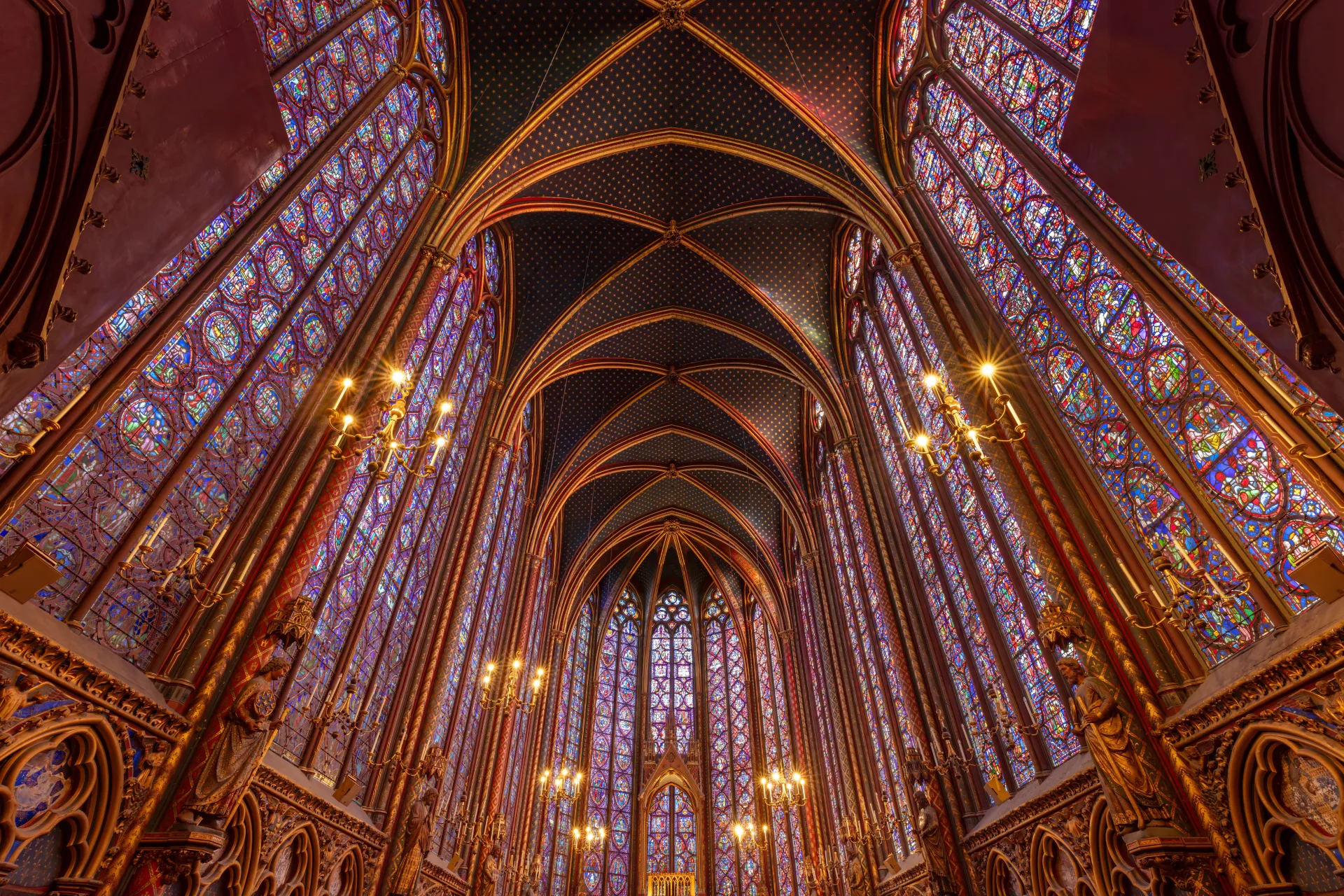
Give the eye somewhere to begin
The interior photograph seems to leave almost no empty space. Windows meet slender stonework, which rises towards a vault patterned with stars. Red and blue may register before any figure or story becomes clear. Each small compartment competes for attention.
Choose one vertical mullion and follow it upwards, then look at the colours divided beside it. The pattern gains a scale. This photograph records November 2022: exposure and image processing affect its brightness, so it can help explain the composition without promising the light of a future visit.
A number is not a viewing checklist
The Centre des monuments nationaux describes fifteen large stained-glass bays containing 1,113 biblical scenes. The number belongs in an introduction, but need not become an assignment. Recognising figures, frames and narrative order at a distance is already a considerable task.
Start with a small form you can distinguish: a head, a fold of clothing or a repeated border. Then step back to see how it joins the colour of the whole window. A close view offers clues to a story; a distant one offers rhythm. Both are useful ways to spend time with the glass.
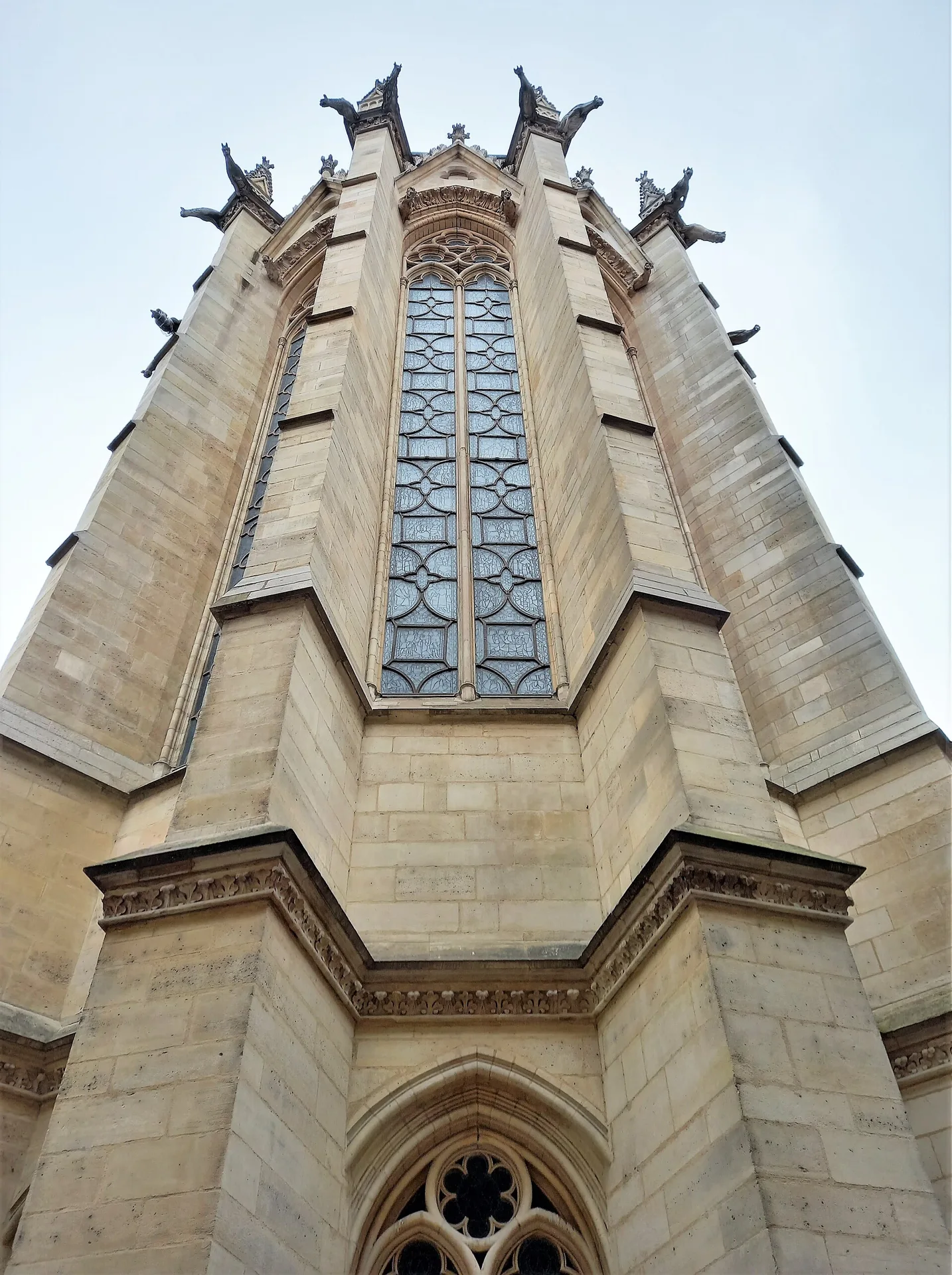
Light passes through the picture
The monument’s glass study stresses looking as well as reading: light has an essential role. An illustration on paper reflects light from a surface; stained glass transmits it through coloured material. Colour can therefore shape an impression of the room before any episode has been identified.
Notice where stone meets glass in the photograph. Edges contain the colour and repeated mullions give the height a cadence. Asking how the images are arranged can be as attentive as asking what they depict. At the monument, weather, time and position may make a familiar colour look quite different.
Two levels served different people
Sainte-Chapelle stood within the royal palace. Its official history explains that the upper chapel served the king and important guests, while the lower chapel served palace staff. A modern heritage visit can make this older allocation of space less obvious.
Compare the exterior photograph with the interior. Seeing the same building from outside did not mean everyone could approach the same level. Entrances, permitted stopping places and proximity mattered alongside the height of a vault. The upper chapel’s splendour occupied a particular place in a social arrangement.
A setting for relics, and a work of restoration
Louis IX commissioned the thirteenth-century chapel to house Passion relics, including the Crown of Thorns. The monument’s history describes the building as an enlarged reliquary. That purpose helps connect its concentrated decoration and light with its royal setting.
The same account records damage during the Revolution and extensive nineteenth-century restoration. Medieval origin and later intervention belong in the same description. Looking at the frames, sculpture and colour, it is possible to ask both what the original setting sought to express and how later work made it visible again.
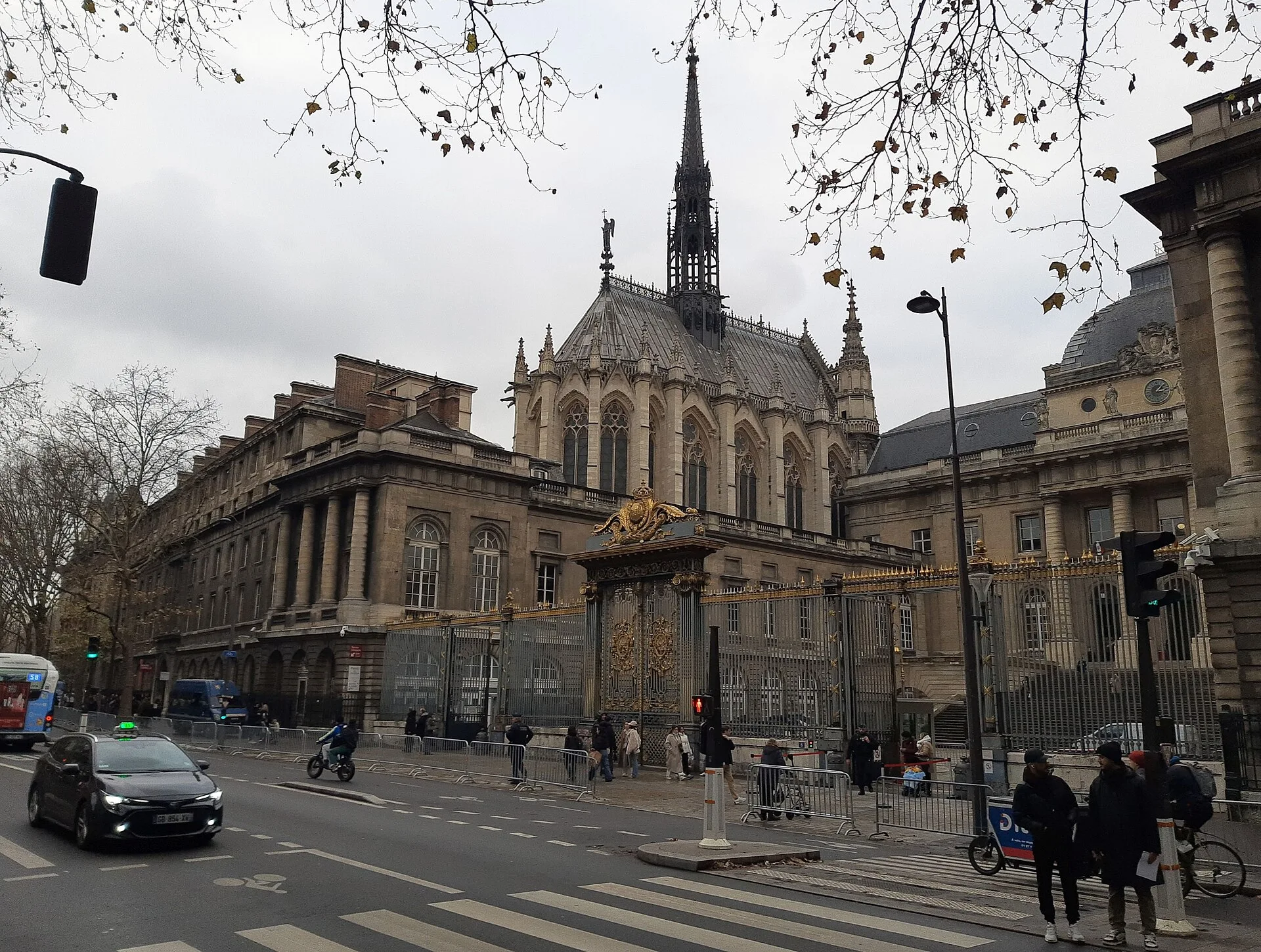
Back outside the palace boundary
The final photograph looks towards the chapel from a public street. Alongside the precinct exterior and upper interior, it supplies a third position rather than a continuous approach. The linked Paris journey mainly studies exterior spaces; its street scene does not provide access to the upper chapel.
For an interior visit, check the monument’s current arrangements separately. For now, keep a smaller exercise: when meeting another stained-glass window, find one edge and one patch of colour before following a narrative. History remains available, while the eye has a manageable place to start.
References
These sources inform the essay’s historical and local context. Its observations and interpretations are original to WalkThere.
Centre des monuments nationaux
A unique set of stained-glass windowsThe official study of the window cycles, bay count and the role of light.
Centre des monuments nationaux
History of Sainte-ChapelleHistory of the two chapel levels, the relics and nineteenth-century restoration.
More journey background
Related journey sources
- The history of the Hôtel de Ville in seven dates — City of Paris
- All about Paris City Hall — City of Paris
- Notre-Dame: free admission and reservations — Notre-Dame de Paris
- Reopening of Notre-Dame de Paris — Paris je t’aime
- Sainte-Chapelle visitor information — Centre des monuments nationaux
- Pont Neuf: the oldest bridge and a refuge for birds — City of Paris
- The Louvre palace — Musée du Louvre
- Visit the Louvre — Musée du Louvre
- Tour Saint-Jacques — City of Paris
- Marché aux fleurs Reine Elizabeth II — City of Paris
- Square du Vert-Galant — City of Paris
- Pont des Arts — City of Paris