
Québec’s Dufferin Terrace: making room for a walk
Read the boardwalk and kiosks alongside the terrace’s successive enlargements and the Saint-Louis remains below, with Parks Canada and city references.
Québec Old TownObservation essay
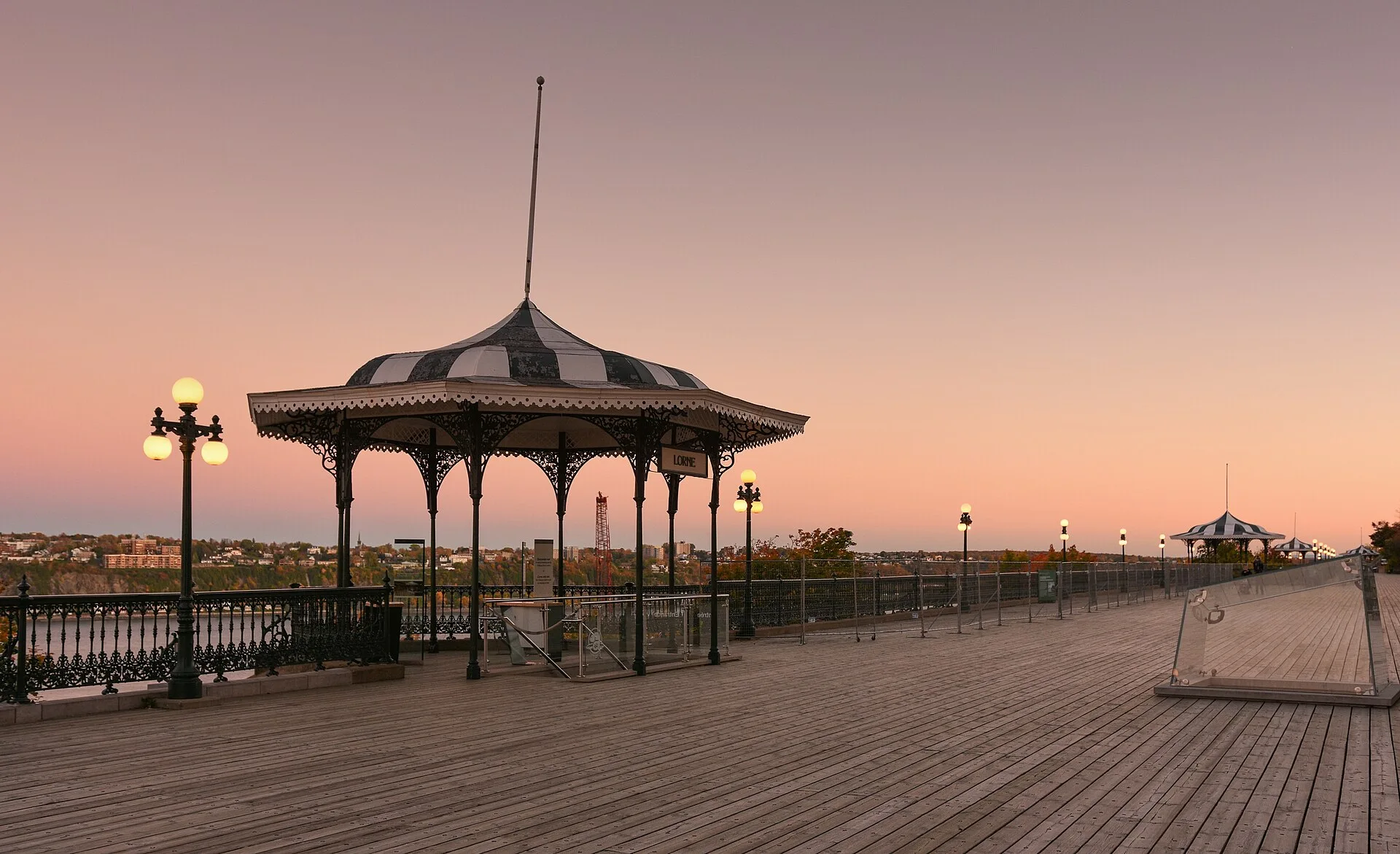
People measure the boardwalk
People recede across the wooden surface in the boardwalk photograph, offering a practical measure of distance. Architecture and sky alone can make a terrace seem like an endless edge; individual figures help bring its length back to walking scale.
The image dates from March 2021. It cannot establish summer crowds or the weather on a future visit. It does show room for passing, walking together and pausing, activities that must share the same surface.
A smaller beginning
Parks Canada describes the first Durham terrace, inaugurated in 1838, as fifty metres long and fifteen wide, supported on stone pillars. It followed the Château Saint-Louis fire by four years. The long promenade encountered today had a more limited beginning.
Keep those dimensions as a reference rather than trying to fit the first terrace exactly onto a present photograph. A public walking space can grow in stages, with each extension providing another distance to travel and another position from which to look.
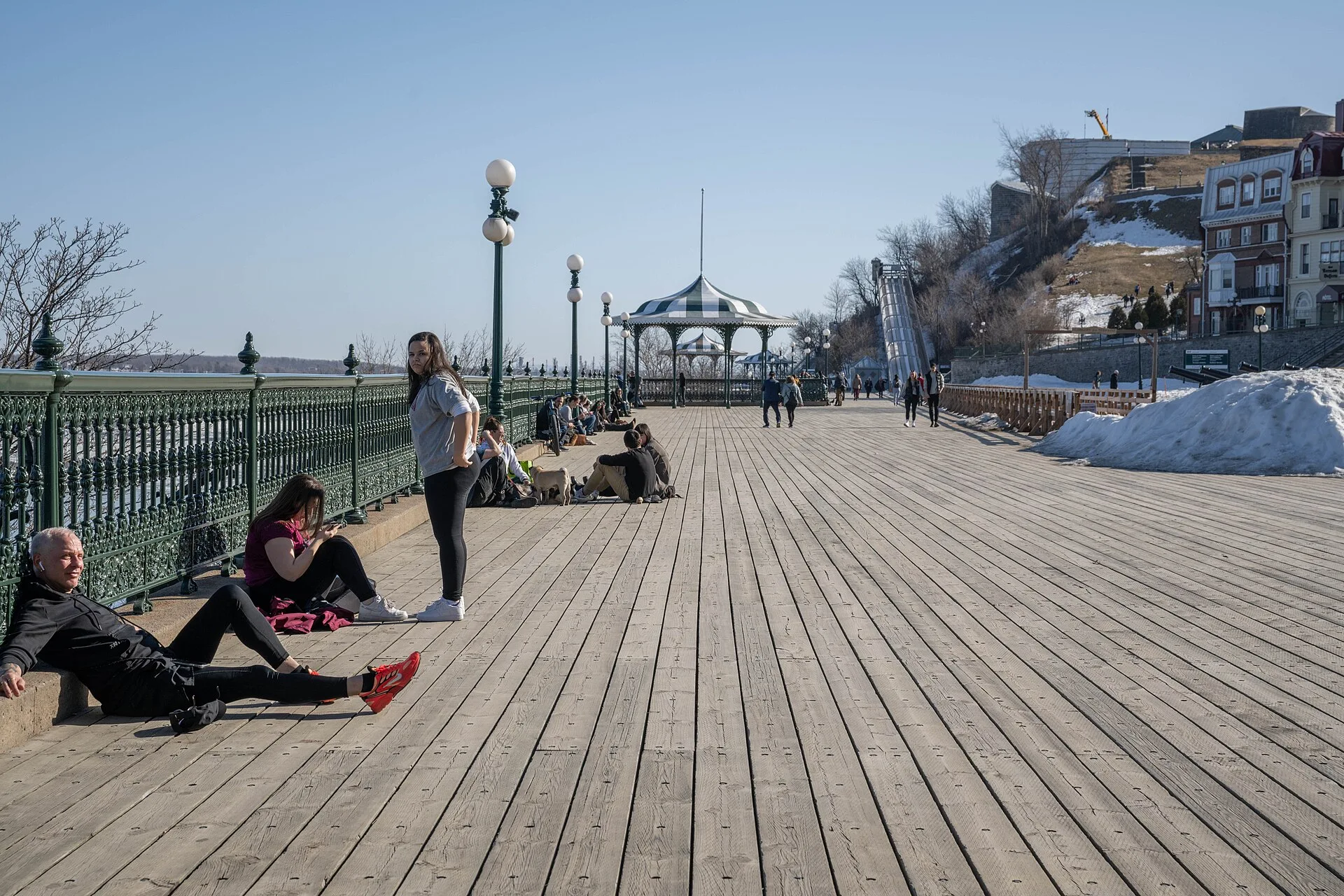
The edge moves onwards
The same history records an extension towards the Citadelle in 1854. Dufferin proposed a larger enlargement during the 1870s, realised in 1879. Those dates turn an apparently continuous promenade into a sequence of building decisions.
For users, extra length has straightforward consequences: more walking ground, additional stopping places and space to accommodate one another. The engineering account becomes easier to understand when connected to the modest business of taking a walk.
A kiosk makes a meeting point
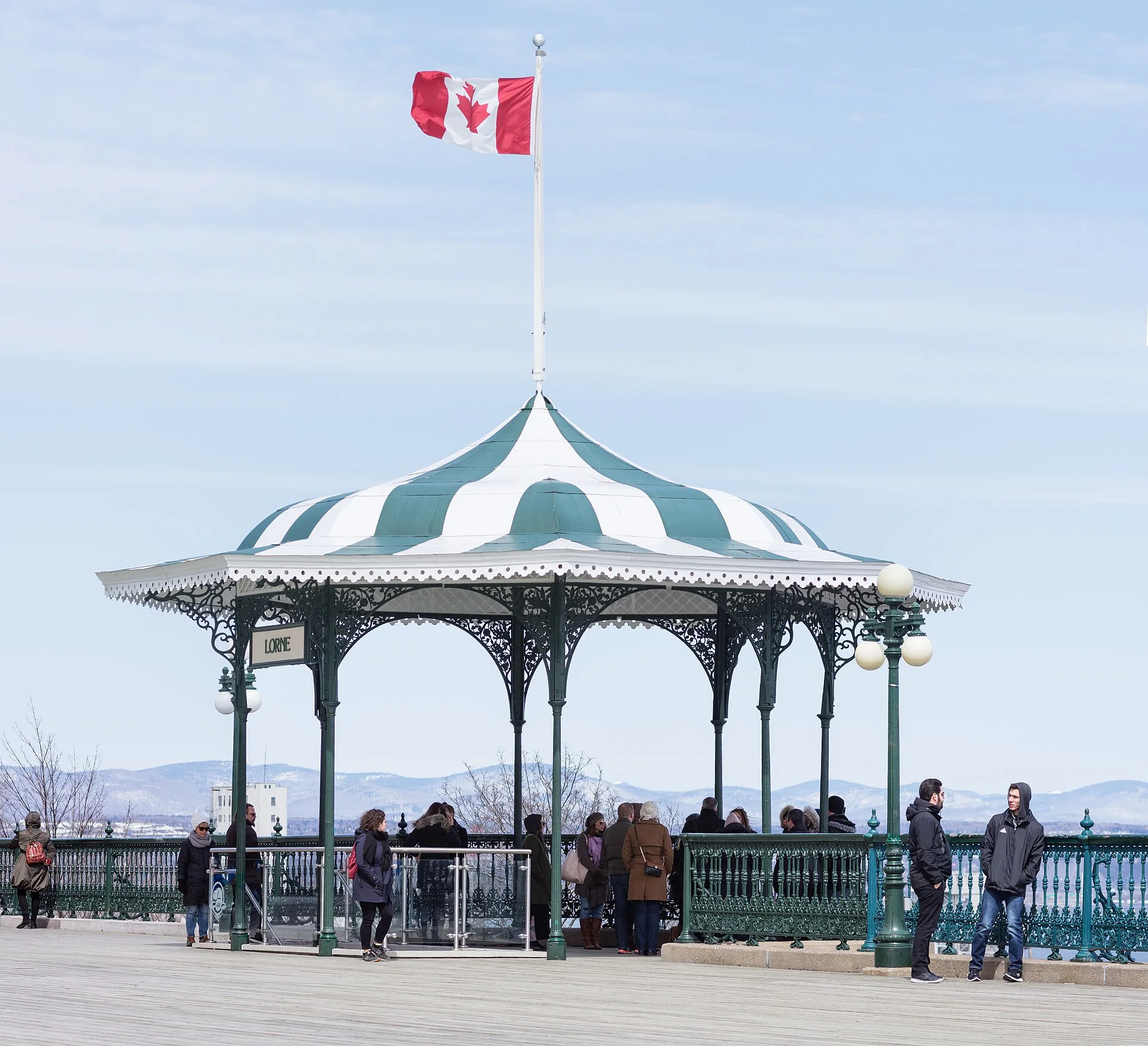
The striped-roof kiosk gives the eye something smaller to hold. Its roof is recognisable while spaces remain between the supports. On an expansive terrace, a particular structure can make directions more precise than a reference to the promenade alone.
Parks Canada records six kiosks in the 1879 project. This essay does not identify the photographed one by its individual name or document the full set. Its visible role is enough to consider: a small structure interrupts a long repetition of paving and railing.
Another view below
The city’s heritage account describes Saint-Louis fort and château remains in this area, some visible beneath glass covers. Looking towards the distance from the promenade and looking down towards archaeological evidence offer different encounters with the same ground.
An exterior photograph cannot explain the complete underground arrangement. Anyone interested in the remains should allow separate time for current site information and interpretation. An informal walk and an archaeological visit can be planned at different levels of detail.
Leave room to pass
Return attention to the surface after studying the views. Where can someone pause while leaving a clear passage? A kiosk or railing can attract several people to one position; consideration for movement matters more than reproducing an old photograph exactly.
The three independently dated images do not record one continuous visit. Check weather and local conditions when planning. For an introduction, the successive extensions and the remains below already supply useful things to notice during a walk.
References
These sources inform the essay’s historical and local context. Its observations and interpretations are original to WalkThere.
Parks Canada
Three terracesParks Canada’s account of the terrace projects of 1838, 1854 and 1879.
Ville de Québec
Saint-Louis Forts and ChâteauxCity heritage context for the fort and château remains below the terrace.
More journey background
Related journey sources
- Fortifications — Ville de Québec
- Porte Saint-Louis — Destination Québec cité
- Place d’Armes — Destination Québec cité
- Rue du Petit-Champlain — Ville de Québec
- Explore Petit-Champlain — Destination Québec cité
- Place-Royale — Ville de Québec
- Place Royale archaeology — Ville de Québec
- Porte Saint-Jean — Destination Québec cité
- Cathedral of Holy Trinity — Ville de Québec
- Breakneck Steps — Destination Québec cité
- Bassin Louise — Ville de Québec