
Madrid’s Plaza Mayor: a room with many doors
Compare the square, balcony details and the illuminated Casa de la Panadería to read enclosure, passages and public use, with three different photographs and official Madrid references.
Madrid Old TownObservation essay
A street before a square
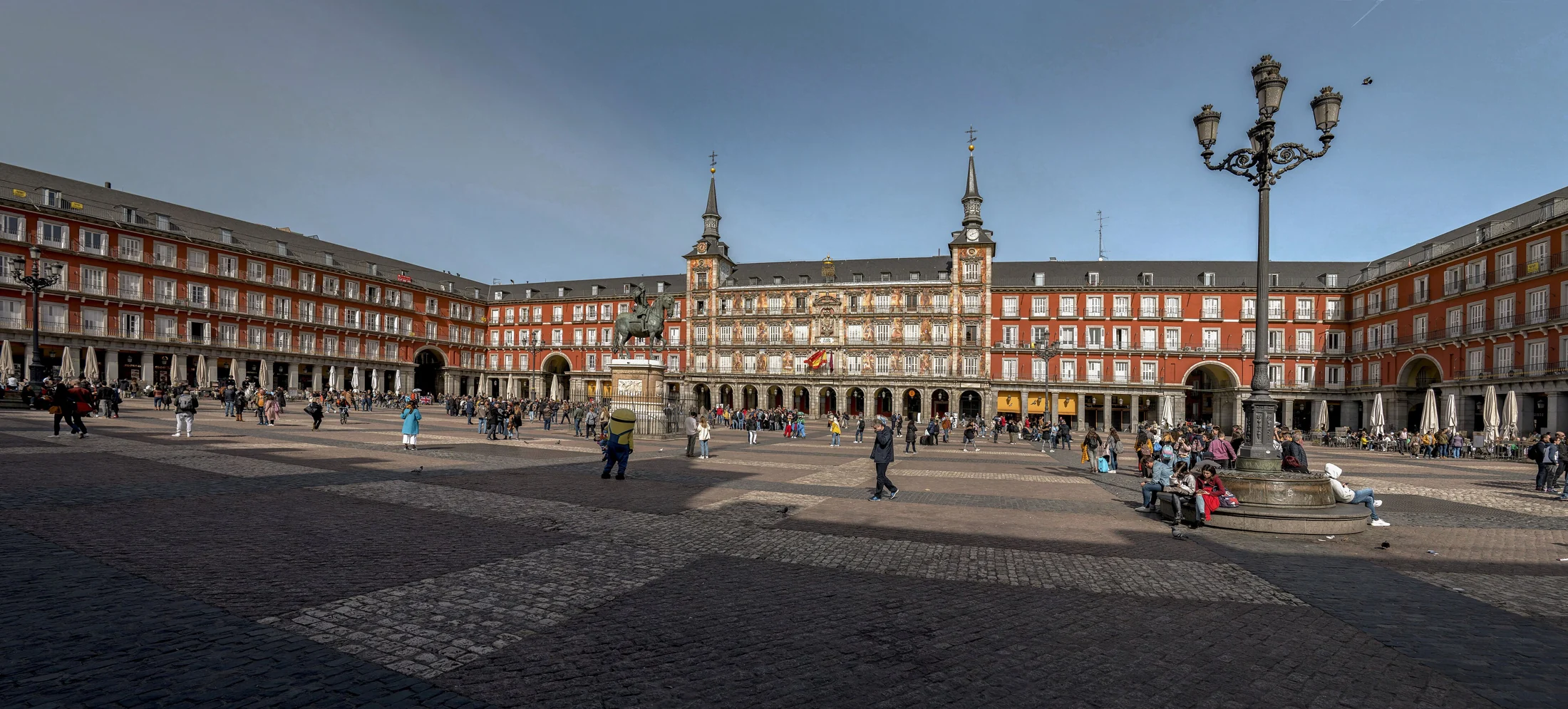
An enclosed square often announces itself through a change of scale: a narrow approach opens onto sky and a broad frontage. The panoramic photograph supplies that openness while leaving the approach outside the frame.
Look for openings at the edges. The surrounding buildings admit streets rather than form an uninterrupted barrier. Some people arrive to stay; others follow a route through. Both movements help explain the space.
Windows make a collective frontage
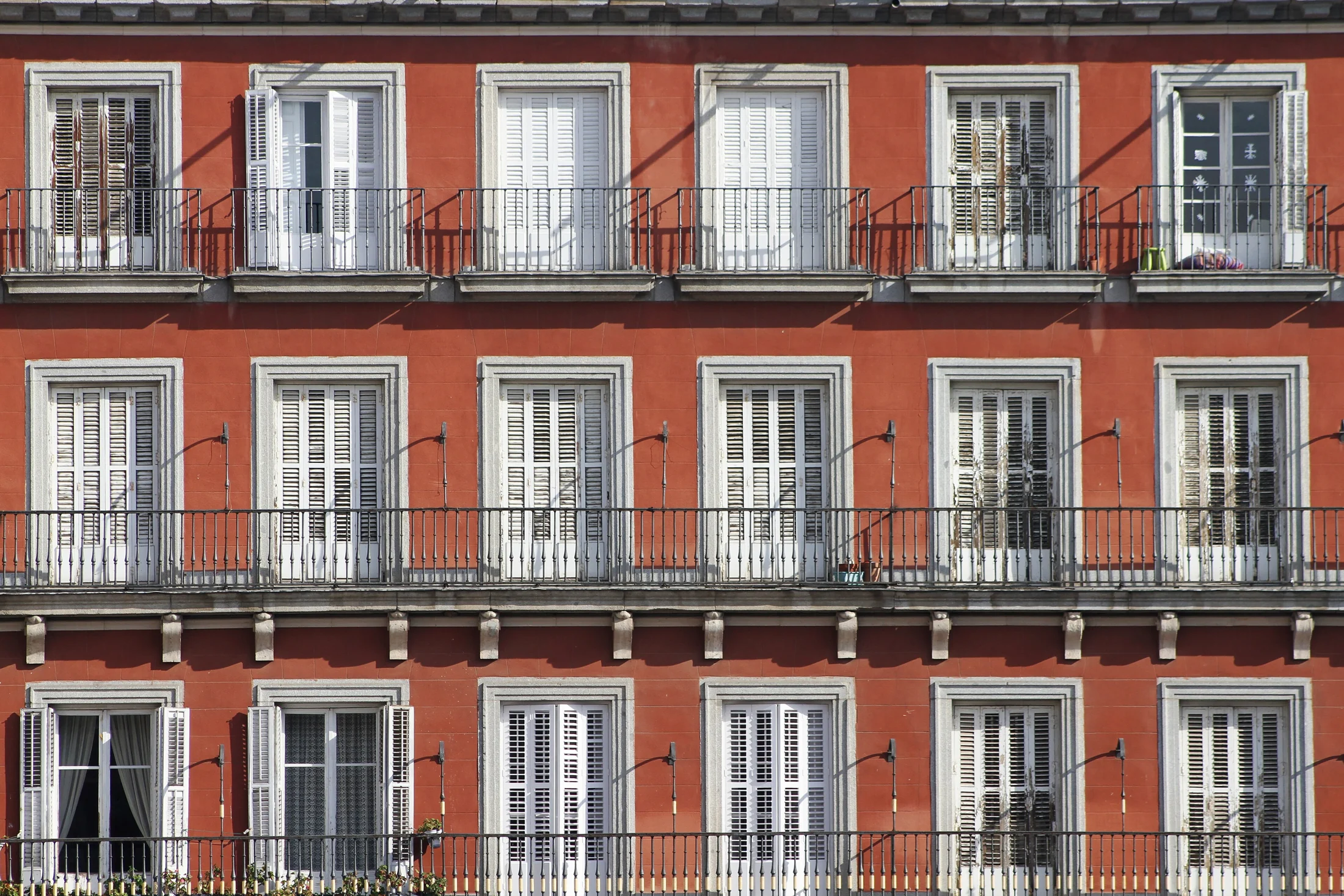
In the detail photograph, white frames repeat across red wall and balconies add depth. From farther away, these units read as one façade. Closer attention suggests separate rooms behind the shared exterior.
A single window occupies a small area while a row carries attention across a building. Comparing detail and panorama reveals how an organised whole can emerge from many smaller units without requiring every building to be named first.
An organised setting for changing uses
Madrid’s official account records Juan Gómez de Mora’s commission to unify the buildings in 1617. It also describes market origins and varied gatherings and celebrations. The architectural setting has accommodated different activities over time.
An apparently empty photograph therefore does not describe a place where nothing happens. Standing, passing and watching can be rearranged by an event. Buildings supply boundaries; people and activities determine how the ground is occupied.
An edge with depth
Shadow beneath the arcades reveals an intermediate zone between building and open ground. Walking under cover offers different light and distance from standing in the centre. The square has more than two simple positions, inside and outside.
Along an edge, supports and openings pass in sequence. From the centre they become a more continuous band. Changing position can be more revealing than waiting for one perfectly centred photograph.
Night selects a building
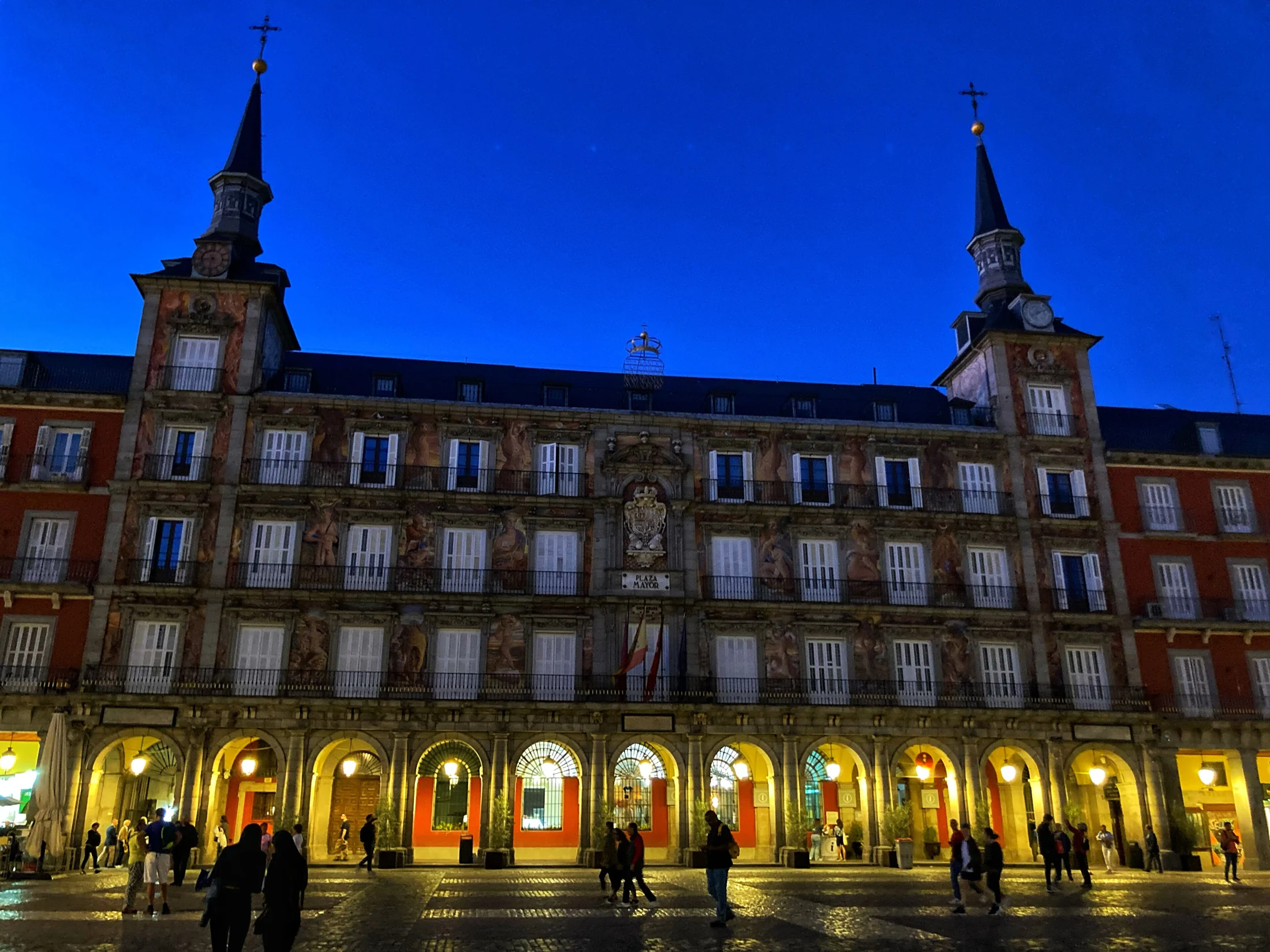
The night image brings Casa de la Panadería forward through illumination. It selects a different focus from the daylight panorama. Official information also notes changes to the building’s façade decoration over time.
Lighting is not a chronology, but it demonstrates how attention is selected. Bright surfaces become memorable while darker passages recede. Returning to the daylight view restores some of the ordinary movement obscured by atmosphere.
The city continues beyond the opening
Official local information also presents nearby Plaza de la Villa. A second square provides a comparison rather than another interchangeable old-town setting: form, entrances and surroundings invite different movements.
The three photographs here remain studies of Plaza Mayor, not a recorded neighbourhood walk. Check current events and access separately. Keep a simple question for another enclosed place: where are its doors, and who is simply passing between them?
References
These sources inform the essay’s historical and local context. Its observations and interpretations are original to WalkThere.
Madrid Destino · Madrid City Council
Plaza MayorOfficial context for the unified façades, arcades, activities and Casa de la Panadería.
Madrid Destino · Madrid City Council
Plaza de la VillaNearby civic-square context as a comparison within the old town.
More journey background
Related journey sources
- Puerta del Sol — Madrid Destino · Madrid City Council
- La Almudena Cathedral — Madrid Destino · Madrid City Council
- Royal Palace of Madrid — Patrimonio Nacional
- San Ginés Church — Madrid Destino · Madrid City Council
- Mercado de San Miguel — Madrid Destino · Madrid City Council
- Arab Wall — Madrid Destino · Madrid City Council
- Plaza de Oriente Square — Turespaña