
Madrid: clocks, civic rooms and royal horizons
Explore Madrid in five chapters from Puerta del Sol to the Royal Palace, with four optional discoveries.
Begin the visual journeyPlan a real visit to Madrid Old TownExplore 8 reviewed views along the routeGuided visual journey
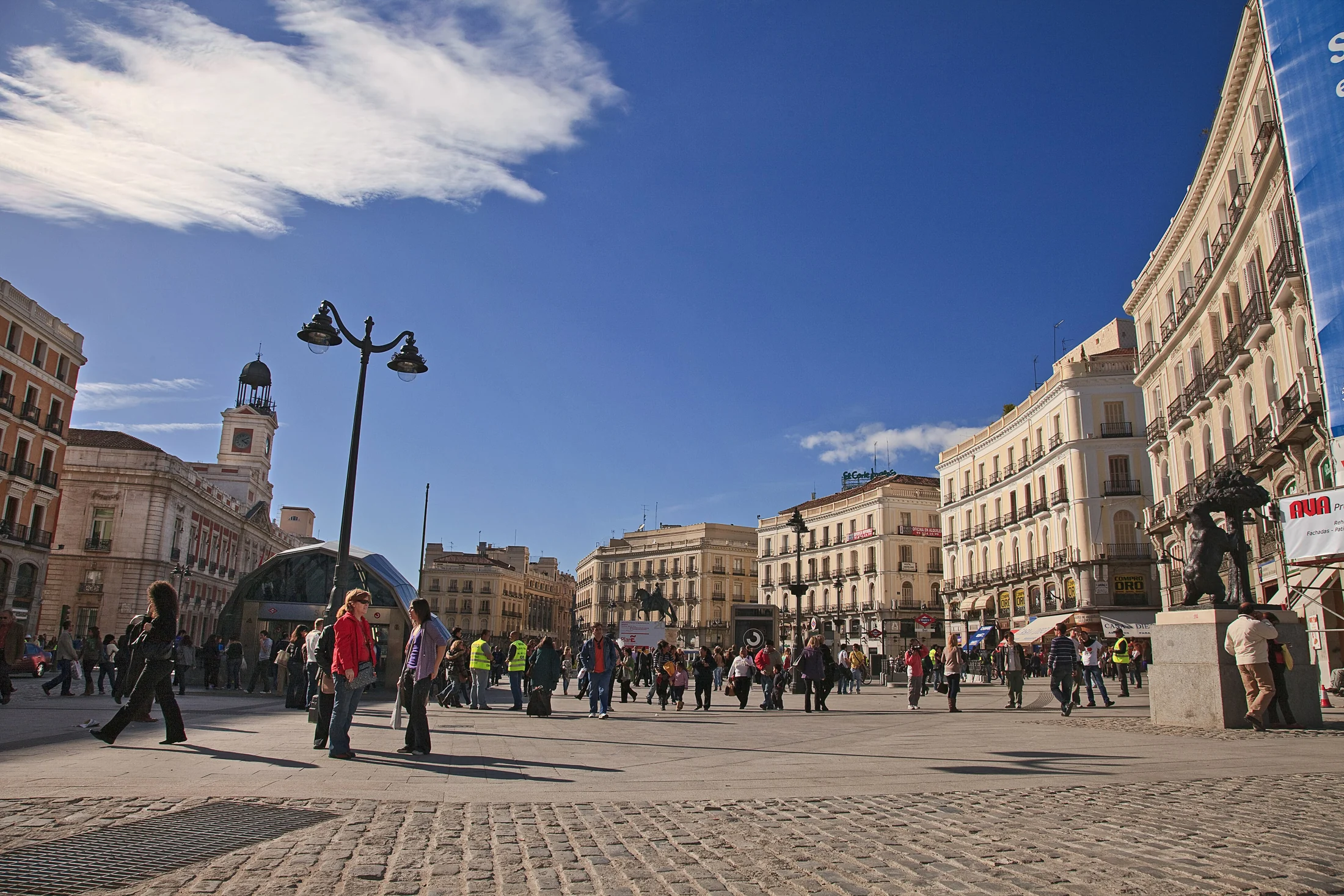
Puerta del Sol square with the equestrian statue, clock tower and curving facades in sunshine · Tomás Fano · CC BY-SA 2.0 · Resized and converted to WebP
Reading mode
Place stories to read at your own pace
Compare independently captured photographs and viewpoints, each with its own date.
Chapter 1
Puerta del Sol: a city learning to tell time
Begin by imagining a square as an instrument for coordinating a city. Puerta del Sol brings together several kinds of orientation: streets converge, a clock gathers attention, and a road marker gives an abstract national network a tangible starting point. Madrid’s official tourism account identifies Sol as the original location of a city gate and the starting point for Spain’s principal radial roads. The name preserves a threshold even though the experience is now that of a central gathering place.
Look first at the outline of the space rather than searching immediately for a famous object. The semi-circular arrangement and converging street mouths make a useful comparison with the enclosed rectangle of Plaza Mayor, our next main chapter. Trace the way a building line guides your eye, then notice where an opening releases it toward another street. A photograph can reveal that relationship without providing evidence of how crowded, loud or easy to cross the square will be during a future visit.
The Casa de Correos provides another kind of orientation. Its clock is associated with the last night of the year, according to the city’s account. A familiar architectural element becomes the focus for a shared moment: time is made public through a façade. Compare the scale of the clock with the surrounding building before returning to street level. This journey begins with everyday coordination rather than a royal interior. San Ginés offers an optional church-and-passage setting before Plaza Mayor. The photographs and dated local 360-degree sequences are independent records; the change between places is an editorial transition, not footage of a continuous walk.
Real-travel note
Dated independent local 360-degree sequences; editorial transitions between sites.
Compare independently captured photographs and viewpoints, each with its own date.
Chapter 2
Plaza Mayor: the architecture of a shared stage
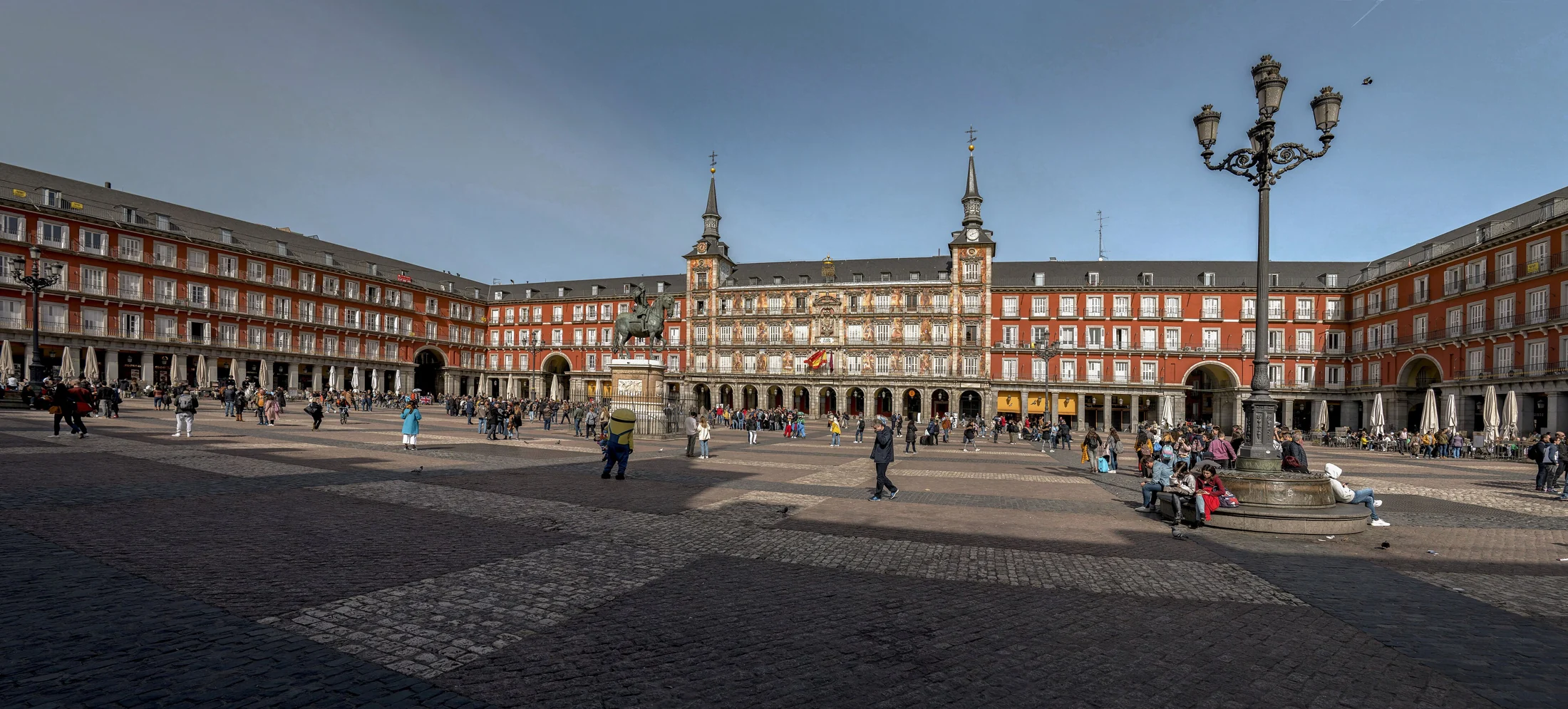
Plaza Mayor changes the question from where streets meet to how a public room is made. Stand back in the available views and compare the continuous building edges with Sol’s converging openings. Repeated windows and an arcaded lower level can make separate frontages read as one enclosure. That unity is an architectural effect with a complicated history, rather than proof that everything visible was built at once.
Madrid’s official account dates Juan Gómez de Mora’s commission to bring uniformity to the buildings to 1617. It also describes the destructive fire of 1790 and Juan de Villanueva’s subsequent reconstruction, including the closing of the corners and nine access arches. Read the square with those different moments in mind. The entrances are especially revealing: an urban room must admit the surrounding city while preserving the impression of an inside. Follow a visible arch toward the darker space beneath it and compare that compressed opening with the bright breadth of the plaza.
The square has accommodated festivities and public spectacles, but a photograph only records one temporary arrangement of its floor. Tables, visitors and shadows do not explain the whole history. Try mentally clearing the central space, then considering how the surrounding windows might change the relationship between spectators and an event. Finally return to the Casa de la Panadería as a visual focus within the repeated façades. Its distinct treatment shows how a unified composition can still give one building special emphasis. The optional San Miguel discovery turns from a large public stage toward the structure of a market. Our next chapter, Plaza de la Villa, replaces this carefully ordered enclosure with a conversation among buildings of different centuries.
Read further: Madrid’s Plaza Mayor: a room with many doorsReal-travel note
Dated independent local 360-degree sequences; editorial transitions between sites.
Before Almudena, pause at the surviving evidence of a much earlier Madrid. The city’s official tourism account places the first wall in the ninth-century emirate and identifies representative remains in Emir Mohamed I Park near Cuesta de la Vega. This is a useful correction to the impression that the city’s story begins with its royal façades. Compare the low surviving fabric with the much taller skyline around the cathedral precinct. A fragment asks for a different kind of attention from a complete-looking monument: notice edges, gaps and the relation to the ground rather than supplying imaginary missing towers. The preview illustrates a surviving portion, not the whole fortified perimeter. Today’s park arrangements need separate checking. Carry this distinction between archaeological survival and later monumental construction into the next chapter, where Almudena’s long modern building history complicates another first impression.
Chapter 3
Plaza de la Villa: three centuries around one square
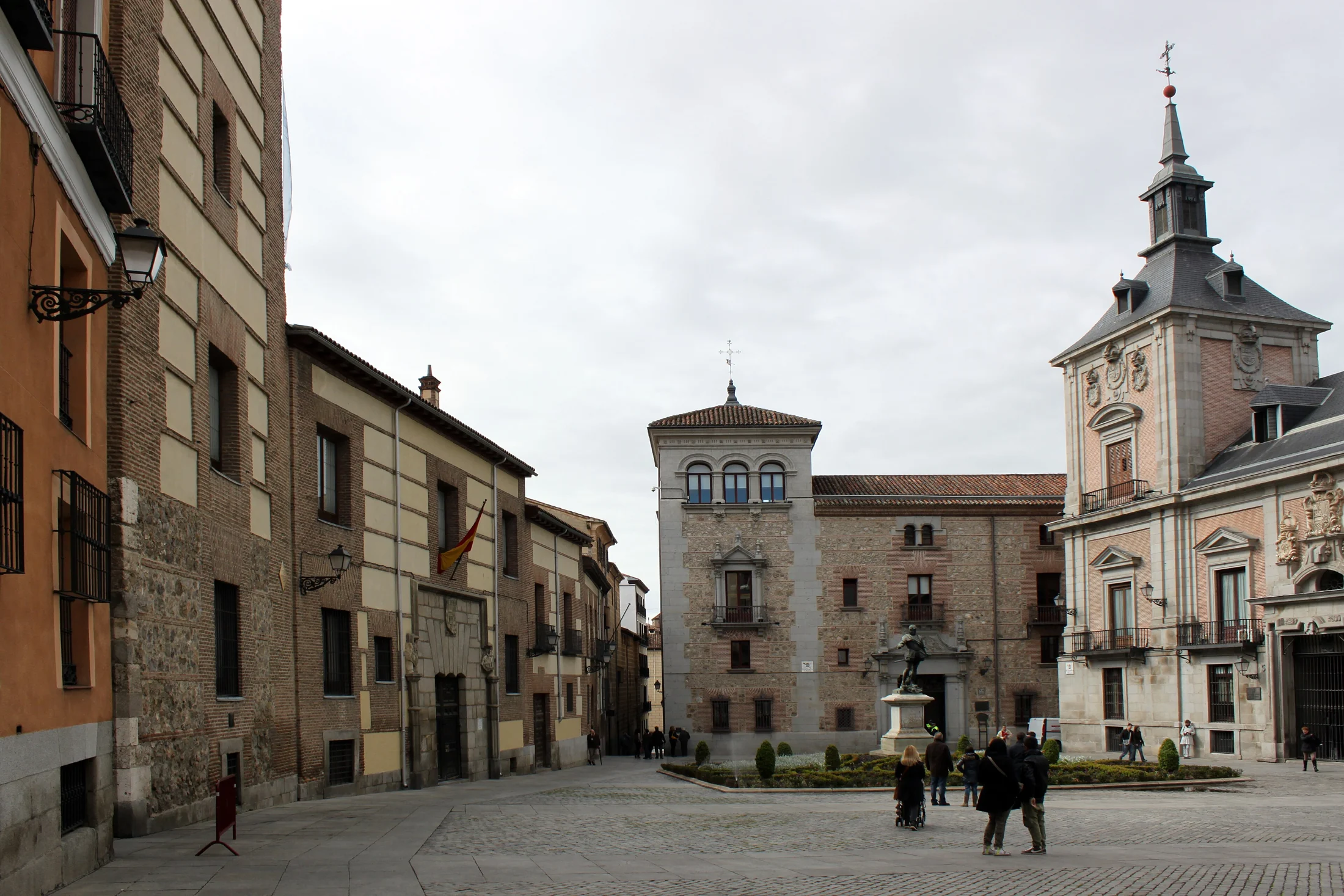
Plaza de la Villa rewards looking from one frontage to another before choosing a favourite building. Its interest lies in the coexistence of different periods at a scale that can be held in a single mental picture. Madrid’s official tourism account identifies the Lujanes house and tower as fifteenth-century Gothic-Mudéjar work on the eastern side, Casa de Cisneros as a sixteenth-century Plateresque palace to the south, and the seventeenth-century Baroque Casa de la Villa to the west. These labels offer a chronology to test through careful comparison, rather than a requirement to recognise every decorative term.
Begin with silhouette. A tower gives one part of the composition a vertical accent; a longer frontage distributes attention horizontally. Then compare openings, rooflines and the relationship of each building to the open ground. Ask how different edges contribute to the square without becoming identical. Unlike Plaza Mayor, where repetition makes a strong first impression, this setting invites an eye that moves between distinct architectural voices. A closer photograph may clarify one edge while a wider view restores the relationships between them.
The Casa de la Villa formerly housed Madrid City Council, according to the same official account. Civic authority therefore enters the story before we reach the royal precinct. Consider how a council building addresses a modest public space, and carry that observation forward to the palace’s much larger scale. The surrounding small streets also matter: the square belongs to a network, not an isolated display case. Our optional Arab Wall discovery looks beneath these later civic layers toward the earlier fortified settlement. The main sequence continues to Almudena, where an apparently historic silhouette turns out to belong to a remarkably long modern building campaign. Each local scene remains independent of the next.
Real-travel note
Dated independent local 360-degree sequences; editorial transitions between sites.
Compare independently captured photographs and viewpoints, each with its own date.
Chapter 4
Almudena: a cathedral across a long building century
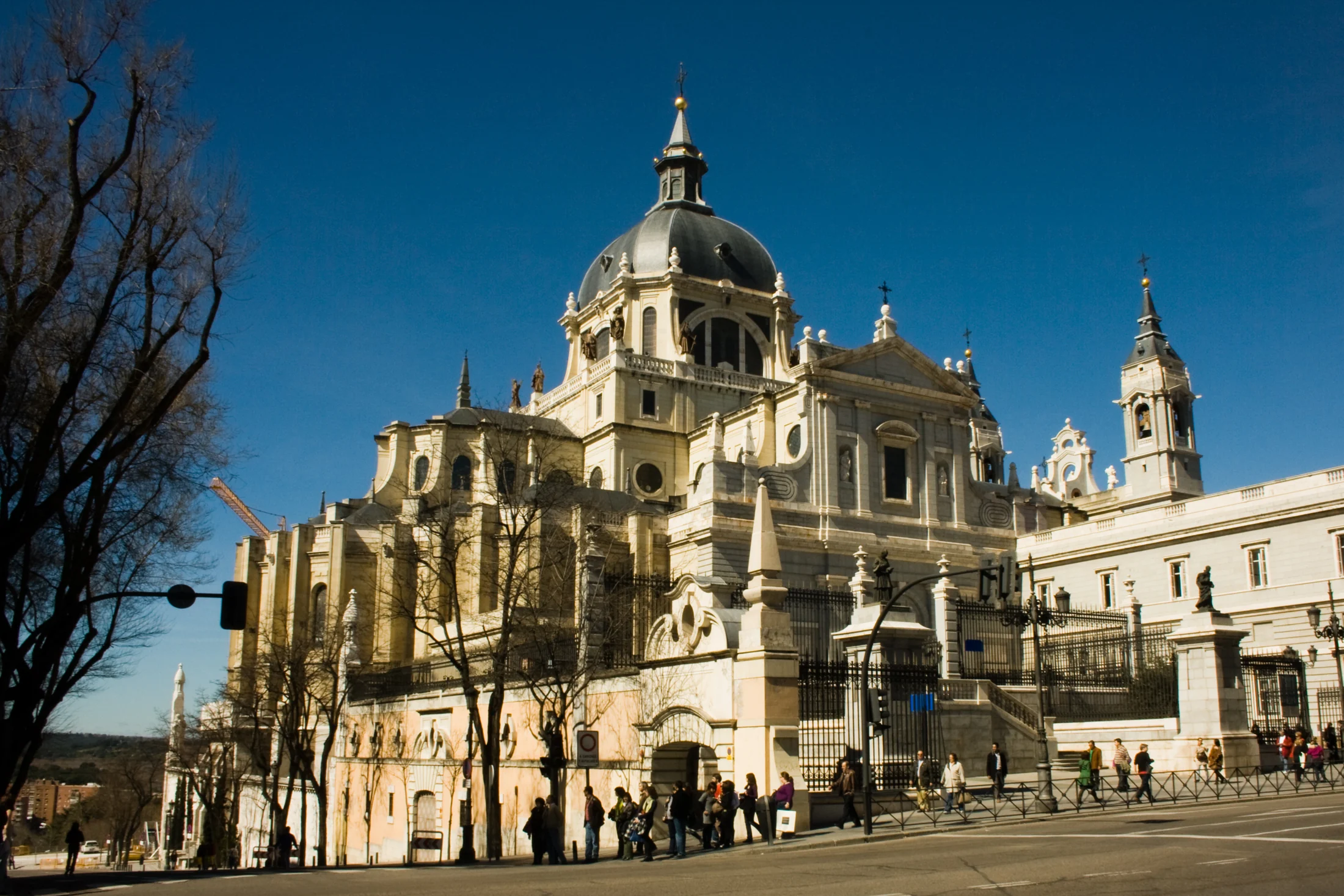
Almudena poses a useful challenge to visual assumptions: how old does a cathedral look, and what does its appearance actually prove? Madrid’s official history places its foundation stone in 1883 and its consecration by Pope John Paul II on 15 June 1993. The gap is central to understanding this building. A monumental church can draw on historical architectural languages while belonging to a much later sequence of planning, interruption and revised decisions.
Start with its position beside the royal precinct. Compare the cathedral’s concentrated vertical emphasis with the palace’s extended mass, using the independent views available in the gallery. The dated archival interior sequence offers a separate comparison of columns, vaults and seating; it does not establish present admission. In the exterior photographs, examine how the building establishes a ceremonial presence: the arrangement of openings, the transition from wall to skyline, and the amount of open space from which the building can be seen. These are questions for observation, not claims that the photographs all share one viewpoint or date.
The city’s account also explains that the initial church project became a cathedral project after the creation of the Madrid-Alcalá bishopric in 1885. An institutional change altered architectural ambition. That relationship recalls Plaza de la Villa, where municipal government gave a building meaning beyond its style. Here, however, the long interval between beginnings and completion asks us to think about changing expectations over generations. Keep the early project, later revisions and final consecration distinct when reading the exterior. If you choose the Arab Wall discovery before this chapter, the contrast becomes sharper still: the early settlement and the cathedral occupy neighbouring ground with very different dates. Plaza de Oriente provides the final optional pause before the Royal Palace. Worship, museum visits and interior admission require their own current arrangements.
Real-travel note
Dated independent local 360-degree sequences; editorial transitions between sites.
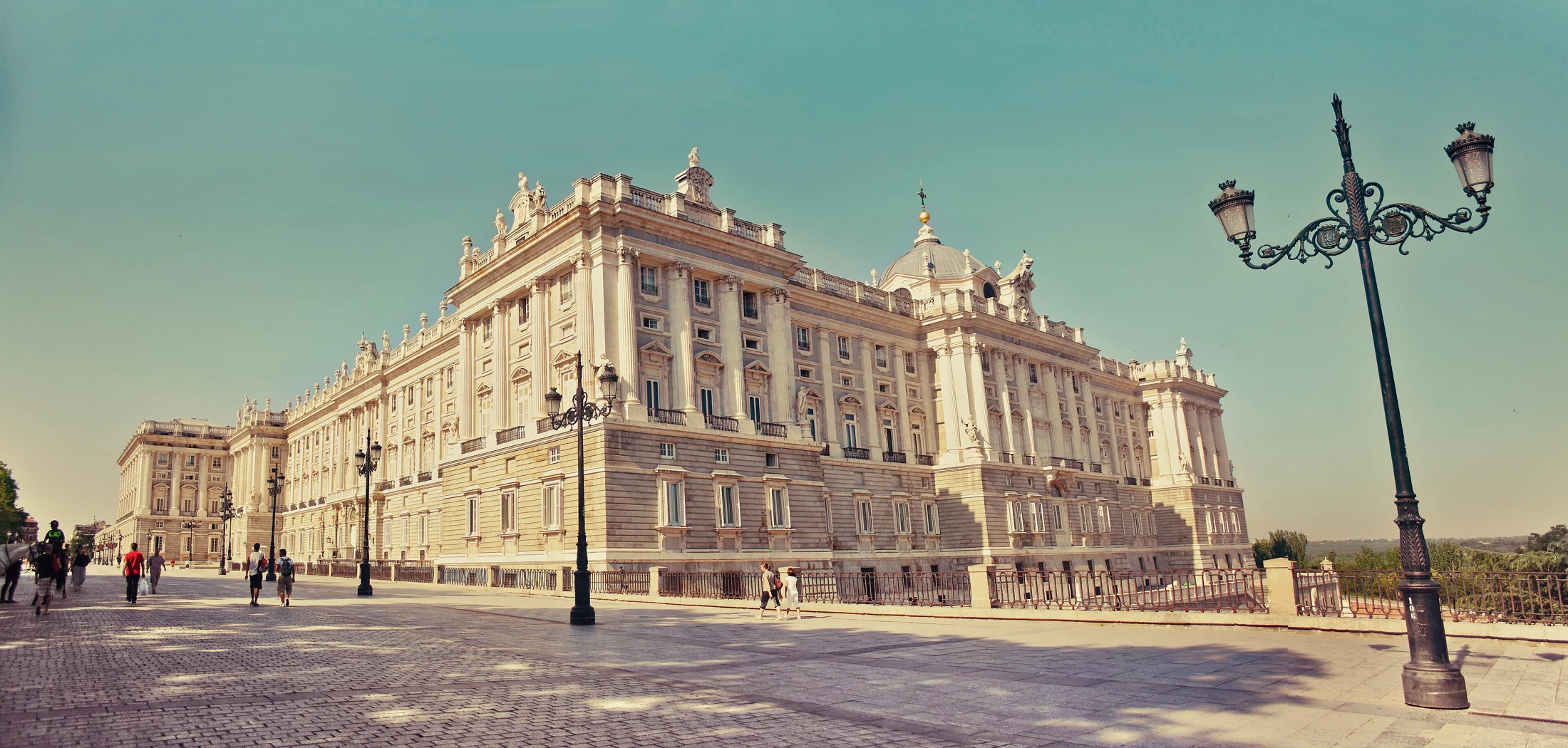
Compare independently captured photographs and viewpoints, each with its own date.
Chapter 5
Royal Palace: rebuilding the image of power
Finish by looking at the palace as a deliberate replacement, rather than an unchanged survival. Patrimonio Nacional records that the earlier Alcázar burned on Christmas Eve 1734. Charles III became the first monarch to live in the new Royal Palace in 1764. Those two dates frame a transformation in the architectural representation of monarchy: a site can retain its political significance while its physical expression changes profoundly.
Begin with the long rhythm of the façade. Repeated openings allow a very large building to be read in smaller units, while the overall mass resists being understood from a single detail. Alternate between the wide photograph and a closer view. What disappears when the frame tightens? A decorative element may become legible while the scale of the precinct slips away. Restore the context image and compare the building with the open ground around it. This is a place where distance itself becomes part of how authority is presented, even though this journey supplies no surveyed walking distance.
If you explored Plaza de Oriente, bring its garden and sculptural setting back into the comparison. The approach to a palace can shape expectation before any interior is entered. Now recall the route’s opening: Sol coordinated streets and public time, Plaza Mayor arranged a shared urban stage, Plaza de la Villa presented civic history, and Almudena demonstrated the long construction of religious identity. The palace adds the rebuilding of royal representation to those overlapping stories. Patrimonio Nacional also explains that the building serves official royal events, which makes a visit different from examining an abandoned monument. Interior access and ceremonial closures must be checked separately. End with the exterior’s relationship to the city, allowing the dated independent local imagery to remain a record of its own moment.
Real-travel note
Dated independent local 360-degree sequences; editorial transitions between sites.
8 reviewed experiences
Explore along the route
Step into the places along this journey. Choose a view independently of the story chapters. Free previews do not count toward chapter progress. Return to the journey above to continue through its stops.
Puerta del Sol: a city learning to tell time Short observation sequence
2025-05 · 5 connected local positions and return. Puerta del Sol square facing the clock-fronted Real Casa de Correos; pedestrians cross the foreground.
Reviewed 2026-11-02 · Nearby viewpoint
Explore at your own pace; these views do not count toward chapter completion. Check each point's coverage note before navigating provider imagery. Availability may change.
Sources
- Puerta del Sol — Madrid Destino · Madrid City Council
- Plaza Mayor — Madrid Destino · Madrid City Council
- Plaza de la Villa — Madrid Destino · Madrid City Council
- La Almudena Cathedral — Madrid Destino · Madrid City Council
- Royal Palace of Madrid — Patrimonio Nacional
- San Ginés Church — Madrid Destino · Madrid City Council
- Mercado de San Miguel — Madrid Destino · Madrid City Council
- Arab Wall — Madrid Destino · Madrid City Council
- Plaza de Oriente Square — Turespaña
- Puerta del Sol square with the equestrian statue, clock tower and curving facades in sunshine — Tomás Fano · Wikimedia Commons
- Ceramic Puerta del Sol street sign on a stone wall — Carlos Delgado · Wikimedia Commons
- Puerta del Sol at night with the illuminated clock tower and visitors — Tomás Fano · Wikimedia Commons
- Panoramic view across Plaza Mayor to its red arcaded facades — Nemo · Wikimedia Commons
- Rows of balconies and white window frames on a red Plaza Mayor facade — José Luiz · Wikimedia Commons
- Casa de la Panaderia and its twin towers illuminated after dark — Artem Vynohradov · Wikimedia Commons
- Plaza de la Villa with historic buildings and its central monument — Anagoria · Wikimedia Commons
- The historic Casa de la Villa facade and tower beside the square — Anagoria · Wikimedia Commons
- Sunlit Plaza de la Villa and the monument framed by brick buildings — Carlos Delgado · Wikimedia Commons
- Almudena Cathedral dome and facade viewed from the street in sunshine — Christian Kadluba · Wikimedia Commons
- Arched entrances and stone ornament on the side of Almudena Cathedral — Luis García (Zaqarbal) · Wikimedia Commons
- Almudena Cathedral illuminated at night above the sloping street — Gerda Arendt · Wikimedia Commons
- Royal Palace of Madrid and its broad paved forecourt — Juanedc · Wikimedia Commons
- Columns, balconies and carved decoration on the Royal Palace east facade — Javier Perez Montes · Wikimedia Commons
- Elevated view of the Royal Palace surrounded by gardens and Madrid rooftops — Tim Adams · Wikimedia Commons
- San Gines church facade at the end of its small entrance courtyard — Luis García (Zaqarbal) · Wikimedia Commons
- Iron columns and glass walls along the exterior of Mercado de San Miguel — Luis García (Zaqarbal) · Wikimedia Commons
- Surviving stone sections of Madrid Arab wall beside a planted slope — Luis García (Zaqarbal) · Wikimedia Commons
- Royal Theatre and the equestrian monument in Plaza de Oriente after dark — Luis García (Zaqarbal) · Wikimedia Commons


Your journey, remembered.
Explored 0 of 5 stops. Explore every stop to unlock your keepsake.
5 stops to your keepsakeExplore every stop to share or download your keepsake.
Plan separate site visits
Allow half a day to a day as an outdoor planning estimate; actual connections and interiors require additional planning.
Official sources checked:
Check actual connections
Five chapters and four discoveries connect independent local scenes through editorial transitions. They do not record a continuous Madrid walk. Check streets, crossings, construction and individual access needs separately; no continuous or step-free route is established.
Arrange interiors separately
The journey mainly studies exterior settings; Almudena also has independently dated archival interior imagery. Photographs and interactive scenes have independent capture dates and do not establish present opening, security or tickets. Plan palace interiors and cathedral visits with each institution.