
The Louvre: look at the building before the paintings
Read the Louvre through three exterior photographs: Cour Carrée, a niche sculpture and the eastern colonnade. Compare scale and repetition while keeping museum admission separate.
Paris Île de la Cité & SeineObservation essay
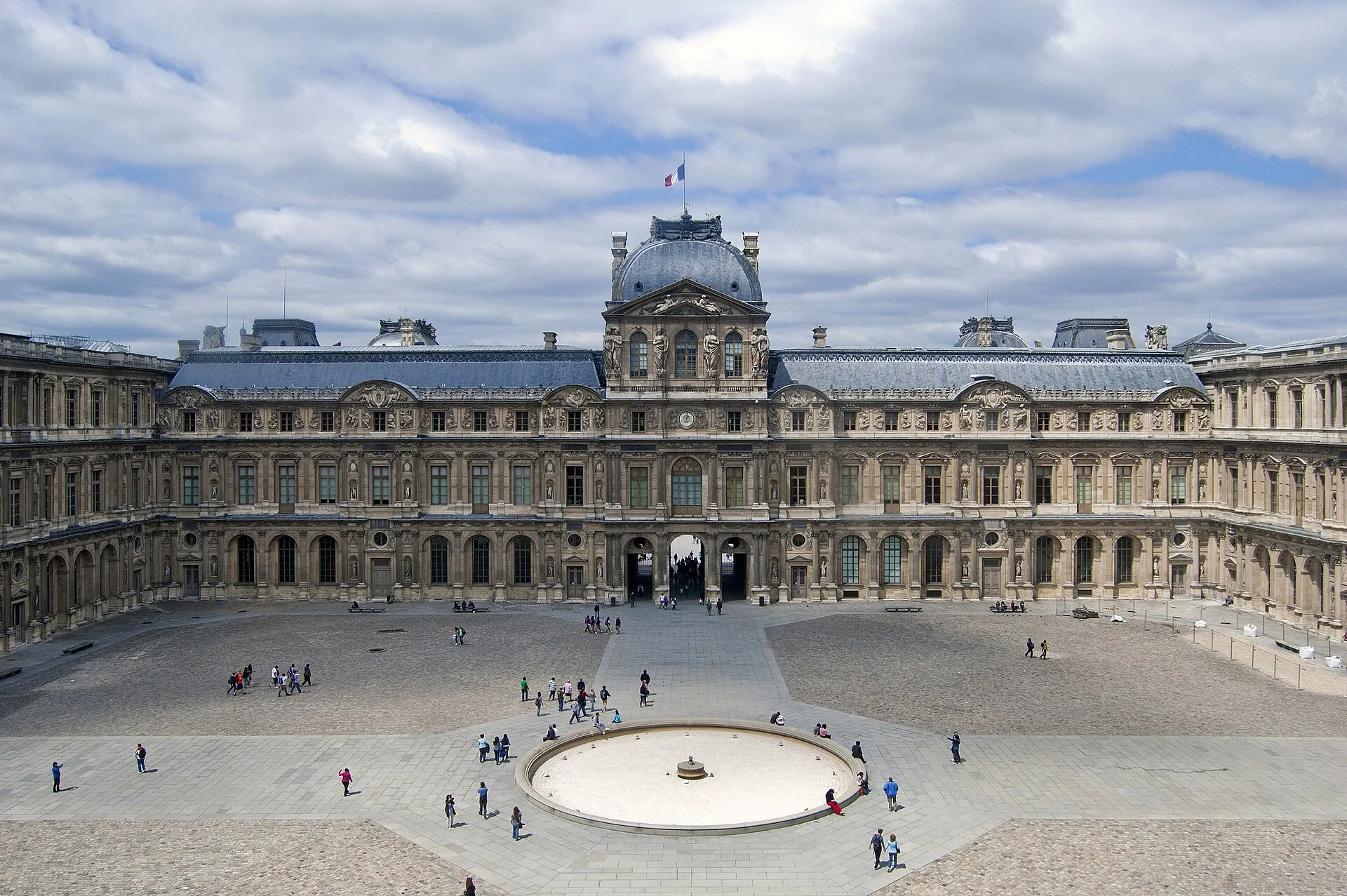
Begin with the unbuilt centre
Collections often come first when thinking of the Louvre. The courtyard photograph instead presents a large area enclosed by buildings. Windows, roofs and decoration become easier to relate across the open centre.
This is an elevated photograph rather than the same view available from pavement level. It helps explain enclosure without establishing a walking route. Keeping the camera position in mind separates an overview from an experience of moving through it.
Repetition holds the details
Windows and façade divisions repeat around the court. That repetition makes the broad organisation legible before individual decoration begins to stand out. Attention can settle into the pattern and then pause over a difference.
Architecture rewards both distance and proximity. Stepping back reveals how a wall is organised; a close view lets one small area become a centre of its own. Understanding the relationship need not begin with memorising every detail.
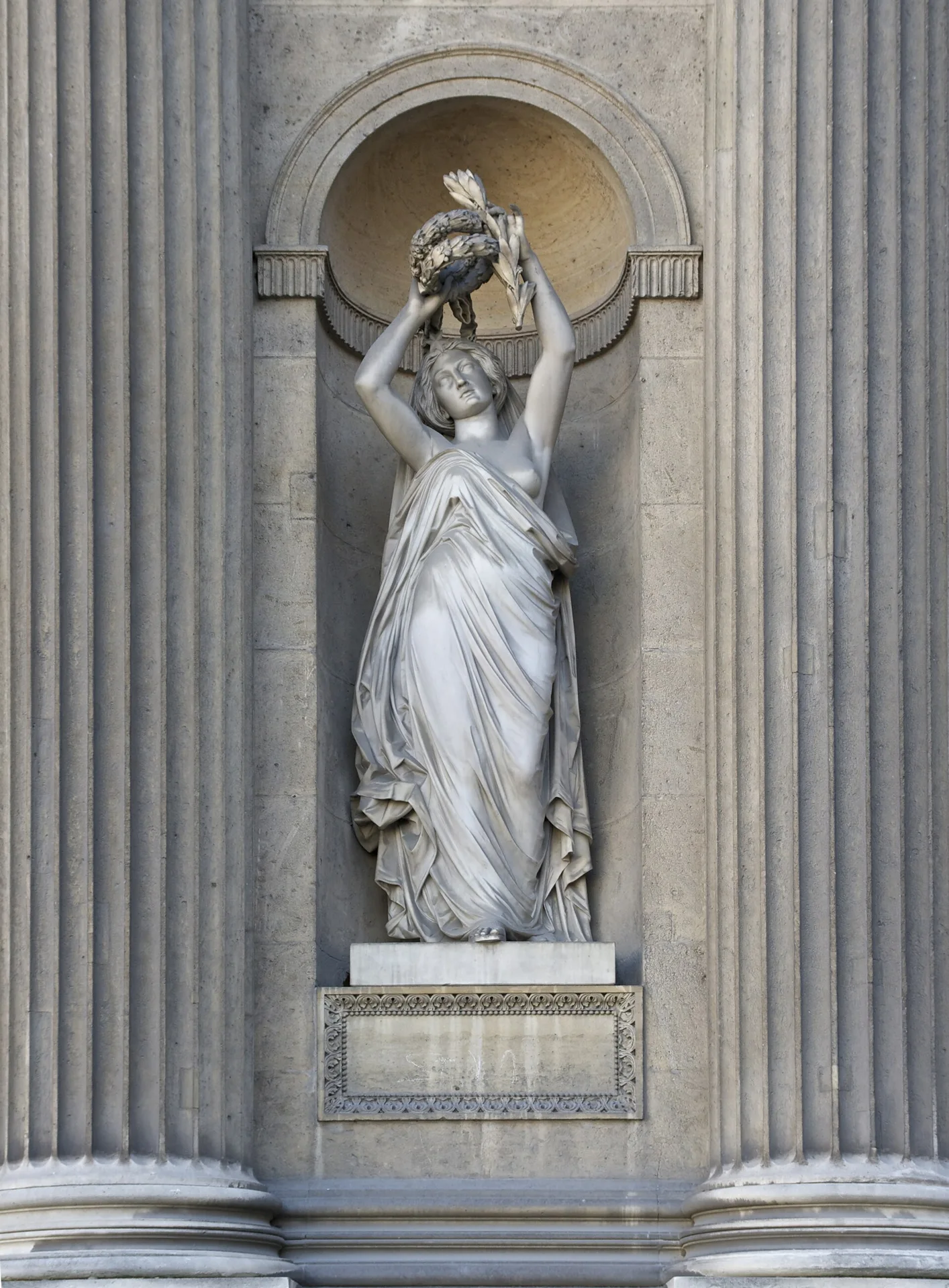
A figure within a wall
The niche-sculpture photograph narrows the frame. Architectural edges and the recess still surround the body. The figure belongs to a façade rather than an isolated gallery display.
Compare it with the courtyard overview. A large building can appear as an even band of texture, then become close enough to notice a hand or fold. The detail remains part of the larger structure even when the camera temporarily singles it out.
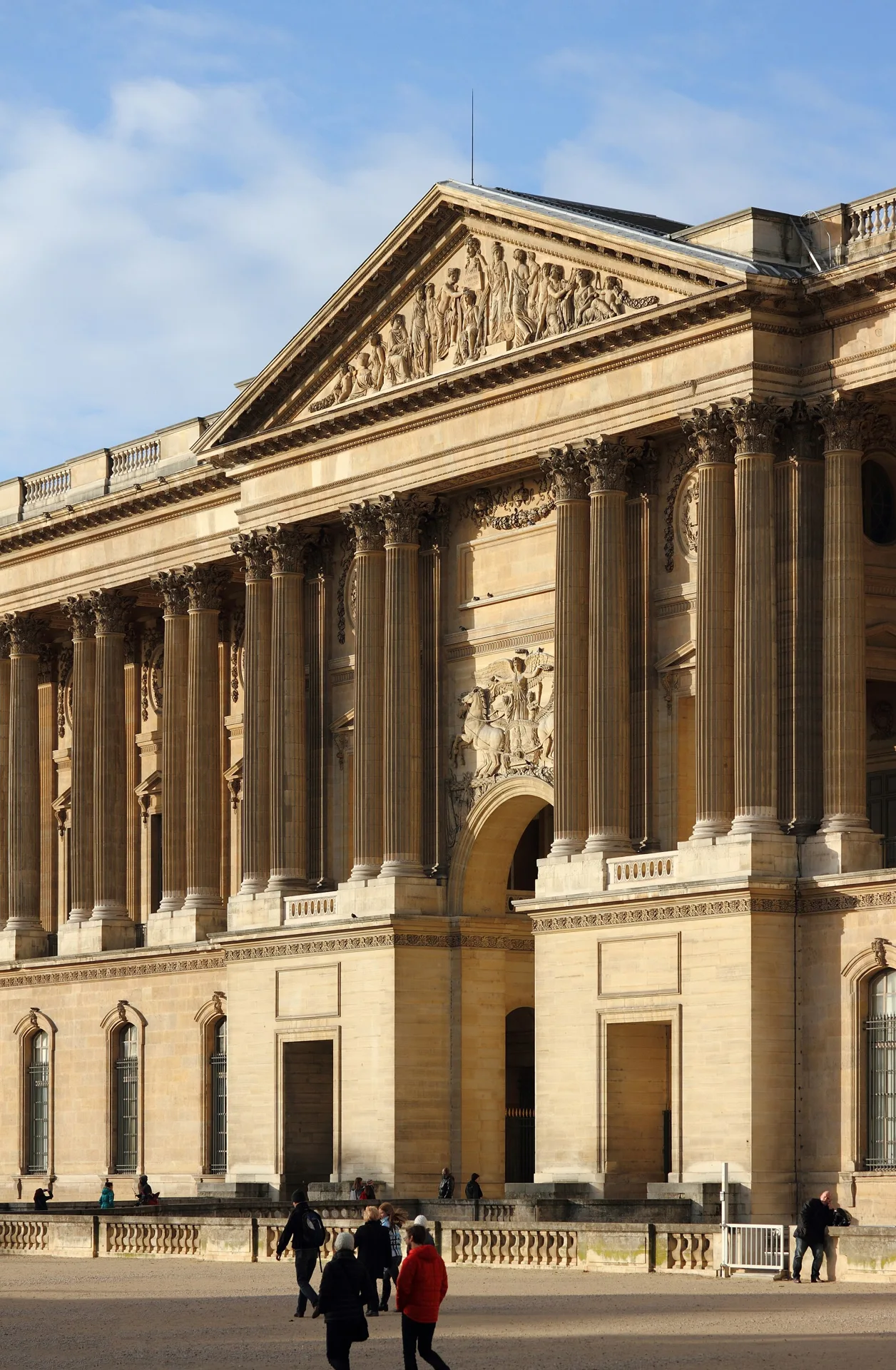
Columns make intervals visible
The eastern colonnade introduces another rhythm. Gaps and shadow distinguish the vertical elements. The eye can follow a column upwards or move sideways through successive intervals.
Architectural terminology is not essential to begin. Compare the width of solids and openings, then notice the darker wall behind. These changes of depth give the frontage thickness rather than the appearance of a flat surface.
Palace and admission information
The Louvre organises palace exploration separately from visitor preparation. One helps interpret spaces; the other covers entrances, booking and current arrangements. Seeing a monumental frontage does not automatically establish the appropriate entrance.
Exterior photographs easily obscure this distinction. Camera position, direction and permitted passage are different kinds of information. Use current official guidance for an actual visit; the photographs here support attention to enclosure, spacing and surface detail.
The exterior deserves its own time
Before entering a museum, its surroundings can feel like an interval to get through. Comparing courtyard, figure and colonnade gives the exterior a sequence of observations of its own, without relying on a list of celebrated paintings.
The images do not establish continuous courtyard access or guarantee that every area is unrestricted. They offer a way to change scale: read the space framed by a building, then see how a particular detail participates in it. That attention to distance remains useful inside a gallery.
References
These sources inform the essay’s historical and local context. Its observations and interpretations are original to WalkThere.
Musée du Louvre
The Louvre palaceThe museum’s official guide to its palace spaces and architecture.
Musée du Louvre
Visit the LouvreCurrent entrance, booking and access guidance, separate from exterior observation.
More journey background
Related journey sources
- The history of the Hôtel de Ville in seven dates — City of Paris
- All about Paris City Hall — City of Paris
- Notre-Dame: free admission and reservations — Notre-Dame de Paris
- Reopening of Notre-Dame de Paris — Paris je t’aime
- A unique set of stained-glass windows — Centre des monuments nationaux
- History of Sainte-Chapelle — Centre des monuments nationaux
- Sainte-Chapelle visitor information — Centre des monuments nationaux
- Pont Neuf: the oldest bridge and a refuge for birds — City of Paris
- Tour Saint-Jacques — City of Paris
- Marché aux fleurs Reine Elizabeth II — City of Paris
- Square du Vert-Galant — City of Paris
- Pont des Arts — City of Paris