
Ghent’s Gravensteen: the castle that became a cotton mill
Move between waterside walls, a close window study and the street entrance, reading industrial use alongside the familiar castle outline.
Ghent Old TownObservation essay
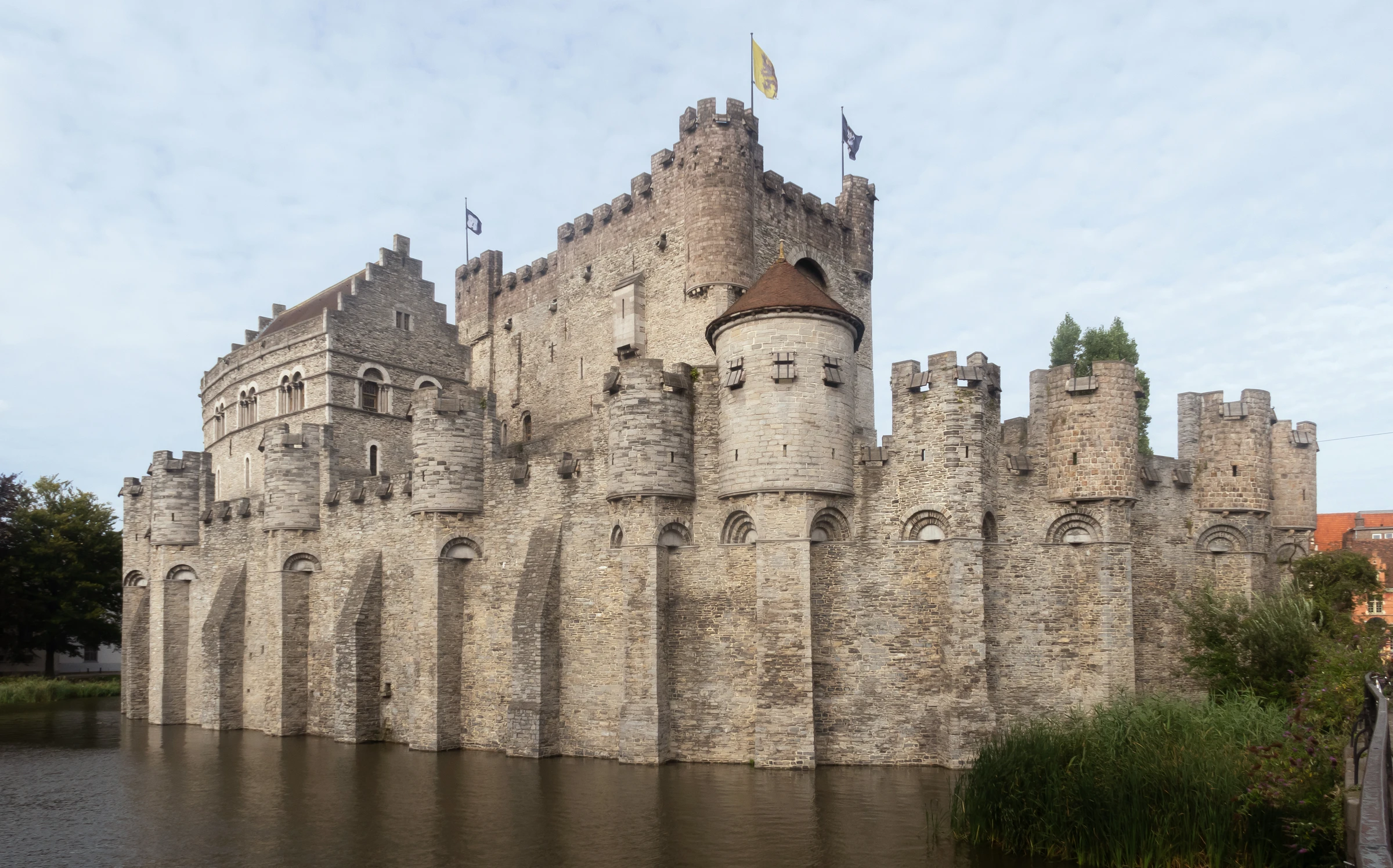
The walls seem to tell one continuous story
From the water, projecting towers and repeated battlements form a coherent boundary. The keep dominates behind them. An open foreground makes the masonry easy to read as a single castle.
That persuasive appearance cannot explain former room divisions or later work on the structure. Keep the distant impression in mind while reading its history of use; the intact outline is only a starting point.
A cotton mill changes the questions
Visit Gent records private ownership from the late eighteenth century, a cotton mill in 1807 and accommodation for roughly fifty workers’ families in outbuildings. Production and domestic needs entered a space associated with defence.
This raises practical questions about entrances, handling goods and separating work from accommodation. The photographs do not locate individual processes. No arbitrary window should be assigned to a spinning room, even though the industrial use changes how the whole building can be understood.
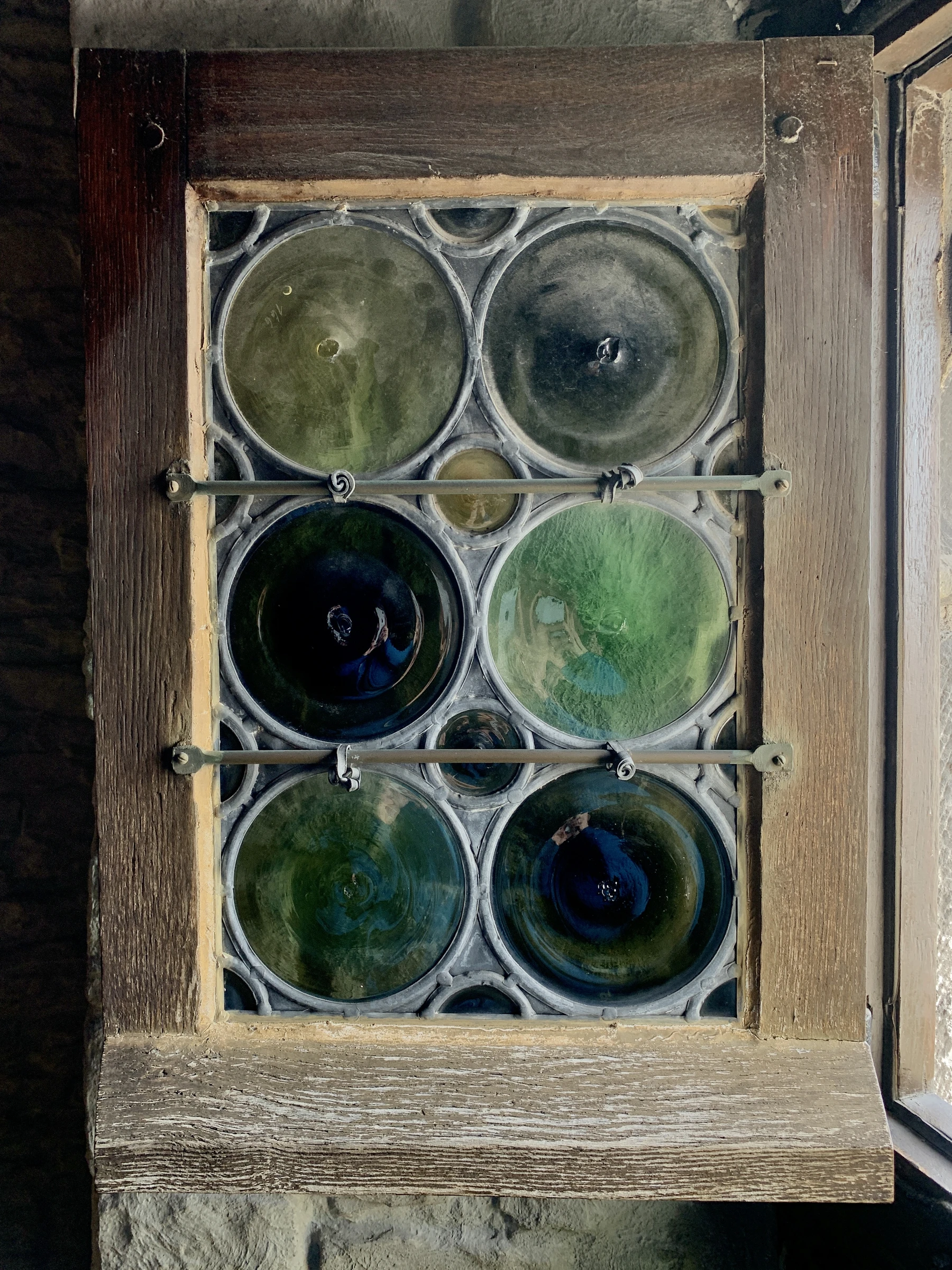
A window reduces the scale of attention
The close photograph shows round panes, a wooden frame and horizontal metal supports. Variations in glass and worn wood replace the complete silhouette. This small fragment scarcely establishes the shape of the tower outside.
Look at how the materials meet and how light passes through them. An old appearance cannot establish a twelfth-century date, nor can every mark be attributed to factory use. Dating requires evidence beyond visual texture.
Restoration belongs to the later history
The tourist office describes deterioration after the factory and residents left, followed by restoration and growing visitor attention around the 1913 world exhibition. The familiar castle appearance also reflects later choices about presentation.
Restoration need not be imagined as a simple return to one past moment. Looking only for a medieval composition can obscure later uses. Without comparative surveys, this article cannot identify individual replacement stones; the photographs can open questions rather than settle them.
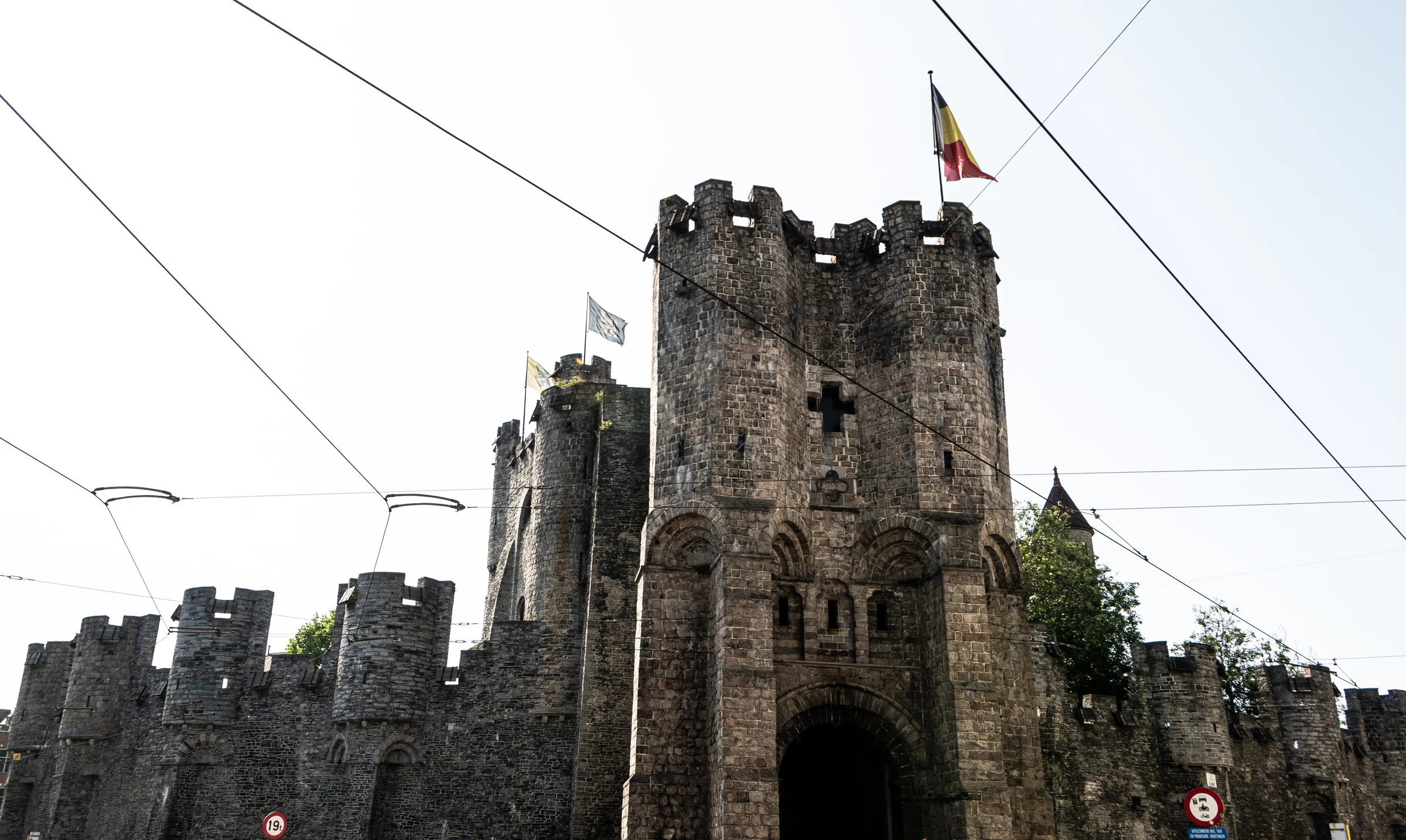
Overhead wires return the entrance to the street
In the entrance photograph, wires cross the sky and traffic signs remain below the deep doorway. Backlighting darkens the stone. Modern circulation and monumental masonry share the same frame.
The waterside view makes the castle seem self-contained; this one places it beside a working street. The retained wires and signs help explain the camera position rather than merely interrupting a historic composition.
Change the viewing distance once more
Visit Gent includes the distant castle among the views from St Michael’s Bridge. Seeing it there and then near the gate offers two scales: a landmark in a wider cityscape and an entrance someone must actually pass through.
These three photographs do not show mill machinery, workers’ homes or a complete indoor route. Consult current visitor arrangements for admission. When describing a preserved castle, consider which parts are visible and which earlier uses still need a written account.
References
These sources inform the essay’s historical and local context. Its observations and interpretations are original to WalkThere.
Visit Gent
Castle of the CountsOfficial account of private conversion, cotton production, workers’ housing and restoration.
Visit Gent
St Michael’s BridgeContext for the distant castle within the panorama from St Michael’s Bridge.
More journey background
Related journey sources
- St Bavo’s Cathedral — Visit Gent
- Ghent Belfry — Visit Gent
- Korenmarkt — Visit Gent
- Gerald the Devil’s Castle — Visit Gent
- St Nicholas’ Church — Visit Gent
- Graslei and Korenlei — Visit Gent
- Patershol — Visit Gent