
Gabriel’s Wharf: the temporary shops that became familiar
Garage units, added shop fronts and painted windows made a place to pause on London’s South Bank. Three older photographs reveal a temporary use with a long everyday life.
London Westminster & South BankObservation essay
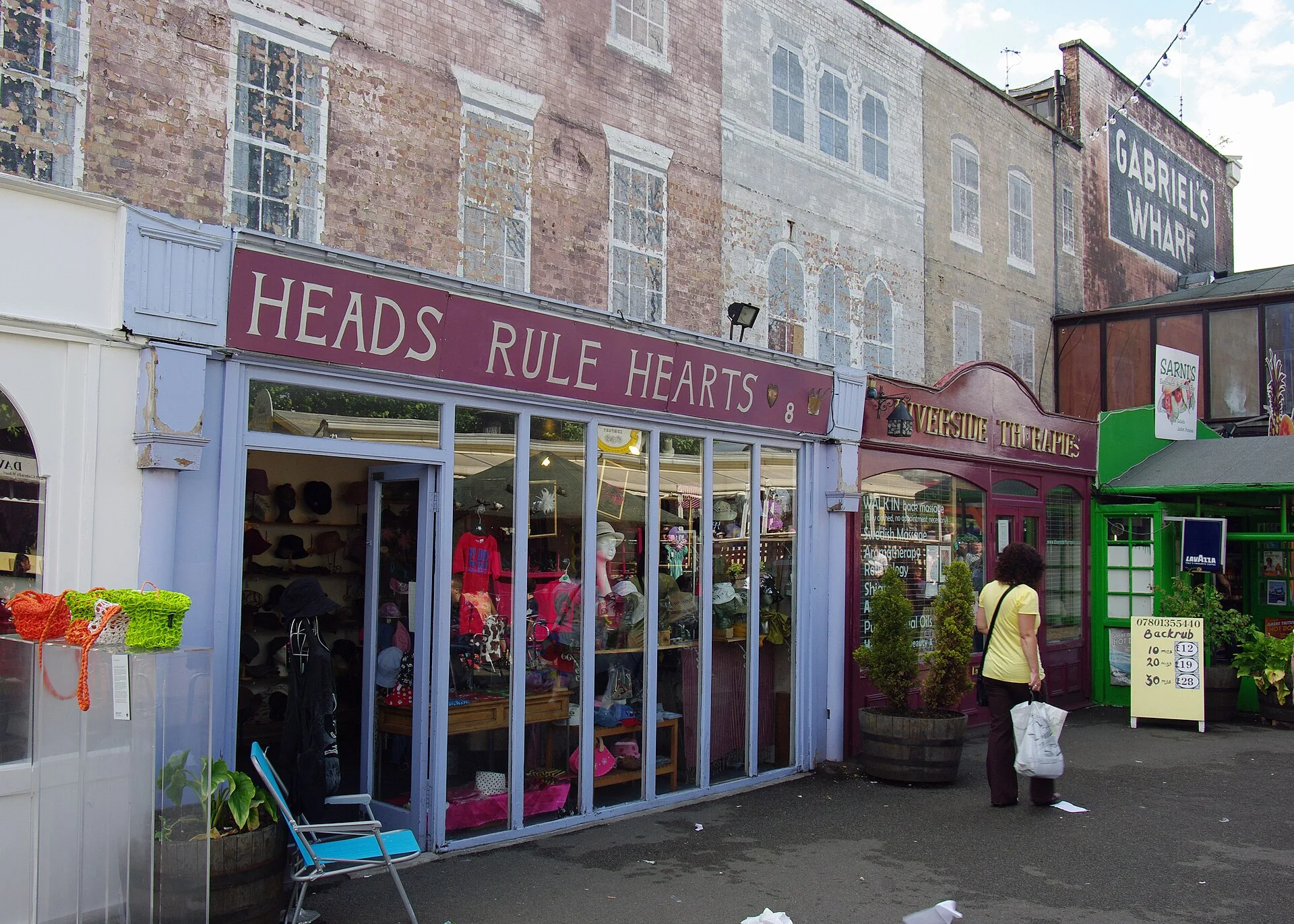
A window is closer than a skyline
In the 2009 photograph, a hat shop carries a dark red sign. Beside it, another business has different lettering and a curved frontage. A shopper pauses with bags; a folding chair stands close to a doorway. Reflections, pots and shelves offer plenty to look at within a few steps.
The South Bank has large silhouettes that help people navigate from afar. These shops shorten the distance. Lettering asks to be read close up and a window rewards a sideways glance. They give a riverside walk somewhere to pause before the next famous building comes into view.
How a garage becomes a shop
Coin Street records a warehouse site later used as a construction compound, opened to the public in 1988. Designer studios occupied factory-built garage units with shop fronts added. The photograph’s variety begins to make sense as a series of adaptations to relatively modest structures.
The important changes happen where a unit meets a passer-by. A door position, a patch of glazing and the height of a sign affect what someone can see inside. Similar underlying rooms acquire different faces. Their simple construction remains behind the effort of each frontage to attract attention.
The windows on the wall
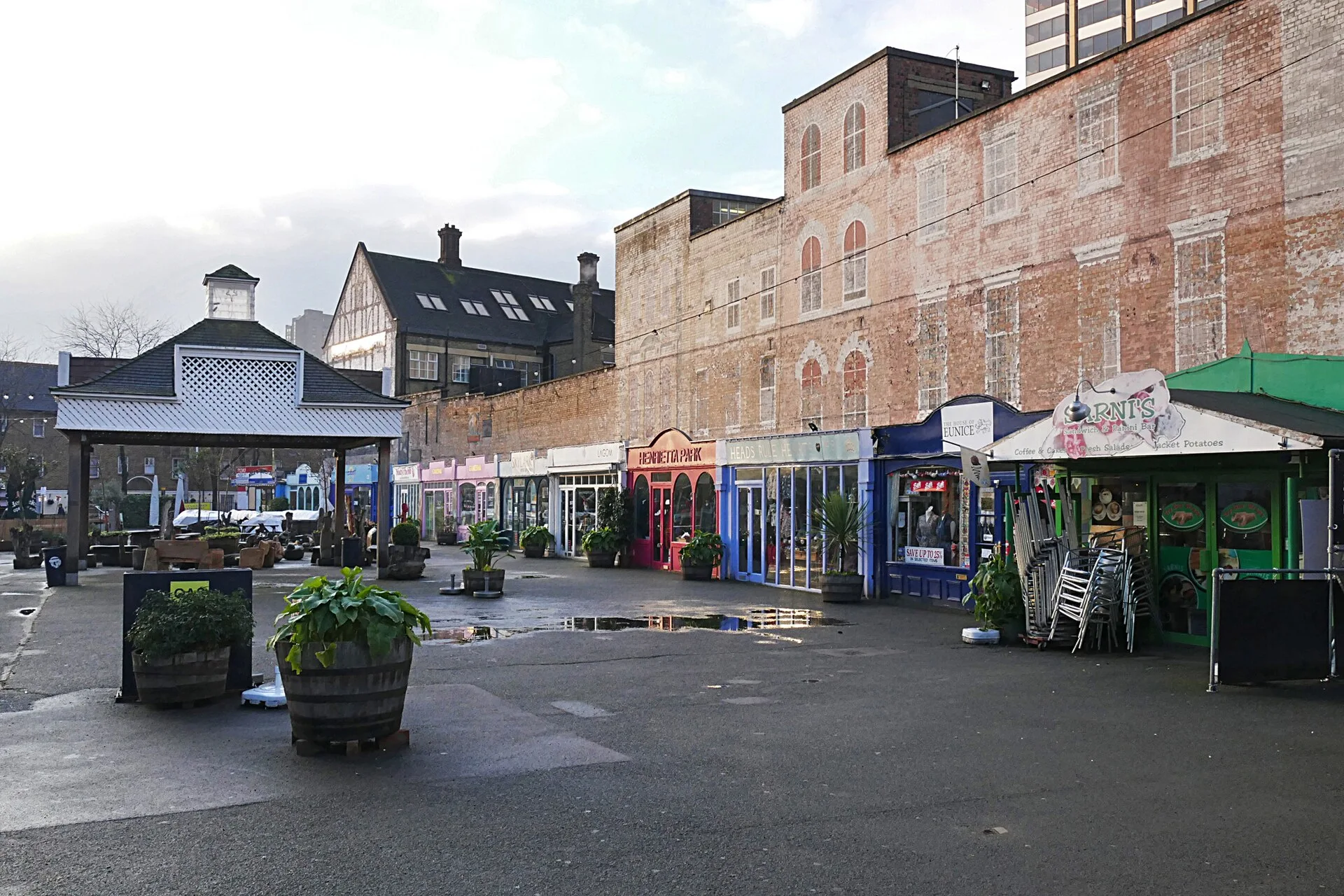
Above the small shops, a high wall carries patterns of windows and brickwork. Coin Street explains that the blank London Studios wall received a trompe-l’œil painting. In the photograph, its painted openings operate at a different scale from the real shop doors below.
The painting adds no rooms and makes the wall no thinner. It does change how the open ground feels enclosed. Individual businesses supply the foreground while the wall gives them a backdrop. The courtyard acquires something of a stage, rather than appearing to sit against the back of another building.
A winter gap in the activity
The January 2016 photograph steps back into the yard. Water lies on the ground and some chairs are stacked. With less activity, the distances between planters, shelters and entrances become easier to see. The shops stand close together without occupying all the space between them.
That space can disappear from descriptions of a commercial destination. Someone can pause before choosing a shop, or simply examine a window and continue to the river. The image cannot explain the businesses’ finances. It can preserve a question about how much room remains available without an immediate purchase.
The riverside has a community ledger
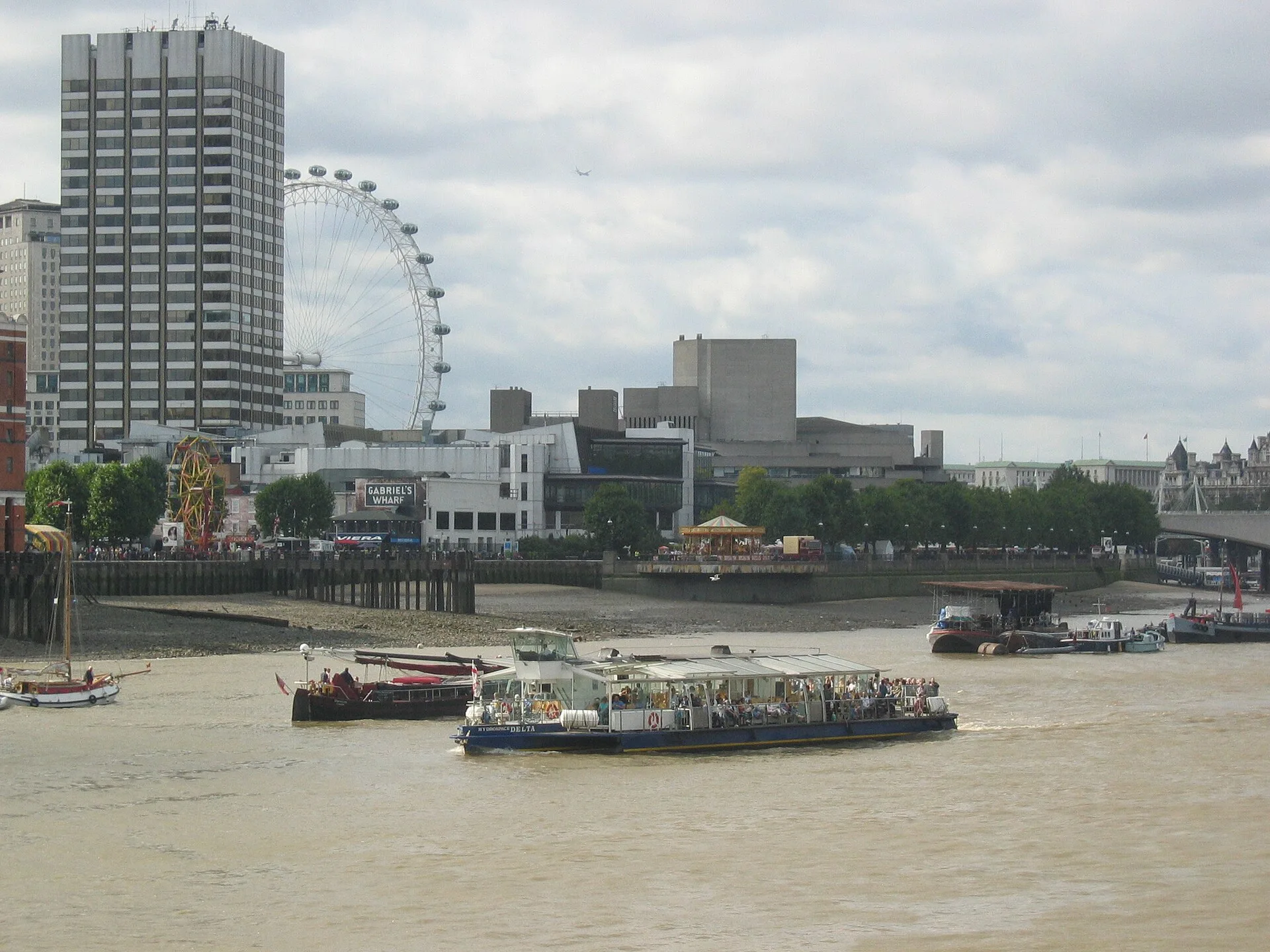
The 2004 river photograph places this part of the bank within a wider city. Boats and water occupy much of the frame; the shops recede. Keeping an appealing riverside place in use also involves income and long-term decisions. Coin Street links commercial revenue with housing, gardens and family services.
Who manages the ground, where income goes and what use comes next all shape everyday access. A visitor might stay half an hour; a resident lives with successive decisions over years. They meet on the same path with different amounts of time invested in its future.
Temporary can leave a lasting question
As of October 2026, these images need a clear date boundary. Coin Street’s statement committed to keeping the previous form open until 27 September 2026. It says the units have reached the end of their life and a new meanwhile use is being developed, without specifying its form. The old signs are historical evidence, not a current shopping guide.
An arrangement begun in 1988 lasted long enough to become familiar. After change, colour and resemblance will be only part of what matters. Can another design retain the easy relationship between doorways and open ground? Even a chair resting beside a wall can leave a useful question for the next plan.
References
These sources inform the essay’s historical and local context. Its observations and interpretations are original to WalkThere.
Coin Street
Development of Gabriel’s WharfDocuments the 1988 opening, garage-unit studios and trompe-l’œil backdrop.
Coin Street
Gabriel’s Wharf: a new meanwhile useThe statement on the previous form through 27 September 2026 and a new meanwhile use.
More journey background
Related journey sources
- Architecture of Westminster Abbey — Westminster Abbey
- Visit the Abbey — Westminster Abbey
- Modern martyrs above the west entrance — Westminster Abbey
- Westminster Bridge listing — Historic England
- Conservation of Elizabeth Tower and Big Ben — UK Parliament
- Parliament Square Garden — Greater London Authority
- Southbank Centre history — Southbank Centre
- Royal Festival Hall — Southbank Centre
- Access maps and floor plans — Southbank Centre
- Undercroft Skate Space — Southbank Centre
- Oxo Tower Wharf development and history — Coin Street
- Tate Modern Project archive: administrative history — Tate Archive
- Visit Tate Modern — Tate
- Bridges: Millennium Bridge — City of London