
Dotonbori: Why the Signs Grow Larger Than People
Read Osaka’s giant signs through its entertainment history, Ebisu Bridge, the riverside and Hozenji Yokocho, where businesses address pedestrians at different scales.
Osaka Namba & DotonboriObservation essay
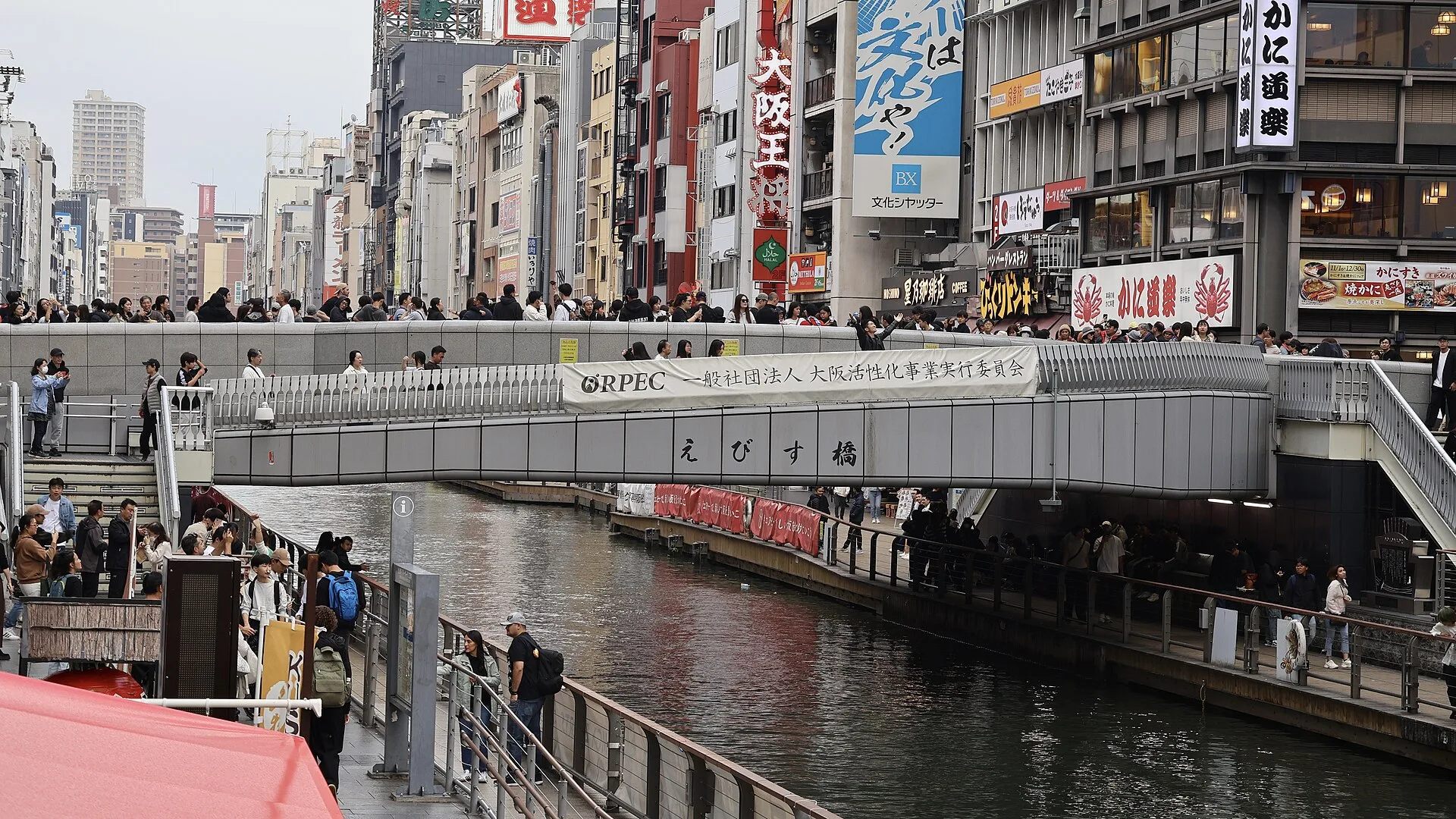
A crab can speak before the shop does
Dotonbori’s signs do more than spell a name. Food and figures become projecting objects that identify a business before anyone enters it. A passer-by may recognise what is offered, or at least remember a form distinct from the next shop.
Small lettering invites close reading; a large silhouette seeks recognition across crowds and competing images. Colour, outline and projection all contribute. The street cannot be explained through its buildings alone.
The entertainment district predates the night photograph
Osaka’s tourism account connects the area with canal excavation and its later development around theatres, kabuki and teahouses. Present-day food and entertainment occupy a district with a longer history of attracting leisure visitors.
That does not make every restaurant an Edo-period survivor or every sign a reconstruction of a theatre frontage. Continuity of use and change of form are different ideas. The recurring question is how businesses persuade people to arrive, remain and spend time.
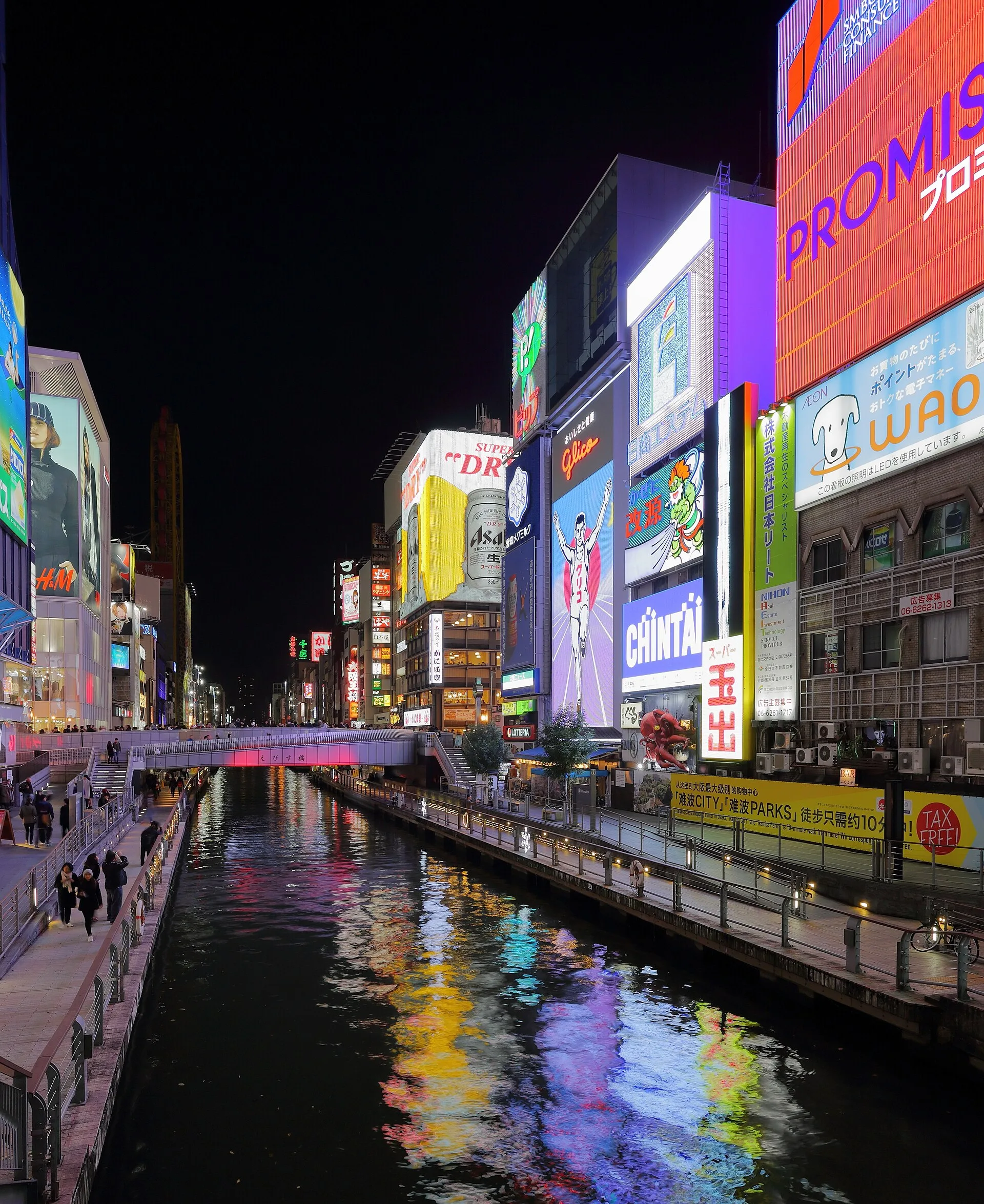
The bridge offers more than one camera position
Ebisu Bridge brings dispersed images into a relatively open view across the water. Separate façades can easily become one bright backdrop in a photograph, even though they belong to different businesses.
The deck still serves people crossing, waiting and looking. Its attraction does not require everyone to occupy the same photographic point. A different position can reveal how signs overlap and how the street actually accommodates movement.
The riverside turns a frontal view into a sequence
From the bridge, the opposite bank resembles a frontal composition. Walking beside the canal makes signs and windows pass successively at an angle. Reflections add another layer, changing with water rather than occupying fixed positions.
Night photographs also depend on exposure and capture time. Signs and tenants may later change. An image can record how commercial graphics enter a river view without serving as today’s business directory or a promise of identical lighting.
Hozenji Yokocho is commercial at another scale
Osaka’s tourism description relates the alley’s origins to stalls serving worshippers and identifies restaurants and bars among its uses. It is not a business-free alternative to Dotonbori. It addresses people at a closer distance.
Large signs seek recognition from afar; smaller entrances require attention nearby. Religious use also continues alongside dining. Declaring one setting authentic and dismissing the other obscures how several kinds of trade and devotion coexist in the same district.
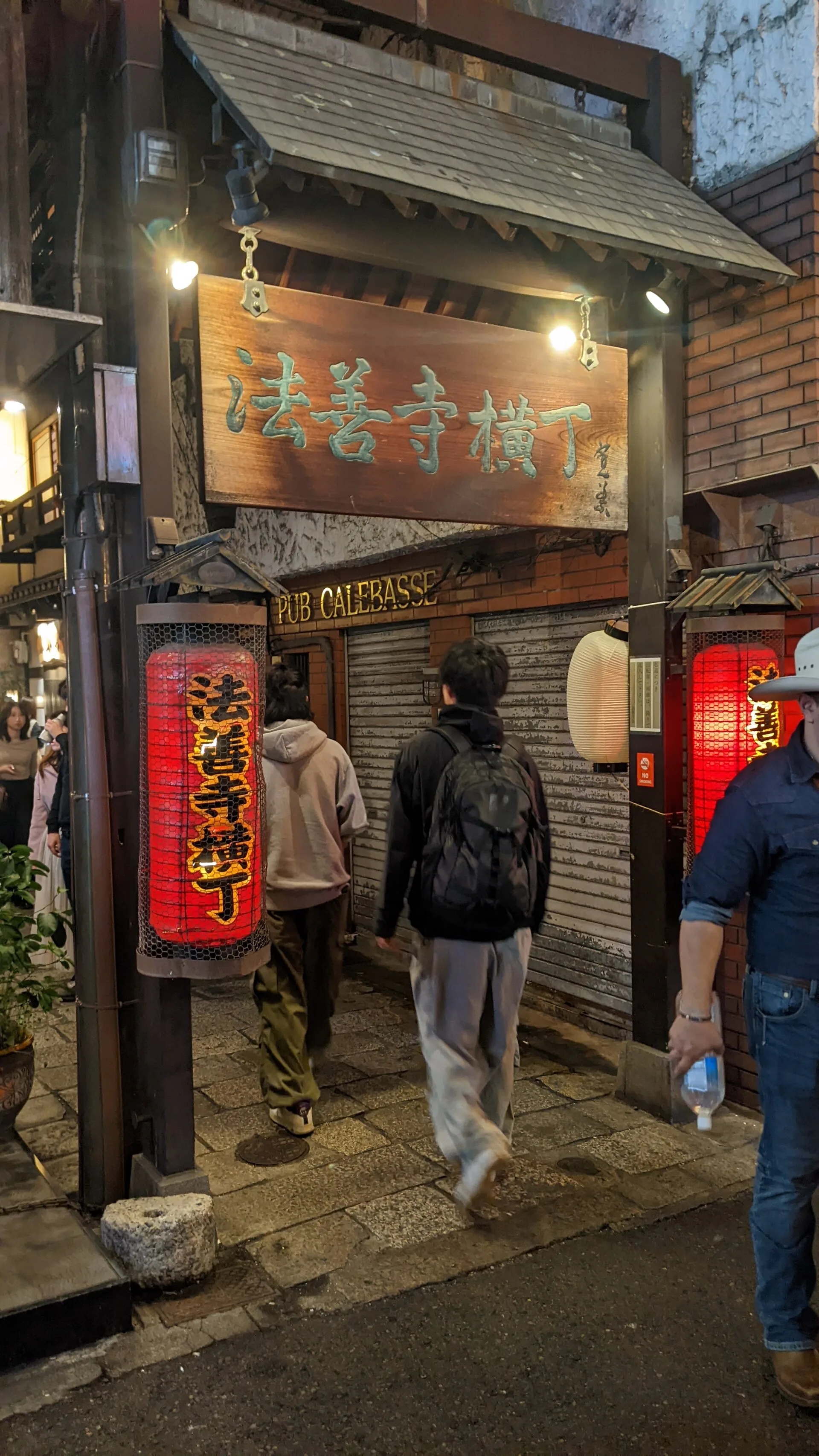
What remains besides a meal
Food can anchor the visit without turning it into a restaurant ranking. Notice what a sign communicates, which façades the bridge places together, how the riverside changes their angles and how a narrow lane brings entrances closer.
Those relationships give the excitement a structure. A large crab becomes a business’s bid for attention, and a small doorway becomes another way of addressing the street. Connecting the two scales makes Dotonbori more particular than a general memory of neon.
References
These sources inform the essay’s historical and local context. Its observations and interpretations are original to WalkThere.
Osaka Convention & Tourism Bureau
DotonboriBackground on Dotonbori’s theatre-street history and culture.
Osaka Convention & Tourism Bureau
Tombori RiverwalkOfficial context for the riverwalk and waterfront setting.
More journey background
Related journey sources
- Ebisu Bridge — Osaka Convention & Tourism Bureau
- Hozenji Yokocho — Osaka Convention & Tourism Bureau
- Kuromon Market — Osaka Convention & Tourism Bureau