
La Boqueria: a roof over many small businesses
Read Barcelona’s Boqueria through its metal structure, entrance decoration and a sweet stall, with three different photographs and official architectural history.
Barcelona La Rambla & Port VellObservation essay
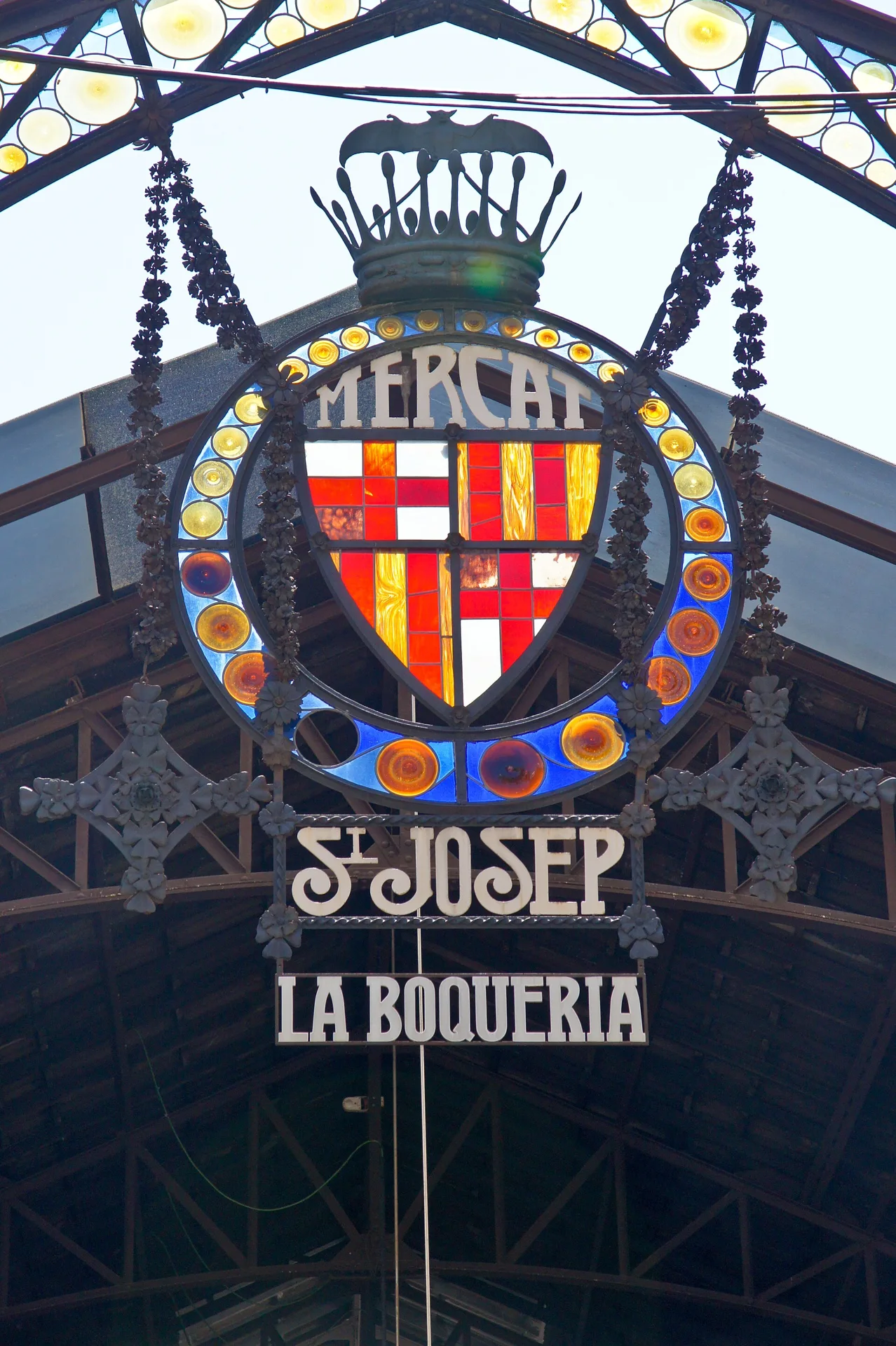
Decoration in front of structure
Coloured circles follow the entrance arch while a crest and market lettering occupy its centre. Behind them, dark beams and diagonal members extend into the building. Decoration and the structure covering the market overlap in the same photograph.
Food usually takes attention first. Looking up reveals something shared across separate businesses. Each stall supplies its own display and lighting; the roof passes over those divisions and holds a larger space together.
Two dates, different stages
Barcelona’s tourism authority dates the market opening to 1840 and completion of its metal cover to 1914. Catalonia’s heritage account also describes the later metal and glass roof. Establishing a market and giving it this covering were distinct stages.
A place of exchange need not begin as one finished architectural object. Shelter, light and structure can change as its uses develop. Separating those moments makes the market easier to understand as an evolving arrangement rather than a single container built all at once.
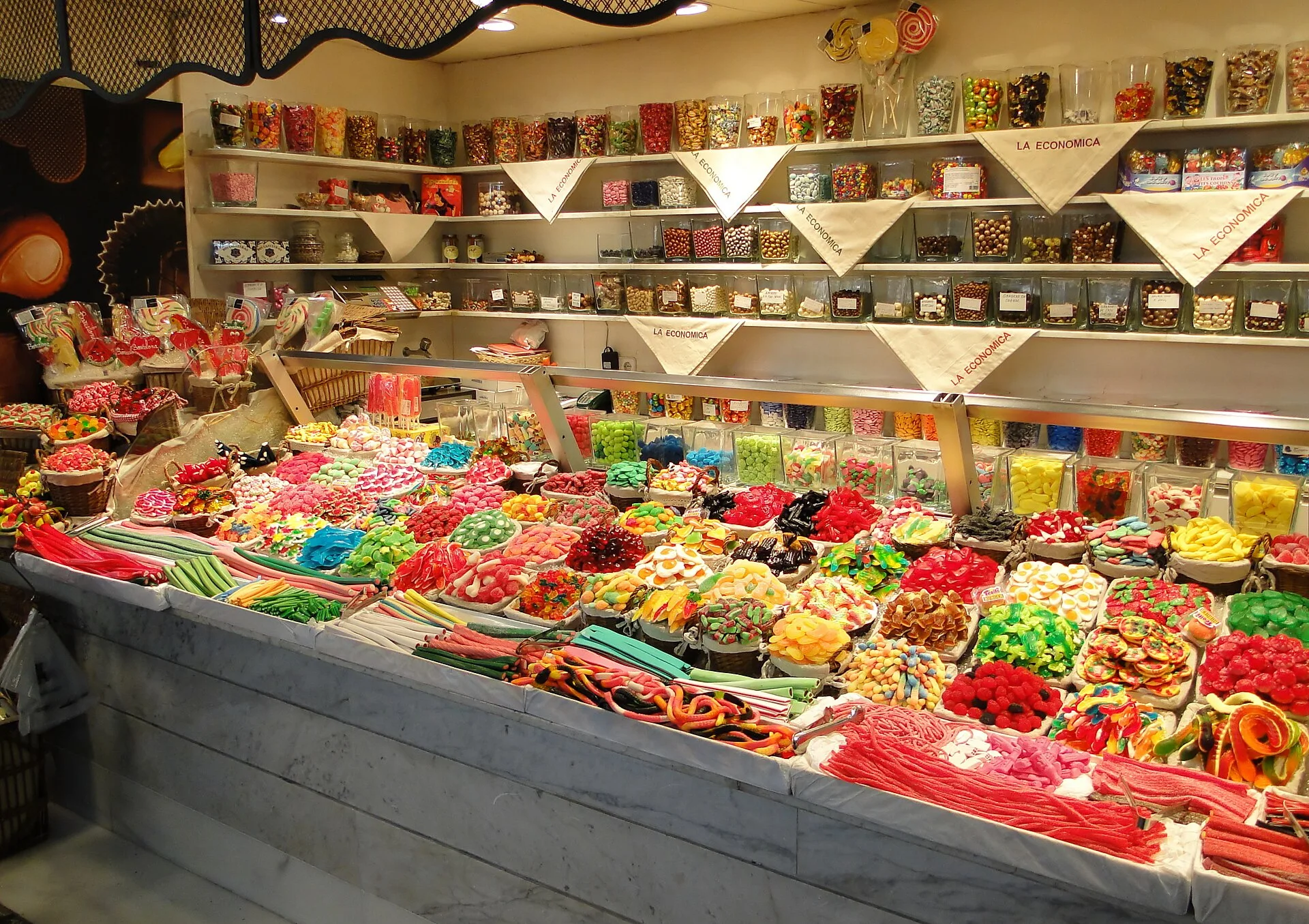
A stall brings the scale closer
The sweet-stall photograph shows jars along shelves, coloured groups across the counter and triangular cloths hanging at the edges. It does not explain the whole hall. It records how one business organises a small field of attention.
Containers at the back can be recognised from a distance; smaller piles near the front invite closer selection. Shelving, counter and lettering occupy different layers. Similar practical tasks allow individual choices, accumulating variety beneath the common roof.
Empty space has work to do
Customers pause at a counter while others need to pass behind them. Buying and moving share a narrow strip of ground. A market plan therefore involves where people stand as well as how much merchandise can fit.
A visitor may choose the clearest photographic position without noticing that it also serves as a turning or departure space. Watching movement before stepping aside gives another way to understand how neighbouring stalls share a passage.
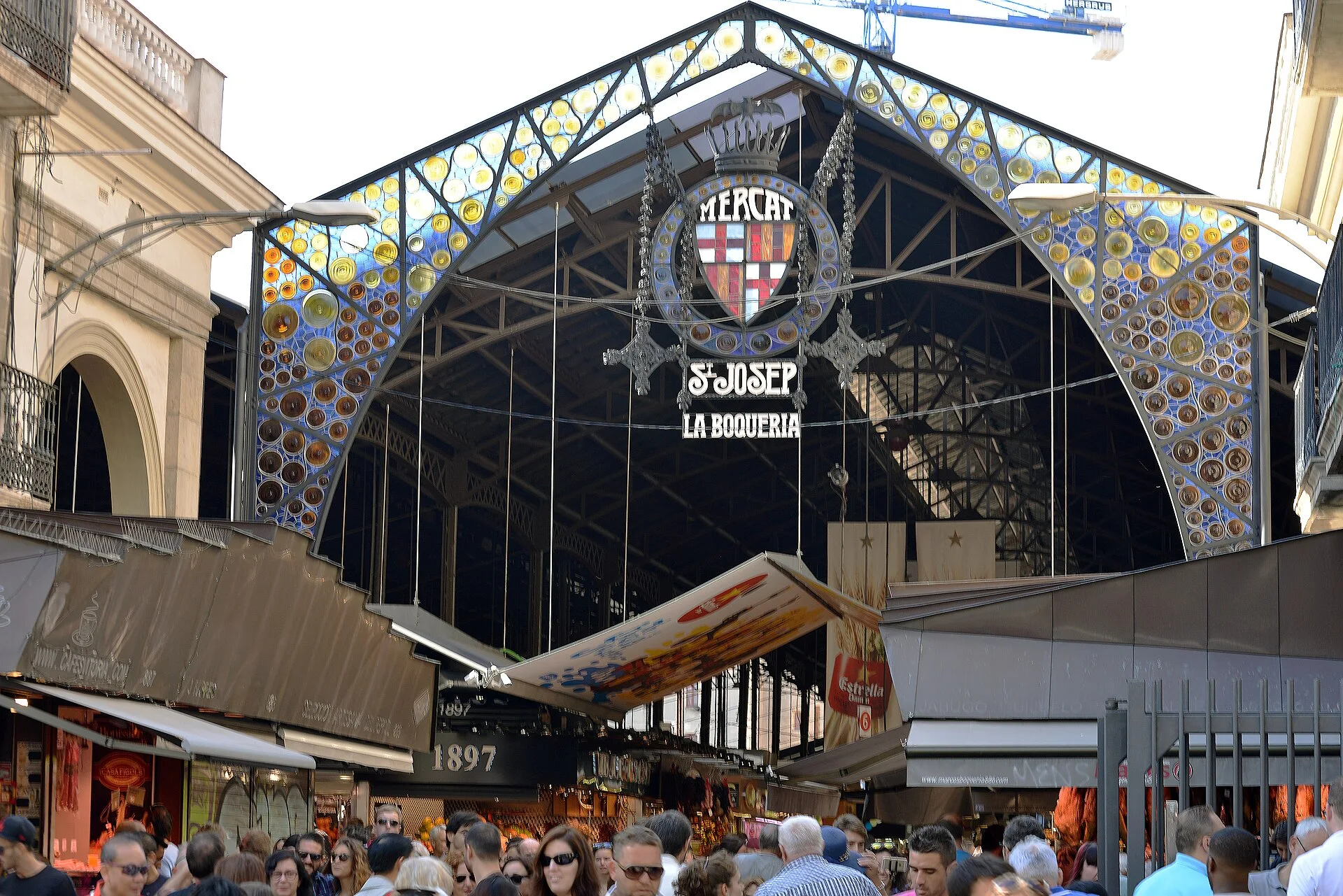
Shelter and light
The heritage account identifies metal and glass in the cover. Those materials describe a practical relationship: shelter needs support, while the interior still benefits from light. The entrance image catches bright street space meeting darker ground beneath the roof.
Notice bright areas beyond the beams and then the lighting supplied by individual stalls. A broad architectural environment meets many smaller illuminated displays. Part of the visual activity comes from attention moving between those different patches of brightness.
Back towards La Rambla
At the entrance, the market joins the street again. People arrive to buy, pass through or look around. The broad meeting of routes eventually narrows into the specific business of asking, choosing and paying at a counter.
These photographs retain their own dates rather than confirming current traders or prices. They offer a sequence for looking: shared roof, individual display, then the space allowing people to pause and pass between them. That leaves a more spatial memory than a list of foods alone.
References
These sources inform the essay’s historical and local context. Its observations and interpretations are original to WalkThere.
Barcelona Turisme
Boqueria MarketOfficial local account of the market opening and metal covering.
Generalitat de Catalunya
La Boqueria MarketHeritage context for the metal and glass cover and former convent site.
More journey background
Related journey sources
- Plaça de Catalunya — Barcelona Turisme
- History of La Boqueria — La Boqueria
- La Boqueria market — La Boqueria
- Plaça Reial — Barcelona Turisme
- Mirador de Colom — Barcelona Turisme
- 19th-century Barcelona — Barcelona Maritime Museum
- Rethinking Columbus Day — Smithsonian National Museum of the American Indian
- Port Vell — Barcelona Turisme
- Rambla de Mar — Port Vell
- La Rambla transformation — Barcelona City Council
- La Virreina Centre de la Imatge — Barcelona Turisme
- The history of the Liceu — Gran Teatre del Liceu
- Basilica of Santa Maria del Pi — Barcelona Turisme
- The Royal Shipyards of Barcelona — Barcelona Maritime Museum