
Barcelona: La Rambla from city square to harbour
Explore Barcelona through five chapters, fifteen credited photographs, nine local 360° scenes and four discoveries along La Rambla and Port Vell.
Begin the visual journeyPlan a real visit to Barcelona La Rambla & Port VellExplore 9 reviewed views along the routeGuided visual journey
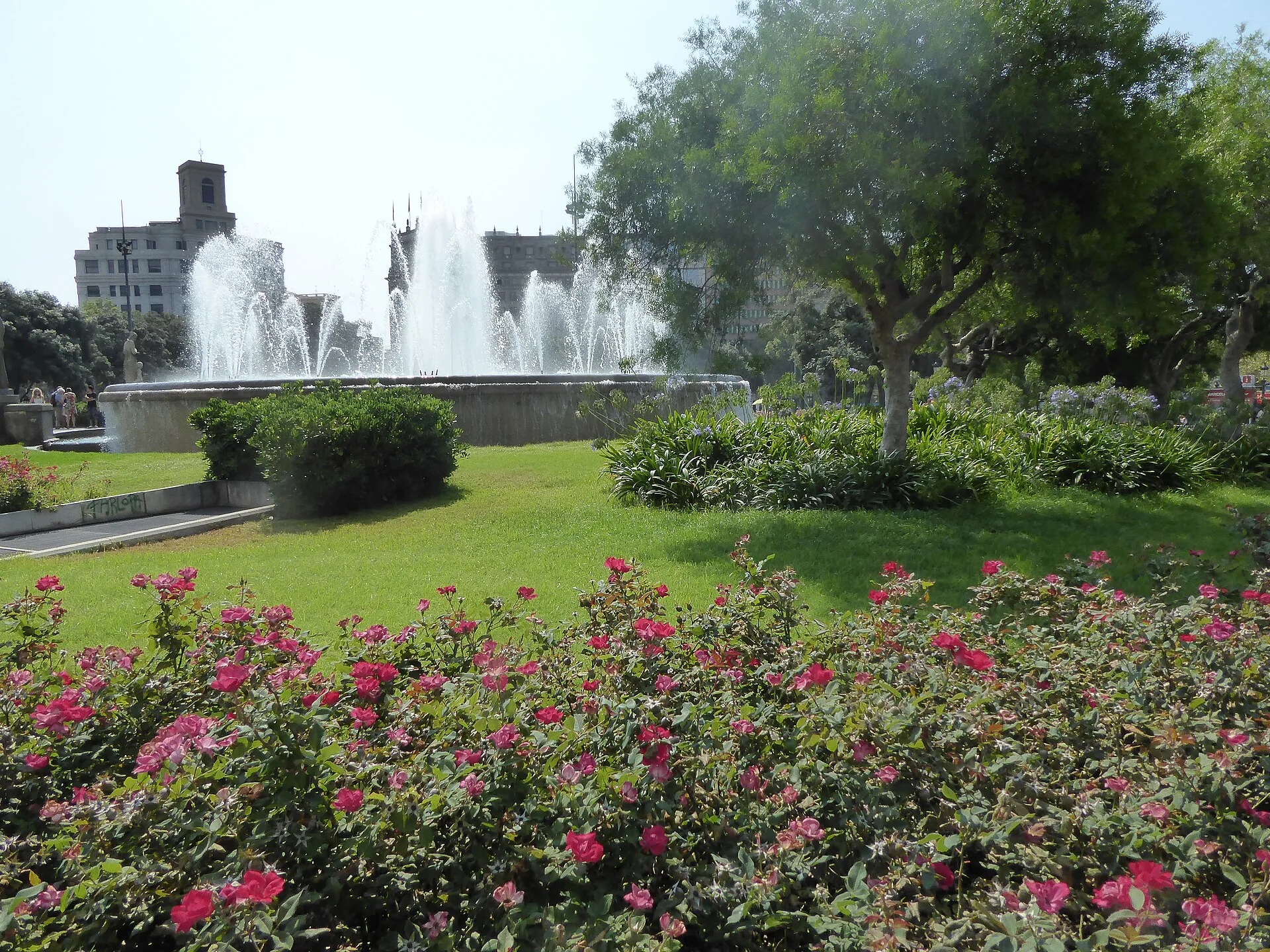
Plaça de Catalunya in July 2014 · Ardfern · CC BY-SA 3.0 · Resized and converted to WebP
Reading mode
Place stories to read at your own pace
Compare independent photographs from different dates and viewpoints.
Chapter 1 · A square at a city seam
Begin at Plaça de Catalunya
Begin with the broad photograph of a planted edge, then switch to the fountain and a single sculpture. The square is not one view: trees and water frame a quiet patch while surrounding streets and buildings pull the eye outwards. Barcelona Turisme describes Plaça de Catalunya as a meeting point between the old city and the Eixample, and dates its inauguration to 1927. It makes a useful starting point for seeing the change from a large open space to the narrower direction of La Rambla.
The images have their own 2014 dates. The November 2017 panorama is another moment and another viewpoint within the square; rotate and compare the three reviewed positions before returning. Planting, people and temporary arrangements can change. The sequence is a small local fragment, not a surveyed walk to the market.
Before leaving the square in the narrative, notice how fountains, trees and sculpture offer several scales of attention. La Virreina provides a separate discovery further down La Rambla, where a palace façade makes a very different edge to the street. Barcelona's current transformation project means real approaches may differ from the archived imagery.
Real-travel note
Dated independent imagery; check current access and works for a real visit.
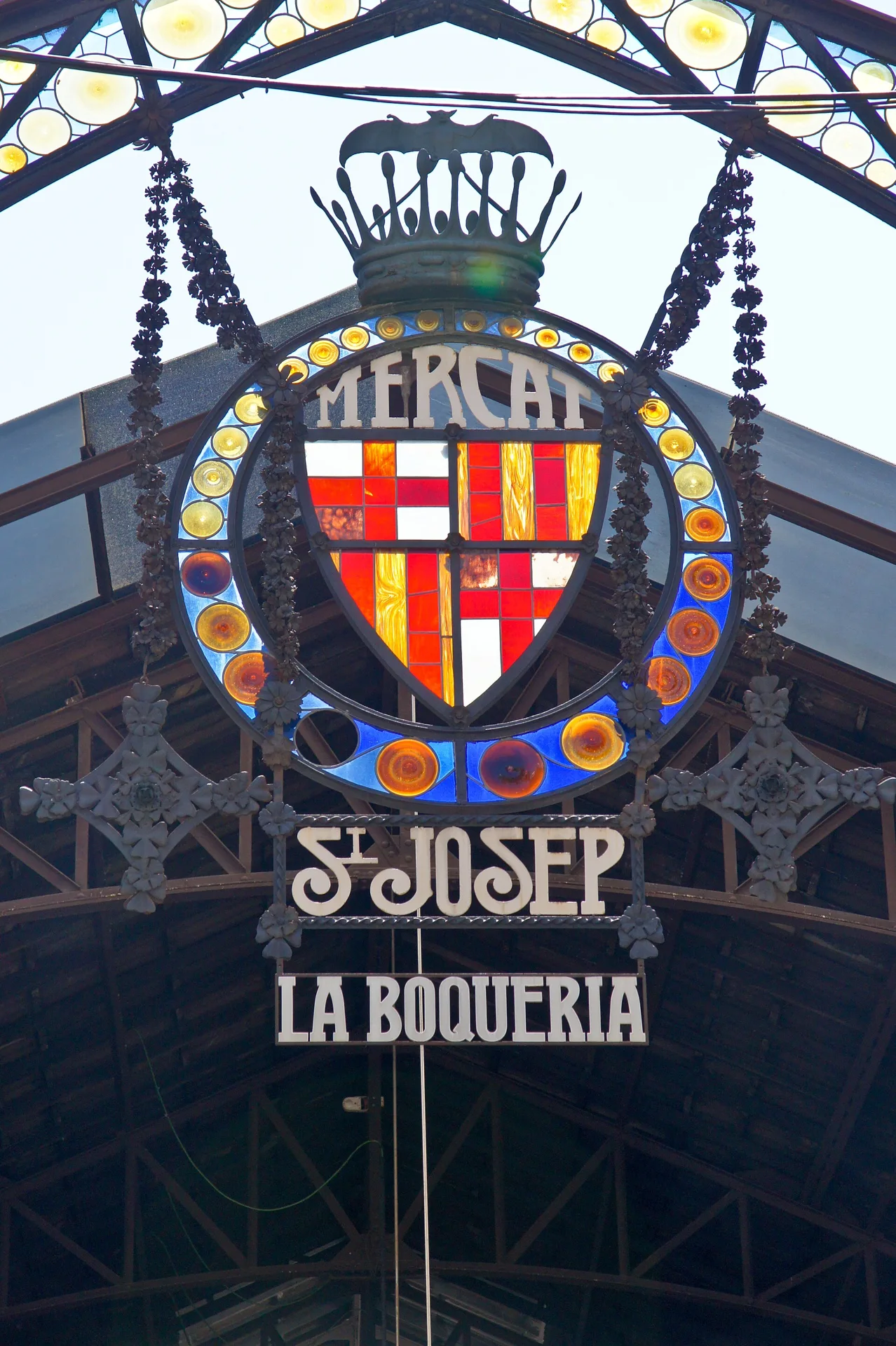
Compare independent photographs from different dates and viewpoints.
Chapter 2 · A threshold into the market
Look at La Boqueria from street and stall
La Boqueria has both a public street face and a dense interior. Start with the entrance crest and the wider roof photograph, looking for the metalwork that marks the change from Rambla to market. Then switch to the sweets photograph: it was taken inside in 2009, independently of the other views. Colour and repetition make one stall readable even when the whole market would be too busy to take in at once. Signs, goods and individual businesses are records of their photographs, not a current directory.
The market's own history dates the modernist entrance arch to 1913 and the roof to 1914. Those two layers turn the threshold into more than a gap in the street frontage. Look back at the roof after the closer crest: what seems decorative at one distance also announces the entrance from further away.
The August 2024 panorama offers seven linked street positions between the market and La Virreina; turn towards the entrance and compare the street edge. It does not provide a connected visit through the market or imply current admission. Check the market's own visitor information before a real visit and make room for shoppers and vendors. The Liceu and Plaça del Pi are separate discoveries nearby.
Read further: La Boqueria: a roof over many small businessesReal-travel note
Dated independent imagery; check current access and works for a real visit.
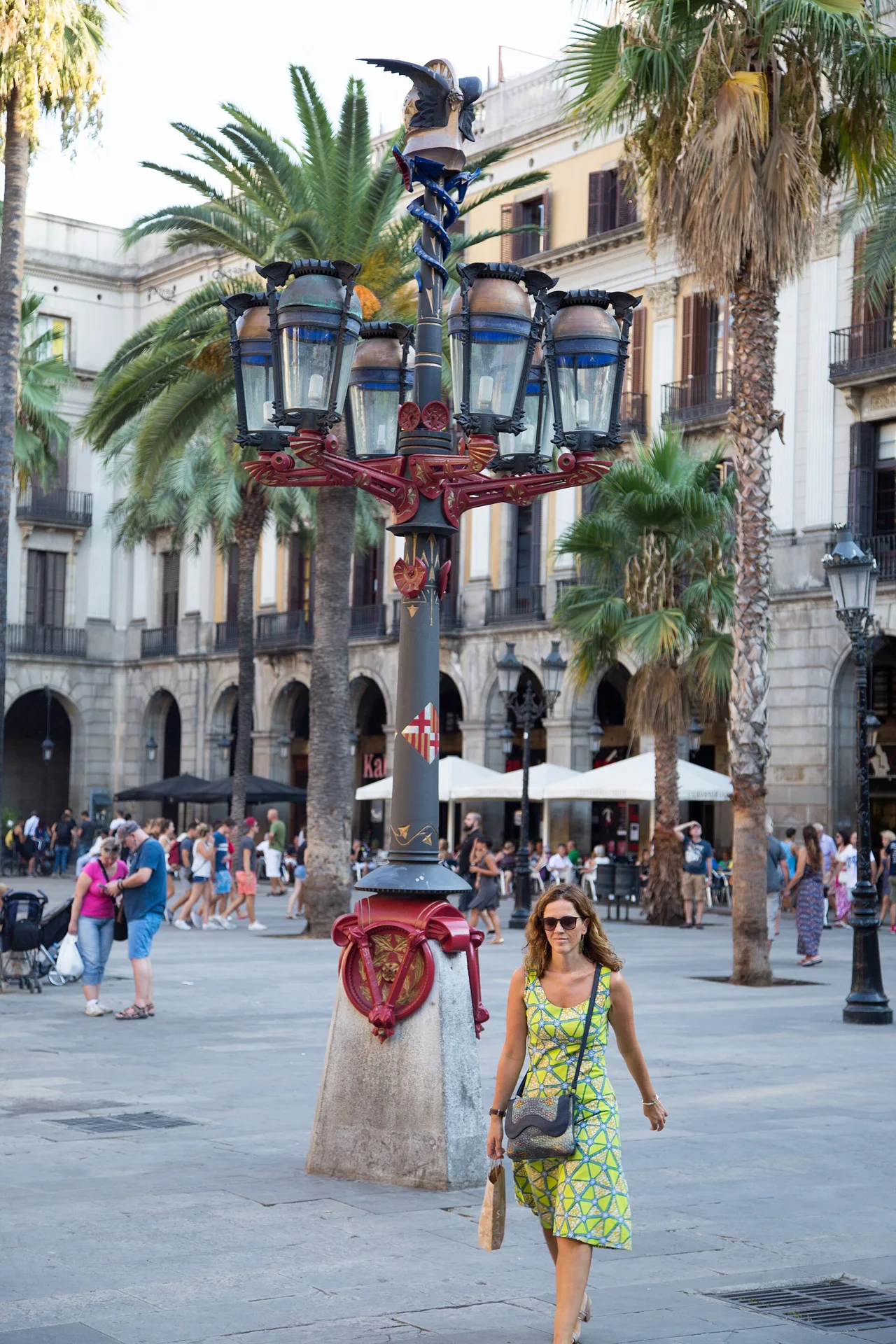
Compare independent photographs from different dates and viewpoints.
Chapter 3 · A room open to the sky
Step into the visual setting of Plaça Reial
After the market's crowded threshold, Plaça Reial opens into an urban room. Use the wider photograph to follow the repeating arcades and balconies, then move closer to the fountain and compare the separate street-side view. The palm trees interrupt the formal rhythm; the arcades give the square a recognizable edge. Each photograph has its own date and position, so changes in tables, signs and people are part of the record rather than a guide to current businesses.
Barcelona Turisme credits the square's design to Francesc Molina and identifies the fountain of the Three Graces and Gaudí's early lampposts. A planned royal statue was never installed. Look for the lampposts in the wider context rather than assuming every object arrived with the original plan: a square can collect layers of design and use over time.
The October 2021 panorama starts beside the square and has five reviewed local positions. Turn between the arcades and open space, compare the positions and return. The fragment does not supply a verified connection from La Rambla or cover every entrance. Use present pedestrian routes for a real visit, and keep outdoor dining and private entrances clear.
Real-travel note
Dated independent imagery; check current access and works for a real visit.
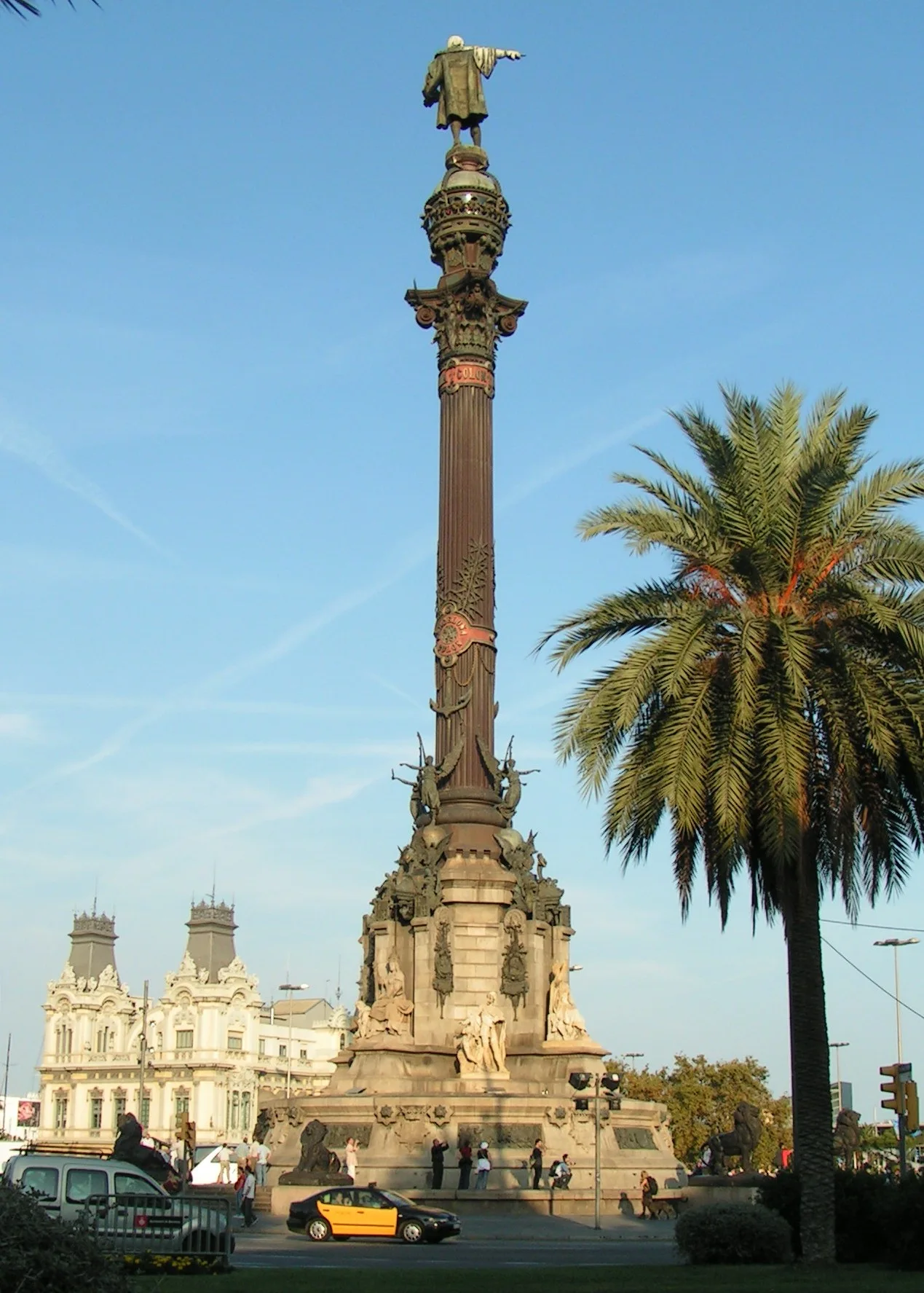
Compare independent photographs from different dates and viewpoints.
Chapter 4 · A monument and difficult histories
Read the Columbus Monument critically
The tall column shifts attention upwards, but its base and lions invite a slower reading. Compare the photographs of the shaft, sculptural base and lions: they are separate views from different years. In the August 2024 street panorama, rotate towards the monument and compare five nearby positions; traffic can interrupt the view, and the fragment does not establish a pedestrian crossing.
Barcelona Turisme dates the monument to the 1888 Universal Exposition. A monument is also a choice about public memory: it celebrates a historical figure while leaving many experiences outside the frame. The Smithsonian's National Museum of the American Indian emphasizes that Indigenous peoples already lived throughout the Americas and describes the devastating effects of colonization. Barcelona's Maritime Museum separately examines the city's nineteenth-century links with colonial economies and slavery. These sources ask us to look beyond the heroic figure on the column.
Pause over who is shown, who is absent, and how a high viewpoint can make a complex history seem like one story. The nearby Royal Shipyards offer a separate discovery about the city's maritime buildings. Do not infer current access to the monument or its lift from the photographs; check current information and crossings for a real visit.
Real-travel note
Dated independent imagery; check current access and works for a real visit.
Compare independent photographs from different dates and viewpoints.
Chapter 5 · The city meets the harbour
Finish at Port Vell and Rambla de Mar
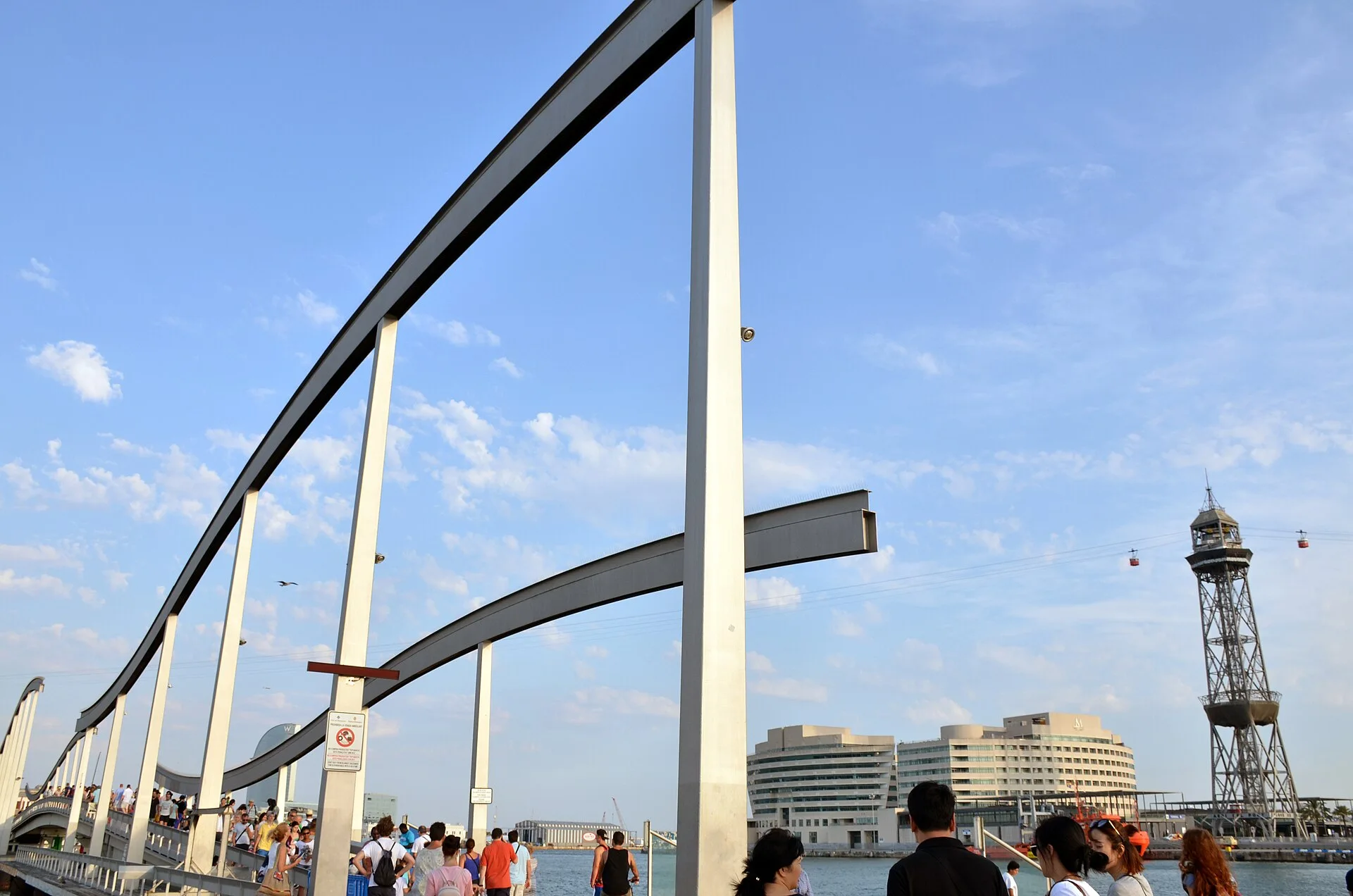
The final chapter opens towards the harbour. One photograph follows the wooden Rambla de Mar, another looks down over Port Vell from an independent elevated position, and a third shows the waterside in another year. Compare the lines of the walkway, moored boats and the city behind them. These are independent photographs, not successive frames from a bridge crossing. The port authority identifies Rambla de Mar as a connection within Port Vell; the broader harbour has its own changing activities and working edges.
The June 2022 interactive scene is on a nearby quay by the boats, not on the bridge itself. It has five reviewed local positions and a return, allowing a close look between moorings and water. It does not verify a full crossing of Rambla de Mar, a connection from the monument, or a step-free itinerary. Look for the difference between the quay-level panorama and the higher photograph.
The city describes the transformation of La Rambla in 2026, so historic scenes should not be treated as a live map of works or entrances. Allow time for real crossings and check the port's current information. The journey ends with a question about scale: how does the enclosed square of the previous chapter become an open edge of water, boats and horizon?
Real-travel note
Dated independent imagery; check current access and works for a real visit.
9 reviewed experiences
Explore along the route
Step into the places along this journey. Choose a view independently of the story chapters. Free previews do not count toward chapter progress. Return to the journey above to continue through its stops.
Begin at Plaça de Catalunya Short observation sequence
November 2017: three positions within Plaça de Catalunya and return. Planting and arrangements can change.
Reviewed 2026-10-28 · Nearby viewpoint
Explore at your own pace; these views do not count toward chapter completion. Check each point's coverage note before navigating provider imagery. Availability may change.
Sources
- Plaça de Catalunya — Barcelona Turisme
- Boqueria Market — Barcelona Turisme
- La Boqueria Market — Generalitat de Catalunya
- History of La Boqueria — La Boqueria
- La Boqueria market — La Boqueria
- Plaça Reial — Barcelona Turisme
- Mirador de Colom — Barcelona Turisme
- 19th-century Barcelona — Barcelona Maritime Museum
- Rethinking Columbus Day — Smithsonian National Museum of the American Indian
- Port Vell — Barcelona Turisme
- Rambla de Mar — Port Vell
- La Rambla transformation — Barcelona City Council
- La Virreina Centre de la Imatge — Barcelona Turisme
- The history of the Liceu — Gran Teatre del Liceu
- Basilica of Santa Maria del Pi — Barcelona Turisme
- The Royal Shipyards of Barcelona — Barcelona Maritime Museum
- Plaça de Catalunya, Barcelona, July 2014 (01).JPG — Ardfern · Wikimedia Commons
- Barcelona - Urlaub 2014 - Brunnen Platz Catalunya 023.jpg — Mummelgrummel · Wikimedia Commons
- Barcelona - Urlaub 2014 - Skulpturen Platz Catalunya 010.jpg — Mummelgrummel · Wikimedia Commons
- Entrance to La Boqueria - panoramio.jpg — Oleksandr Samoylyk · Wikimedia Commons
- La Boqueria, Barcelona.jpg — Bernard Gagnon · Wikimedia Commons
- Barcelona 2015 10 10 0465 (22518828424).jpg — Harvey Barrison from Massapequa, NY, USA · Wikimedia Commons
- Barcelona 2016-232.jpg — Victor Grigas · Wikimedia Commons
- Barcelona - fountain in Plaça Reial - 02.jpg — Joe Mabel · Wikimedia Commons
- Barcelona 2016-234.jpg — Victor Grigas · Wikimedia Commons
- Barcelona Columbussäule.JPG — Corradox · Wikimedia Commons
- 018 Monument a Colom, pl. Portal de la Pau (Barcelona), lleó i pedestal.jpg — Enric · Wikimedia Commons
- A. Vallmitjana Abarca, lleons del monument a Colom, Barcelona (6476639911).jpg — Catalan Art & Architecture Gallery (Josep Bracons) from Barcelona, Catalonia · Wikimedia Commons
- 12 Barcelona Rambla de Mar 29072016.jpg — Vassil · Wikimedia Commons
- Monument a Colom i rambla de Mar.jpg — Pere prlpz · Wikimedia Commons
- 042 Rambla de Mar, Port Vell de Barcelona.jpg — Enric · Wikimedia Commons
- Barcelona - Palau de la Virreina - façana.jpg — Didier Descouens · Wikimedia Commons
- WLM14ES - Nocturna del Teatre del Liceu, Barcelona - MARIA ROSA FERRE.jpg — MARIA ROSA FERRE ✿ from Vilafranca del penedes, Catalunya · Wikimedia Commons
- Plaça del Pi (Barcelona) 02.jpg — Nicholas Gemini · Wikimedia Commons
- 113 Drassanes Reials, Museu Marítim de Barcelona, façana nord.jpg — Enric · Wikimedia Commons


Your journey, remembered.
Explored 0 of 5 stops. Explore every stop to unlock your keepsake.
5 stops to your keepsakeExplore every stop to share or download your keepsake.
Plan time along La Rambla
Choose the places you want to see and arrange real connections separately.
Official sources checked:
Allow time for changes
Half a day outdoors is an estimate, not a measured walk. The city describes La Rambla’s transformation in 2026; check current works and pedestrian crossings.
Treat the market as a working place
Check the market’s current information and leave room for shoppers and vendors. Interior photographs are separate from the street panorama.
Plan the harbour and venues separately
The harbour panorama is on a nearby quay, not Rambla de Mar. Check current crossing and venue access rather than assuming an uninterrupted route.