
Batu Caves: Beyond the Colours, a Different Sense of Scale
Compare the forecourt, painted stairs, limestone chamber and shrines at Batu Caves, understanding how a cave and an active religious place share the same space.
Batu CavesObservation essay

The brightest image is not the whole setting
Batu Caves’ entrance photographs often leave a memory of coloured stairs and the large statue. Their clarity does not explain the space above. The interior introduces a different scale rather than simply extending the colour further uphill.
Forecourt, ascent and chamber do different things: establish a destination, make arrival a physical effort and change the visitor’s expectation. Keeping the three together explains more than the entrance image alone.
Steps provide a scale measured by the body
A staircase divides height into repeated units. Feet and pauses turn an abstract rise into effort, while the treads give the eye a regular reference for people and distance.
Colour strengthens that order without removing the climb. People appearing as figures in a photograph still need space to ascend, pause and return. The stairs are a working passage, not an empty backdrop awaiting occupation.

Inside, architecture no longer sets the highest edge
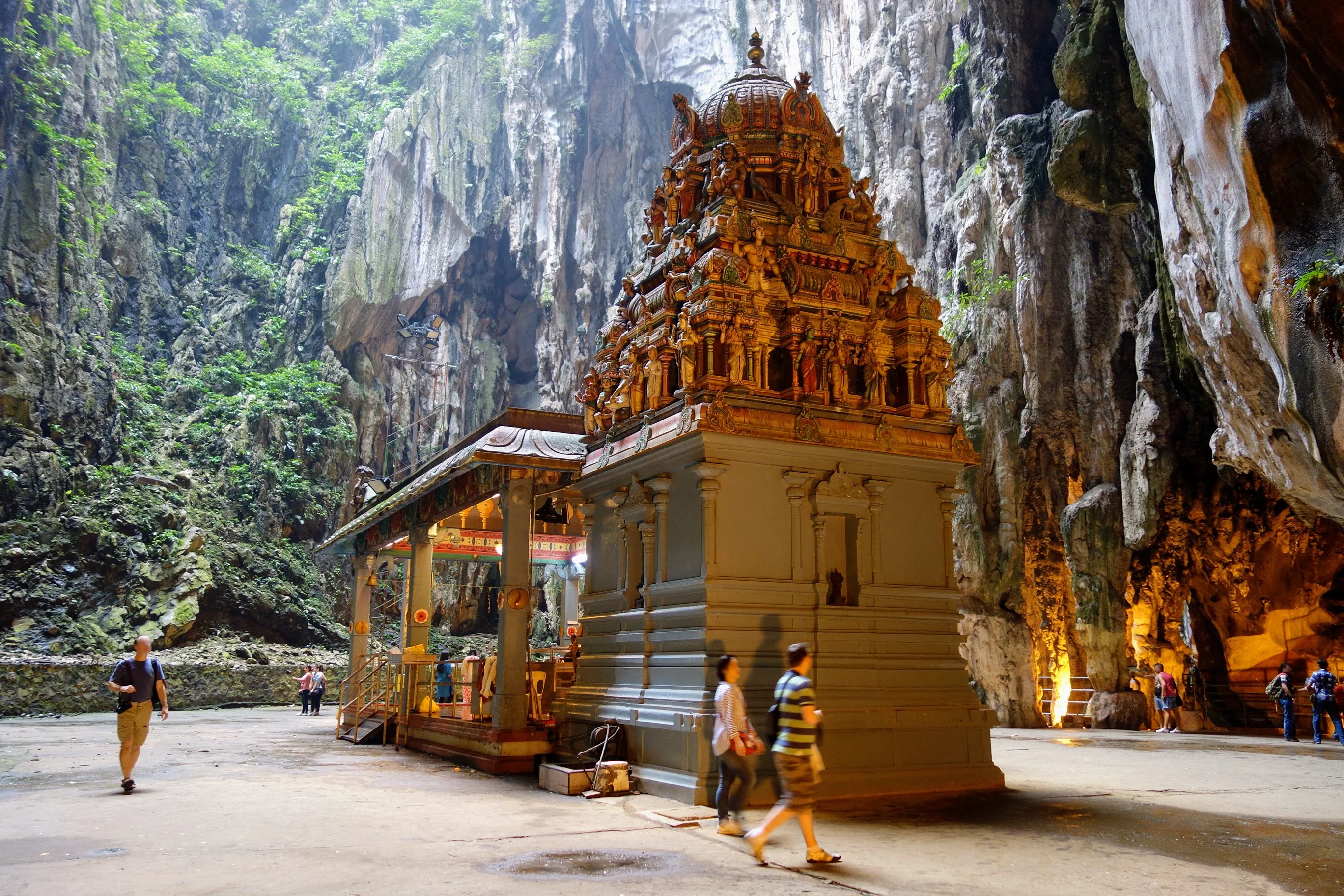
The Temple Cave photograph places people and shrines below much larger limestone surfaces. Unlike a conventional interior bounded by a roof, the chamber surrounds smaller buildings whose familiar proportions remain visible within it.
Scale can be understood through those relationships without dramatic numerical claims. People, steps and shrines provide comparisons. A single image records only part of the chamber, not a complete plan or proof of connections to every other cave.
Light distinguishes rock from constructed form
Openings bring light into parts of the chamber while other surfaces remain darker. Defined architectural edges contrast with the irregular projections and shadows of rock. Their coexistence is more revealing than either isolated close view.
Calling it only a natural wonder removes its users; calling it only a colourful temple overlooks the larger geological space. Its particular character comes from both being present together.
A shrine is more than a scale marker
A small shrine beneath a high wall can help a visitor judge size, but its purpose is not to measure scenery. Batu Caves is an active Hindu religious setting, with worship alongside tourism.
Give prayer room rather than expecting it to wait for a photograph. Historical images do not establish current access or photography arrangements. Respecting religious use makes the setting more particular than a large interior available for unrestricted exploration.
The return is also part of the visit
The chamber may feel like an ending after the climb, yet the physical visit includes descending again. An entrance photograph and an interior panorama do not describe that effort for an individual visitor.
Consider forecourt, stairs and chamber separately when planning around weather and capacity. Even in photographs their different functions remain clear: distant orientation, bodily movement and a limestone enclosure around sacred buildings. Together they explain more than a colourful gateway.
References
These sources inform the essay’s historical and local context. Its observations and interpretations are original to WalkThere.
Tourism Malaysia
Batu CavesContext for Batu Caves’ natural setting and religious identity.
Tourism Malaysia
4 Top Cultural Destinations in SelangorRegional tourism context for cultural and religious places.