
Batu Caves: from the forecourt to Temple Cave
Follow a Batu Caves walking route through the forecourt, up the 272 steps and into Temple Cave, with real photographs and a practical decision about the climb.
Guided visual journey

Murugan statue beside the colourful staircase at Batu Caves · Balon Greyjoy (uploader) · CC0
Reading mode
Place stories to read at your own pace
Chapter 1 · Before the climb
The forecourt and Murugan statue
The first decision at Batu Caves happens before you climb. From the open forecourt you can see the gold-coloured statue of Lord Murugan beside a long flight of painted steps. Behind both rises the limestone hill. The photograph was made on 21 August 2019; it shows a particular afternoon, with visitors crossing the broad concrete space. It does not tell you how hot, crowded or wet the approach will be on your day.
Tourism Malaysia describes Batu Caves as a Hindu place of worship as well as a visitor destination. That changes how to read the spectacle in front of you. The statue is not merely a landmark to pass on the way to a viewpoint; the cave beyond the stair is used for prayer. During Thaipusam the site has a different rhythm and much larger gatherings. If you are here to look, give worshippers room and avoid blocking an entrance for a photograph.
The Temple Cave sits above 272 steps. You can see almost the whole climb from here, which makes this the honest place to decide whether to continue. The pictures on this page are four separate photographs, not a continuous recording of the steps. The map places chapters in order but draws no verified walking track through the vertical stair or cave. Look at the ascent, consider the heat and rain, and turn back if the climb is not right for you. The next photograph moves to the foot of the stair rather than pretending the camera carried you there.
Real-travel note
This is an active place of worship. Check current visitor rules and festival arrangements before travelling; leave space for people praying.

Chapter 2 · The effort is visible
At the foot of the rainbow steps
At the foot of the stair the climb stops being a shape on the hill and becomes a series of narrow treads. The photograph, taken on 1 December 2019, looks directly up the painted flights. You can see the rail, people at different heights and the cave opening beyond. The famous colour is part of the place, but it is the rise that determines whether the visit works for you.
Tourism Malaysia gives 272 steps to the main cave. That number is more useful than an invented walking time: pace changes with heat, rain, crowding and the number of times you pause. The stair is exposed to the weather. Keep the handrail and leave room for others rather than treating the ascent as a race or a photo set. If it rains, slow down; if you are uncertain about stairs, the forecourt is already a complete stopping point.
This is not a chapter about Dark Cave or a claim that every side attraction is open. The journey stays with the public approach to Temple Cave. The photograph is a still at the bottom of the staircase, not a set of linked panoramas. The next chapter jumps to the cave interior. The vertical movement between them is real, but it has not been captured as an interactive sequence here.
Real-travel note
The 272 steps are exposed and can be busy. There is no verified step-by-step imagery here; recheck access and conditions before climbing.
Chapter 3 · Inside the limestone
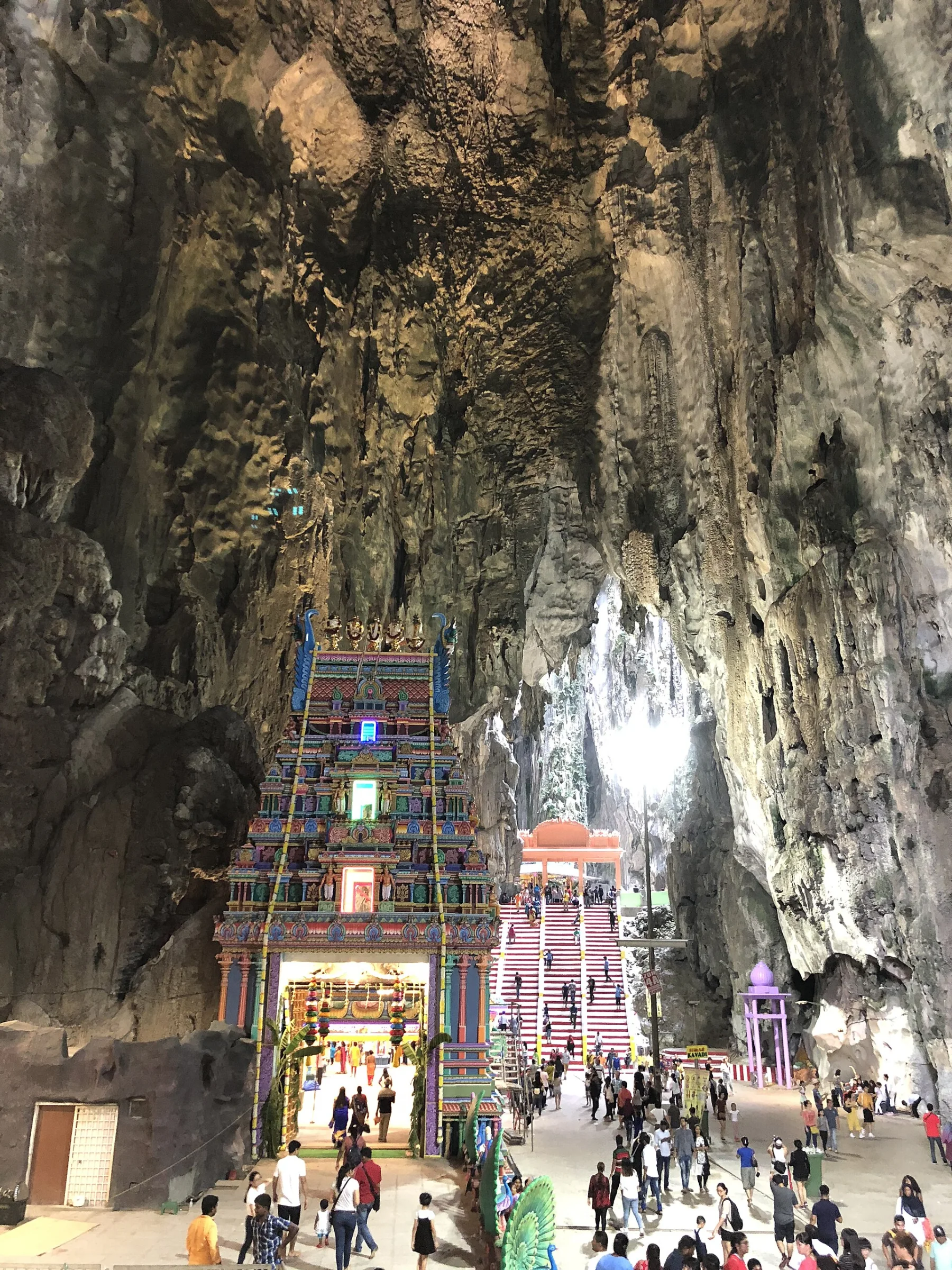
Temple Cave opens above the stairs
The reward for the stair is not a conventional summit view. Inside Temple Cave the space suddenly broadens: pale limestone rises above shrines, and daylight enters from an opening overhead. The 31 August 2018 photograph shows a section of the chamber with another short interior stair and a small shrine below the rock. It is one camera angle, not a floor plan of the cave.
Tourism Malaysia identifies the main cave as Temple Cave, the best-known part of the Batu Caves complex. The religious spaces are used, not reconstructed scenery. You may hear prayer or find a gathering that changes where visitors can stand. Let the actual signs and stewards determine what is open when you arrive; this page cannot settle that from an older photograph.
The cave may feel cooler than the exposed steps, yet the visit does not erase the work of descending them afterwards. This chapter is deliberately a separate editorial photograph. The image viewer cannot move you from the stair foot into this chamber, and the map does not draw an imaginary indoor line. If the climb was too much, you lose nothing by ending at the forecourt rather than forcing the cave.
Real-travel note
The cave remains a worship space. Keep passages clear and follow current on-site signs; the return still involves the staircase.
Chapter 4 · A place still in use
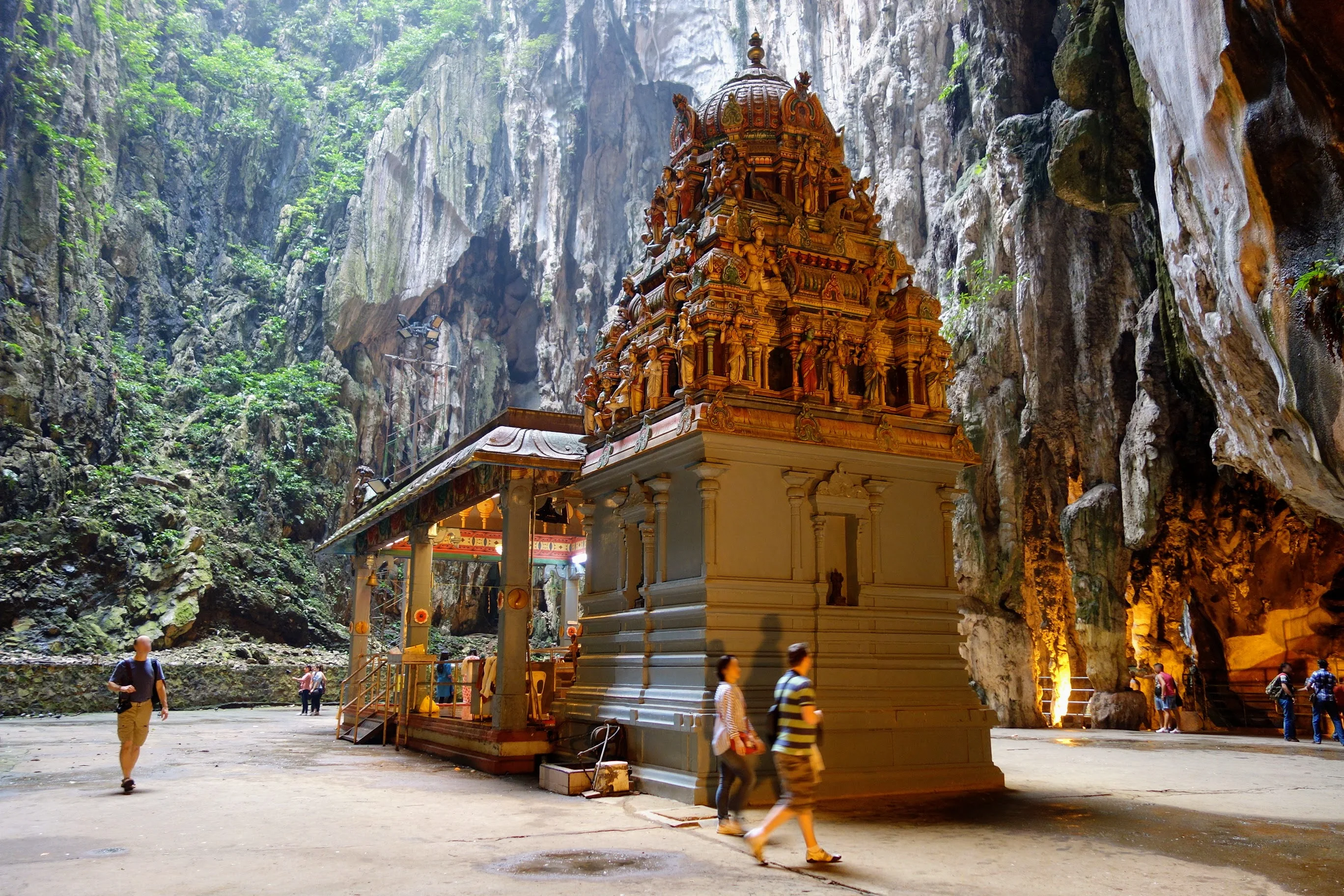
A shrine within the cave
The final photograph comes closer to the reason the steps lead here. A brightly detailed shrine stands against rough limestone. The image was made on 2 October 2015; people pass through the frame, and the shrine is lit beneath a high cave wall. The contrast between carved, painted architecture and uneven rock is the character of this stop.
It would be easy to write this as a scenic finale, but the structure is part of an active Hindu site. A visitor may photograph a broad chamber while someone else has come to worship. That is a different claim from saying the shrine is a museum piece. Keep your distance when prayer is taking place and use current on-site guidance for photography, clothing and access. This older image cannot establish what is permitted today.
The four views have taken you from the open forecourt through the stair and into the cave. They have not recorded every tread, landing or corridor. Nor do they show the descent. If you come in person, make the same physical journey back down the 272 steps and check conditions before you travel. If you stay online, this is a sourced visual introduction that helps you decide whether the climb and the setting appeal to you, not a replacement for being there.
Real-travel note
Check current worship and photography guidance at the site. To leave Temple Cave, you still have to descend the stairs; this page does not map an alternative route.
Sources
- Batu Caves — Tourism Malaysia
- 4 Top Cultural Destinations in Selangor — Tourism Malaysia
- 20190821 Batu Caves entrance and statue-1 — Wikimedia Commons
- Batu Caves. Stairway to Temple Cave. 2019-12-01 10-49-38 — Wikimedia Commons
- Inside of batu caves — Wikimedia Commons
- Inside Batu Caves (geotagged photograph) — Wikimedia Commons
- Batu Caves Temple Cave Shrine 2015 — Wikimedia Commons


Your journey, remembered.
The keepsake unlocks when you reach this section.