
Athens’ Ancient Agora: excavation beside the railway
Read a railway-side excavation, a distant temple and a later church alongside the Agora’s modern archaeology, distinguishing remains, reconstruction and museum records.
Athens Historic CentreObservation essay
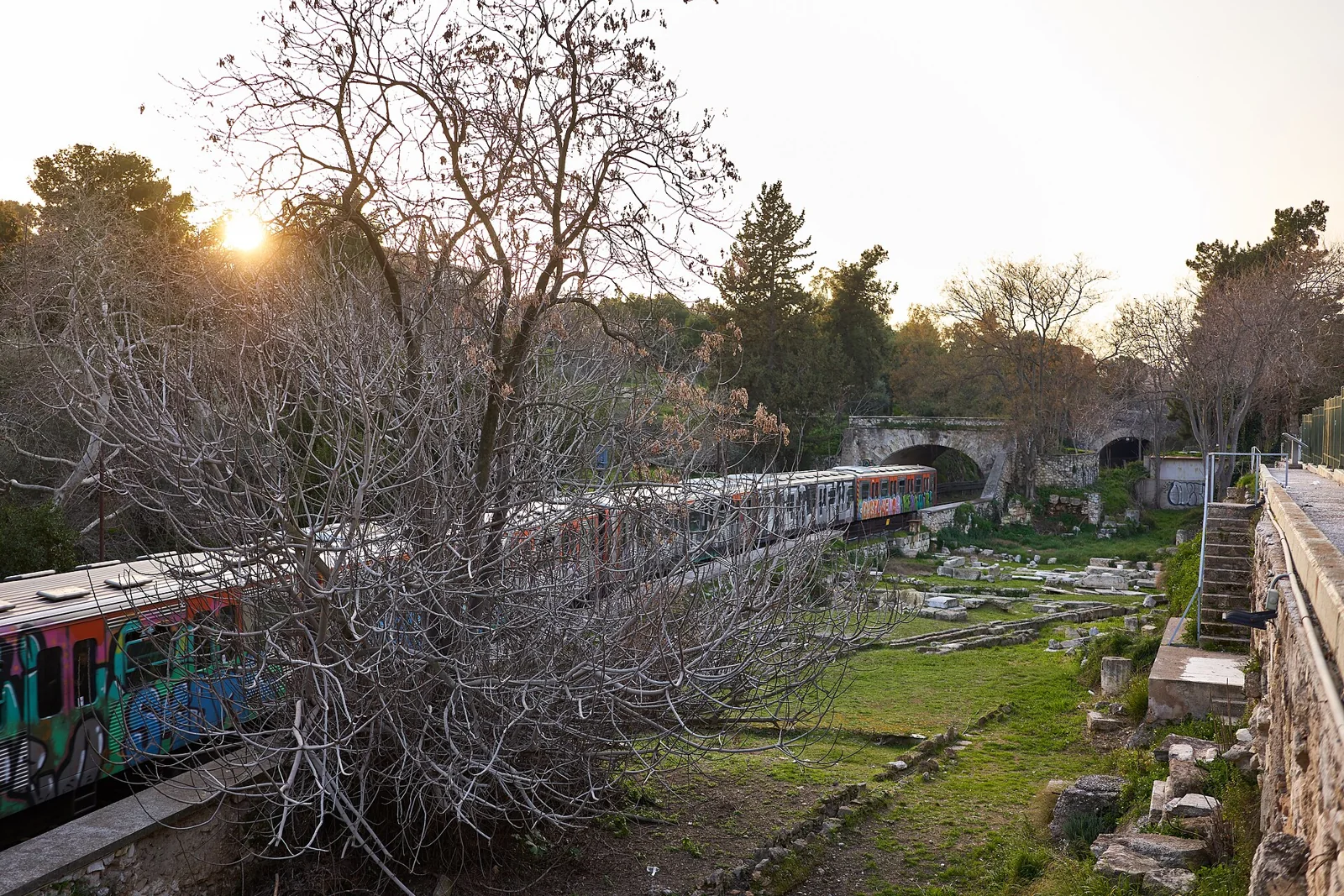
An incomplete building can be the starting point
The opening photograph records excavation between Adrianou Street and the railway. Low walls and changes of level occupy the foreground, with an active city at the edge. There is no single intact building obligingly organising the entire scene.
Follow junctions and interruptions in the wall lines. Missing portions should not automatically acquire imagined roofs and crowds. The railway supplies a present-day reference: archaeological ground remains beside a city through which people continue to move.
More than a market
The American School of Classical Studies describes the ancient Agora as a centre for business, politics and law, bringing merchants and participants in civic affairs into the same broader setting. The familiar translation as a marketplace supplies only part of that account.
A range of public activities does not identify every photographed wall as a particular shop or courtroom. Assigning specific functions requires plans and interpretation. An open patch in a photograph cannot establish where the participants in an ancient debate stood.
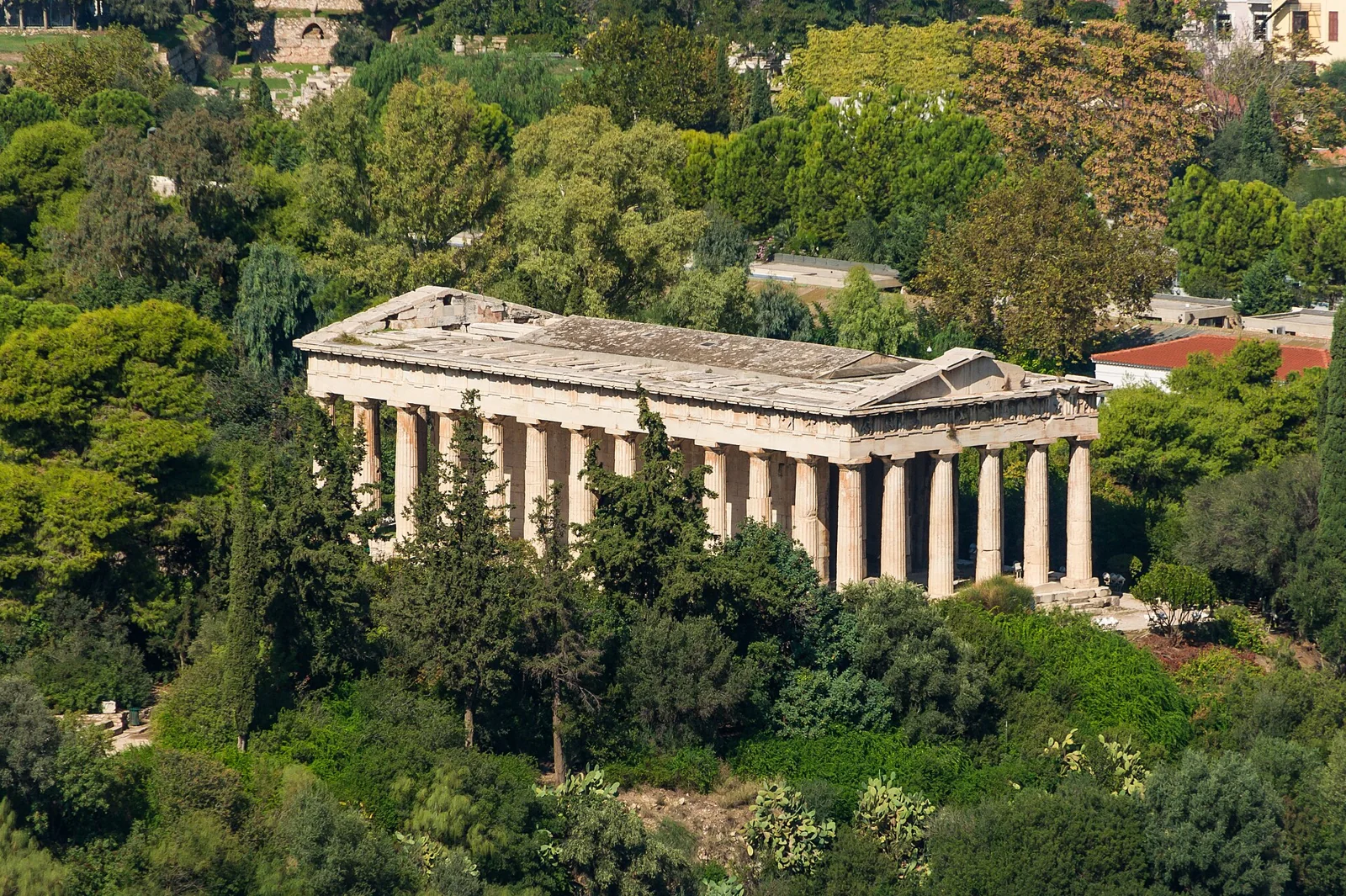
The temple supplies a different scale
The second photograph looks towards the Temple of Hephaestus from the Acropolis. Its roof and colonnade remain recognisable while distance and vegetation make surrounding ground harder to read. Compare that whole volume with the closer, fragmented masonry of the first image.
These separately dated viewpoints do not form consecutive steps. Areas that appear adjacent from above may be divided by boundaries, routes or level changes on the ground. Current site guidance is needed to turn an overview into an actual visit.
Keep the records with the finds
The School dates its excavations to 1931 and identifies the reconstructed Stoa of Attalos as the home of finds and excavation records. Objects are accompanied by information about discovery and context, questions a handsome isolated photograph cannot resolve.
The word reconstructed also belongs in a reading of the building. A complete-looking structure should not automatically be understood as entirely ancient fabric still standing untouched. These images do not enter the stoa or museum; the reference supplies background on preservation rather than a photographed collection tour.
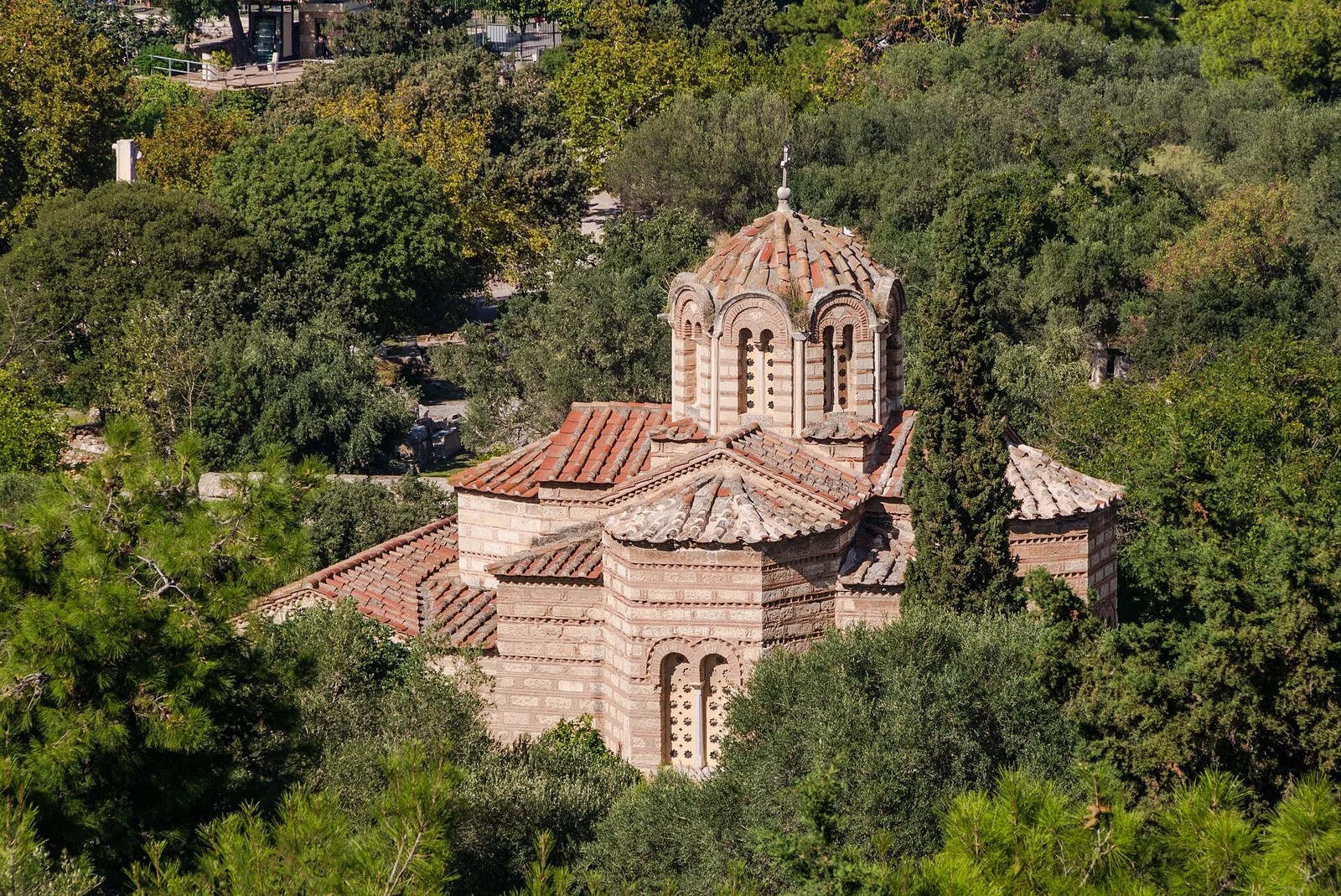
A church brings later time into view
The third photograph includes the Holy Apostles church within the Agora landscape. Its different outline helps resist compressing every visible structure into a single classical moment. The School’s introduction describes a long history of habitation rather than one period alone.
Compare the way each volume meets the ground and the intervals supplied by vegetation and paths. Recognising different periods need not mean immediately mastering every rebuilding. Unanswered questions can be carried into further reading without removing later life to simplify the story.
Visitors and researchers use different spaces
The School’s visitor information distinguishes excavation offices from the museum where selected finds are displayed. Public interpretation coexists with research and management activities. Check present admission arrangements before choosing how to divide time between site and museum.
The three photographs do not survey a continuous or accessible itinerary. Return to the first wall lines beside the railway: the next useful step might be identifying a building, or finding a plan that explains a gap. Both begin with noticing what the photograph leaves unresolved.
References
These sources inform the essay’s historical and local context. Its observations and interpretations are original to WalkThere.
American School of Classical Studies at Athens
Ancient Agora: public life and its surviving tracesInstitutional account of public functions, excavations since 1931 and preservation of finds and records.
American School of Classical Studies at Athens
Visiting the Site and MuseumResearch institution’s distinction between offices, the site and the museum display.
More journey background
Related journey sources
- Acropolis: a monument above a living city — UNESCO World Heritage Centre
- Plaka: the city at the foot of the rock — Official Athens Guide
- Monastiraki: many histories in one urban frame — Official Athens Guide
- Syntagma: the modern capital in a public square — Official Athens Guide
- Areopagus — Official Athens Guide
- Anafiotika — Official Athens Guide
- Hadrian Library — Hellenic Heritage
- Zappeion — International Olympic Committee