
Angkor Wat: Read a Wall as Well as the Towers
Examine Angkor Wat’s narrative reliefs, the Churning of the Sea of Milk and conservation work to understand a monument at the scale of carved figures.
Angkor Wat coreObservation essay

A silhouette is immediate; a wall takes time
The towers and their reflection can dominate a memory of Angkor Wat. The relief galleries ask for another kind of attention. No single viewpoint replaces their contents, and a close photograph rarely explains why each figure appears.
At this scale, architecture becomes a wall beside the viewer. Bodies, gestures and arrangements carry information. Distinguishing a standing figure, a moving group and a central character is already a form of reading, even before every name is known.
Repetition can carry narrative
A long relief differs from an independently framed picture. Repeated poses and ranks require the eye to move along the wall. What appears as a decorative band from farther away resolves into differences of action and position.
Repetition can establish collective scale, but similar motifs do not automatically belong to one story. Angkor Wat’s galleries contain different subjects. Identification needs reliable interpretation corresponding to the particular location, rather than a title inferred from one crop.
Churning the sea gives the stone a direction of force
APSARA identifies a section of the eastern gallery with the Churning of the Sea of Milk: gods and asuras pull a serpent around a mountain to obtain the nectar of immortality. This is a Hindu mythological subject, not a record of ordinary work.
Its arrangement communicates force. Opposing ranks, a pivot and the serpent connect individual bodies into one action. Narrative is carried partly by composition itself: relationships and opposing movements become visible without every detail first being translated into words.
Historical subjects and myths are different readings
APSARA also relates part of the southern gallery to Suryavarman II. The monument’s reliefs therefore should not be treated as a single category. Royal representation and religious narratives can occupy the same architectural setting.
A historical reference does not make an image a modern documentary photograph. Scale, ranks and regalia can communicate status. Asking how authority is represented is more useful than assuming every dimension reproduces an actual event literally.
Protecting a carving can involve the roof above it
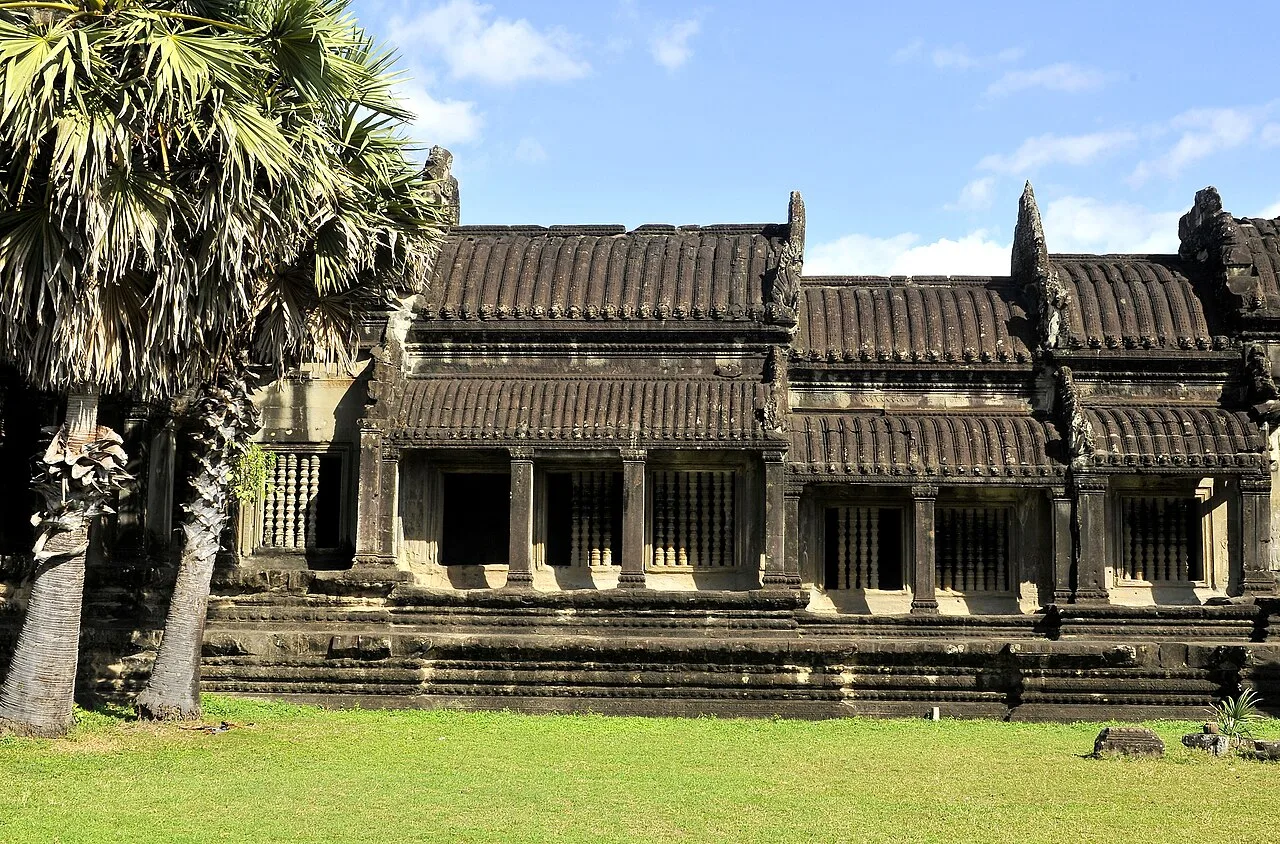
World Monuments Fund’s account of work at the Sea of Milk gallery discusses moisture and the building around the relief. Conservation involves more than treating an isolated carved surface; causes of damage can lie above or beside it.
Supports, closures and redirected circulation may be part of that work. Visitors can avoid adding contact: keep hands and bags away from carvings and stay behind protective boundaries. A closer photograph does not justify extra wear on the material.

Give one section enough attention to understand it
A first visit cannot identify every figure. Choose a relief with reliable interpretation, look at the whole, examine one detail and return to the larger arrangement. The gallery need not be merely a passage to an upper level.
That sequence can leave a clear relationship in memory: how a rank is organised, how gestures connect or why a roof matters to preservation. Towers and reliefs offer complementary distances from the same monument. Neither needs to serve merely as an interval before the other.
References
These sources inform the essay’s historical and local context. Its observations and interpretations are original to WalkThere.
APSARA National Authority
Angkor Wat: Bas-Relief GalleriesOfficial background on Angkor Wat’s galleries and narrative reliefs.
World Monuments Fund
Churning of the Sea of Milk GalleryContext for the Churning of the Sea of Milk relief and its conservation.
More journey background
Related journey sources
- Angkor — UNESCO World Heritage Centre
- Tourism information and Angkor visitor code — APSARA National Authority
- Wander through Angkor’s thousand-year history with Street View — Google Maps Blog