
Rome: from the Pantheon’s columns to the Tiber
Read five places in Rome through fifteen credited photographs and optional 360° scenes: the Pantheon, Piazza Navona, Campo de’ Fiori, Ponte Sant’Angelo and the castle. Four extra explorations bring smaller squares, a talking statue and an old street into view.
Begin the visual journeyPlan a real visit to Rome Historic CentreExplore 9 reviewed views along the routeGuided visual journey
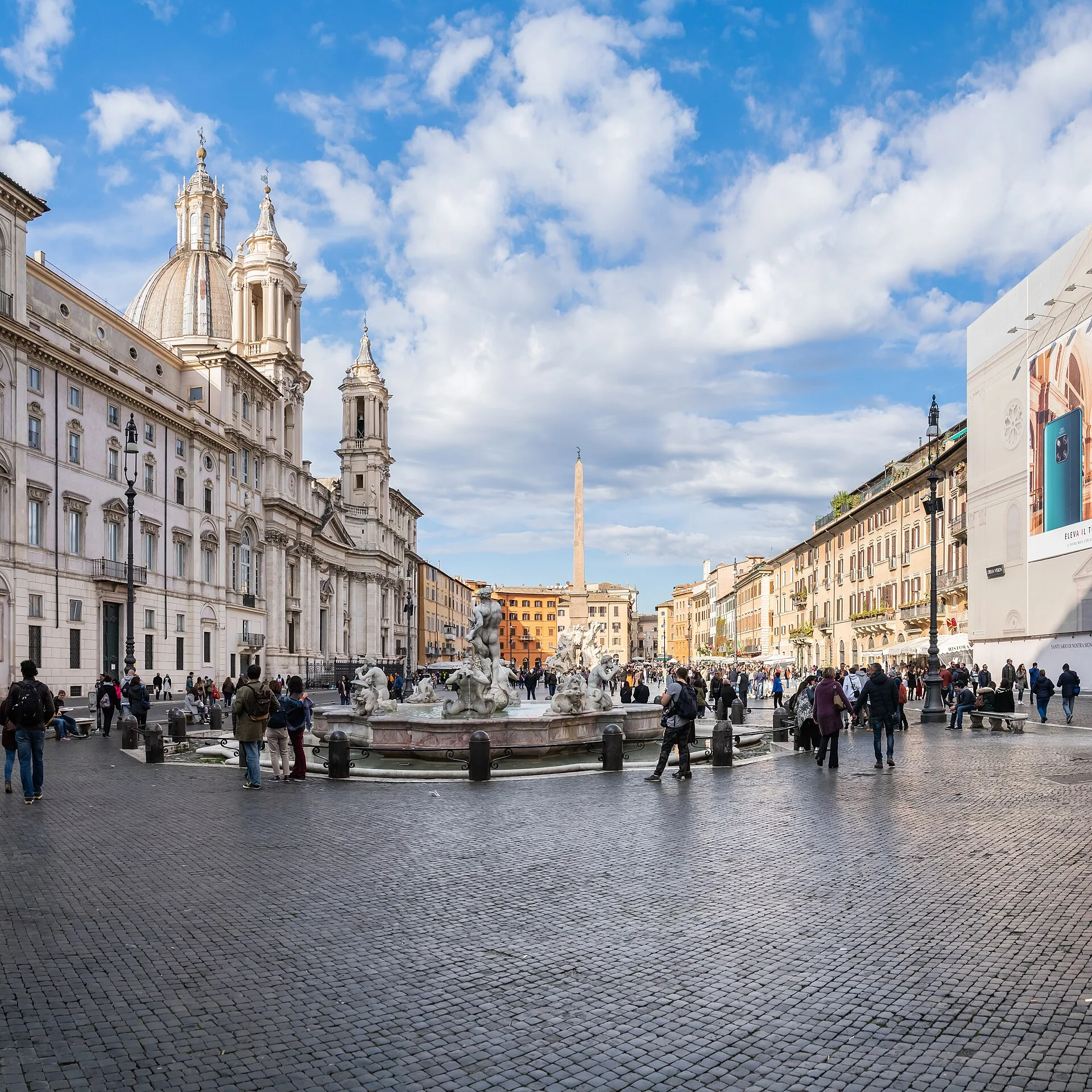
Piazza Navona and its monumental setting · Krzysztof Golik · CC BY-SA 4.0 · Resized and converted to WebP
Reading mode
Place stories to read at your own pace
Use the gallery arrows and thumbnails to compare the setting, a detail and another viewpoint. Photographs are independent dated observations.
Chapter 1 · A doorway across a square
Let the Pantheon change your sense of scale
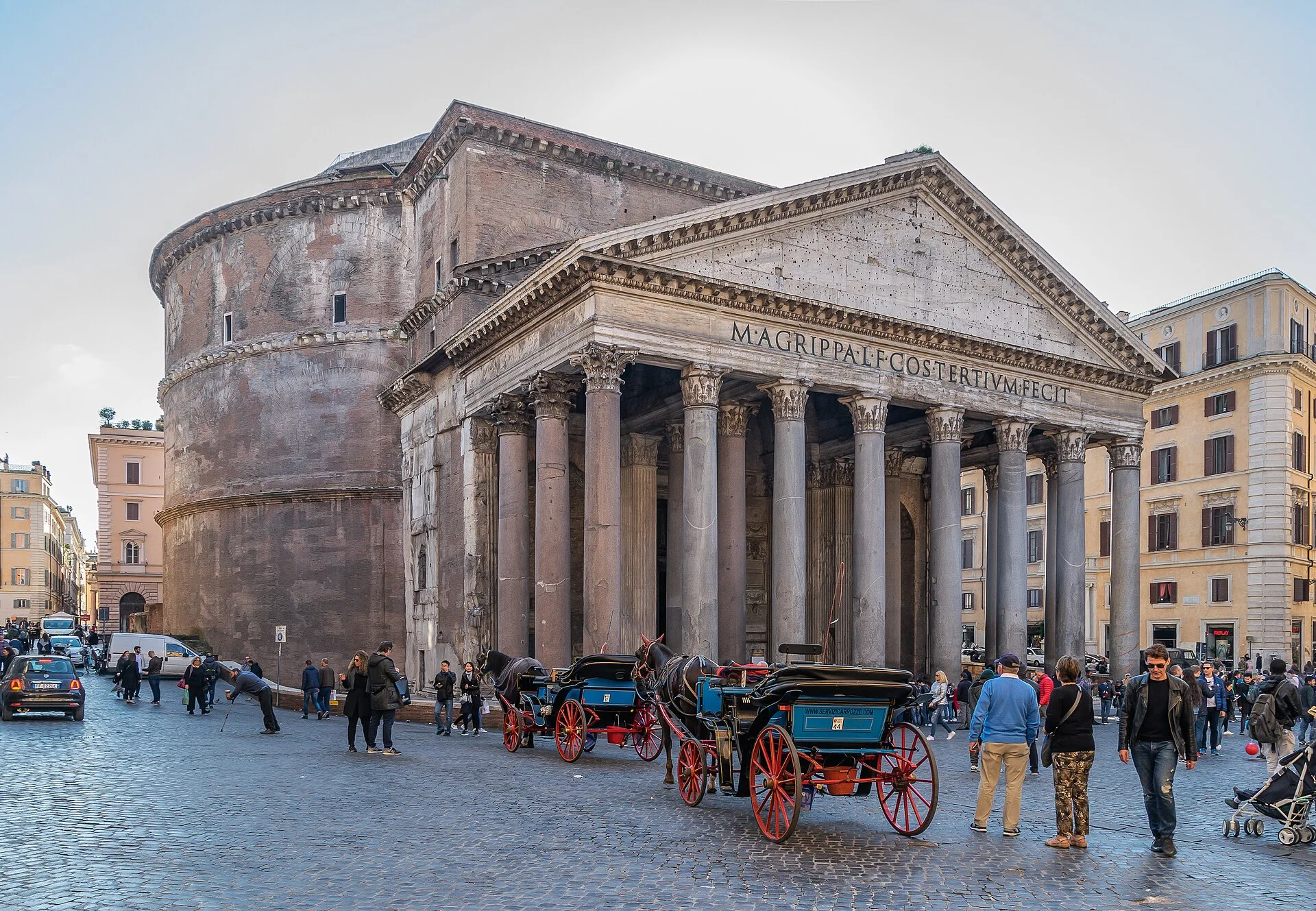
Start outside. Across Piazza della Rotonda, the Pantheon’s columns form a dark band against the bright square. Follow their tops to the triangular pediment, then look behind it: the round body belongs to a different geometry. People at the bottom of the image help give both forms a scale. The museum’s account explains that the ancient building became the church of Saint Mary and the Martyrs in 609. Its survival and its continuing religious use are part of the same story.
The three photographs change your distance rather than reconstruct one arrival. A November 2018 view sets the building in its square; the October 2016 frame brings the front and stonework closer; a September 2019 image looks up inside the open porch. That third image is a ceiling study, not a view of the rotunda’s interior or its oculus. Compare the regular column rhythm with the decorated surfaces above it, then return to the wide frame to see how much the crowd occupies the foreground.
The optional June 2026 exterior scene lets you rotate and compare a small reviewed area. It does not take you through the bronze doors. Admission and religious activity remain separate from this visual journey; consult the museum’s own visitor information. A nearby exploration turns to Piazza della Minerva and its elephant-and-obelisk monument. The change from an immense portico to a compact sculptural object is worth a detour, even though the two camera sets are independent.
Read further: Rome’s Pantheon: whose name is above the door?Real-travel note
Exterior observation only. The porch-ceiling photograph is not the rotunda interior; museum admission and worship arrangements need a separate check.
Use the gallery arrows and thumbnails to compare the setting, a detail and another viewpoint. Photographs are independent dated observations.
Chapter 2 · A long urban room
Follow Piazza Navona’s length before its fountains
Piazza Navona is easier to understand when you let your eyes travel along it. Its long edges keep drawing attention past the nearest people and towards the next fountain. Look for the repeated windows and the way the church façade interrupts the line. The city’s tourism office identifies the square with the remains of Domitian’s stadium. The archaeological area below is a separate place to visit: the open square and the buried structure are not interchangeable experiences.
Two November 2018 photographs establish the broad space from different positions. The third picture, also from November 2018, approaches the Ganges figure on the Fountain of the Four Rivers. Compare the building-sized rhythm of the first images with the carved body, rock and water in the detail. The photographs were made independently and do not let you follow an individual person through the square. Nor should fountain water in an old image be read as a current operating notice.
The July 2016 local panorama fragment supplies another scale: rotate towards the square and use the checked nearby positions to notice how figures and façades overlap. It does not descend to the stadium or continue to the market. Just off the southern end, Pasquino offers a very different kind of sculpture. The city describes it as one of Rome’s talking statues, associated with anonymous satirical texts. That small street-corner exploration gives the monumental square a more conversational neighbour.
Real-travel note
The square and the underground stadium are separate visits. Local panorama movement does not link the chapters or include archaeological admission.
Use the gallery arrows and thumbnails to compare the setting, a detail and another viewpoint. Photographs are independent dated observations.
Chapter 3 · A square changes through the day
Look between Campo de’ Fiori’s stalls and statue
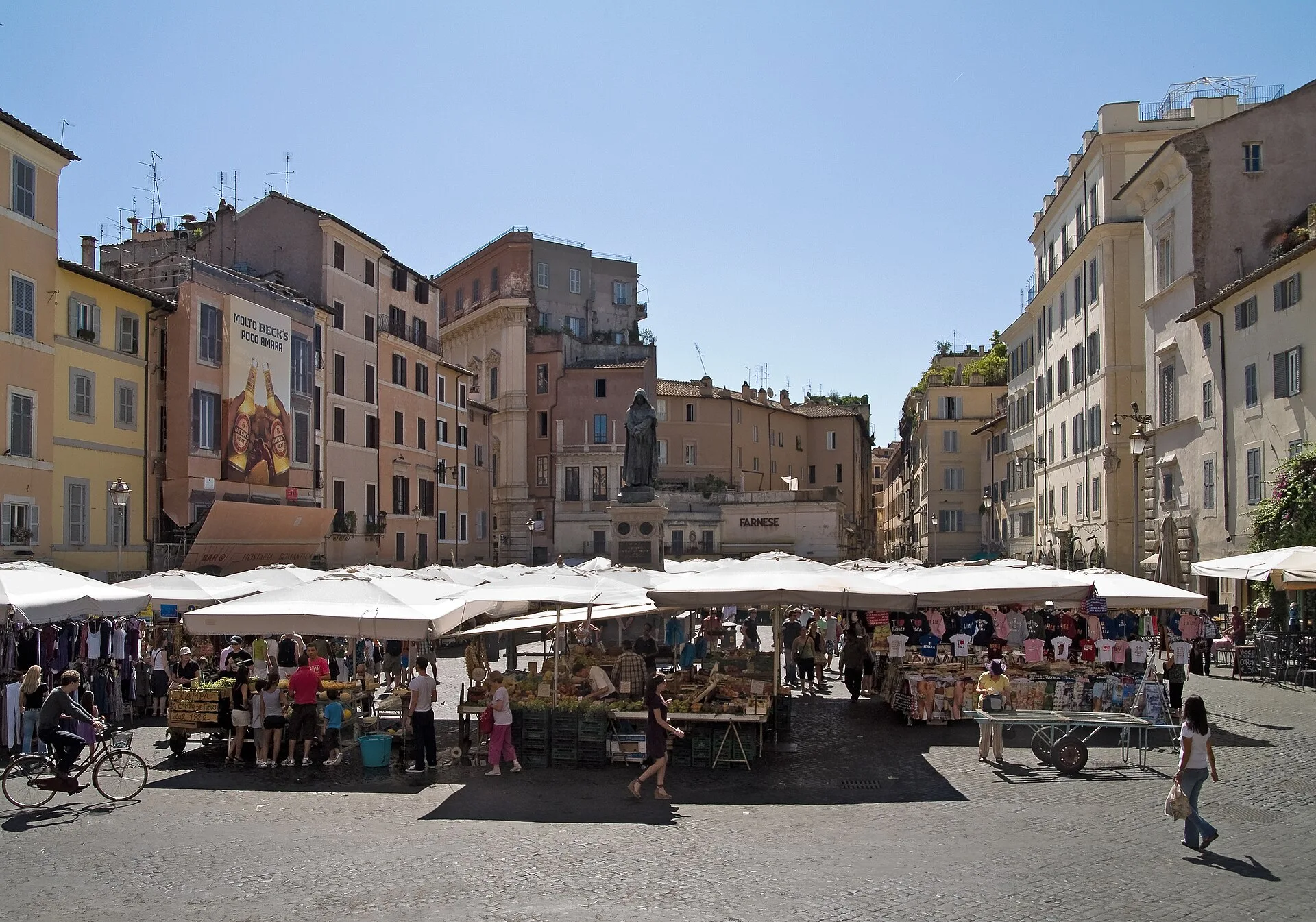
At Campo de’ Fiori, start with the gaps between the stalls. Their canopies interrupt the surrounding façades and make a second, lower roof across the square. The dark monument to Giordano Bruno rises through that temporary layer. The official district guide places this square between Navona and Piazza Farnese, but an actual walk still involves streets and a major road crossing. The editorial sequence here is a way to compare places, rather than a recording of every step between them.
The August 2009 photograph shows a market arrangement with the monument behind it. The October 2014 close view isolates Bruno’s figure, while the February 2021 photograph turns towards a fountain. Read each date as part of the image: stalls, shutters, crowds and light can differ, and the first photograph does not promise a market whenever you arrive. In the close view, compare the heavy folds of the cloak with the lighter café and shop edges in the wider frame.
The optional May 2021 fragment gives three local positions around the square and a checked return. Turning may reveal a different relationship between the monument and surrounding buildings, but the scene is historical. Piazza Farnese is a separate nearby exploration: compare its open paving and palace frontage with Campo’s temporary canopies. It offers a quieter architectural question—how an edge frames a square—without making a claim about how busy either place will be on your visit.
Real-travel note
Historical square imagery; market operation varies. Piazza Farnese is an independent local scene and does not include entry to the palace.
Compare the riverbank view, a sculpted angel and a clearly labelled elevated bridge view using the gallery arrows and thumbnails.
Chapter 4 · A line across the water
Read Ponte Sant’Angelo from parapet to skyline
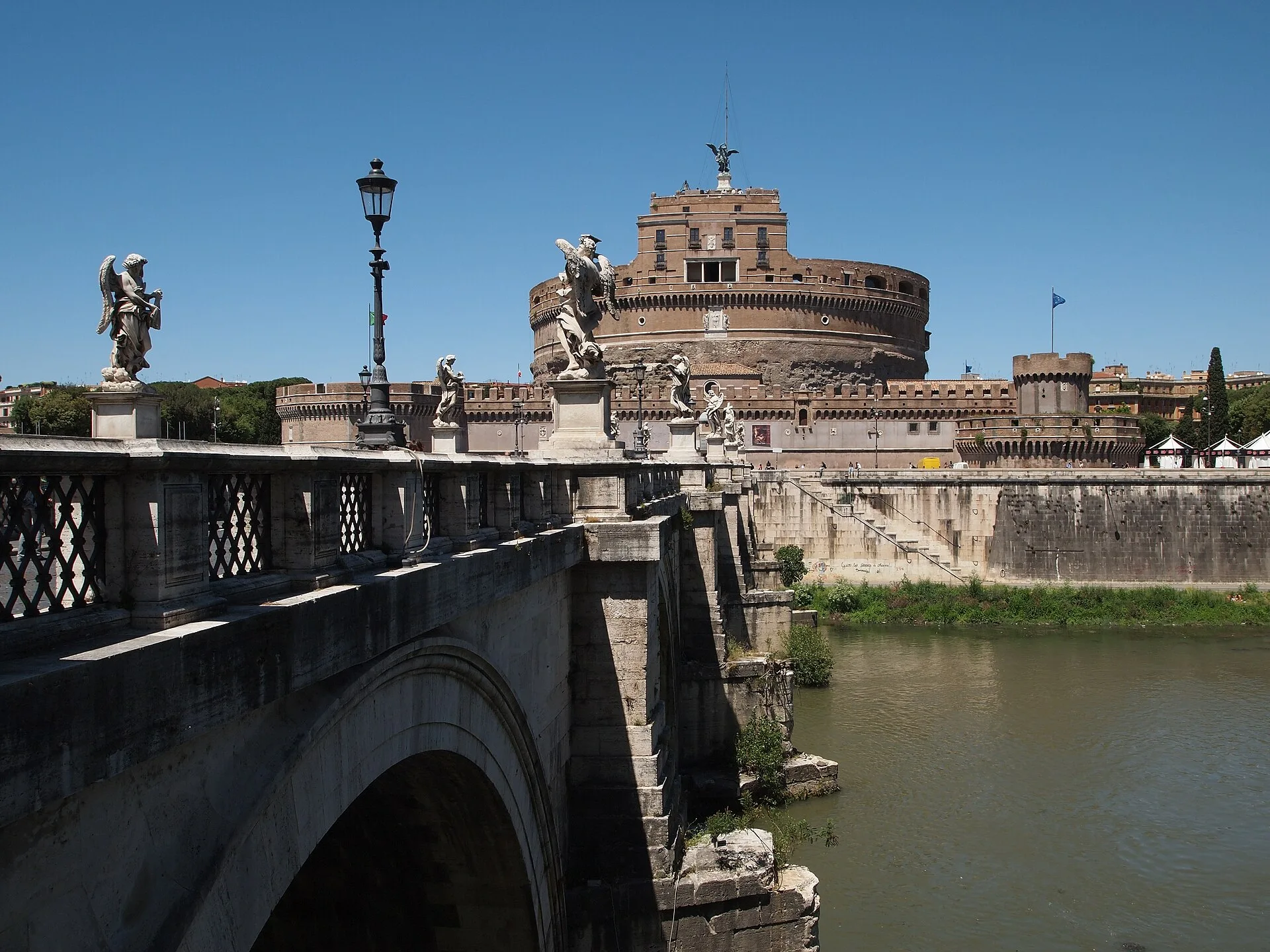
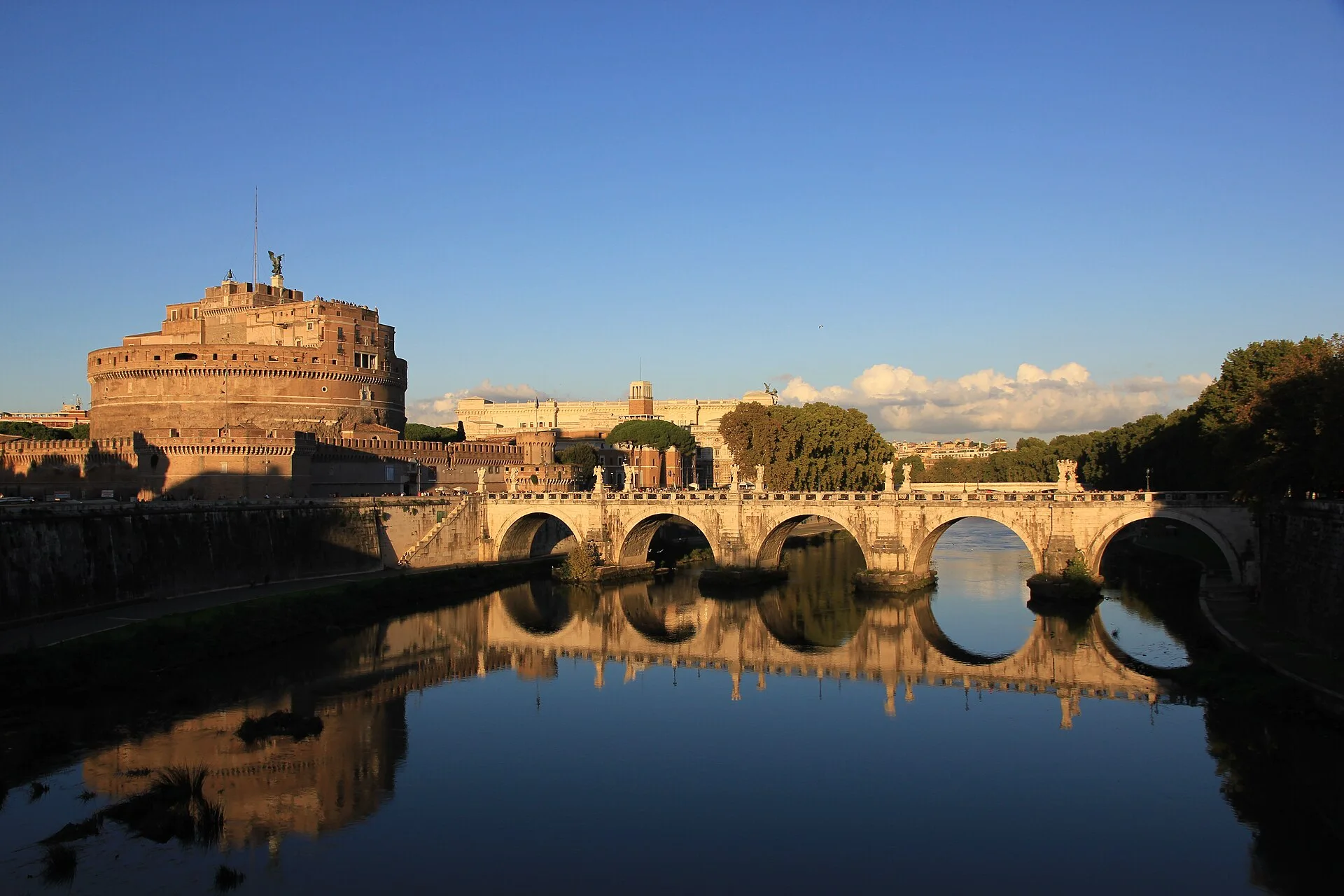
The river changes the scale of the journey. On Ponte Sant’Angelo, a line of sculpted figures makes the bridge feel like an approach as much as a crossing. In the broad photograph, trace the parapet towards the castle and then follow the arches down to the water. The official account explains that Hadrian’s bridge connected the city with his mausoleum in AD 136. The angel sculptures belong to a later layer; the visible scene brings those different histories into one frame.
The May 2012 image looks towards the bridge and castle from the riverside. A September 2009 close view studies the angel bearing a cross. The September 2019 photograph looks down from an elevated position across the bridge and Tiber: it is deliberately labelled as a high viewpoint, not something a pedestrian at parapet height can see. Use that change of height to compare the bridge’s overall line with the much larger figure in the close image. None of the three is a successive frame from the interactive camera.
The April 2021 Google fragment is an independent local observation near the bridge. Rotate to compare the river and castle, then try the reviewed short movement and return. It does not establish a safe present-day crossing, a descent to the lower riverbank or a continuous path from Campo de’ Fiori. Via dei Coronari adds a narrow-street contrast before this open water: look at the way façades shorten the visible distance, then return to the bridge’s longer sightline.
Real-travel note
The gallery includes an elevated overview. Local historical imagery does not verify lower riverbank access or a present-day crossing.
Use the gallery arrows and thumbnails to compare the setting, a detail and another viewpoint. Photographs are independent dated observations.
Chapter 5 · A round form, many lives
End with the castle’s layers beside the Tiber
Finish outside Castel Sant’Angelo by separating its shapes. The round central mass, projecting walls and upper building do not form a single flat façade. In the riverside images, the bridge gives them a direction, while the water adds another image below. Italy’s official tourism account describes the monument’s beginning as Hadrian’s mausoleum. Later uses changed the building, and today’s national museum needs its own visit rather than an assumption that every visible door is an available entrance.
An October 2012 photograph shows the castle with the bridge and water in warm light. The March 2013 image brings blue-hour reflections, and the September 2007 exterior gives another daylight relationship between walls and river. Compare the same heavy mass under those different conditions instead of treating the evening colour as a promise. The gallery stays outside: there is no reconstructed room, terrace admission or secret-passage tour hidden behind a change of photograph.
The reviewed local 360° scene adds a chance to look along the outer walls and back towards the river. Small movements change how the bastions overlap with the central building; they do not take you through the museum. You can end the journey by remembering one contrast: columns and an open square at the beginning, a circular mass and a river at the end. For a physical visit, use the museum’s current admission information and a current pedestrian map to choose your onward route.
Real-travel note
Exterior local observation only. Castle rooms, upper terraces and the Passetto require their own visitor arrangements.
9 reviewed experiences
Explore along the route
Step into the places along this journey. Choose a view independently of the story chapters. Free previews do not count toward chapter progress. Return to the journey above to continue through its stops.
Let the Pantheon change your sense of scale Short observation sequence
June 2026: exterior observation around Piazza della Rotonda. Three local positions and return, without entering the Pantheon or connecting to Navona. The porch-ceiling photograph is independent.
Reviewed 2026-10-25 · Nearby viewpoint
Explore at your own pace; these views do not count toward chapter completion. Check each point's coverage note before navigating provider imagery. Availability may change.
Sources
- The Pantheon — Turismo Roma
- Pantheon: history and visitor information — National Museums of Rome
- Navona Square — Turismo Roma
- The Stadium of Domitian Archaeological Area — Turismo Roma
- Campo de’ Fiori — Turismo Roma
- Ponte Sant’Angelo — Turismo Roma
- Castel Sant’Angelo National Museum — National Museums of Rome
- Castel Sant’Angelo National Museum — Italia.it
- Piazza della Minerva — Turismo Roma
- Pasquino — Turismo Roma
- The heart of Rome: Piazza Navona and Campo de’ Fiori — Turismo Roma
- Pantheon in Rome (1).jpg — Krzysztof Golik · Wikimedia Commons
- Pantheon (Rome) - Exterior 01.jpg — John Samuel · Wikimedia Commons
- Rome Pantheon porch ceiling.jpg — Nicholas Hartmann · Wikimedia Commons
- Piazza Navona in Rome 07.jpg — Krzysztof Golik · Wikimedia Commons
- Piazza Navona in Rome 04.jpg — Krzysztof Golik · Wikimedia Commons
- Piazza Navona Gange fontana dei Fiumi Roma.jpg — Wolfgang Moroder · Wikimedia Commons
- Campo dei Fiori.jpg — Myrabella · Wikimedia Commons
- Giordano Bruno in Campo de' fiori.jpg — Livioandronico2013 · Wikimedia Commons
- Fontana in Campo de’ Fiori.jpg — Bargioni · Wikimedia Commons
- Ponte Sant Angelo.jpg — Danbu14 · Wikimedia Commons
- Angel Ponte Sant Angelo cross.jpg — Marie-Lan Nguyen · Wikimedia Commons
- Ponte Sant Angelo Rome Vatican photographed by Robbie Conceptuel.png — Conceptuel · Wikimedia Commons
- Castel Sant Angelo (Rome).jpg — BjoernEisbaer · Wikimedia Commons
- Castel Sant Angelo - Rome (8603293859).jpg — salomon10 from Germany · Wikimedia Commons
- Castel Sant'Angelo, Rome - panoramio.jpg — Colin W · Wikimedia Commons
- Bernini elephant and obelisk, Rome.jpg — Nhartmannphotos · Wikimedia Commons
- Pasquino-statue-Rome-May-2009.jpg — Acediscovery · Wikimedia Commons
- Via dei Coronari da Piazza San Simeone.jpg — Alessandro57 · Wikimedia Commons
- Piazza Farnese with Santa Brigida.jpg — Carlat82 · Wikimedia Commons


Your journey, remembered.
Explored 0 of 5 stops. Explore every stop to unlock your keepsake.
5 stops to your keepsakeExplore every stop to share or download your keepsake.
Plan time in historic Rome
Use the visual route to choose stops, then plan the physical connections separately.
Official sources checked:
Give the outdoor route room
The five chapters form an editorial order, with a southward turn to Campo de’ Fiori before returning towards the Tiber. Allow half a day outdoors as a planning estimate; detours, queues and museum interiors add time. No measured total walking track is published.
Separate squares from admission
The Pantheon remains a place of worship and publishes official ticket arrangements. The castle, underground stadium and any upper terrace are separate visits. Check official sources rather than relying on an open door in historical imagery.
Choose crossings on a current map
Use current pedestrian facilities at major streets and the river approaches. The virtual fragments do not verify crossings, lower riverbank access or a step-free itinerary; stone paving can be uneven.