
Melaka old town: from Jonker Street to Porta de Santiago
Preview five stops for a Melaka old-town walking route through documentary photos, with optional 360° views at three stops. Plan your actual path with a current map.
Explore 3 reviewed views along the routeGuided visual journey
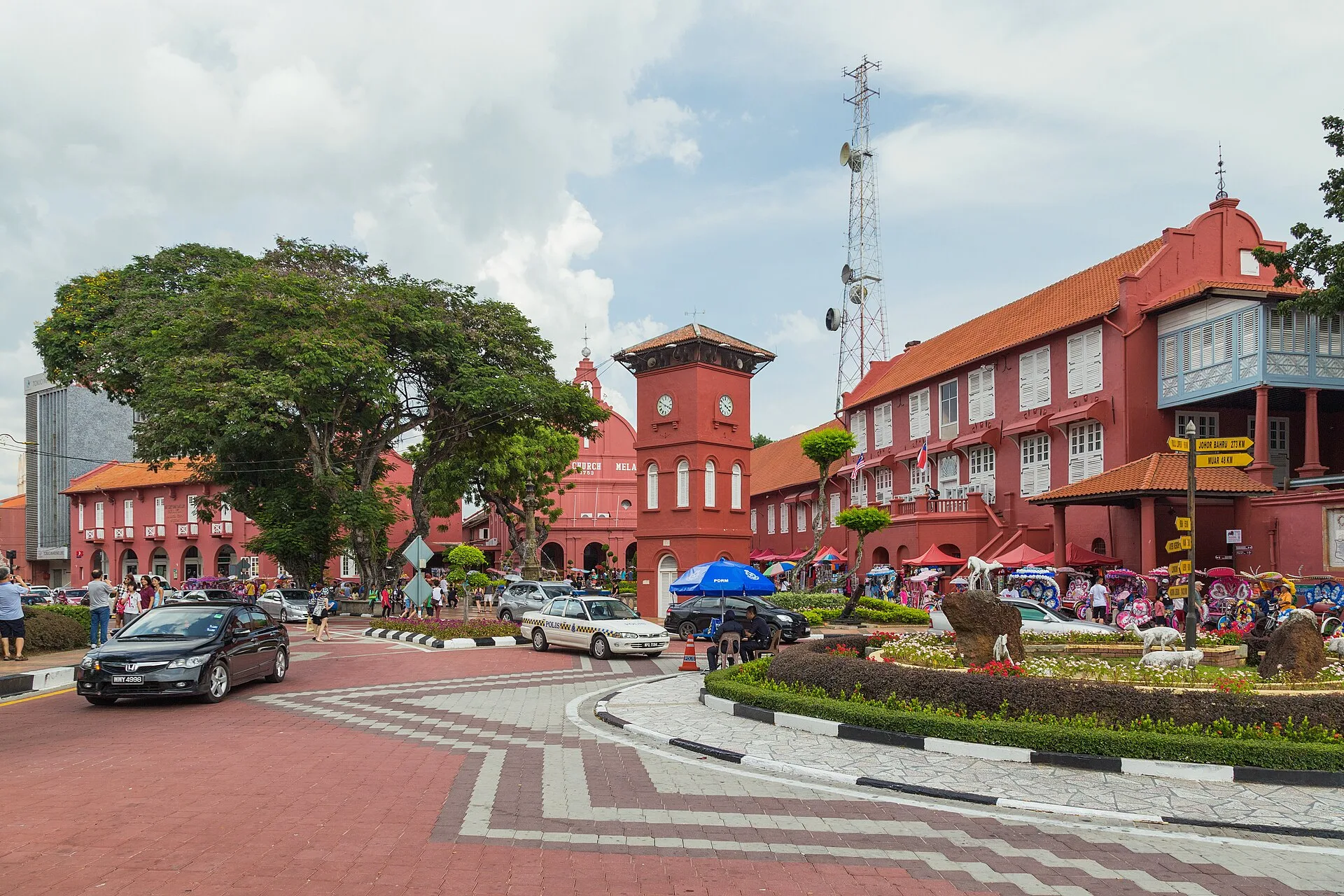
Red historic buildings around Dutch Square · Marcin Konsek · CC BY-SA 4.0
Reading mode
Place stories to read at your own pace
Chapter 1 · The living street
Begin on Jonker Street
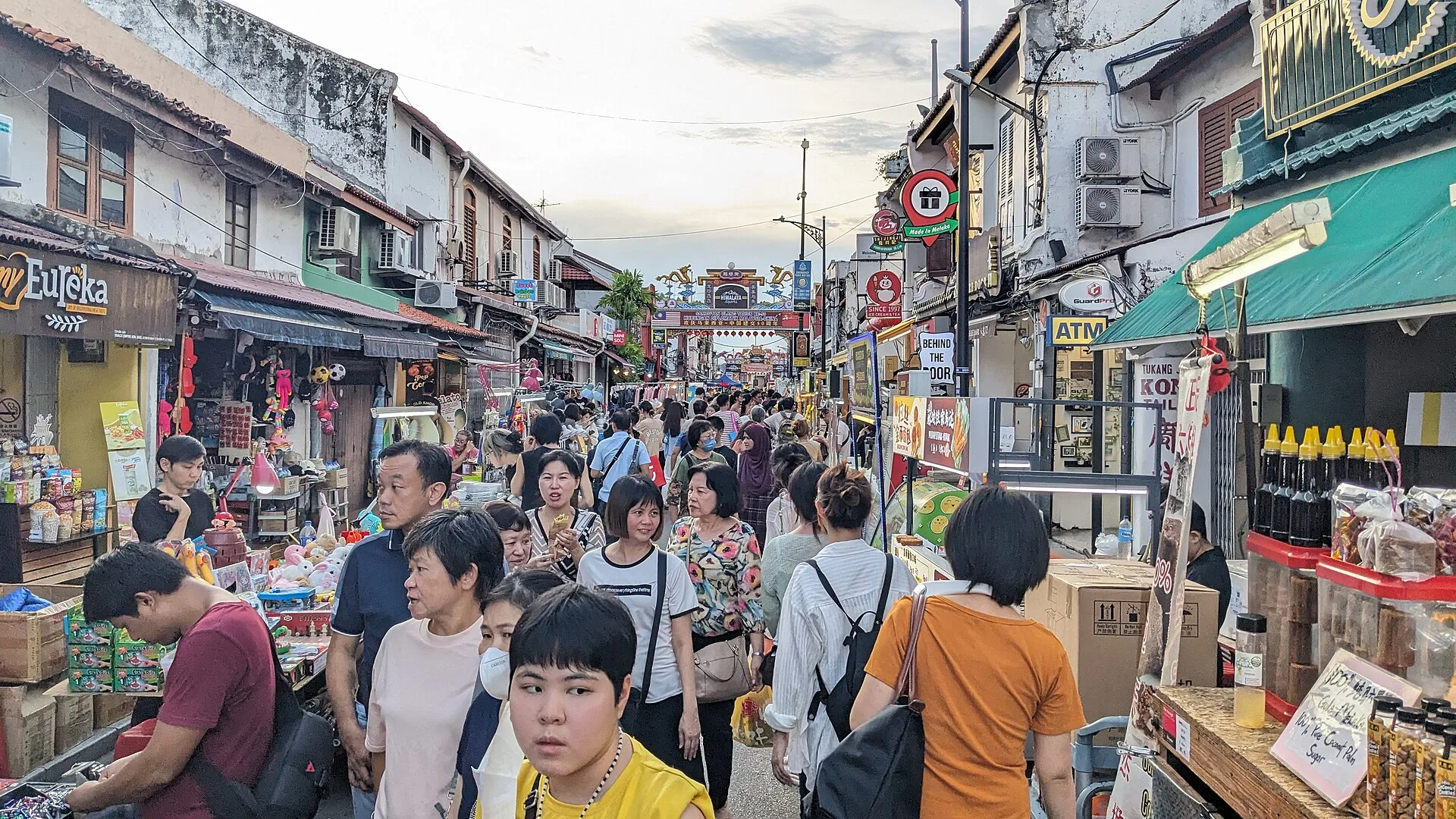
Start with the street rather than a monument. This photograph of Jonker Street was taken on an evening in May 2024: shop signs, people and a line of stalls draw the eye down the old shophouse corridor. It captures a social scene, not a promise that a night market is operating when you arrive. In daylight, without stalls, the same street can feel quite different. Look up from the merchandise to the upper floors and the narrow rhythm of the façades.
UNESCO describes Melaka and George Town together as historic trading towns shaped by centuries of exchange between Malay, Chinese, Indian and European communities. Jonker Street is one way into that story, but the living businesses here are not museum displays. The photograph helps you picture the scale of the street; it does not identify every building or tell you which shop is open today. Leave room for residents and workers, and avoid treating the roadway as a fixed photo spot.
Our five images were taken independently, in different years and by different people. The next stop, Cheng Hoon Teng, sits in the surrounding historic quarter, but the camera does not record the intervening walk. Use current pedestrian directions and crossings rather than the sequence of pictures as turn-by-turn navigation. The value of beginning here is the contrast: you first meet a busy commercial street, then a temple that has a very different pace.
Real-travel note
Market hours vary. Check current local information before planning an evening visit, and use a live map for the short walk to the temple.
Chapter 2 · A working temple
Pause at Cheng Hoon Teng
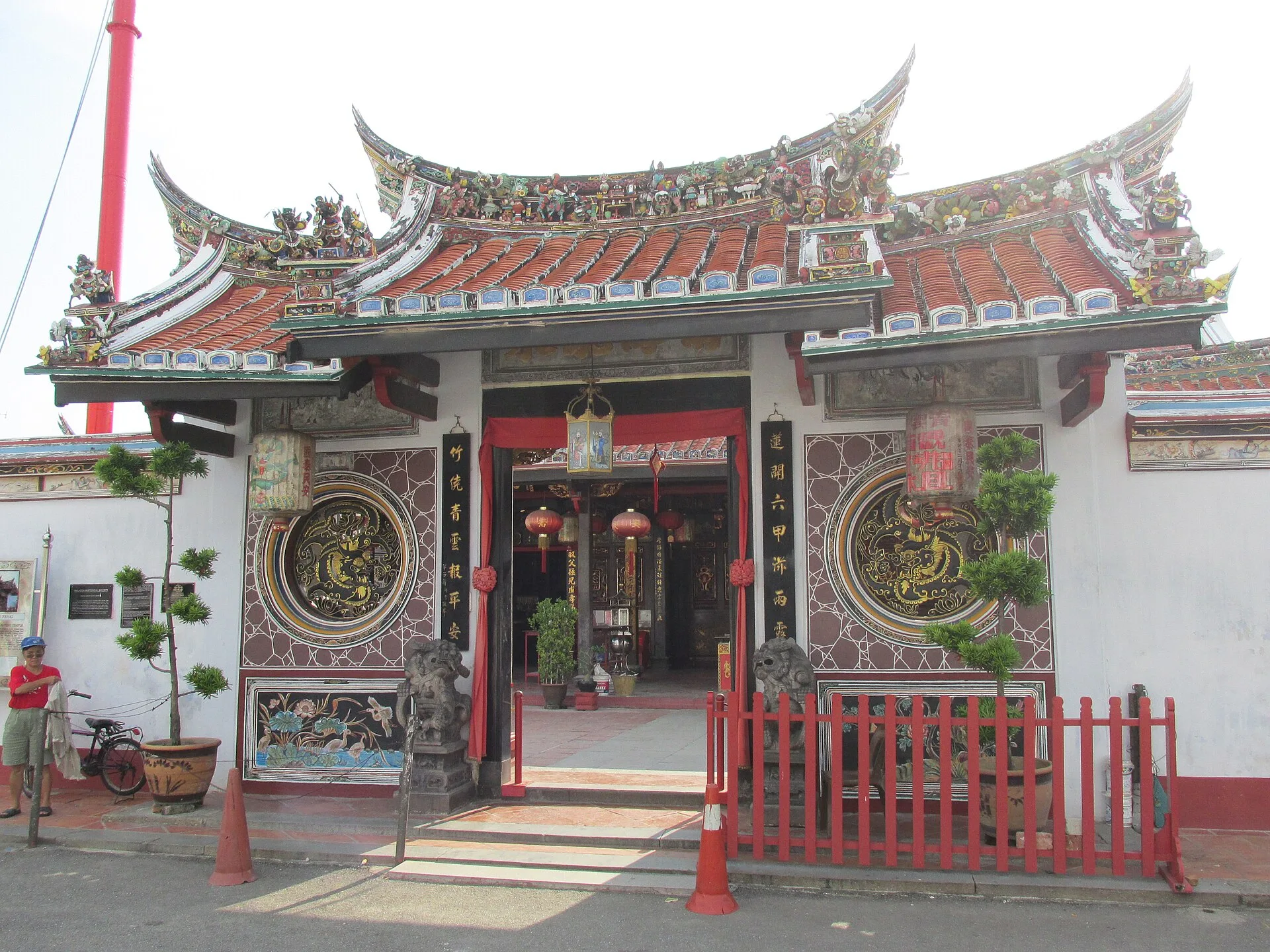
A few streets from Jonker Street, the tone changes at Cheng Hoon Teng. The 2016 photograph shows the temple entrance: carved rooflines and a compressed frontage sit directly in the urban fabric. It is an exterior view, useful for recognising the place without implying that the photographer entered a private or restricted part of the complex. This is still a religious site. The most respectful first step is to slow down and observe how others enter and worship.
The temple’s own history pages describe its long development and the craftsmen and communities involved in building it. That layered account matters more than a single “oldest” label: structures have been maintained, repaired and changed over time. Tourism Malaysia includes Cheng Hoon Teng among Melaka’s religious heritage, a reminder that the old town’s many traditions occupy neighbouring streets rather than separate districts. A photograph of the gate can introduce the architecture, but it cannot prove what rituals, access rules or restoration work you will encounter on your visit.
From here the journey changes to Dutch Square on the other side of the historic centre. This is an editorial jump between sourced images, not a continuous street-view route. Before setting off, check the present crossing and the route you prefer. If you enter the temple, dress and photograph according to posted rules and give worshippers space; a good visit should not turn someone else’s prayer into background scenery.
Real-travel note
A place of worship, not merely a photo stop. Follow current entry and photography rules and check opening information before travelling.
Chapter 3 · The civic centre
The red buildings of Dutch Square
At Dutch Square, the scale opens up. The photograph shows red buildings around a busy public space, with visitors crossing the foreground and trees breaking up the façades. Tourism Malaysia identifies this as one of Melaka’s defining colonial-era ensembles, including the Stadthuys and Christ Church. The red is immediately memorable, but the square is not only a backdrop for a selfie: it is a place where the city’s European colonial layers meet the daily movements of residents and visitors.
The image was made on a morning in February 2016. It documents that moment rather than the present arrangement of bicycles, vehicles, shade or pedestrian space. UNESCO’s account of Melaka as a trading town helps put the Dutch-period architecture in a longer sequence; it does not erase the Malay sultanate, Portuguese period or the many Asian communities that also shaped the port. To understand the square, notice what is preserved, what has been repurposed, and what still functions as a route through town.
The next photo is up at St Paul’s Hill. A change of elevation is part of the real visit, but our still images do not survey the approach or prove an accessible route. Check signs and the path underfoot. If heat or rain makes the climb unappealing, there is no obligation to complete every chapter in one walk; the photographs are an introduction to deciding what suits you, not a completion challenge.
Real-travel note
This is a working public space. Use current crossings and signs; allow for sun, rain and a climb toward the next stop.
Chapter 4 · Above the square
Climb to St Paul’s Hill
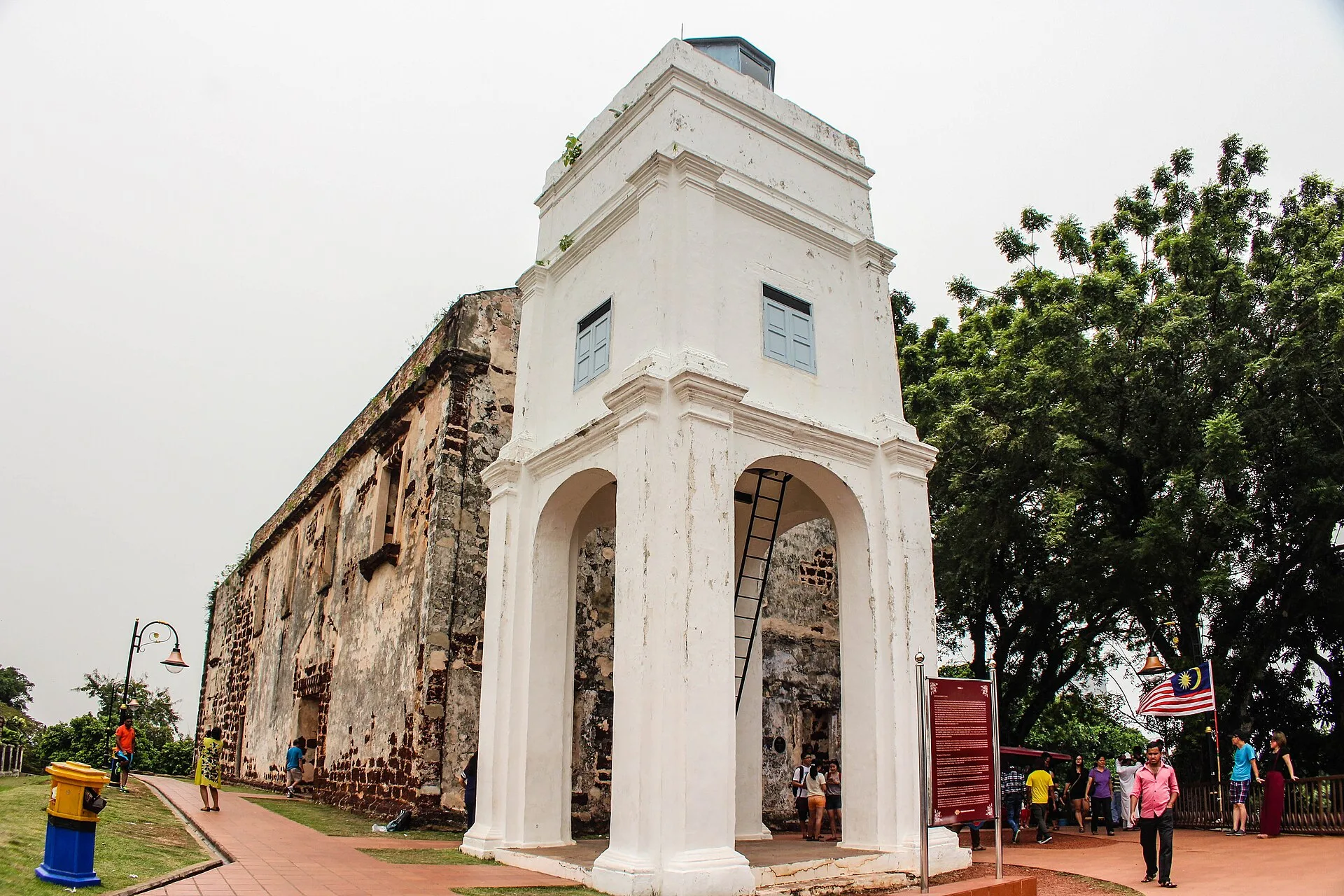
St Paul’s Hill asks for a different pace. A short climb separates the square from the church ruins, and the photograph rewards that change with weathered walls, open sky and a building no longer used as it once was. Tourism Malaysia describes the hill and church as a historic Melaka stop. The surviving fabric belongs to a layered history, including Portuguese and Dutch periods; a single photograph cannot explain every alteration or give a complete account of who used the site.
The September 2015 image is particularly useful for noticing what remains: a façade, openings and exposed masonry rather than a restored interior. Ruins can tempt us to imagine an unchanged 16th-century scene, but they are also the result of later uses, losses and preservation. Treat any legend heard on the hill as a story with a source, not as something the stone itself proves. The image records the structure on one day; it cannot guarantee clear views, dry steps or an empty site when you come.
From the hill, our final chapter shifts to Porta de Santiago. That visual move roughly follows the old-town heritage cluster, but the photographs were made in separate years and are not linked walking frames. Take the path and stairs that are actually open. If the climb or descent is difficult, decide whether to visit the gate by another suitable route instead of relying on these pictures for accessibility advice.
Real-travel note
There is a hill climb and descent. Wear suitable shoes, consider heat or rain, and verify the currently open path on site.
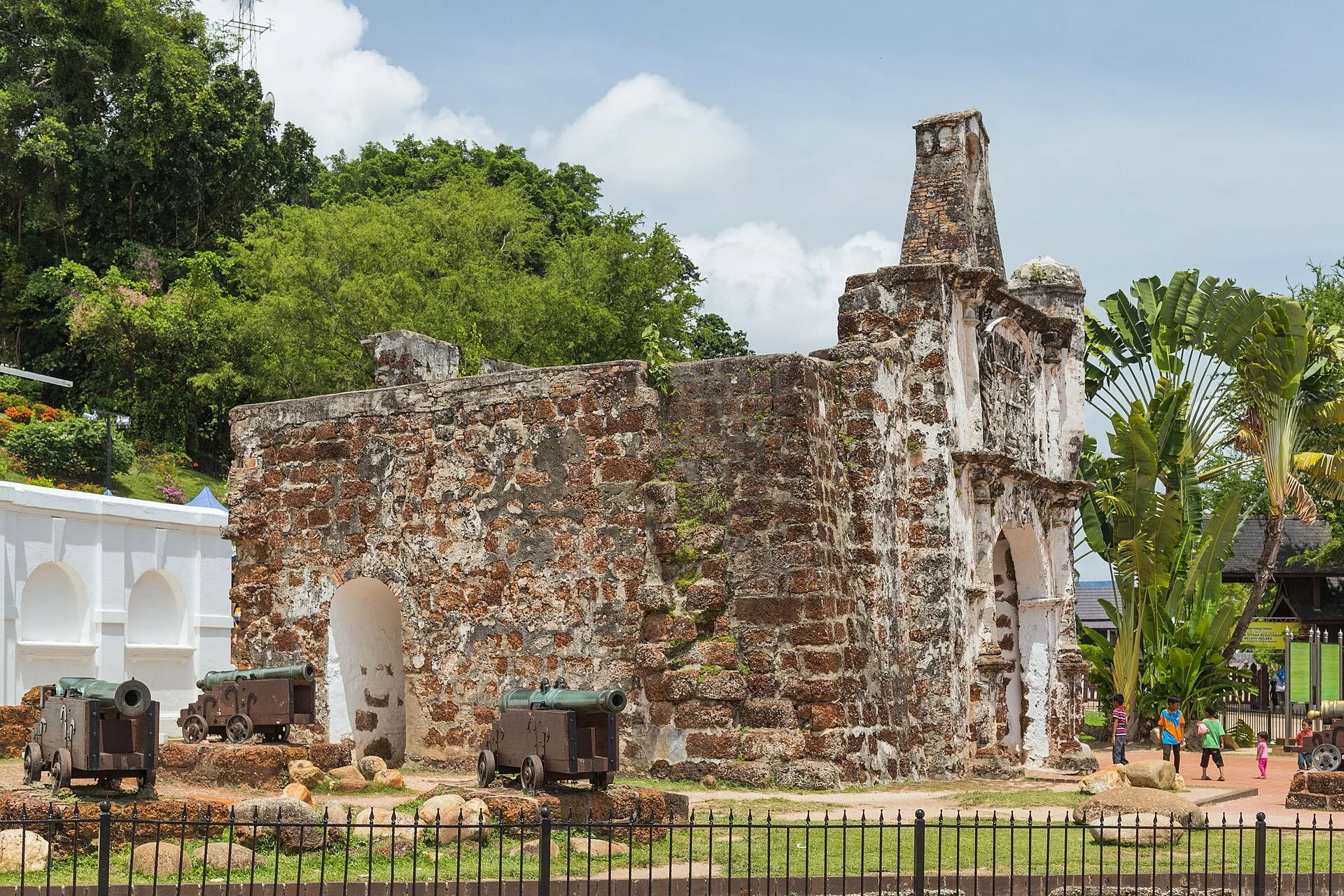
Chapter 5 · The surviving gate
End at Porta de Santiago
The last photograph is deliberately smaller in scale than the stories attached to it. Porta de Santiago is a stone gateway with a cannon nearby, not an intact fortress. Tourism Malaysia identifies it as a remaining part of A Famosa, the Portuguese fortification associated with Melaka’s colonial history. Framing the gate as a fragment matters: it prevents a visitor from expecting to walk the walls of a complete fort that is no longer there.
The photograph dates to February 2016. People and objects around the arch may have changed since then, but the image is still a useful introduction to the surviving form. UNESCO’s World Heritage description positions Melaka within a much wider story of commerce and cultural contact. By the time you reach this gate, the route has also passed a Chinese temple and a Dutch-period civic centre. The point is not to flatten those places into one neat colonial timeline; it is to notice how several histories occupy a compact city.
Five main documentary photographs have taken you through five distinct stops. Optional 360° viewpoints at Jonker Street, St Paul’s Hill and this gate let you look around when the live imagery is available, but they are separate moments, not connected walking footage. At Cheng Hoon Teng and Dutch Square, extra licensed photographs offer other angles instead of an unverified panorama. If this preview makes you want to go, use an up-to-date map and official access information to plan the real walk. If you would rather spend more time in one part of town, that is a sound decision too: Melaka is a living place, not a route you need to finish for a badge.
Real-travel note
The gateway is a historic remnant. Follow current site signs and verify any temporary access restrictions before visiting.
3 reviewed experiences
Explore along the route
Step into the places along this journey. Choose a view independently of the story chapters.
Explore at your own pace; these views do not count toward chapter completion. Short sequences cover only the reviewed section. Imagery availability may change.
Sources
- Melaka and George Town, Historic Cities of the Straits of Malacca — UNESCO World Heritage Centre
- Dutch Square — Tourism Malaysia
- St Paul’s Hill: The Church of St Paul — Tourism Malaysia
- Melaka — Tourism Malaysia
- Built History — Cheng Hoon Teng Temple
- Jonker Street Night Market in Melaka, Malaysia — Wikimedia Commons
- Melaka C - Cheng Hoon Teng entrance — Wikimedia Commons
- Cheng Hoon Teng Temple Melaka 2 — Wikimedia Commons
- Melaka - Cheng Hoon Teng Temple — Wikimedia Commons
- 2016 Malakka, Plac Holenderski (05) — Wikimedia Commons
- Melaka C - fountain, garden and Christ Church — Wikimedia Commons
- Melaka, Malaysia - Dutch Square or Red Square, March 2023 — Wikimedia Commons
- 1521 St Paul’s Church (Ruins) - Front View — Wikimedia Commons
- 2016 Malakka, A Famosa (01) — Wikimedia Commons


.jpg)


_-_Front_View.jpg)
.jpg)
Your journey, remembered.
The keepsake unlocks when you reach this section.