
Lyon Historic Centre, from the Saône to Fourvière
Explore two quarters of Old Lyon, the Saône riverbanks and the view from Fourvière hill.
Begin the visual journeyPlan a real visit to Lyon Historic CentreExplore 9 reviewed views along the routeGuided visual journey
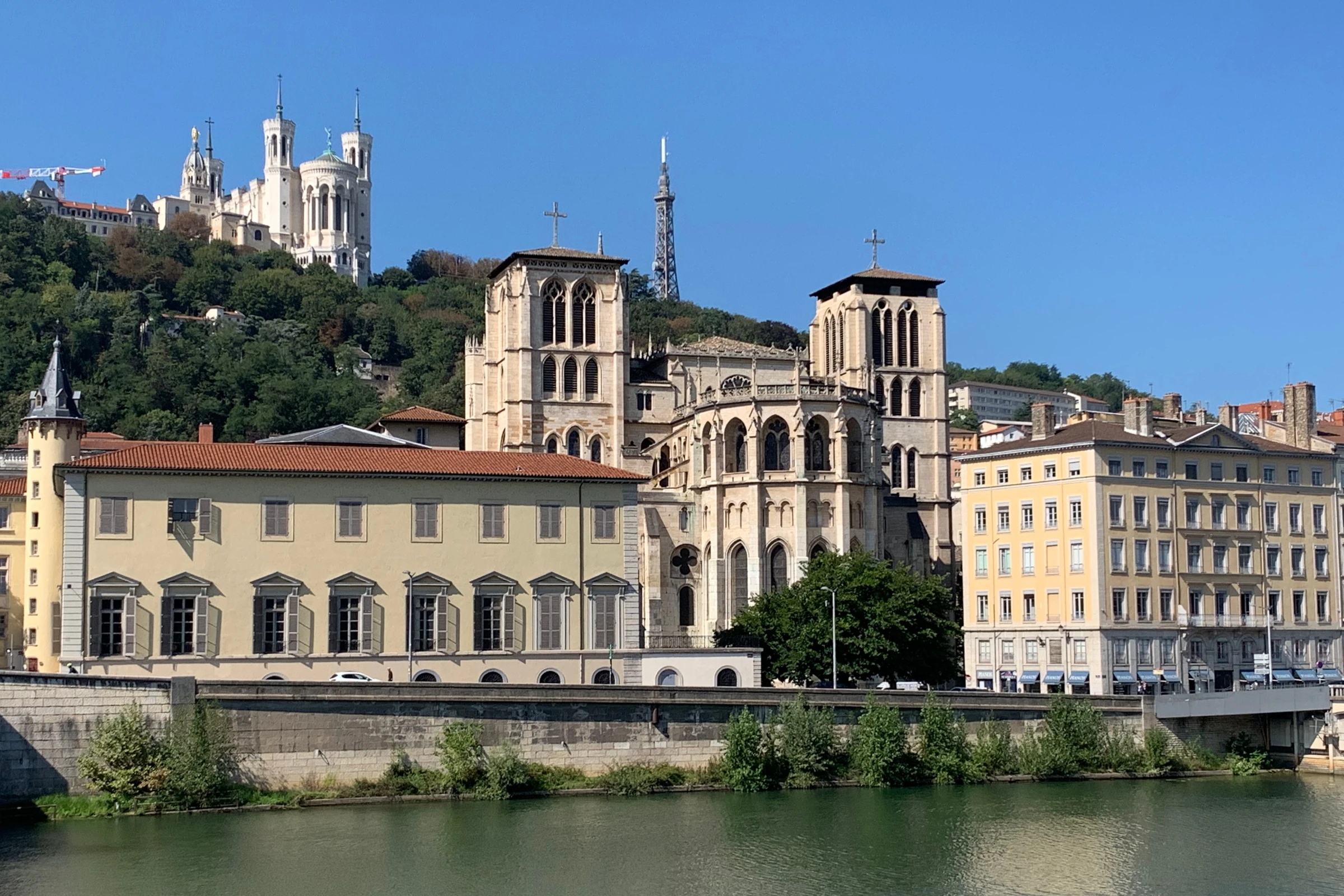
Old Lyon across the Saône · Benoît Prieur · CC0 · Resized, WebP
Reading mode
Place stories to read at your own pace
Each photograph has its own camera position and capture date.
Chapter 1
Saint-Jean, a cathedral and its square
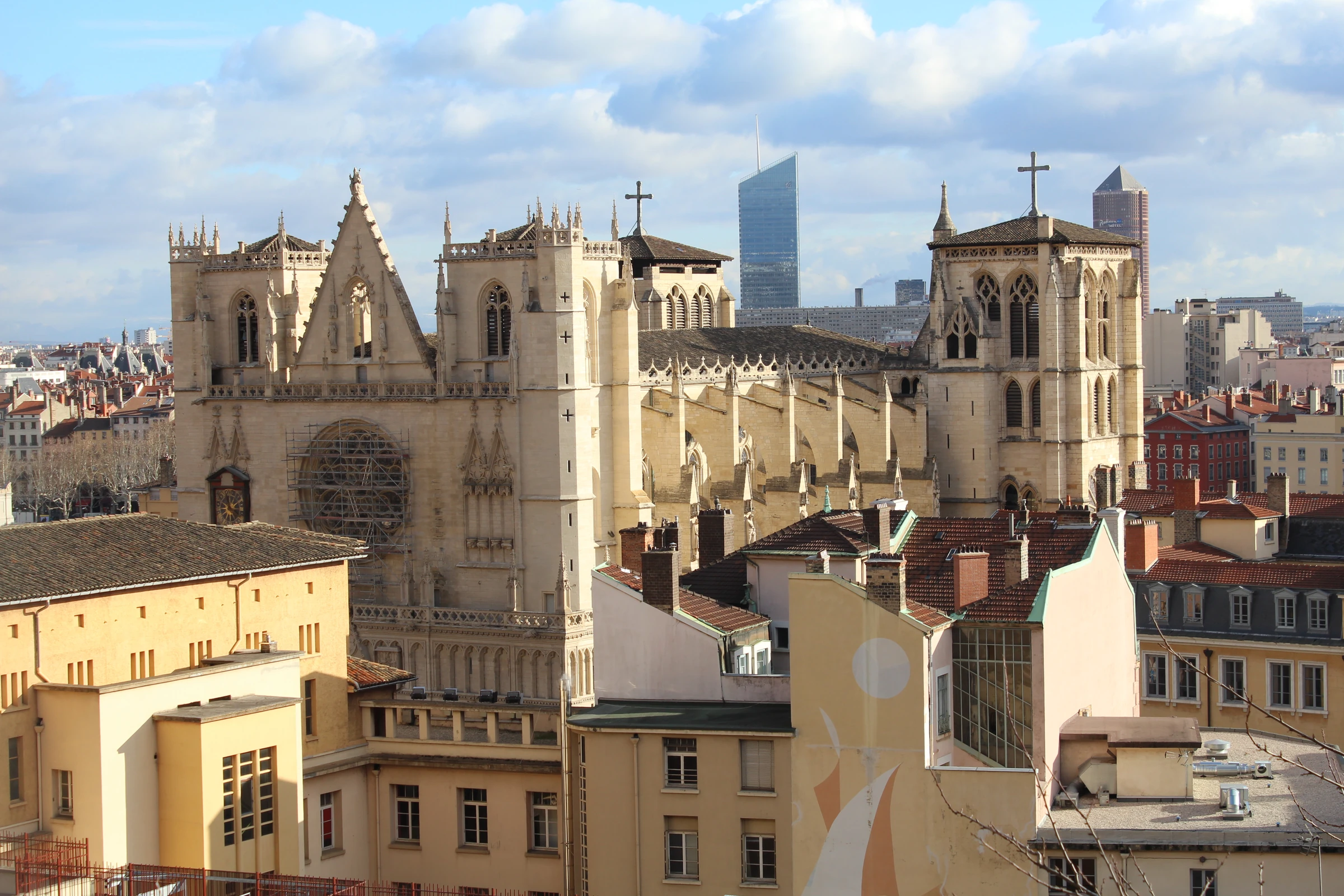
Start with the space in front of the cathedral. Place Saint-Jean gives you enough room to read the front as a whole, something the narrower streets of Vieux Lyon rarely allow. Compare the height of the religious building with the street fronts that collect around it. The square belongs to the city as well as to the cathedral. The open ground makes it possible to move across the field of view, pause in the middle and see how the composition changes when the building is no longer straight ahead.
The cathedral was built from the twelfth to the fifteenth century. Those centuries make more sense if you imagine a succession of campaigns, with later builders inheriting walls, foundations and decisions from earlier ones. The tourist office also notes two major church councils held here in the thirteenth century. A public event gives a point of reference within that long construction history. It also suggests how a building could already be central to the life of the city while work on it extended across generations.
The broad still looks across tiled roofs to the west front and the long side of the nave. In the close still, trace the branching stone of the rose window around its centre. The portrait of Rue des Antonins shows how abruptly the room to look around narrows once you leave the square.
Along its northern side, the archaeological garden tells another story about the size of this religious precinct. The surviving remains there belong to other buildings, including the churches of Saint-Étienne and Sainte-Croix and a baptistery. The cathedral is the most prominent building in the square today, while the archaeology records a group of related institutions. Imagine the everyday distances between those buildings before returning your attention to the standing cathedral.
The discovery at Maison du Chamarier carries the story into a house associated with the cathedral precinct. Its courtyard belonged to a residence, a different kind of space from the one spreading in front of the cathedral. Together they give a sense of how closely domestic, administrative and religious life could sit in this part of Lyon. Compare how the view gathers around a building from across a square with how it narrows when you look inward into a house.
Real-travel note
Consult the cathedral and tourism office for access to individual buildings and archaeological areas.
Each photograph has its own camera position and capture date.
Chapter 2
Saint-Paul, a church in the grain of the old town
Saint-Paul gives Vieux Lyon a different scale. You are close to the northern end of the historic riverside district, where the slope presses against the built-up strip by the Saône. The church shares that strip with ordinary streets and residences. To get your bearings, think of the river as a long edge below you and the hill as the higher edge behind the neighbourhood. The streets make sense within that shallow band of land even when the river itself falls out of sight.
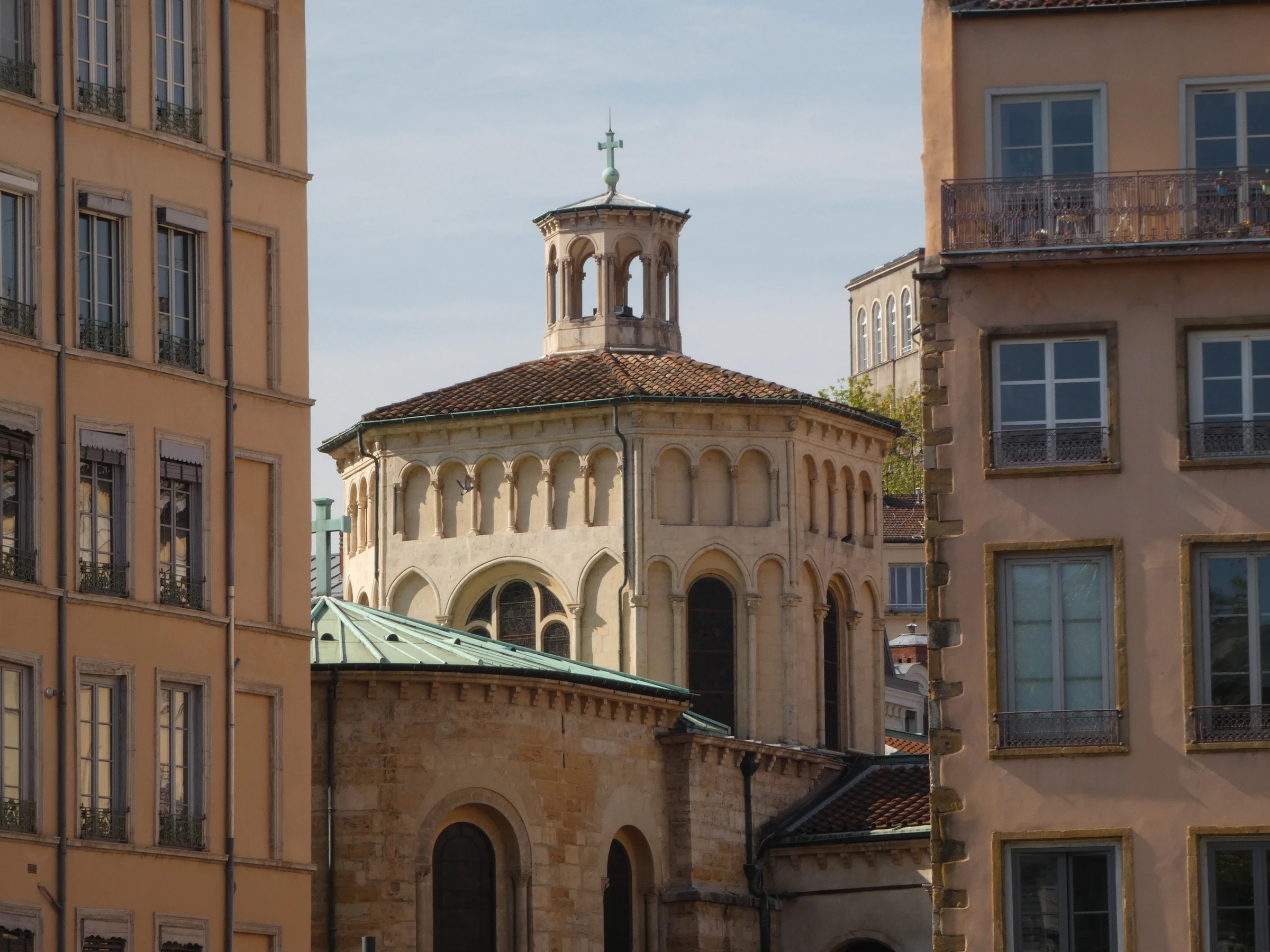
The City of Lyon dates the building work at Saint-Paul from the eleventh to the fifteenth century and notes important nineteenth-century alterations. It singles out the survival of Romanesque elements, including parts of the nave and the structure beneath the dome in the octagonal tower. A silhouette seen over rooftops and a building observed from beside its walls are two ways of getting to know the same church. The skyline locates it among other buildings. A closer view gives a sense of the separate masses that meet within the site.
The Renaissance houses of Vieux Lyon preserve evidence of another kind of wealth and ambition. At Gadagne, the museum traces the buildings to the Pierrevive family and records a purchase by the Florentine Gadagne family in 1545. The property later passed through very different arrangements, from an elite residence to smaller tenancies and finally to museum use. It helps explain why a block of apparently ordinary street fronts can hold such a substantial building behind it. The way space is divided from the street can change even where a familiar outline survives.
Compare this chapter with Saint-Jean. The cathedral introduced a broad public foreground and buildings connected to a religious institution. Here, church, houses and local streets press more closely together in the view. In the still from Quai Saint-Vincent, two residential fronts frame the lantern. The detail isolates the carving above the church portal, and the Rue Juiverie portrait follows the pale strip in the paving between the buildings. A tight scene makes individual walls important, while a wider one helps place the church within the strip of settlement between river and hill.
Real-travel note
Check access to the church and Gadagne separately before visiting.
Each photograph has its own camera position and capture date.
Chapter 3
The Saône, a view across the city
Take in the river from bank to bank. The broad Saône view lets the eye travel along the water before climbing the line of old town roofs toward Fourvière. That change in height does much of the work of orienting you. At water level the quays pull the city into a horizontal line. Behind them one row of buildings can hide another, until the hill lifts the skyline above both. Fourvière is still a distant landmark here. Save the change in viewpoint for the last chapter, when we look back down from the hill.
The Saône lies between Vieux Lyon and the Presqu’île in this part of the centre. The latter occupies the tongue of land between the Saône and the Rhône. UNESCO treats the historic city as a site made up of several areas that preserve evidence of Lyon’s development over a long period. The river makes the separation between neighbourhoods conspicuous on a map. Seen at street level, it also provides room to understand how those districts belong to one city.
Lyon’s history museum describes the late antique city drawing closer to the Saône as Roman power waned. The church established itself on the river side of the hill, leaving an enduring concentration of religious sites. The river scene is useful after the two church chapters because it gives all those streets a larger setting. Try finding the strip of land in your mind first, then put the religious and residential buildings back into it. From this distance, even an important building may register as just one part of a crowded row.
The still made from the water brings the arches of Pont Bonaparte down to the level of a boat’s wake. The context still faces a different crossing, the red footbridge at the Palais de Justice. Each view makes the direction of the river and the shape of a crossing visible at once.
Two discoveries give the river chapter its own human scale. The historic Palais de Justice makes a long architectural front toward the water. The Passerelle Saint-Vincent offers a much narrower figure across it. Compare a structure made to run beside the current with one built to cut across it. Both help explain why the same open stretch of water can work as a foreground for buildings, a boundary between districts and part of an everyday route through the city.
Real-travel note
Choose your crossing separately and check local access to each bank and to the footbridge.
Each photograph has its own camera position and capture date.
Chapter 4
Place des Terreaux, a square with three landmarks
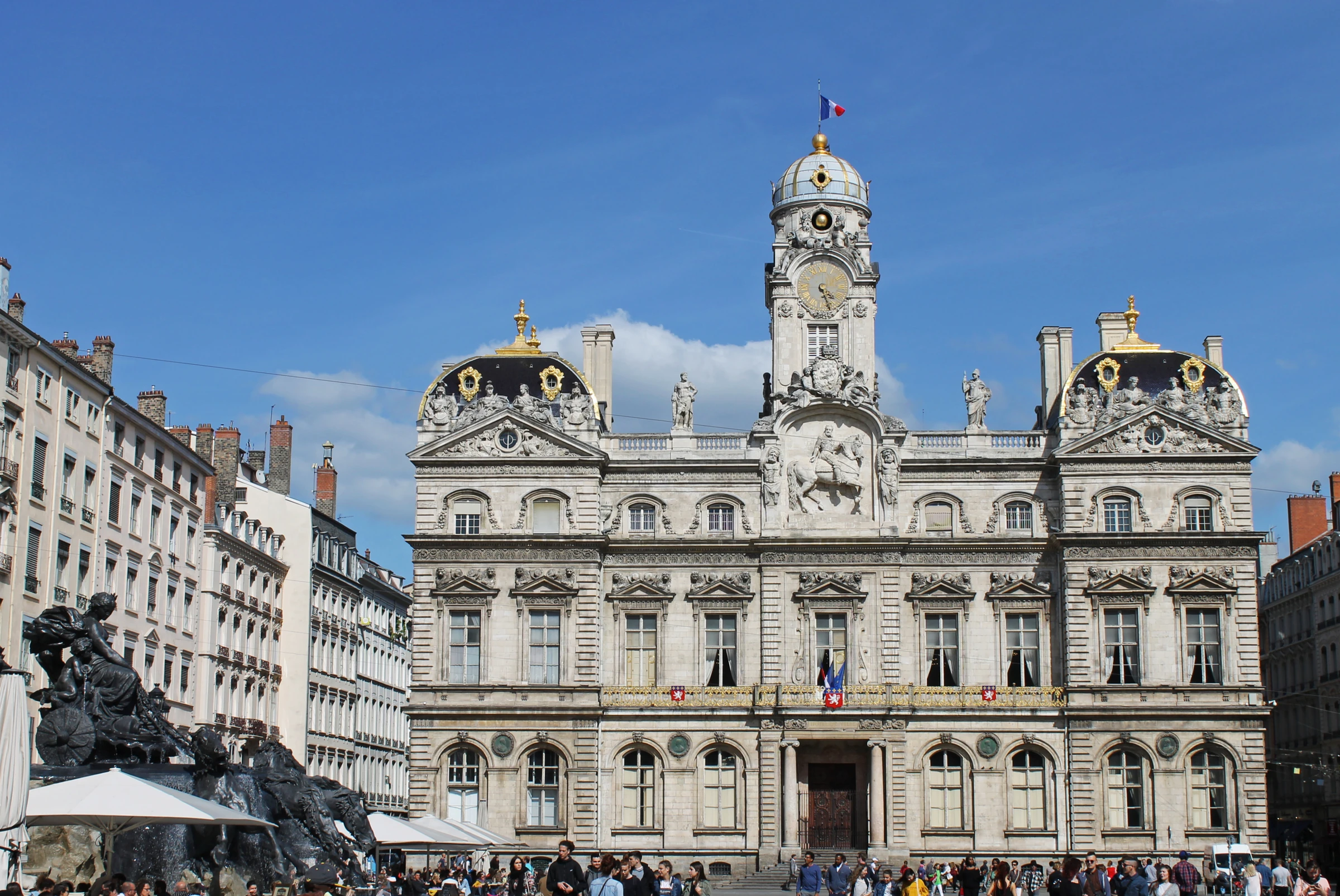
At Place des Terreaux, think of the paving as the space that allows the architecture to be read together. City Hall closes the eastern end of the square. The Palais Saint-Pierre forms the southern edge. The Bartholdi fountain gives the open ground a more concentrated subject. From different camera positions one building takes over the foreground and another retreats to the side. Keep the layout in mind while you change views and the separate pieces of architecture remain part of the same square.
City Hall acquired its present profile through building and rebuilding. Gadagne’s account of its architectural model describes the severe fire of 1674 and the work entrusted to Jules Hardouin-Mansart and Robert de Cotte early in the eighteenth century. The long elevation beside it corresponds to another history. The Palais Saint-Pierre housed a Benedictine abbey, with a cloister court behind its broad face. The Museum of Fine Arts traces its founding to the 1801 Chaptal decree, which established painting collections in cities across France. An abbey building became part of a public museum while retaining its place on the square’s edge.
The fountain works in a different register. Bartholdi’s horses and figures gather mass and movement in a single group. Against straight lines of windows and cornices, the impression of force comes from forms that bend, turn and bunch together. The sculpture has also occupied more than one position in the square. The tourist office records its relocation during the redesign led by Christian Drevet and Daniel Buren. In the wide still, the fountain appears at the edge of the City Hall view. The close still puts water and the horses at the centre. In the museum still, people crossing the paving give the long southern facade a scale you can compare with the other two views.
Bellecour, the associated discovery, lets you compare very different uses of open ground within the Presqu’île. In one square, civic buildings enclose a fairly tight rectangle. In the other, a distant statue and the edges of the square are separated by a large foreground. Both place prominent monuments within the public space of the city. Your sense of proportion depends as much on the distance around those monuments as on the objects themselves.
Real-travel note
Use the Museum of Fine Arts and the tourist office to check visits, events and any temporary changes to the square.
Each photograph has its own camera position and capture date.
Chapter 5
Fourvière, looking back from the hill
The last chapter changes the direction of the view. On the Saône the buildings rose from the river to the hill behind them. At Fourvière you are looking at the summit itself or looking back down from it. Use the river chapter as a reference as you move between the two perspectives. A large building in the foreground can make the rest of the city feel distant. From the open side of the hill the great mass of streets and roofs helps put the building back into the geography of Lyon.
UNESCO connects the city’s ancient history with this hill. The Roman settlement of Lugdunum began here, long before the skyline acquired its modern silhouette. Over time the centre of activity extended to the land by the Saône and across the water. From earlier chapters you know that the cathedral, riverside residences, courthouse and public squares belong to very different institutions and periods. A view from above brings their settings into relation without turning them into a single building campaign or a single moment in history.
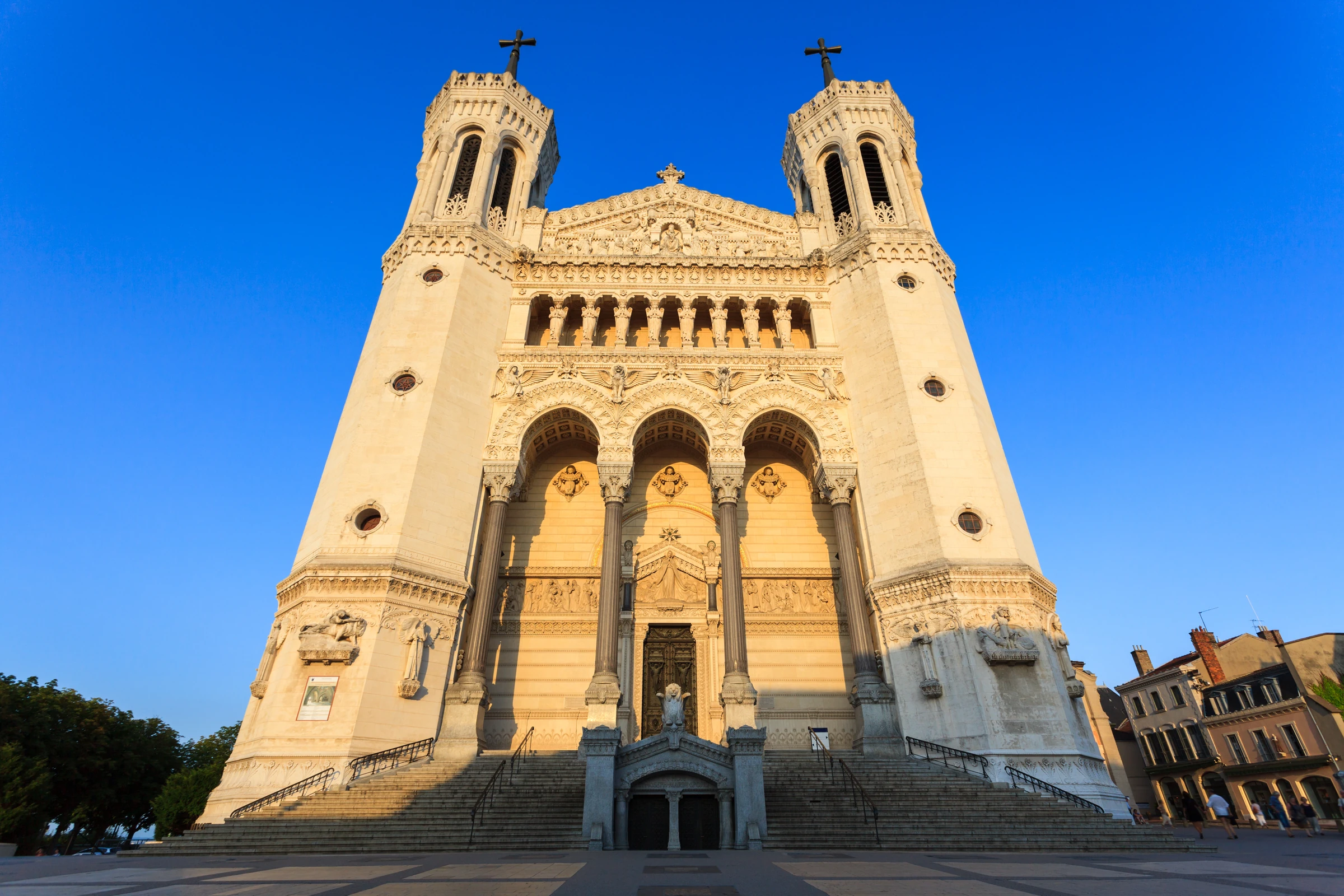
The sanctuary dates the laying of the basilica’s first stone to 1872 and its consecration to 1896. The title of basilica followed in 1897. Those are three distinct milestones in the history of the same building. Seen from the river, its shape becomes part of the whole hill. The exterior still looks up at the twin towers and the three arches over the entrance, while the interior still isolates a gold and blue mosaic vault. The separate view down over the Saône includes the row of trees on the far quay. The interior photograph records the vault at the time of capture. Consult the sanctuary for current admission arrangements.
Finish by recalling where you could see the hill in the preceding chapters. The Palais de Justice discovery gives the riverside a civic face. The paired views at Terreaux and Bellecour give the Presqu’île its own public scale. Fourvière relates those pieces from above. The chapter change is a jump to a separately planned visit. The sanctuary publishes ways of reaching the hill, including the funicular from Vieux Lyon, and separate information for visiting the building.
Real-travel note
Plan the hill separately. Check the sanctuary’s directions, current transport service, opening and access arrangements before you go.
9 reviewed experiences
Explore along the route
Step into the places along this journey. Choose a view independently of the story chapters. Free previews do not count toward chapter progress. Return to the journey above to continue through its stops.
Saint-Jean, a cathedral and its square Short observation sequence
360° capture month 2021-02. 3 connected local positions with movement in either direction. Three views from Place Saint-Jean face the cathedral’s carved portals. Sheeting covers part of the upper façade and a work barrier crosses part of the square. Still photograph taken 2017-12-28.
Reviewed 2026-11-20 · Nearby viewpoint
Explore at your own pace; these views do not count toward chapter completion. Check each point's coverage note before navigating provider imagery. Availability may change.
Sources
- Historic Site of Lyon — UNESCO World Heritage Centre
- The Vieux Lyon district — Lyon Tourist Office
- Saint John’s Cathedral — Lyon Tourist Office
- The archaeological garden at Saint-Jean — Lyon Tourist Office
- Saint-Paul church — Ville de Lyon
- History of the Gadagne buildings — Gadagne
- History of Lyon — Gadagne
- Lyon’s bridges and the Saint-Vincent footbridge — Ville de Lyon
- Place des Terreaux — Lyon Tourist Office
- The Bartholdi fountain — Lyon Tourist Office
- Two hundred years of the Museum of Fine Arts — Musée des Beaux-Arts de Lyon
- A model and history of Lyon City Hall — Gadagne
- The consecration of Notre-Dame de Fourvière — Notre-Dame de Fourvière
- Getting to Fourvière — Notre-Dame de Fourvière
- Fourvière visitor information — Notre-Dame de Fourvière
- Maison du Chamarier — Lyon Tourist Office
- The historic courthouse with 24 columns — Lyon Tourist Office
- Palais de Justice de Lyon heritage record — Ministère de la Culture
- Lyon’s squares, including Place Bellecour — Lyon Tourist Office
- The statue of Louis XIV — Lyon Tourist Office
- Saint-Jean Cathedral’s west front and long nave rise above tiled roofs and pastel buildings in Vieux Lyon. — Chabe01
- The round rose window of Saint-Jean Cathedral, with petal-like stone tracery set into the west façade. — © Xavier Caré / Wikimedia Commons
- The paved Rue des Antonins runs between close-set buildings near Saint-Jean Cathedral. — Sebleouf
- Saint-Paul Church’s octagonal lantern and tiled roof framed by two buildings across the Saône. — Romainbehar
- Pointed stone arches frame the carved Conversion of Saint Paul above the church portal. — Romainbehar
- A strip of blue sky above the narrow Rue Juiverie, with a pale band running through the paving. — Sgroey
- Saint-Jean Cathedral and the old town waterfront across the Saône, with Fourvière Basilica on the wooded hill above. — Benoît Prieur
- The stone arches of Pont Bonaparte seen from the water, with a white boat wake in the foreground. — Romainbehar
- A red footbridge spans the Saône alongside the historic courthouse and the opposite quay. — Romainbehar
- The ornate Lyon City Hall and its clock tower face Place des Terreaux, with part of the Bartholdi Fountain at left. — Aldg692VX
- Water spills between the rearing horses beneath the central figure of the Bartholdi Fountain. — Zairon
- Pedestrians and a cyclist cross Place des Terreaux in front of the Musée des Beaux-Arts. — Corentin Eustacchi
- The sunlit west façade of Fourvière Basilica, with two towers and three arches above the entrance stairs. — Fenliokao
- Inside Fourvière Basilica, gold and blue mosaics cover the vaulted ceiling around a round central medallion. — Pymouss
- A view from Fourvière over the Saône, a long row of riverside trees and the dense roofs of central Lyon. — Celeda
- A stone arch frames the sunlit interior courtyard and gallery of the Maison du Chamarier. — Guilhem Vellut
- The footbridge leads straight toward the long colonnade of Lyon’s historic courthouse, with Fourvière above it. — Calips
- The red deck and suspension cables of the Saint-Vincent footbridge beside a stone pylon above the Saône. — Calips
- The red gravel of Place Bellecour meets pale façades below Fourvière, under a blue sky with scattered clouds. — Guilhem Vellut


Your journey, remembered.
Explored 0 of 5 stops. Explore every stop to unlock your keepsake.
5 stops to your keepsakeExplore every stop to share or download your keepsake.
Plan your visits in Lyon
Use the chapters to get oriented and check visiting arrangements in the old town, the Presqu’île and Fourvière separately.
Official sources checked:
Old Lyon and the Presqu’île
Saint-Jean and Saint-Paul are on the Old Lyon side. Terreaux and Bellecour are on the Presqu’île. Check crossings, interior access and local diversions for your visit.
Fourvière hill
Allow a separate trip up the hill. The sanctuary publishes directions from Vieux Lyon by funicular and information on openings and visits.