
Lisbon: from patterned squares to the roofs of Alfama
Explore Lisbon in five chapters between Rossio, Carmo, Praça do Comércio, the cathedral and Portas do Sol. Compare fifteen credited photographs and optional local street scenes, with four extra places to explore independently.
Begin the visual journeyPlan a real visit to Lisbon Baixa & AlfamaExplore 9 reviewed views along the routeGuided visual journey
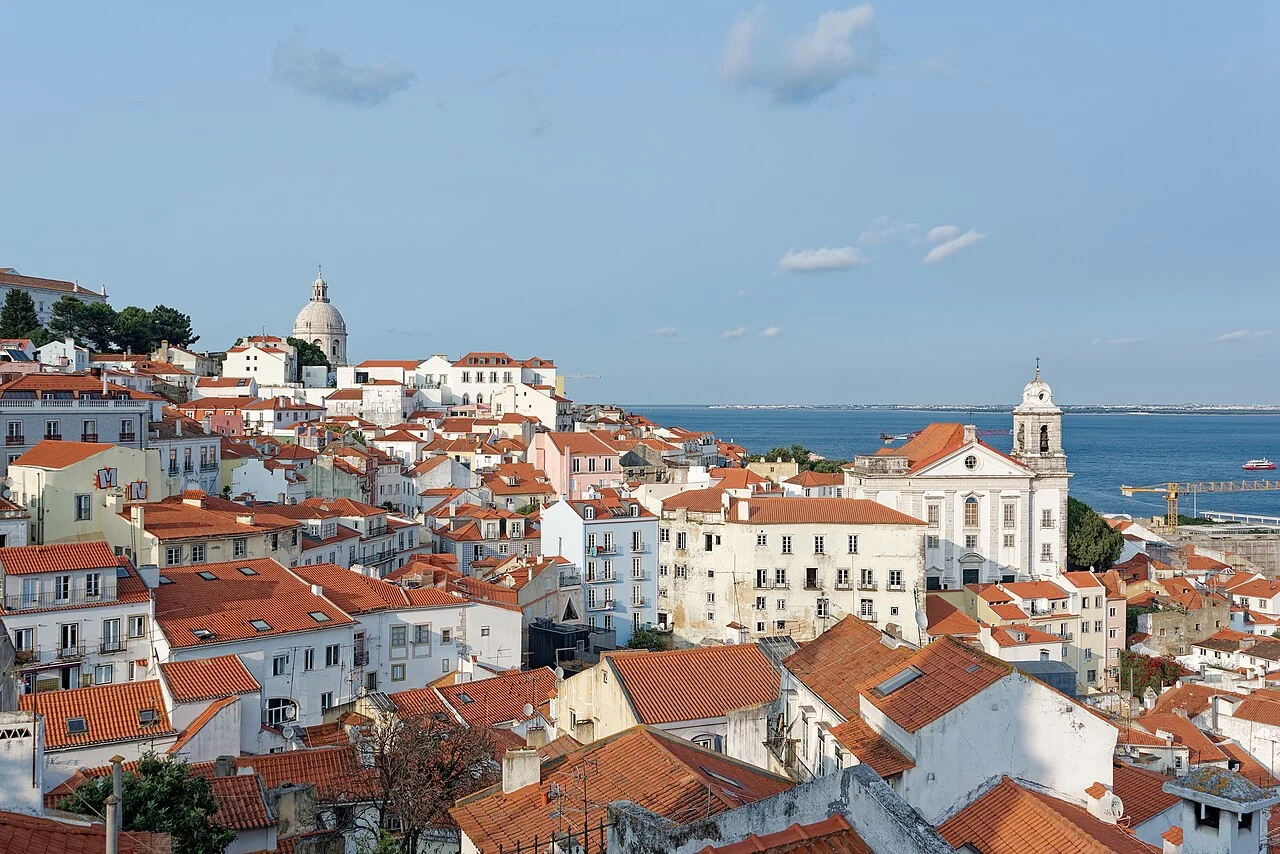
Alfama seen from Portas do Sol · Jakub Hałun · CC BY 4.0 · Resized and converted to WebP
Reading mode
Place stories to read at your own pace
Use the visible gallery arrows and thumbnails to compare the place, a detail and another viewpoint.
Chapter 1 · Start with the ground
Find a rhythm in Rossio’s paving
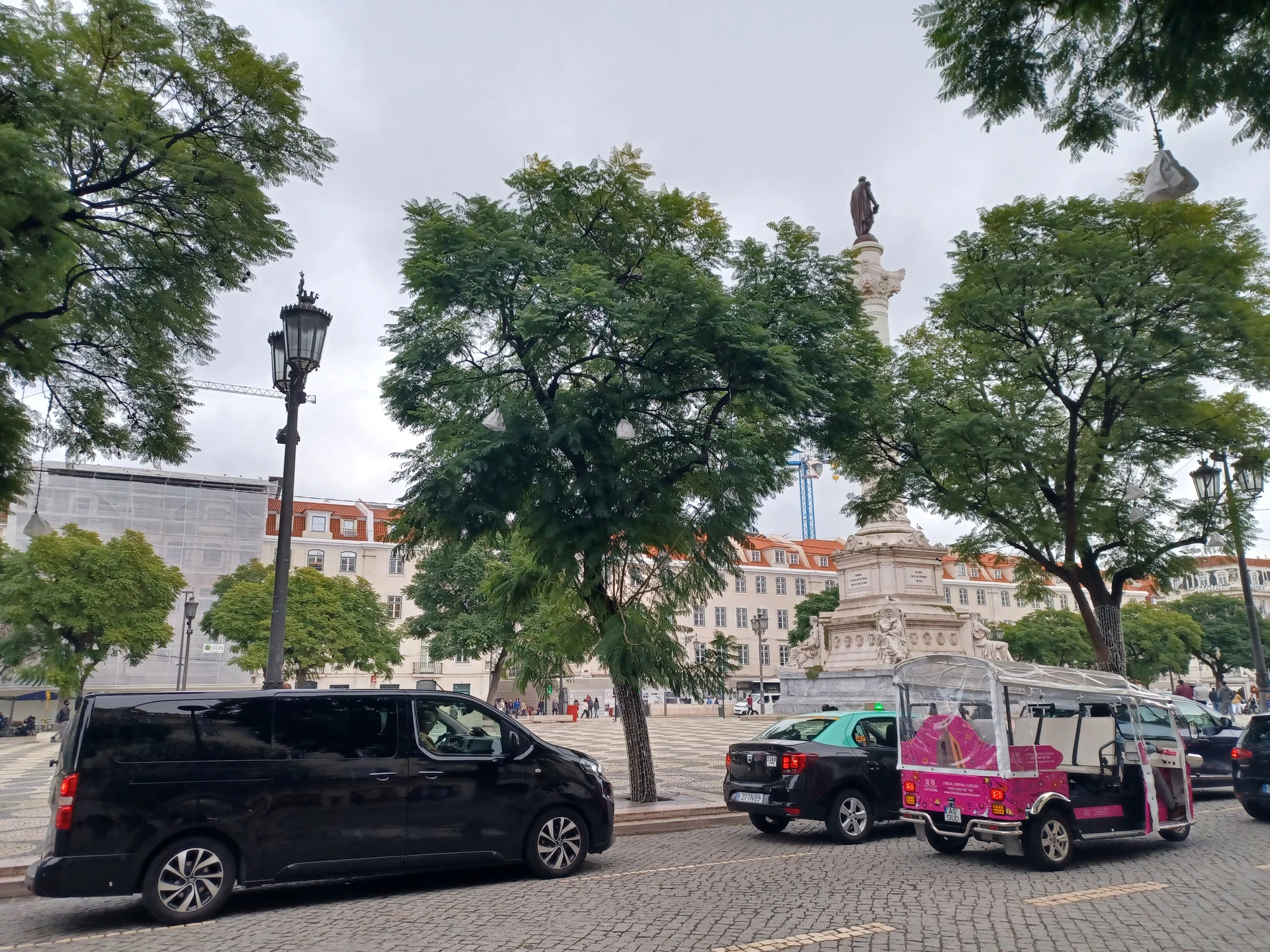
Begin by looking down. The dark and light paving at Rossio gives the square a rhythm before a building becomes your destination. Follow a curve through the photograph, then look up to the fountain and the column. Their vertical forms are useful reference points when the surrounding streets all seem to offer another direction. Visit Lisboa identifies Rossio as the familiar name for Praça de D. Pedro IV, so those two names on a map refer to the same square.
The gallery changes both date and distance. Two January 2023 photographs show the square from different positions; the November 2011 image includes the fountain and paving. Trees, parked vehicles and people may interrupt the view, which is part of reading an occupied square rather than a perfectly cleared postcard. Use the visible arrows and thumbnails to compare the column’s position against the edges of the frame. The images are independent photographs, not steps recorded during one visit.
The June 2026 Google fragment is at the square’s street edge. Turn towards the paving before trying its three local positions and return. It does not carry you to Carmo or validate a crossing into the square. Keep that distinction when planning an actual day: the visual journey connects ideas, while traffic, crowds and the physical climb still need your own decisions.
Read further: Lisbon’s Rossio: the waves beneath your feetReal-travel note
June 2026 local street-edge imagery. Three positions only; use actual pedestrian facilities, not the road-camera position.
Use the visible gallery arrows and thumbnails to compare the place, a detail and another viewpoint.
Chapter 2 · A smaller room in the city
Pause between the fountain and Carmo’s doorway
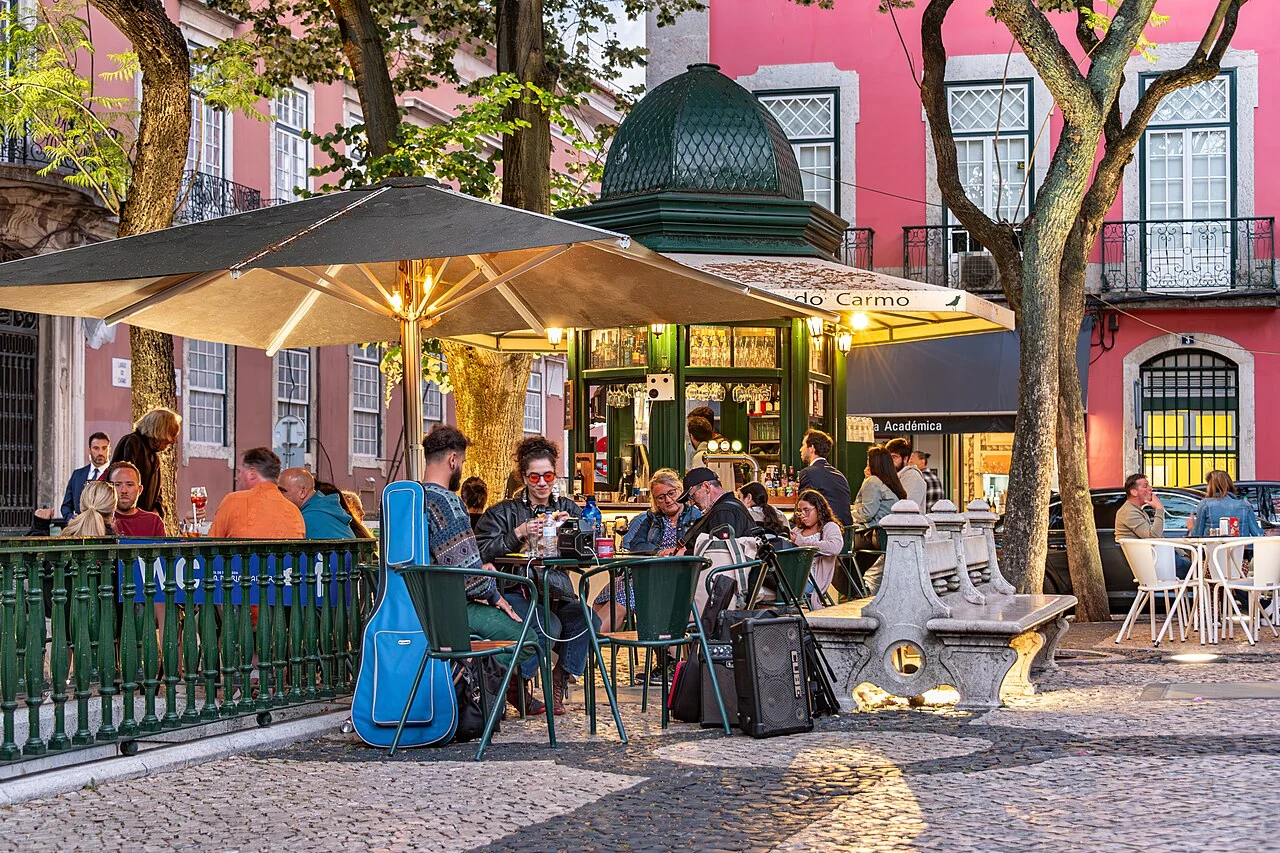
Carmo changes the scale of the journey. Instead of Rossio’s long open space, look for a smaller square organised by trees, seating, a fountain and a stone entrance. Start with the café frontage in the first picture and ask where people have left room to pass. Then switch to the convent façade: the doorway becomes a destination without requiring you to enter it. The fountain gives another way to understand how much space these elements share.
The June 2024 square photograph, June 2025 façade and May 2019 fountain are separate observations. Their trees, light and temporary furniture do not have to match. In the façade picture, compare the shape of the opening with the branches above it; in the fountain view, compare the canopy with the buildings behind. These changes of scale make a small place worth more than a single quick image. They do not establish today’s café seating or an open museum door.
The July 2024 Google fragment looks along the outside of Largo do Carmo and offers three positions with a return. It stays outside the archaeological museum. Santa Justa is a separate nearby exploration from below, not a transport connection supplied by this chapter. Carris’s viewing-platform notice was checked on 23 October 2026 and reported a temporary closure. Consult the operator before planning around any lift or platform, and do not assume a virtual route resolves the hillside’s steps.
Real-travel note
July 2024 exterior square fragment. No museum entry or verified lift connection; check current Carris and museum information.
Use the visible gallery arrows and thumbnails to compare the place, a detail and another viewpoint.
Chapter 3 · Leave an edge open
Let Praça do Comércio open towards the river
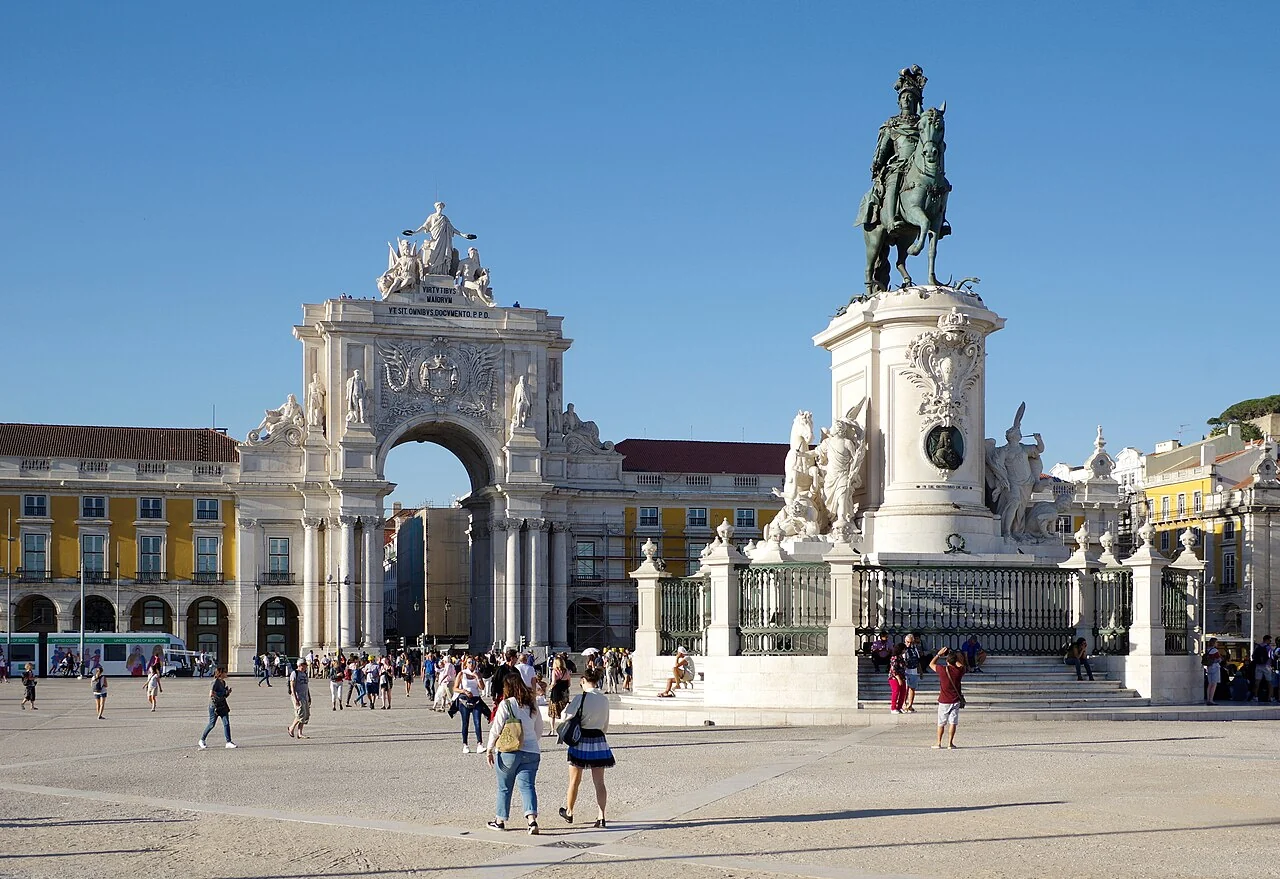
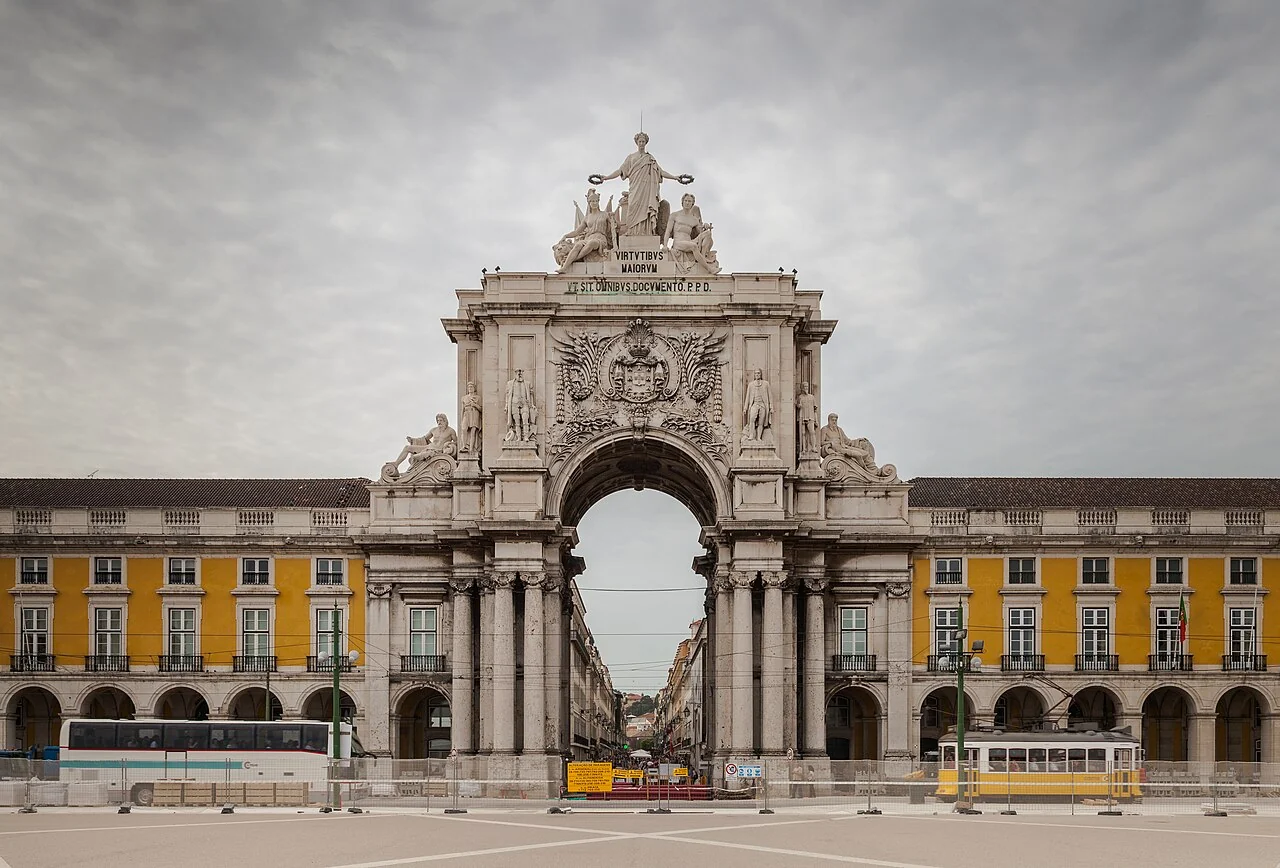
At Praça do Comércio, turn your attention from an enclosed street to an open edge. Look at the repeated arcades and then find the Rua Augusta Arch. Together they give the square a strong frame, but the river prevents that frame from feeling closed on every side. From a photograph alone, the width can be difficult to judge; use the people and the equestrian statue as scale references rather than relying only on the monumental façade.
The first photograph records the square in October 2018, the arch view was made in May 2012, and the June 2025 photograph looks east from the top of the arch. That last viewpoint is deliberately labelled as elevated. It cannot show what is visible to somebody standing on the paving, and it does not include admission to the arch. Compare the broad organisation of roofs and streets there with the closer arches in the other images. Visit Lisboa also uses the local name Terreiro do Paço for this square.
The optional Mapillary panorama sequence was captured on 12 October 2026 along the river-facing edge of the square. Look back towards the arch, rotate to the river and try the local forward/back controls. A few neighbouring frames and their return were checked, not every continuation in the upload. Cais das Colunas has a separate April 2026 Google fragment beside the road; it is not the next linked step from this scene or permission to descend to wet steps. The chapter ends with a change of viewpoint, not a promise about present access.
Real-travel note
October 2026 Mapillary square-edge panorama sequence; only local steps were checked. Events and river access may change; no arch admission or safe waterside descent is included.
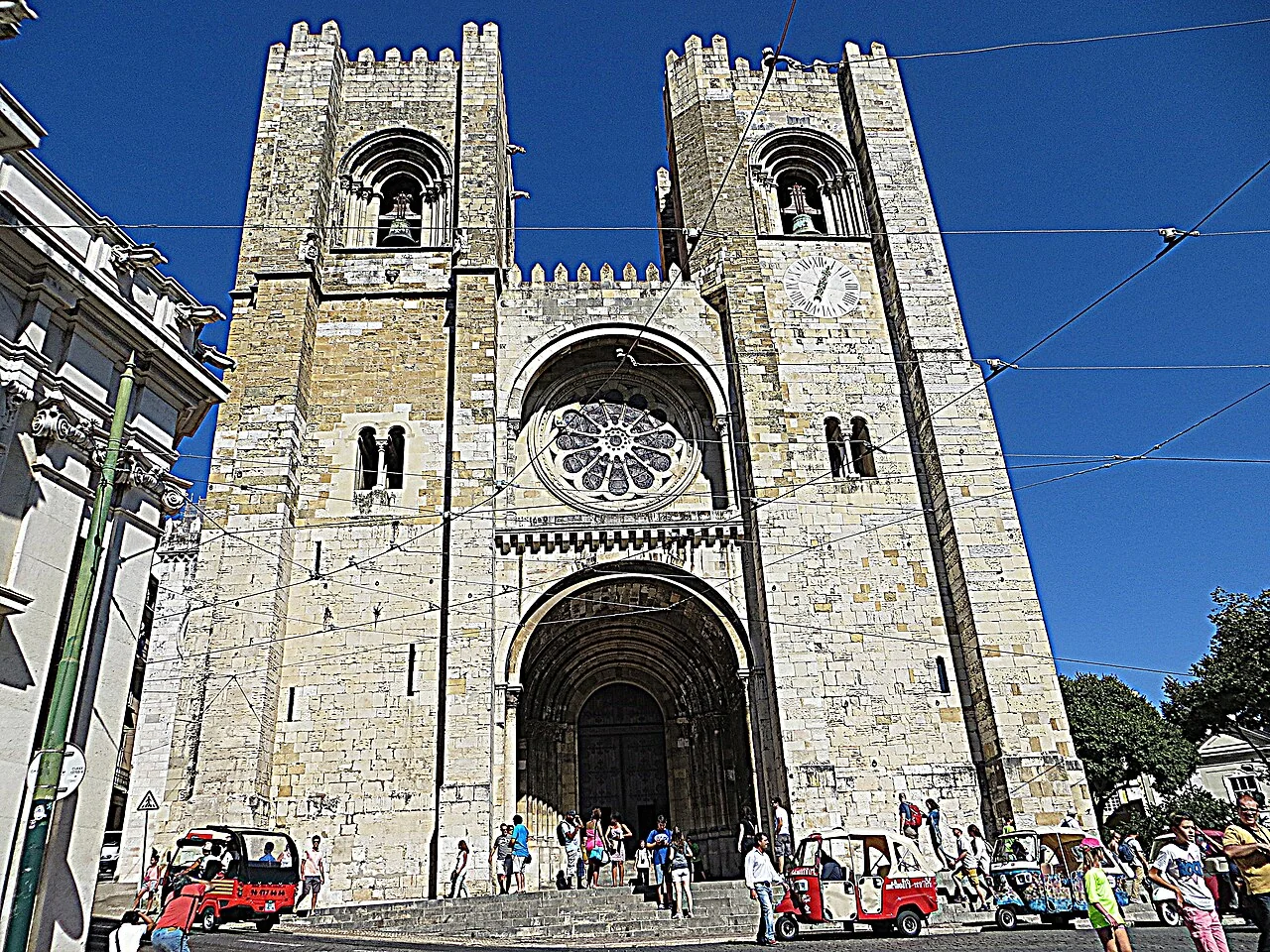
Compare the western façade, an interior rose window and exterior doors. Use the visible gallery arrows and thumbnails.
Chapter 4 · Change the distance
Read the cathedral from façade to glass
The cathedral gives the journey a more compact face. Look for the two towers and the round window before studying the lower opening. Unlike an isolated monument in a wide park, this building shares its surroundings with narrow streets, movement and neighbouring façades. The first image is an exterior view; the glass picture is explicitly an interior photograph. Switching between them changes the question from the shape of a building to the way light passes through a detail.
The August 2014 façade, January 2023 interior rose window and April 2012 doors are independent credited pictures. The interior photograph is included for comparison, not as an interactive room or evidence of a free entrance. Look for the circular geometry in the glass, then return to the exterior to see where the feature belongs. The door photograph offers a third scale rather than a third almost-identical view of the window. Their dates also explain why people and lighting cannot be followed from one image to the next.
The August 2024 Google fragment stays outside near Largo da Sé and offers three positions with a return. It does not enter the church or provide a continuous tram or walking route from the lower city. The cathedral published revised visitor rules in May 2026, so older photographs are not a reliable guide to admission. Check its own visitor information before going inside, leave space for worship and do not copy a road-camera location as a place to stand.
Real-travel note
August 2024 exterior street fragment. The gallery’s rose window was photographed inside; no indoor scene, admission or verified tram crossing is included.
Use the visible gallery arrows and thumbnails to compare the place, a detail and another viewpoint.
Chapter 5 · Roofs become a landscape
Find Alfama’s landmarks from Portas do Sol
Finish by widening the frame again. From Portas do Sol, roofs that seemed like separate buildings from street level become a layered surface leading towards the Tagus. Choose one pale church against the red roofs, then use it as a reference when you change pictures. The point is not to identify every building immediately. A few recognisable forms can make a dense neighbourhood less abstract without turning it into a diagram of a route you have already walked.
The gallery uses June 2025 photographs made from this viewpoint. One establishes a broad part of Alfama; another isolates Santo Estêvão; the third turns towards São Vicente de Fora. These are different frames, not a stitched 360° image and not three linked camera positions. Compare how a tower or dome changes its apparent size against the roofs. They show the place in the light of those particular days, not a guarantee of sunset, clear weather or an unobstructed view when you visit.
The optional August 2024 Google fragment is near the upper square and offers local observation with a checked return, not a descent through Alfama’s residential lanes. Santa Luzia is a separate exploration with its own garden and tile panel preview; it is not automatically the next linked panorama. Keep private doorways and narrow passages clear in a physical visit. The journey can end with one remembered detail—a roof, a church or a line of river—without pretending that every hillside connection has been surveyed.
Real-travel note
August 2024 upper-square imagery is local only. No verified descent, step-free route, terrace availability or continuous connection to Santa Luzia is promised.
9 reviewed experiences
Explore along the route
Step into the places along this journey. Choose a view independently of the story chapters. Free previews do not count toward chapter progress. Return to the journey above to continue through its stops.
Find a rhythm in Rossio’s paving Short observation sequence
June 2026: three positions along Rossio’s street edge and return. Rotate towards the paving; not a safe crossing or a continuous connection uphill.
Reviewed 2026-10-23 · At the place
Explore at your own pace; these views do not count toward chapter completion. Check each point's coverage note before navigating provider imagery. Availability may change.
Sources
- Calçada Portuguesa — Visit Lisboa
- Escola de Calceteiros at Quinta Conde dos Arcos — Lisboa City Council
- Rossio — Visit Lisboa
- Carmo Archaeological Museum — Visit Lisboa
- Praça do Comércio — Visit Lisboa
- Cathedral visiting rules — Sé de Lisboa
- Miradouro das Portas do Sol — Lisboa City Council
- Miradouro de Santa Luzia — Visit Lisboa
- Santa Justa viewing platform closure notice — Carris
- Praça Dom Pedro IV, Lisboa 01.jpg — Simon Burchell · Wikimedia Commons
- Pedro IV square Lisbon.jpg — Anton Zelenov · Wikimedia Commons
- Praça Dom Pedro IV, Lisboa 10.jpg — Simon Burchell · Wikimedia Commons
- Lisboa - Largo do Carmo (53847670618).jpg — Jorge Franganillo · Wikimedia Commons
- Ruins of the Carmo Convent, now the Carmo Archaeological Museum, in Lisbon, 20250604 1539 9322.jpg — Jakub Hałun · Wikimedia Commons
- 2019-05-16 15-46-19 PT Lisbon JHe N (54099695669).jpg — Jan Helebrant · Wikimedia Commons
- Lisbon Praça do Comércio BW 2018-10-08 17-42-58.jpg — Berthold Werner · Wikimedia Commons
- Arco Triunfal da Rua Augusta, Plaza del Comercio, Lisboa, Portugal, 2012-05-12, DD 02.JPG — Diego Delso · Wikimedia Commons
- View from the Arco Triunfal da Rua Augusta towards the east, Lisbon, 20250604 1428 9279.jpg — Jakub Hałun · Wikimedia Commons
- Katedrala Se - panoramio.jpg — Mister No · Wikimedia Commons
- Sé de Lisboa (Lisbon Cathedral) 62.jpg — Simon Burchell · Wikimedia Commons
- Doors of Lisbon Cathedral.jpg — Uhooep · Wikimedia Commons
- View from from Miradouro das Portas do Sol, Lisbon, 20250603 2018 9054.jpg — Jakub Hałun · Wikimedia Commons
- Igreja de Santo Estêvão from Miradouro das Portas do Sol, Lisbon, 20250606 1958 0420.jpg — Jakub Hałun · Wikimedia Commons
- View of Mosteiro de São Vicente de Fora from Miradouro das Portas do Sol, Lisbon, 20250603 2018 9052.jpg — Jakub Hałun · Wikimedia Commons
- Elevador de Santa Justa - Lisboa - Portugal (51689389075).jpg — Vitor Oliveira from Torres Vedras, PORTUGAL · Wikimedia Commons
- Rua Augusta Arch (Lisbon) 01.jpg — Bernard Gagnon · Wikimedia Commons
- Tourists at Cais das Colunas, Lisbon, Portugal julesvernex2.jpg — Jules Verne Times Two · Wikimedia Commons
- Amazing tile work at Miradouro de Santa Luzia - Lisbon (52750123452).jpg — Haydn Blackey from Cardiff, Wales · Wikimedia Commons


Your journey, remembered.
Explored 0 of 5 stops. Explore every stop to unlock your keepsake.
5 stops to your keepsakeExplore every stop to share or download your keepsake.
Prepare a Lisbon visit
Use the story to choose observations, not as turn-by-turn navigation.
Official sources checked:
Keep the climbs visible in your plan
Rossio → Carmo → Praça do Comércio → Cathedral → Portas do Sol is editorial order. Roughly 3–4 km and half a day outdoors are planning estimates, not a measured or verified walking track. Detours and indoor visits add time.
Do not depend on a virtual lift
Paving, steps and slopes require separate planning. Carris’s Santa Justa viewing-platform notice checked on 23 October 2026 reported a temporary closure; recheck current service and platform access. No imagery here proves an accessible climb or a safe road/tram crossing.
An interior photograph is not admission
The cathedral’s rose-window image is a credited indoor photograph, not an interactive room. Consult current cathedral and Carmo museum rules; arch climbing and other admissions are separate.