
Kyoto Higashiyama at Dawn
Walk from Kiyomizu-dera to Gion before the streets fully awaken.
Guided visual journey
Licensed documentary photograph (resized for web) · Basile Morin · CC BY-SA 4.0
Reading mode
Six stories to read at your own pace
Chapter 1 · Before the lanes fill
Kiyomizu-dera at Dawn
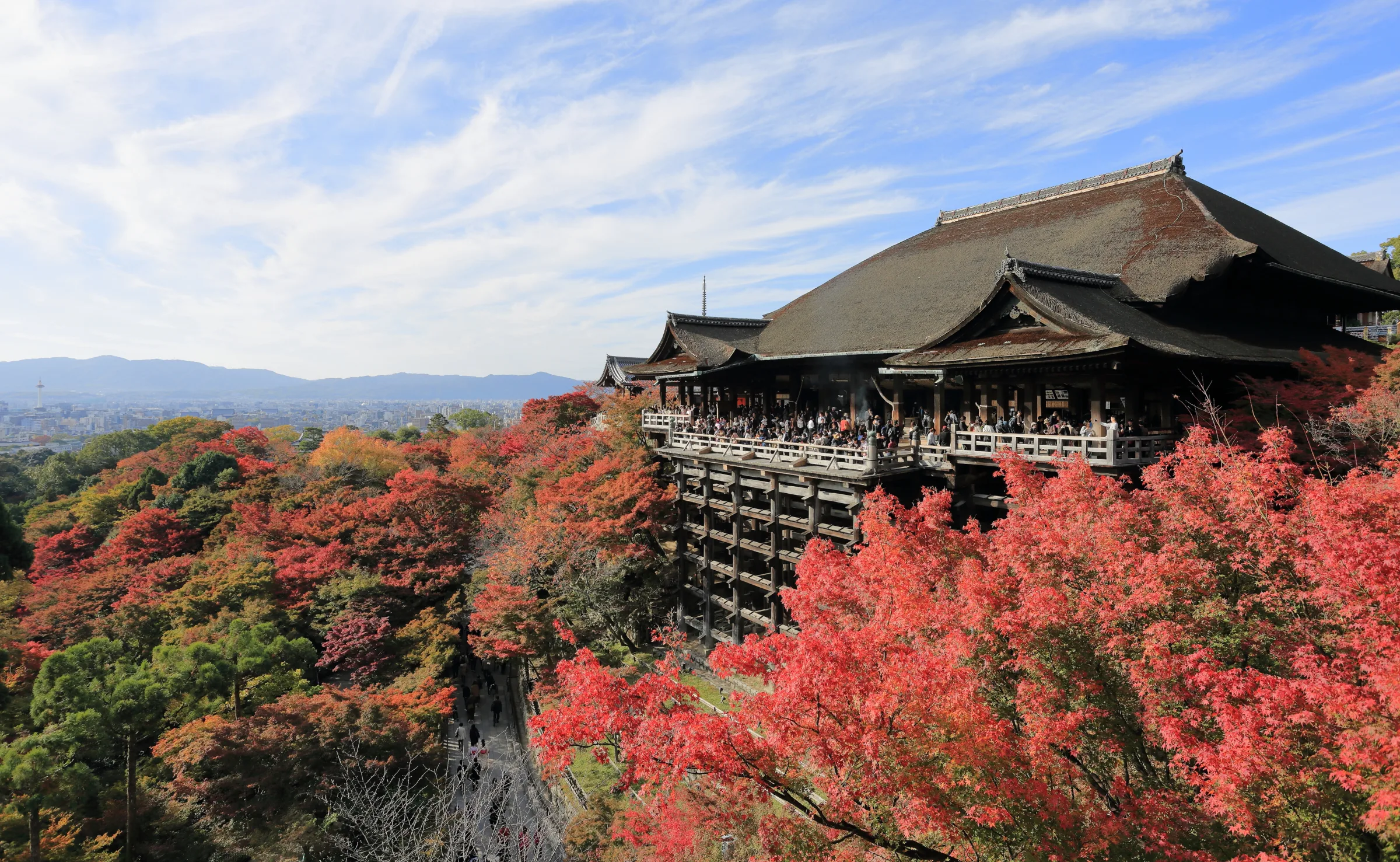
Kiyomizu-dera stands halfway up Mount Otowa, on the eastern edge of Kyoto. The temple says it was founded in 778 and has been rebuilt after repeated fires. Most of the buildings visitors see today, including the Main Hall, were reconstructed in 1633. The hall is a National Treasure. Its broad wooden stage projects from the cliff on tall zelkova pillars, joined without nails, and the temple describes the stage as nearly 13 metres high. From it, the city sits below the trees. That view is the reason this walk begins here rather than in Gion.
The early hour is the point. Kyoto Travel’s dawn itinerary starts at this gate because it opens at 6:00, before the souvenir slopes below are crowded. The temple’s own 2026 table keeps that opening time all year and moves the closing time: 18:00 for much of the year, 18:30 in July and August outside the special nights, and 21:30 during the published night openings in spring, mid-August and late November. Those night periods change from year to year. Amulets and seal stamps are a later errand. A temple notice says the conferment desks begin around 8:00. The pages that list hours do not state a standing ticket price, so confirm the current charge on the temple site before you go.
The temple’s engi tells another kind of beginning. The monk Kenshin followed a dream north from Nara, found the Otowa waterfall, and received a sacred log from the hermit Gyoei. Two years later, the warrior Sakanoue no Tamuramaro is said to have met him while hunting and helped establish a hall for an eleven-headed, thousand-armed Kannon. That is the temple’s tradition. The halls themselves record a later history of fire and rebuilding, and in 1994 UNESCO inscribed Kiyomizu-dera as one of seventeen Historic Monuments of Ancient Kyoto.
The walk that follows leaves by the approach and turns down into the lanes. Wheelchair access exists on the temple grounds by a step-free route from Chawan-zaka, not by the stone stair of Sannenzaka. There is no temple car park. City buses stop at Gojo-zaka or Kiyomizu-michi, each about a 10-minute walk, and Kyoto Travel gives about 25 minutes on foot from Keihan Kiyomizu-Gojo. Recheck routes on the morning you travel.
Real-travel note
The gate opens at 6:00. Closing time follows the season and the night-opening calendar. Tripods, monopods, drones and commercial or costume shoots are prohibited on the grounds. Please recheck hours, fees and access on the temple’s site before you leave.
Chapter 2 · The first steps down
Sannenzaka: The Descent Begins
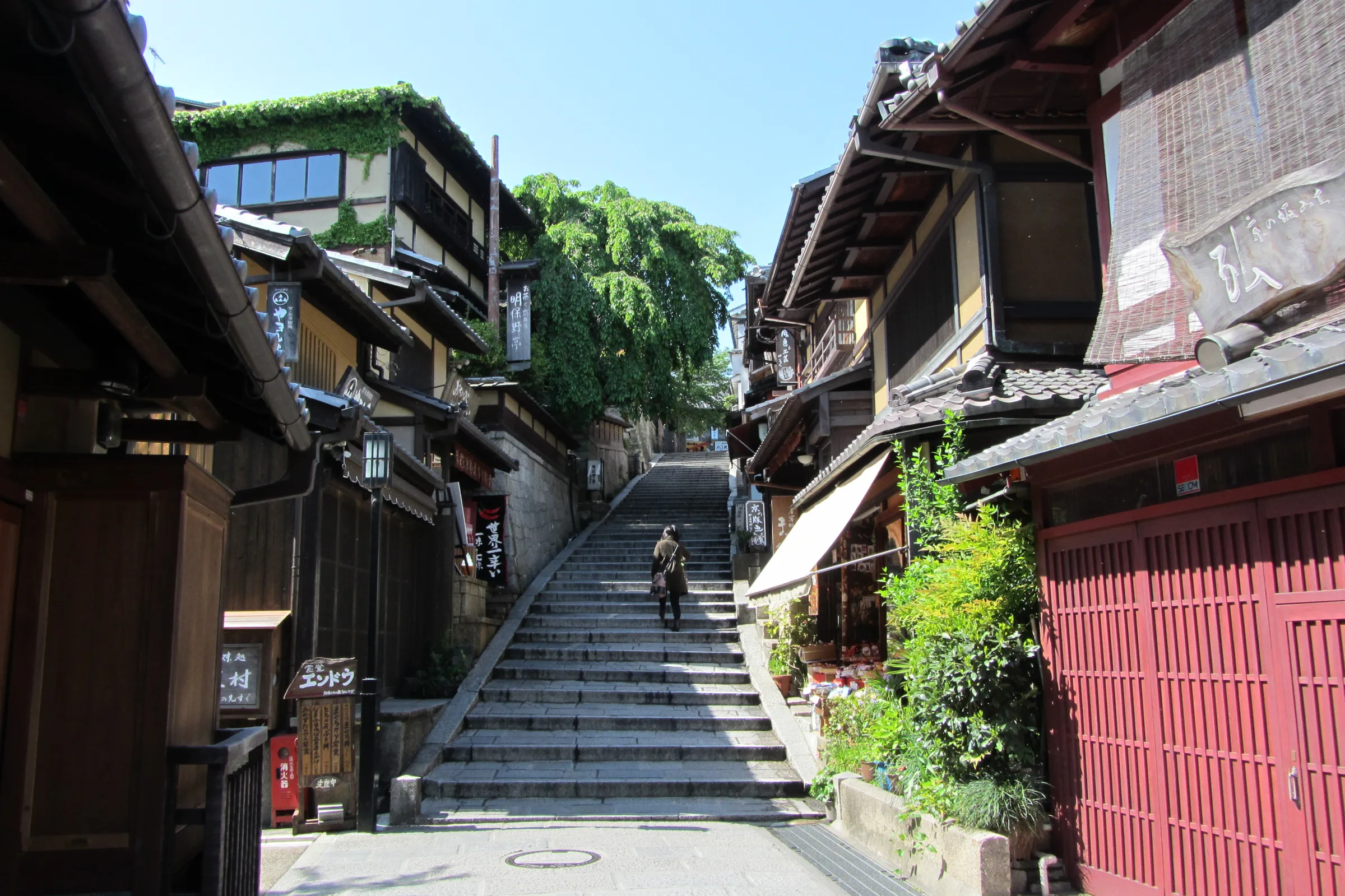
Sannenzaka is the slope you meet first on the way down. Kyoto Travel’s dawn walk says to leave Kiyomizu-dera, continue for a few minutes and turn right. The street is also written 産寧坂. OpenStreetMap records both a flight of stone steps and the pedestrian lane that continues them. The photograph for this chapter looks up those steps between wooden fronts, which is the honest picture of the descent: you will walk them downward, toward Ninenzaka.
People on the slope link the name “three years” to a wish fulfilled within three years, or to a fall that brings three years of misfortune. Those are local sayings, not a recorded origin of the street. What you walk is a living temple approach: tiled roofs, lattice, and goods set out at the edge of a lane where people also live. Kyoto Travel asks visitors to remember the homes, to skip tripods and not to block the road.
Daytime changes the same steps. By late morning the slope is one of the busiest walks in the city, with shoppers stopped in the stair and little room to pass. The dawn itinerary exists because that pressure arrives later. The trade-off is real. At 6:00, when the temple gate has just opened, many of these shopfronts are still shut. You get the lane, the stone and the quiet. You do not get the open counters, the samples or the conversation of a shopping hour. If the shops are the reason for your visit, come back down later and accept the crowd. If the walk is the reason, stay with the early hour.
Kyoto Travel’s separate crowd-avoidance page, which climbs from Ninenzaka toward the temple, allows about 10 minutes for Sannenzaka. That is a published guide time for the uphill direction, not a distance surveyed for this page and not a promise about your pace. The surface is stone, often polished, and wet weather makes it slick. There is no level bypass that still counts as walking Sannenzaka.
Real-travel note
Expect stone steps and a slope. Early morning is quieter and many shops are closed. Do not use a tripod or stop in the stair. Please recheck any temporary street closure before you go.
Chapter 3 · Shops still shut
Ninenzaka: The Streets Begin to Stir
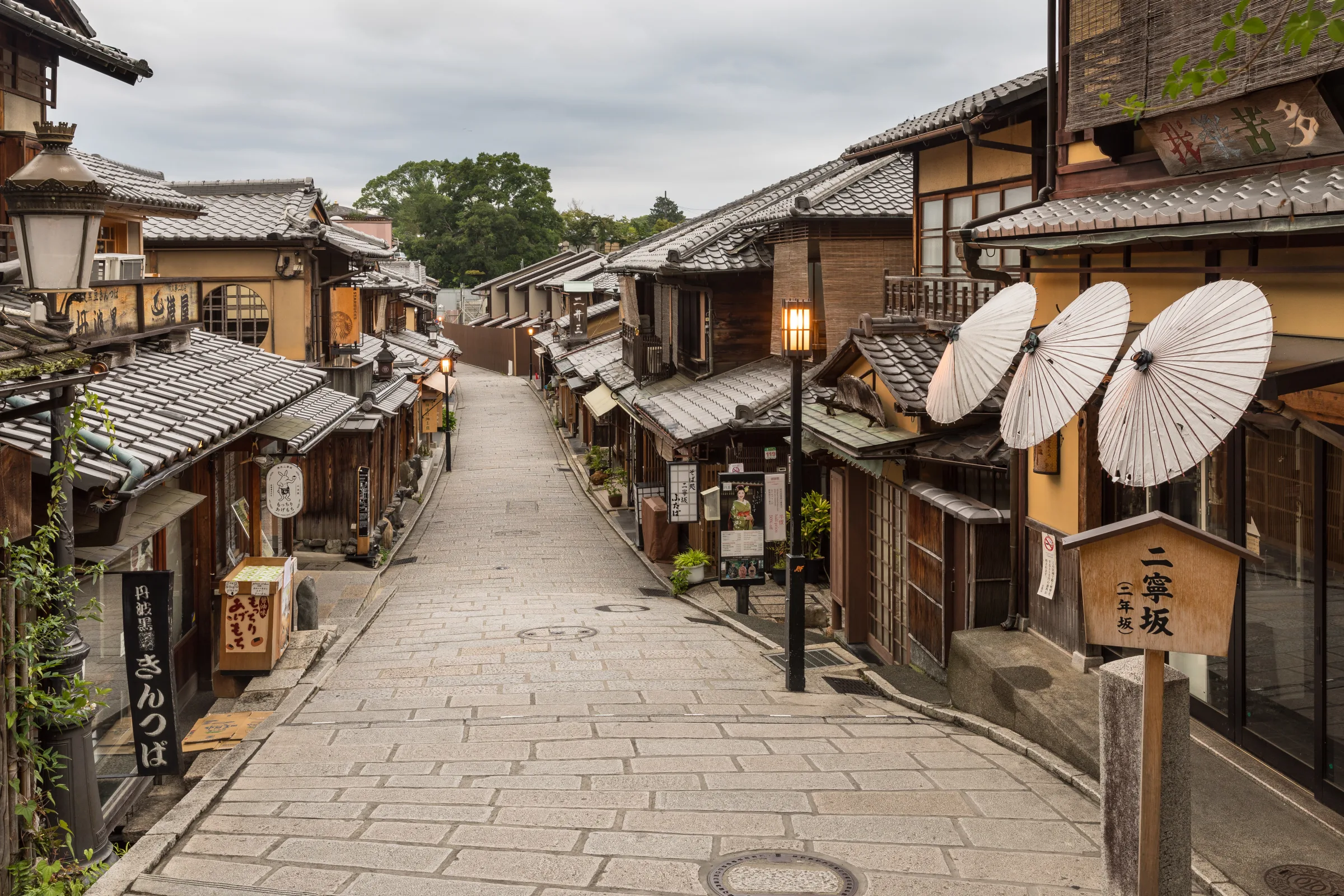
Ninenzaka continues the descent. The two slopes are often named in one breath, and a shop sign in the photograph even stacks 二寧坂 above a smaller 三年坂, which is how easily the pair is confused. The camera position recorded with that photograph sits on the Ninenzaka way in OpenStreetMap, and the larger characters on the sign say Ninenzaka. This chapter uses that street, not the stair you just left.
The photograph was made at 5:40 on 12 June 2019. Paper umbrellas are open beside a wooden front, a lantern is lit, and the stone pavement runs empty downhill. That is a useful picture of the bargain this hour offers. The lane is already dressed for the day. The businesses behind the lattices are not necessarily receiving anyone yet. Kyoto Travel describes the same streets as a lively temple town once the sightseers arrive, and as something quieter only for a short time beforehand. If you need breakfast from a counter on the slope, you may be early. The official dawn article points to a coffee shop near Kodai-ji that it says opens at 7:00 and closes on Mondays. Treat that as a dated suggestion from the tourism board, and check the shop itself.
“Two years,” like “three years” on the slope above, is a folk saying. The fact underfoot is the paving, the slope, and a row of frontages that are also a neighbourhood. People live behind and beside the shops. A paused group, a pole or a loud conversation fills the lane at an hour when residents are still at home.
Kyoto Travel’s uphill notes allow about 5 minutes for Ninenzaka, between the pagoda side and the steps up to Sannenzaka. Use that as a guide to scale, not as your schedule. The way is stone and it is not flat. OpenStreetMap marks steps as well as the pedestrian lane. Good shoes matter more than an extra minute on the map.
Real-travel note
The early hour is quiet, and many shops are still closed. The lane is narrow and partly residential. Keep the way clear for people who live here, and recheck shop hours if you are counting on breakfast.
Chapter 4 · A tower over the roofs
Yasaka Pagoda: The Shape of Higashiyama
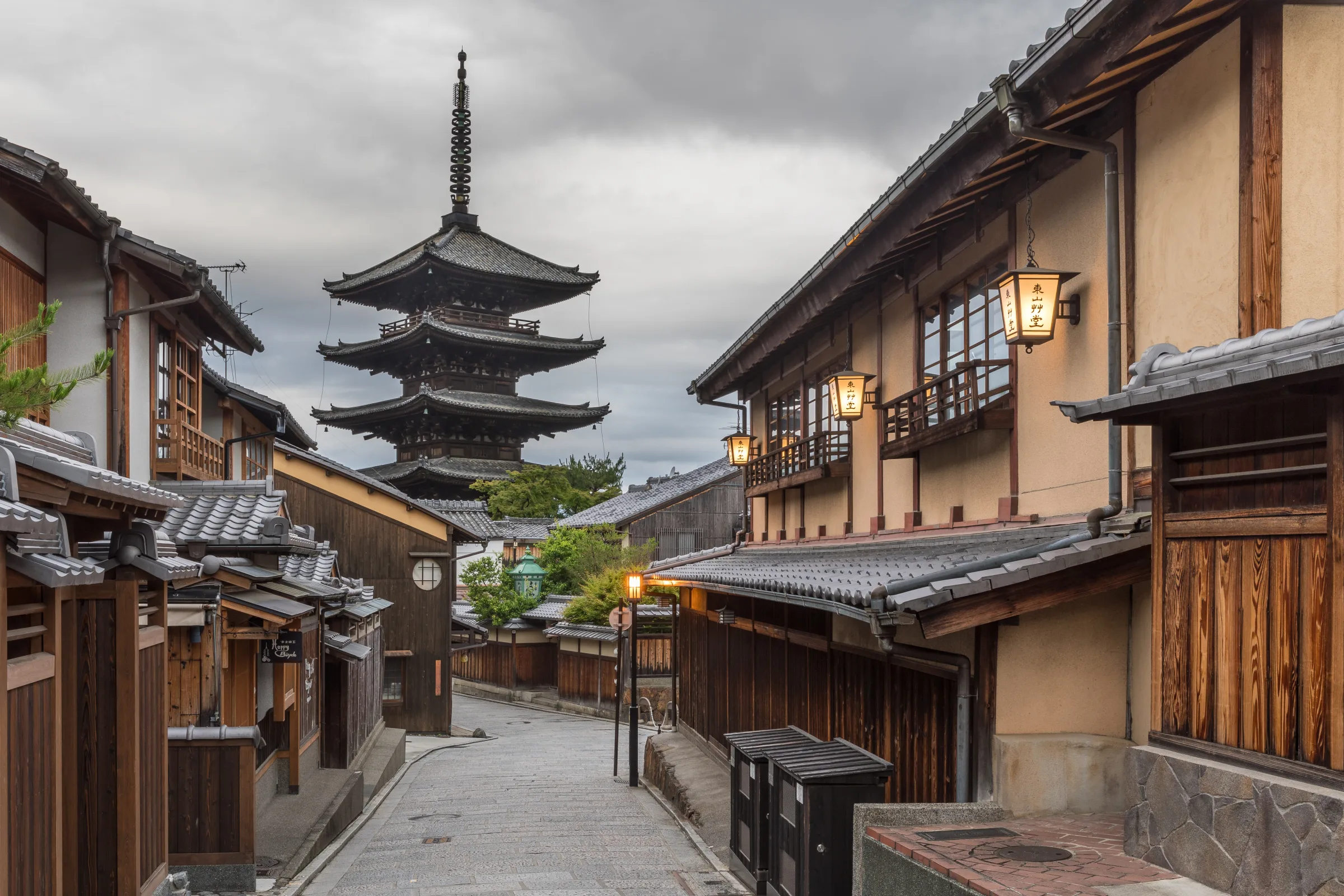
Yasaka Pagoda is the five-storey tower of Hokan-ji, and it is the shape that organises this part of Higashiyama. Kyoto Travel says the view opens partway down Sannenzaka and Ninenzaka, with the pagoda rising ahead. On the ground it stands just west of the lower end of those slopes, so the natural order is to meet it after Ninenzaka and before turning north toward Nene-no-michi. The photograph looks along Yasaka-dori at 5:24 on the same June morning as the Ninenzaka picture: lanterns still on, the lane empty, the tower centred over the roofs.
Kyoto City’s tourism page calls Hokan-ji an old temple of the Yasaka clan from the Asuka period, and it gives the pagoda’s height as 46 metres. The tower in the photograph is the building the Agency for Cultural Affairs dates to 1440, the twelfth year of Eikyo, and lists as an Important Cultural Property designated on 28 December 1897: a three-bay, five-storey pagoda with a tile roof. The older founding belongs to the temple’s tradition. The precinct is a paid visit, and the city summary does not state the fee. Ask at the gate.
The dawn walk uses the public view from the lane. Going inside is a separate visit, with its own hours and charge. People live along this street too. The same courtesy as on the slopes applies: no tripod in the lane, and no blocking the few metres of pavement to hold the tower in frame.
This is not part of the UNESCO listing that includes Kiyomizu-dera. The World Heritage property is a set of named monuments, not the whole hillside. The pagoda matters here because it is the local skyline, an Important Cultural Property, and the visual hinge between the shopping slopes and the quieter lanes to the north.
Real-travel note
The tower is visible from the lane. A visit inside Hokan-ji is paid and separate from the walk. Do not block the street for a photograph. Please recheck admission before you rely on it.
Chapter 5 · A lane before the gate
Nene-no-michi and the Kodai-ji Quarter
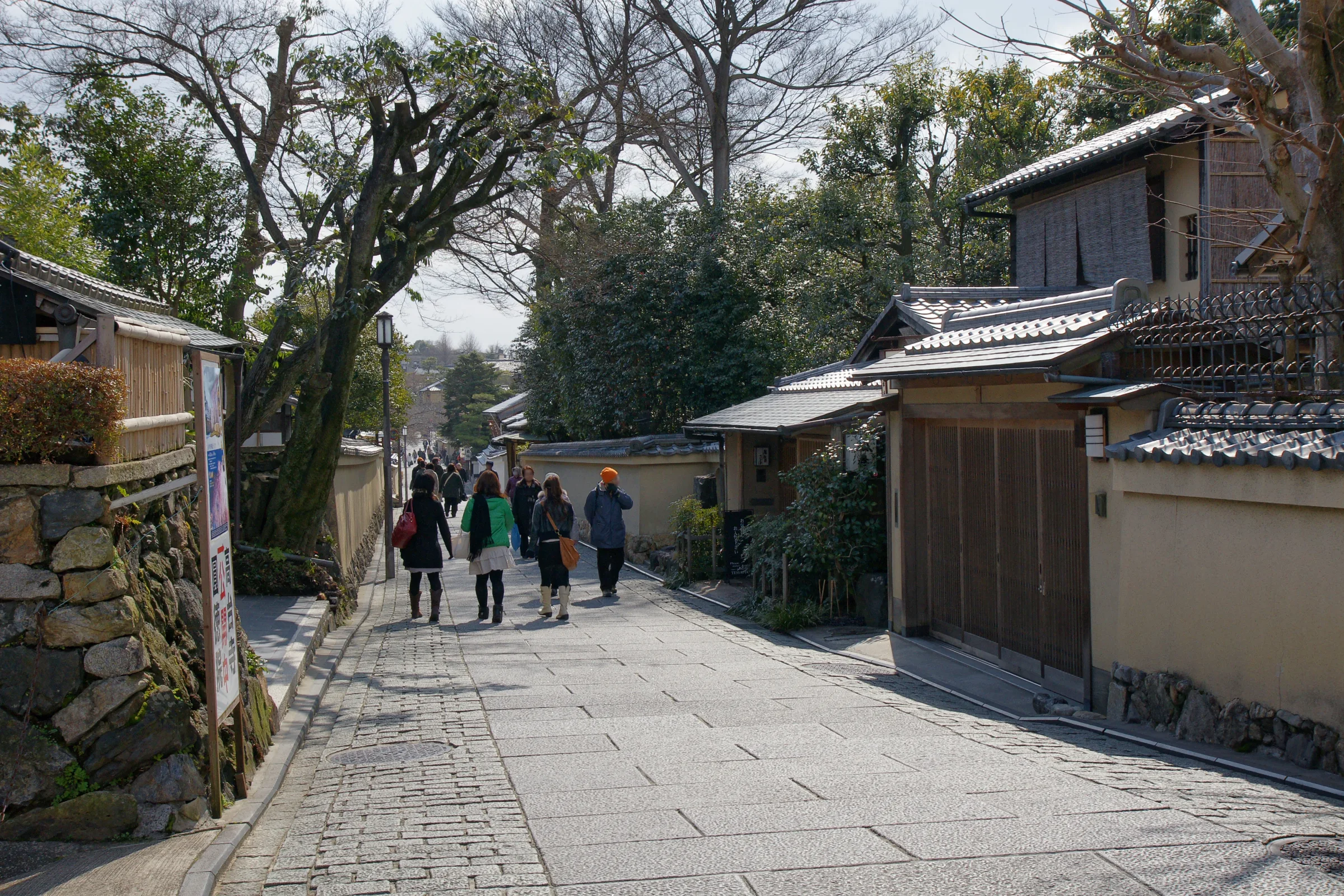
Nene-no-michi is the change of tone after the pagoda. The shopping slopes fall behind, and the walk becomes a stone-paved lane of walls, gates and trees, with Kodai-ji on the eastern side. Kyoto Travel says the road takes its name from Nene, also called Kita-no-mandokoro, the wife of Toyotomi Hideyoshi, who spent her last years in this quarter. The same article says Kodai-ji was built by her to mourn him, and that the lane is the beautiful approach people now associate with that history. The photograph shows the paving and the walls rather than the temple garden, which is the right subject for a chapter you can walk before the gate opens.
Kodai-ji’s English visiting page opens the grounds at 9:00, with last entry at 17:00 and the gates closing at 17:30. Adult admission is listed at 800 yen, with a student fare and a combined ticket for Entoku-in. Other listings give different hours and a lower fare, so check the temple’s own page again before you count on the number. At the 6:00 start of the dawn walk, the garden is still shut. Kyoto Travel says so, and suggests coffee nearby while you wait. The lane is worth walking at that hour. The garden is not yet there to see. Come back after 9:00 if the garden is what you came for.
Entoku-in sits across the lane. Kyoto Travel describes it as a subtemple tied to the place where Nene lived out her last years, which is why the quarter still feels like a neighbourhood where the temple roofs show above the walls. A label on the map is not an invitation through a private gate.
Kyoto Travel’s longer Higashiyama walk allows about 5 minutes between the Kodai-ji area and Ninenzaka. The dawn article does not add a separate measured time for the northbound version. The surface is stone and gently sloping, easier than the stair at Sannenzaka and still not a flat pavement. In rain the stones are slippery, and the lane is narrow enough that a rickshaw or a small group changes the pace.
Real-travel note
The lane is walkable before Kodai-ji opens at 9:00. The garden is not. Recheck the temple’s hours and the 800-yen adult fare on its own site, and leave room for people who live along the walls.
Chapter 6 · The street wakes up
Yasaka Shrine and the Edge of Gion
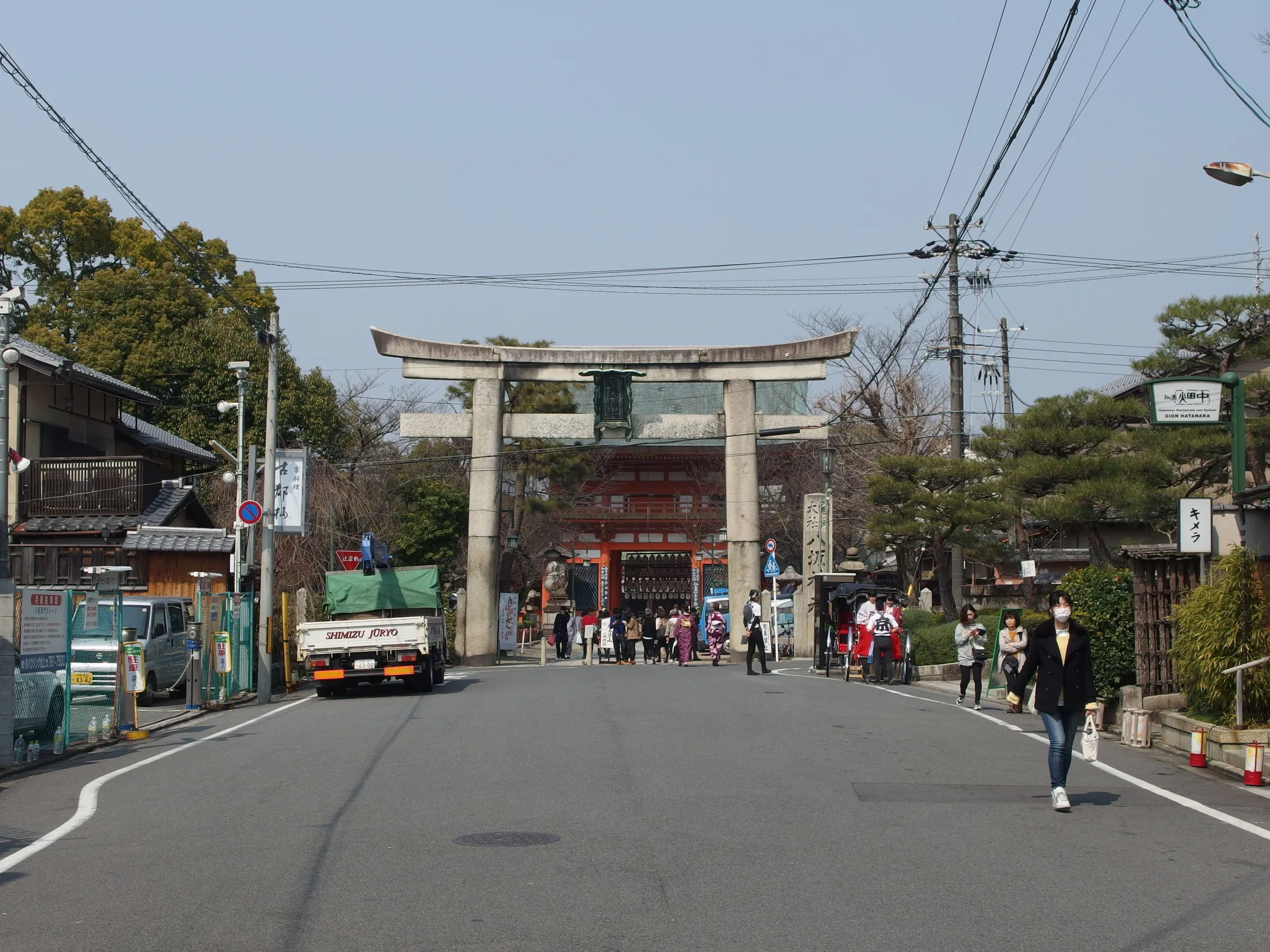
The last turn is north, out of the Kodai-ji lanes, until a stone torii carries the characters 八坂神社. Kyoto Travel treats that gate as the end of the Higashiyama dawn walk. The shrine was long called Gion Shrine and is still spoken of as Gion-san. Leaving by the west side, the same article says, you meet the streets of Gion running toward the station. Eastward are Maruyama Park and, beyond it, Chion-in. This journey stops at the edge, where the shrine and the street share one view.
The shrine’s English page gives more than one beginning. One, from the shrine record, places the arrival of the spirit of Susanoo in 656, brought by a Korean envoy in the reign of Emperor Saimei. Another says that in 876 the priest Ennyo built a temple here and enshrined the same deity. Both sit in the shrine’s own account as theories. What you can see without choosing between them is a working shrine: on the nights of 17 and 24 July, mikoshi leave for, and return from, the otabisho in the city. Those nights are not a quiet dawn. If your date falls in the Gion festival, read the shrine’s current notice before you expect an empty approach.
Kyoto Travel says the grounds are open at all times. The office hours on the shrine page are 9:00 to 17:00, which is a desk, not a gate. There is no ticket to walk through the west torii on an ordinary morning. The photograph used here was taken in the early afternoon of 17 March 2014. It shows the stone torii, the vermilion gate behind it, rickshaws and traffic. It is a true picture of the place and a poor picture of dawn. Use it to recognise the gate. Use the morning hour, if you have it, to see the same gate with fewer people. By mid-morning the street in front is a bus route and a gathering place, and the quiet you had on Ninenzaka does not survive here.
Gion is not a stage set. Teahouses, shops and homes share these blocks. Kyoto Travel’s note for the slopes applies with more force at this end: do not block the road, and do not treat residents or people in working dress as subjects. The west side is also where you leave. Gion-Shijo and Kawaramachi stations are the usual rail exits. Buses run on Shijo and Higashioji. None of those services is repeated here as a live timetable.
Real-travel note
The shrine grounds are open at all times on an ordinary day. Festival mornings are different. The west torii opens onto a working street. Please recheck festival notices, and do not photograph people as scenery.
Sources
- Higashiyama at Dawn — Kyoto Tourism Federation
- How to avoid the crowds while accessing Kiyomizu Temple and Higashiyama — Kyoto Tourism Federation
- Learn: history and the Main Hall — Kiyomizu-dera
- Visit — Kiyomizu-dera
- FAQ — Kiyomizu-dera
- Access and 2026 opening hours — Kiyomizu-dera
- History — Yasaka Shrine
- Historic Monuments of Ancient Kyoto — UNESCO World Heritage Centre
- Hokan-ji (Yasaka Pagoda) — Kyoto City Tourism Association
- Hokan-ji five-storey pagoda — Agency for Cultural Affairs
- Visiting hours and admission — Kodai-ji
- Kiyomizu-dera — OpenStreetMap
- Sannenzaka steps — OpenStreetMap
- Ninenzaka steps — OpenStreetMap
- Yasaka Pagoda — OpenStreetMap
- Nene-no-michi guidepost — OpenStreetMap
- Yasaka Shrine — OpenStreetMap
- Kiyomizu-dera, Kyoto, November 2016 — Wikimedia Commons
- Sannenzaka, Kyoto — Wikimedia Commons
- Ninenzaka in the early morning — Wikimedia Commons
- Yasaka-dori and the Tower of Yasaka at first light — Wikimedia Commons
- Nene-no-michi, Kyoto — Wikimedia Commons
- Yasaka Shrine stone torii — Wikimedia Commons


,_Kyoto,_Japan.jpg)

.jpg)
Your journey, remembered.
The keepsake unlocks when you reach this section.