
Dublin: institutions, stories and a river crossing
Explore Dublin through Trinity, the castle, two cathedrals and the Ha’penny Bridge, with four optional city discoveries.
Begin the visual journeyPlan a real visit to Dublin Old TownExplore 9 reviewed views along the routeGuided visual journey
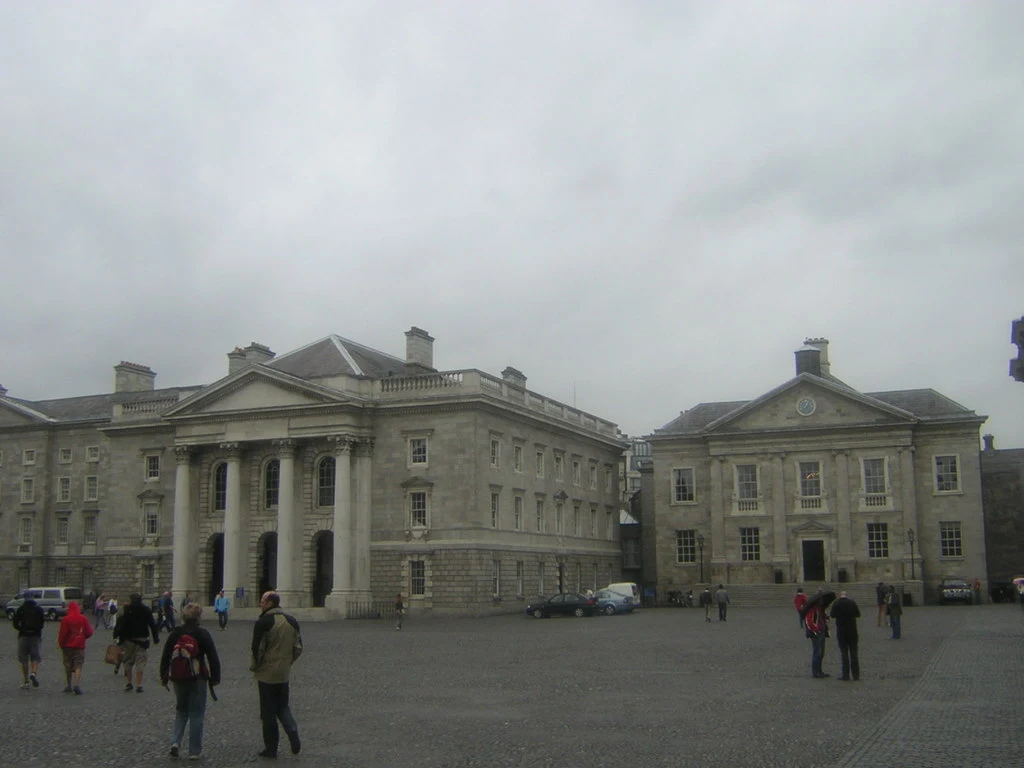
Trinity College courtyard with classical buildings and visitors · Christopher Hilton · CC BY-SA 2.0 · Resized and converted to WebP
Reading mode
Place stories to read at your own pace

Compare independently captured photographs and viewpoints, each with its own date.
Chapter 1
Trinity: an institution within the city
Begin Dublin with an institution whose age cannot be read straight from a single façade. Trinity College’s own history dates its royal charter to 1592 and identifies the site supplied by Dublin Corporation as the former Priory of All Hallows. A university therefore began here through both a legal act and the reuse of an older religious site. Hold those two histories together while considering the boundary between the college and the city. A foundation date belongs to an institution; it does not date every building that now represents it.
Use the independent views to compare enclosure and exposure. Which architectural edges suggest a court, and which acknowledge the surrounding streets? Look for the rhythm of openings, the proportion of wall to sky and the way an entrance concentrates attention. These are visual questions that can be pursued without claiming that the gallery records one arrival through the campus. Each photograph and local Google scene carries its own capture history.
The college history also records the university’s closure and conversion into a Jacobite barracks in 1689. The place of study was drawn into political conflict rather than standing apart from it. That episode makes a useful bridge to our next chapter, Dublin Castle: both settings ask how architecture accommodates authority and how later uses alter an apparently stable landmark. The optional Molly Malone discovery shifts the scale toward a figure of street life. Campus tours and the Book of Kells Experience have their own visitor arrangements, available through Trinity’s official visitor site.
Real-travel note
Local scenes have independent capture dates; connections between stops are editorial.
Compare independently captured photographs and viewpoints, each with its own date.
Chapter 2
Dublin Castle: changing forms of authority
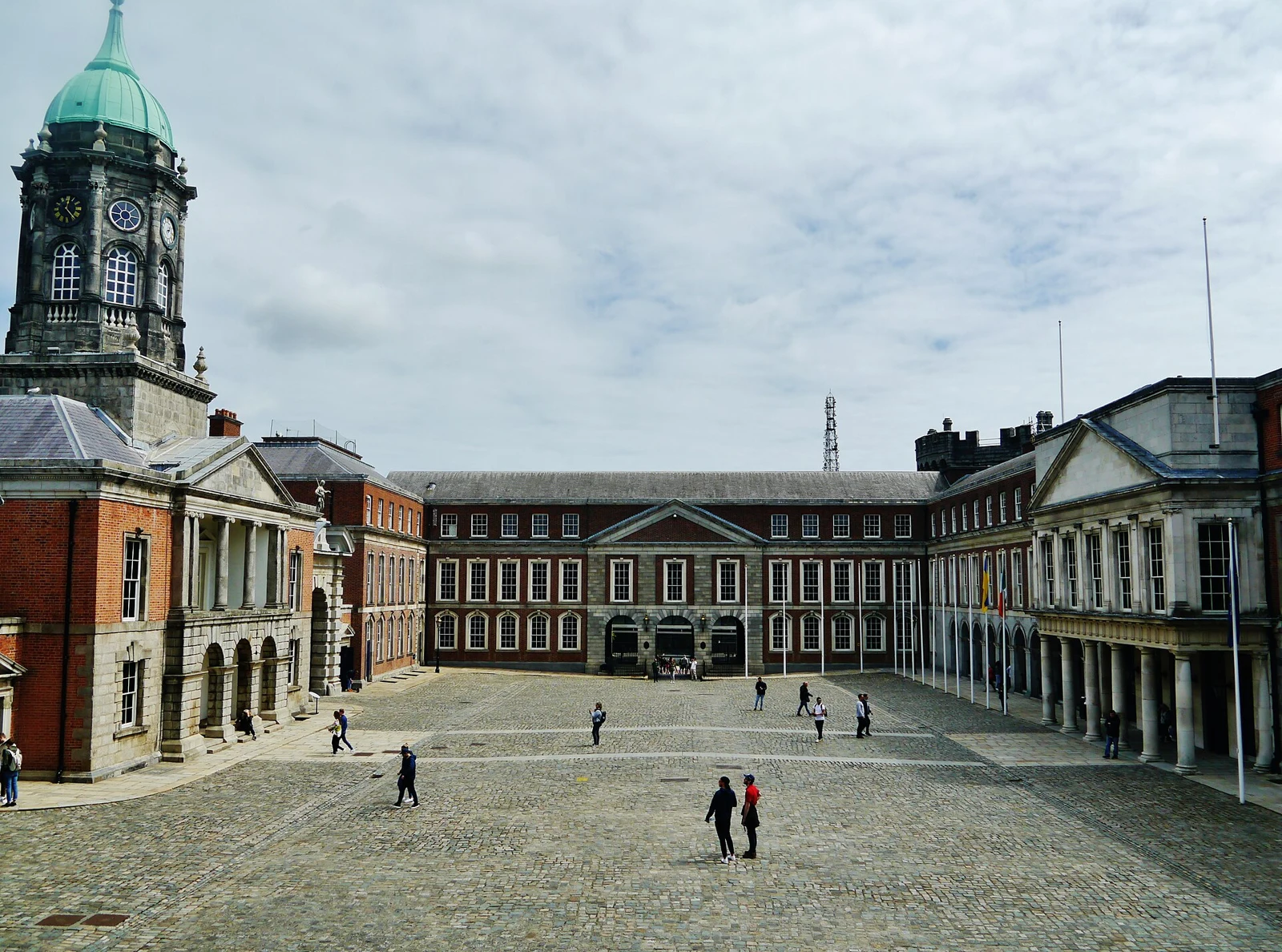
Dublin Castle rewards a question more useful than asking whether it looks like a castle: which period of power does a particular part of the place express? The Office of Public Works dates the site’s role as the seat of English, and subsequently British, rule in Ireland from 1204 until 1922. Its history also places the medieval castle on elevated ground previously occupied by a Viking settlement. The name covers a layered governmental precinct rather than a building with one architectural birthday.
Begin with the relationship between enclosed space and outward presentation. A courtyard can organize movement around its edges while a frontage turns institutional authority toward an audience. Compare those spatial effects in whichever independent views are available. Instead of assigning a date to a wall by appearance alone, use the official history to keep the different phases of the precinct distinct. Stone, painted surfaces and openings may each contribute to the visual impression without proving their age.
The long span from medieval government to the transfer of power in 1922 is the historical tension of this chapter. A ceremonial setting can survive major changes in the state it serves. Consider how the same place might be read as a workplace, a symbol of administration and a historical visitor destination. Chester Beatty offers an optional departure into the history of collecting, while Christ Church moves the main sequence toward religious institutions. The exterior Google scene is local to this stop; the transition to the next institution is editorial. Consult the castle’s visitor information separately for tours and interiors.
Real-travel note
Local scenes have independent capture dates; connections between stops are editorial.
Compare independently captured photographs and viewpoints, each with its own date.
Chapter 3
Christ Church: sacred space and a working city
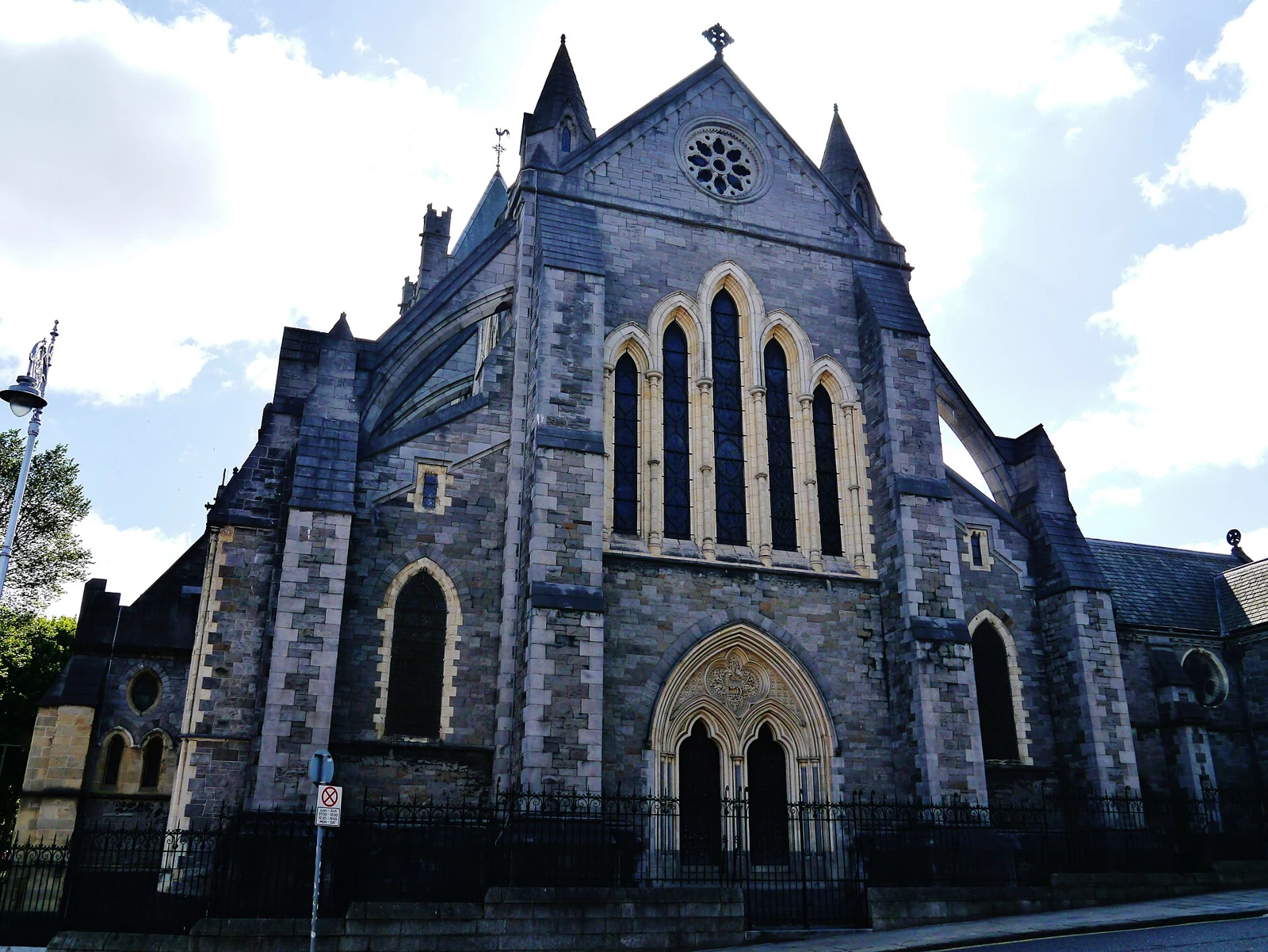
Christ Church introduces a different kind of continuity: a religious institution whose building has repeatedly changed. The cathedral’s official history describes its origins around 1030 and its later development in stone under Anglo-Norman patronage. These are distinct phases, not rival dates for the same unchanged structure. Reading the exterior becomes more interesting when the building is treated as the result of successive decisions rather than an untouched survivor from a single century.
First compare mass and articulation. How does a large volume become legible through smaller openings and divisions? Follow the outline against the sky, then let your eye return to the scale at which a person might encounter a wall. A broad photograph and a closer view answer different questions: one locates the building, another may clarify the spacing of architectural features. Neither requires imagining the entire interior beyond the visible surface.
The official history gives a striking account of the crypt in the sixteenth and seventeenth centuries: it accommodated trade and business, and a letter from 1633 describes drinking establishments there. That evidence complicates a tidy division between sacred architecture and everyday urban activity. Think of the church as part of a working city, with uses that do not fit neatly into a modern visitor category. The optional Wood Quay discovery adds an archaeological and civic dimension nearby. Our main sequence next considers Saint Patrick’s and a writer who held ecclesiastical office. Cathedral tours, worship and crypt admission belong to current visiting arrangements; the local exterior scene and separately dated photographs do not constitute an interior tour.
Real-travel note
Local scenes have independent capture dates; connections between stops are editorial.
Compare independently captured photographs and viewpoints, each with its own date.
Chapter 4
Saint Patrick’s: Swift and public responsibility
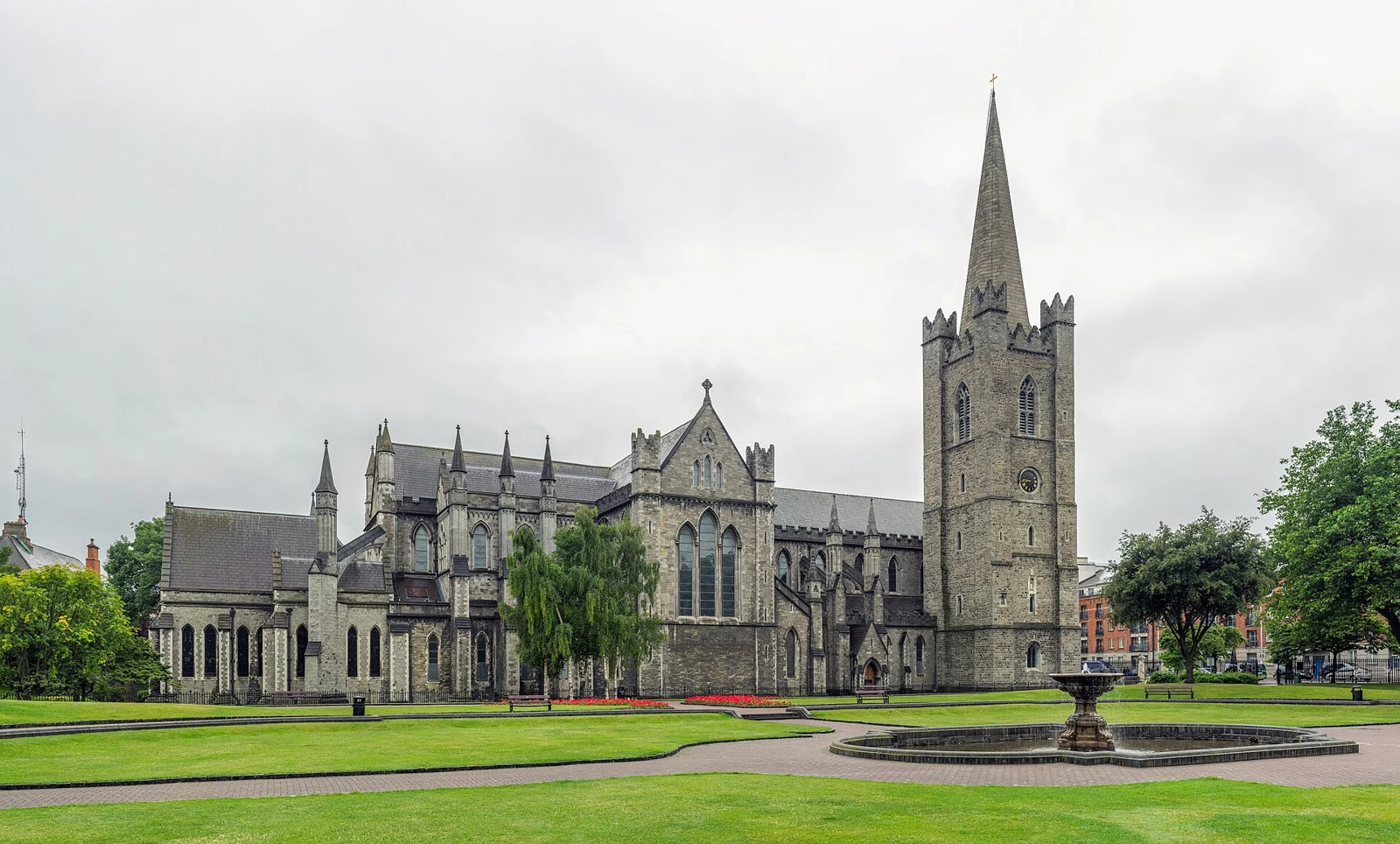
Saint Patrick’s brings a named writer into the story of Dublin’s institutions. The cathedral identifies Jonathan Swift, author of Gulliver’s Travels, as its dean from 1713 until his death in 1745. His literary identity and his church office occupied the same lifetime. This is a useful place to resist reducing a historical figure to either a book title or an entry on a list of clergy. Consider instead how writing, institutional duties and the problems of urban society could meet in one career.
Read the building first at the scale of its silhouette, then at the scale of repeated architectural elements. Compare the relation of vertical emphasis to the longer body of the structure. How much space does an independent viewpoint give the architecture to be seen as a whole? A photograph frames a chosen encounter, while a local interactive scene lets you inspect its own surroundings. Neither should be mistaken for a record of walking here from Christ Church.
The cathedral’s account also explains that Swift left money to establish a hospital for people with mental illness. His legacy therefore extends beyond literature and ecclesiastical remembrance into care. That connection changes the questions we bring to a monument: who is remembered, what practical institutions continued, and which part of the story is visible from the street? The next chapter returns to everyday movement at the Ha’penny Bridge, with Temple Bar as an optional urban comparison. Plan any cathedral interior visit through its official site, taking account of worship and visitor arrangements as separate uses of a living institution.
Real-travel note
Local scenes have independent capture dates; connections between stops are editorial.
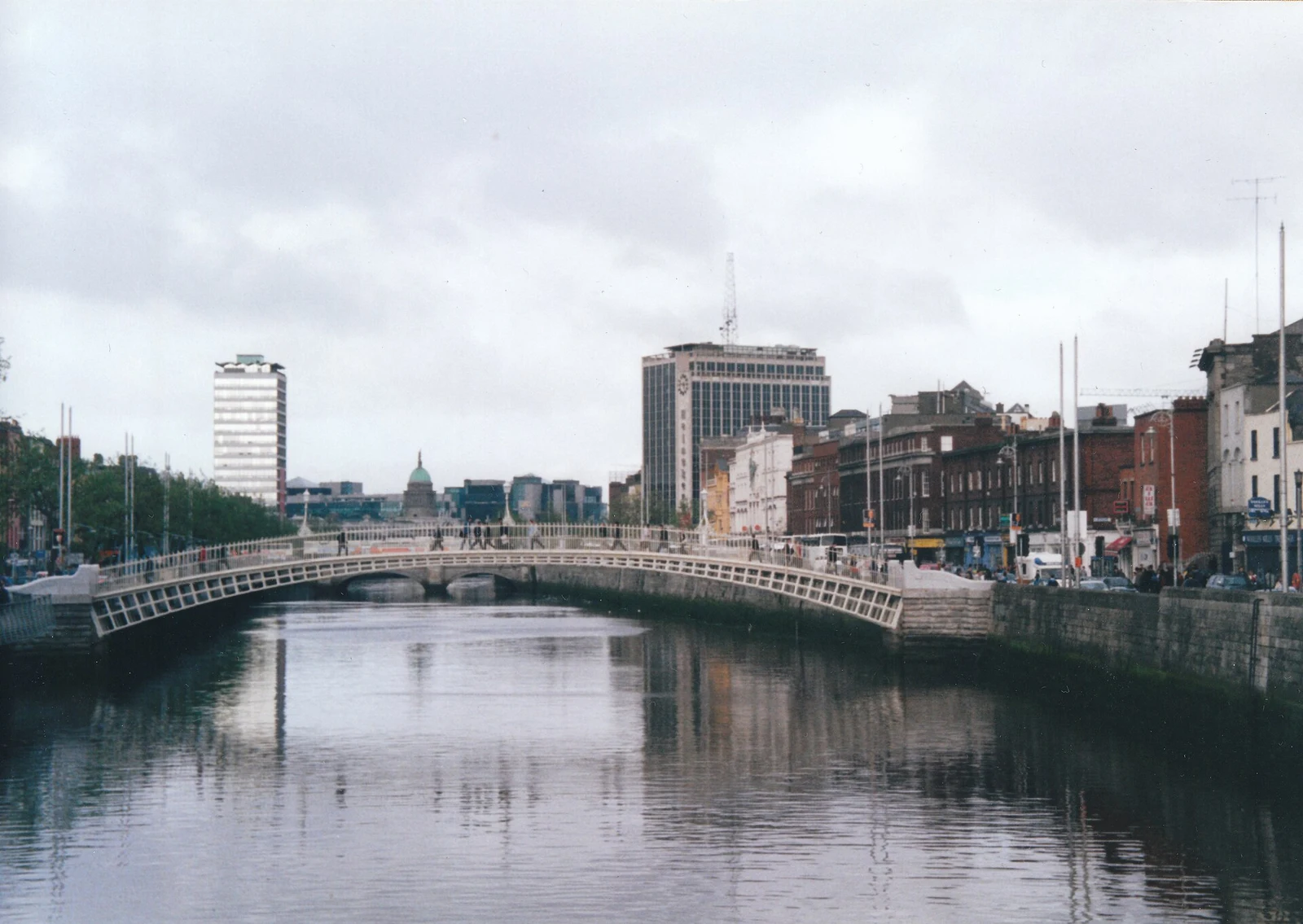
Compare independently captured photographs and viewpoints, each with its own date.
Chapter 5
Ha’penny Bridge: the price of crossing
Finish at the river with a crossing whose familiar nickname preserves the memory of payment. The Central Bank of Ireland, in its account accompanying a commemorative coin, dates the Ha’penny Bridge’s opening to May 1816 and connects its manufacture with the Coalbrookdale ironworks in Shropshire. Fáilte Ireland’s visitor account explains the halfpenny toll that gave the bridge its popular name and records that tolls continued until 1919. An apparently light urban landmark thus carries a history of manufacture, movement and the price of crossing.
Look at the relationship between the bridge’s span and the river corridor. Compare the line of the crossing with the horizontal direction of the quays. Where an available view includes the structure, consider how repetition helps a narrow pedestrian bridge appear both coherent and open to its setting. Reflections, river level and the number of people belong to the moment of capture; they are not permanent attributes of the place. The separate photographs and exterior Google scene can be compared without turning their different viewpoints into a single uninterrupted crossing.
Return to the opening chapter in thought. Trinity organized learning, the castle organized government, and the cathedrals connected religious institutions with civic life. Here the subject is a smaller transaction repeated across generations: getting from one bank to the other. The former charge survives in language after its collection ended. End by considering which everyday arrangements become city symbols, and why a name can preserve social history more effectively than a large commemorative inscription.
Read further: Dublin’s Ha’penny Bridge: the price that stayed in the nameReal-travel note
Local scenes have independent capture dates; connections between stops are editorial.
9 reviewed experiences
Explore along the route
Step into the places along this journey. Choose a view independently of the story chapters. Free previews do not count toward chapter progress. Return to the journey above to continue through its stops.
Trinity: an institution within the city Short observation sequence
2022-07 · 5 connected local positions and return. College Green facing Trinity College’s western entrance across the street; trees and traffic partly interrupt the facade.
Reviewed 2026-11-01 · Nearby viewpoint
Explore at your own pace; these views do not count toward chapter completion. Check each point's coverage note before navigating provider imagery. Availability may change.
Sources
- History of Trinity — Trinity College Dublin
- History — Office of Public Works · Dublin Castle
- History — Christ Church Cathedral
- Jonathan Swift, Dean 1713–1745 — Saint Patrick’s Cathedral
- Ha’penny Bridge commemorative coin — Central Bank of Ireland
- Ha’penny Bridge — Fáilte Ireland · Visit Dublin
- Report on Molly Malone Statue — Dublin City Council
- Chester Beatty — Chester Beatty
- Art in Parks, Civic Offices — Dublin City Council
- Plan a Trinity visit — Trinity Visitors
- Visitor FAQ — Office of Public Works · Dublin Castle
- Visiting — Christ Church Cathedral
- Visit — Saint Patrick’s Cathedral
- Temple Bar district — Dublin City Council Film Office
- Visit Chester Beatty — Chester Beatty
- Wood Quay Venue — Dublin City Council
- Trinity College Dublin, Parliament Square.jpg — Mindriot
- The famous facade of Trinity College, Dublin - geograph.org.uk - 1874425.jpg — Eric Jones
- Trinity College, Dublin, main courtyard - geograph.org.uk - 2209051.jpg — Christopher Hilton
- Dublin Dublin Castle Exterior Great Courtyard 1.jpg — Zairon
- Dublin Dublin Castle Exterior Great Courtyard Bedford Tower 1.jpg — Zairon
- Dublin Dublin Castle Exterior Great Courtyard 5.jpg — Zairon
- Dublin Christ Church Cathedral Exterior Facade 2.jpg — Zairon
- Dublin Christ Church Cathedral Exterior South Portal.jpg — Zairon
- Dublin Christ Church Cathedral Exterior Choir 1.jpg — Zairon
- St Patrick's Cathedral Exterior, Dublin, Ireland - Diliff.jpg — Diliff
- Dublin St. Patrick's Cathedral Exterior Tower 2.jpg — Zairon
- Dublin St. Patrick's Cathedral Exterior Choir 1.jpg — Zairon
- 2002-05-Dublin-Ha-penny-Bridge-1.jpg — Gunnar Klack
- Dublin Ha' Penny Bridge 1.jpg — Zairon
- Ha' Penny Bridge over the river Lilley.jpg — Curtiscmb
- Suffolk Street, Dublin - geograph.org.uk - 4793145.jpg — Ian S
- Exterior of the Chester Beatty, Dublin, Ireland.jpg — Derval O'Carroll
- Dublin City Council HQ from north bank (across river).jpg — Adam Jones
- 2008-05-23 The Temple Bar, Dublin, Ireland.jpg — Gordon Leggett


Your journey, remembered.
Explored 0 of 5 stops. Explore every stop to unlock your keepsake.
5 stops to your keepsakeExplore every stop to share or download your keepsake.
Plan separate site visits
Allow half a day to a day as an outdoor planning estimate; actual connections and interiors require additional planning.
Official sources checked:
Check actual connections
Five chapters and four discoveries connect independent local scenes through editorial transitions. They do not record a continuous Dublin walk. Check streets, crossings, construction and individual access needs separately; no continuous or step-free route is established.
Arrange interiors separately
The journey focuses on exteriors. Photographs and interactive scenes have independent capture dates and do not establish present opening, security or tickets. Plan campus tours, castle interiors and cathedral visits with each institution.