
Zurich: old town, river and lake
Explore Zurich through its station, Lindenhof, two landmark churches and Bellevue, with four discoveries among lanes, towers and civic spaces.
Begin the visual journeyPlan a real visit to Zurich Old TownExplore 9 reviewed views along the routeGuided visual journey
Reading mode
Place stories to read at your own pace
Compare independently captured photographs and viewpoints, each with its own date.
Chapter 1
Hauptbahnhof: a city addressed to arrivals
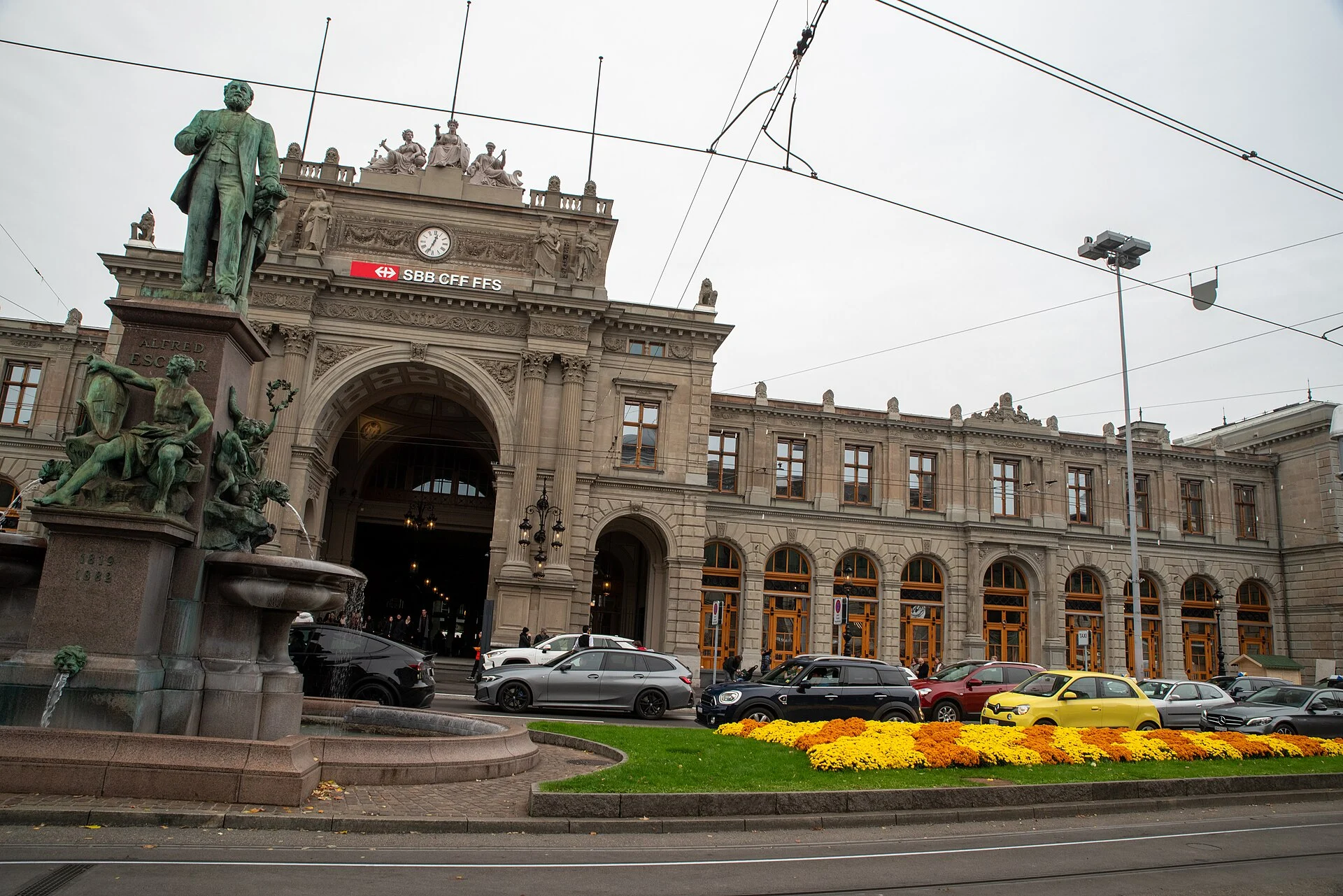
Zurich begins here with the architecture of arrival. Hauptbahnhof, often shortened to HB, is a useful first subject because a station must address both the railway and the surrounding streets. Read the exterior as a sequence of openings, repeated bays and a central emphasis. The size of a doorway and the size of the whole frontage tell different stories: one accommodates a person, while the other announces an institution within the city. A photograph can hold these scales together even when the practical business of catching a train lies outside its frame.
SBB identifies the main hall's architecture with 1871 and describes artworks by Niki de Saint Phalle and Mario Merz inside it. That is useful context for understanding a station as more than transport infrastructure. It is not a promise that those interior artworks appear in this chapter. The detail photograph does enter the main hall to study its arched windows and roof structure; it does not promise that either named artwork is visible. The wide photograph shows the station façade, Escher monument and flower beds, while the context frame turns toward the nearby Limmat.
Compare the wide photograph with the detail and context frames as independent observations. Look for the relationship between the station and the ground in front of it, then for how the hall photograph changes the scale and enclosure of the study. Vehicles, people and signs belong to particular photographic moments. They can explain scale, but they do not supply a current timetable, a verified entrance or an account of today's traffic. Differences in light are invitations to compare surfaces rather than evidence of a single uninterrupted visit.
Augustinergasse follows as the first optional discovery. Its smaller street frontage changes the scale before Lindenhof introduces a broader view. This ordering connects ideas about urban space; arrange an actual journey separately. The indoor still remains separate from the historical August 2016 covered entrance-vestibule interactive scene; plan station circulation, platform access and an actual hall visit independently. Before continuing, choose one architectural rhythm in the main frontage and see how differently that rhythm works when the subject becomes a narrow old-town lane.
Real-travel note
Plan movement and indoor visits separately.
Compare independently captured photographs and viewpoints, each with its own date.
Chapter 2
Lindenhof: reading the city from above
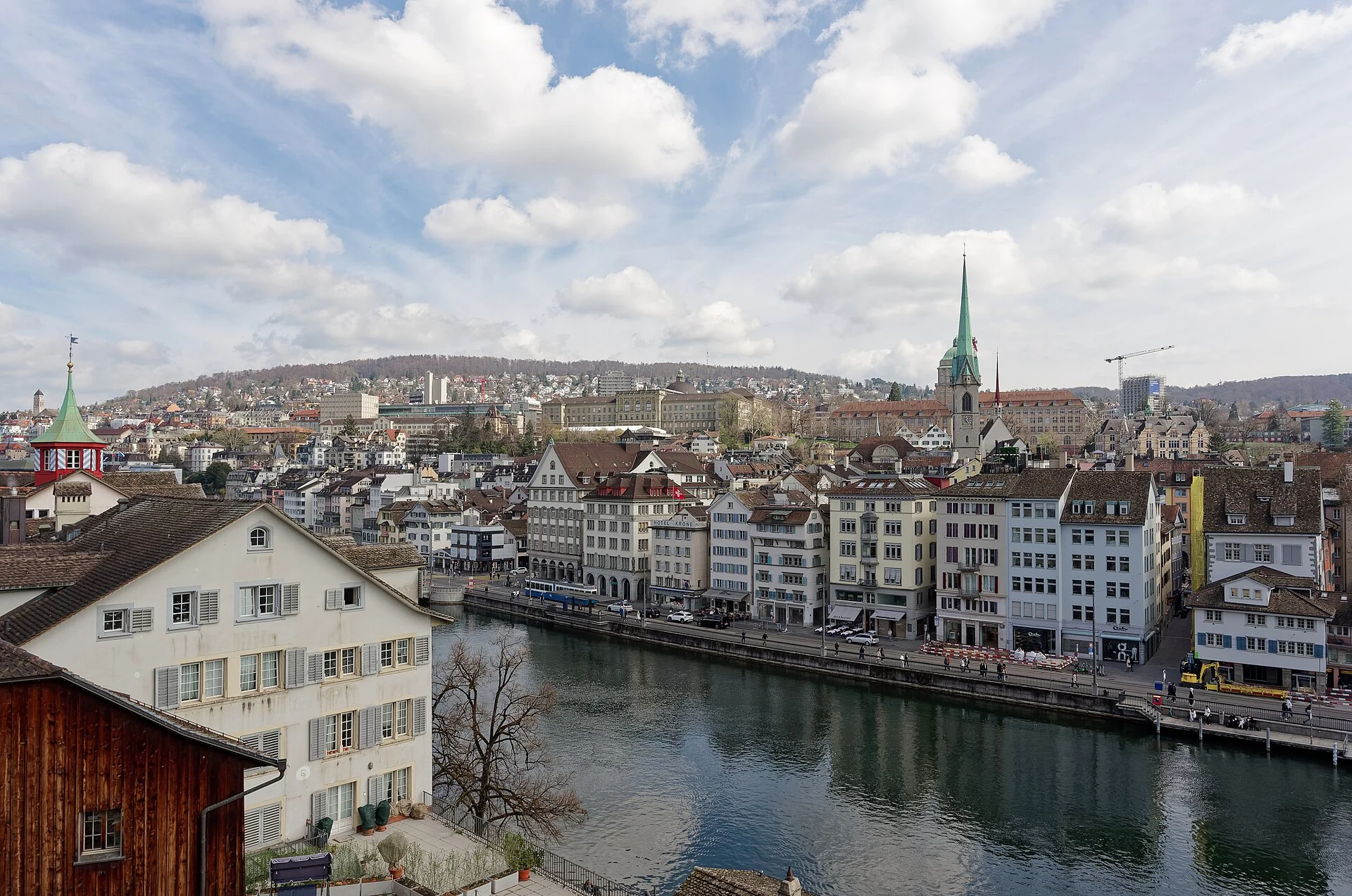
Lindenhof offers a change of level and a change in the way Zurich can be read. Instead of confronting one large frontage, the eye can compare the pieces of a city across the river. Look for the relation between a foreground edge, the Limmat and the buildings beyond it. A tower seen from a distance becomes part of a wider composition, while the same tower studied close up can dominate an entire chapter. This shift in scale is the reason for pausing here.
Zurich Tourism describes a Roman fort on this site in the fourth century and a royal palace in the ninth century. These histories explain why the place matters without making every visible wall or tree a survival from those periods. The present setting and the earlier uses occupy the same location, but they are different kinds of evidence. Use the historical account as context, then return to what each selected photograph actually shows.
Read the wide, detail and context images separately. The detail shows outdoor chess players; the context returns to trees, benches and houses on the hill. Where does the view open, and where does a tree, parapet or nearby building limit it? What becomes easier to understand when the river is visible? A photograph's season affects foliage and shade, so the images need not offer identical sightlines. Nor does an elevated view establish the slope, steps or accessibility of a real approach. The local interactive scene instead records a nearby old-town lane below the hill, including capture-date street works; it does not reach the hilltop terrace or river overlook.
The Rathaus discovery follows this chapter, moving from the larger urban composition toward a civic building at the river. Grossmünster then gives one major landmark sustained attention. The sequence is editorial rather than a record of descending the hill and crossing the city. Before moving on, trace a roofline within the photographs and notice how the river separates buildings while also giving them a shared foreground. That relationship will remain useful through both church chapters and the final lake-edge setting.
Real-travel note
Plan movement and indoor visits separately.
Compare independently captured photographs and viewpoints, each with its own date.
Chapter 3
Grossmünster: two towers beside the river
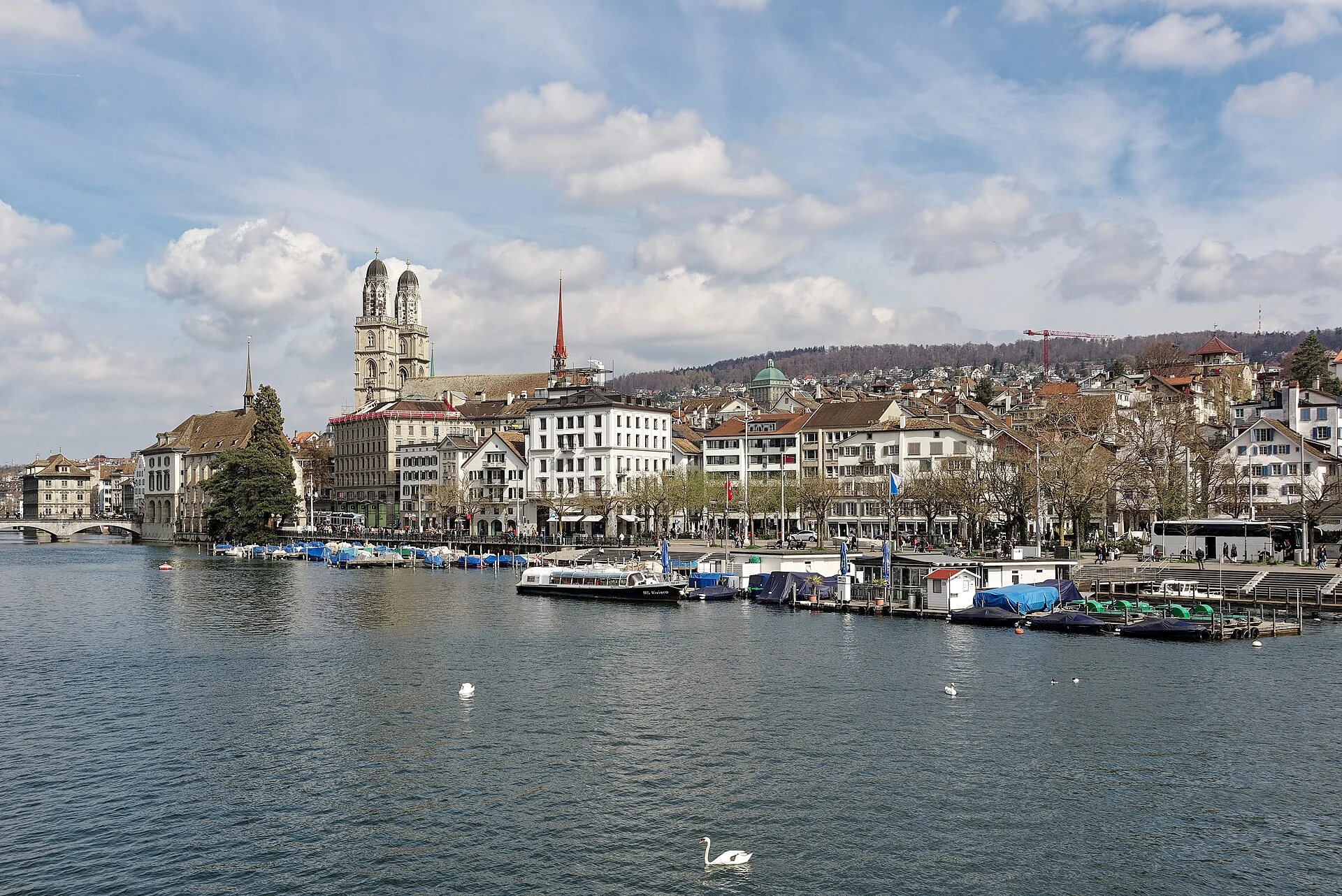
Grossmünster makes Zurich's skyline recognisable through the pairing of its towers. Begin by comparing their proportions with the larger body of the church, then look at the ground and neighbouring buildings that make their height legible. A distant river view can compress the whole composition into a silhouette. A closer photograph restores the scale of masonry, windows and architectural edges. Neither is a complete account of the building, but together they make a useful exercise in reading a landmark.
Zurich Tourism identifies Grossmünster as a landmark associated with the Reformation. Its account also connects the church's origin story with Charlemagne. Keep legend, documented institutional history and visible architecture distinct. A carved figure or a recognisable tower does not by itself prove the details of a foundation story. The exterior remains rewarding without requiring the viewer to turn every architectural feature into an illustration of a single historical episode.
Use the three photographs to compare mass, surface and setting. The close image studies a carved entrance portal; the context includes the Limmatquai riverfront. Ask which elements can be recognised from far away and which require a closer frame. Notice how the river or an adjoining street changes the apparent space around the church when included. The wide, detail and context images were made independently; their light, weather and human activity do not form one recorded visit. Local interactive imagery is a close side exterior and adjoining lane, without a complete twin-tower view. Exterior imagery also does not include a tower ascent or an inspection of stained glass inside. Those are separate experiences with separate arrangements.
St. Peter is the optional discovery after this chapter. Its clock tower introduces a different way of making a church legible above the old town, before Fraumünster provides the next main comparison. This order encourages attention to contrasts in outline rather than documenting a crossing between doorways. Return once more to Grossmünster's twin towers and compare their visual weight with the surrounding roofs. The city around them is part of the subject: a landmark gains much of its meaning from what makes it stand out.
Real-travel note
Plan movement and indoor visits separately.
Compare independently captured photographs and viewpoints, each with its own date.
Chapter 4
Fraumünster: a different silhouette across the Limmat
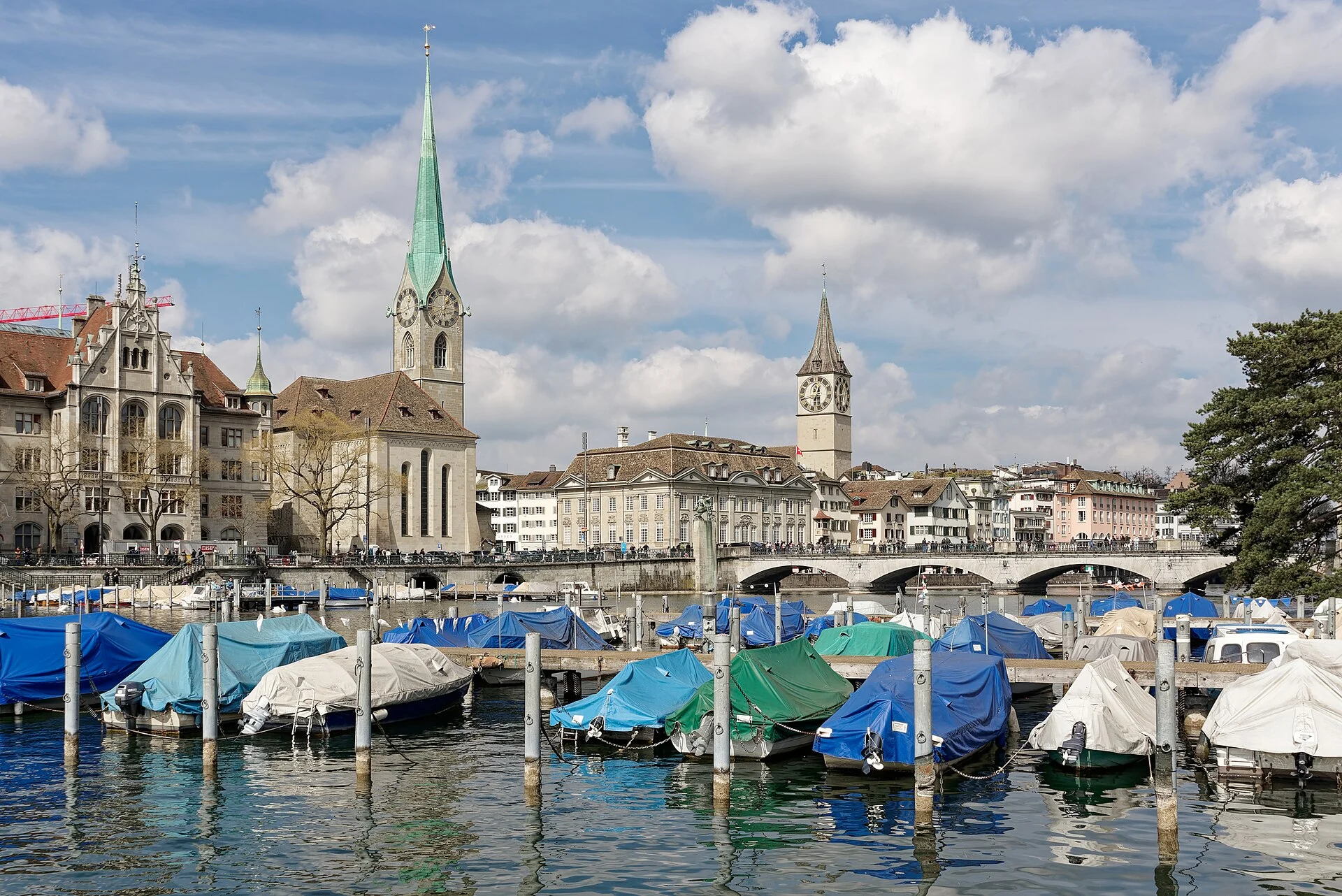
Fraumünster changes the skyline conversation. After Grossmünster's paired towers, concentrate on how a single pronounced vertical element relates to a lower church body and the surrounding urban space. The river provides a useful comparative setting, but the two churches should retain their separate identities. Look at the edges of the selected frame as carefully as its centre: adjoining roofs and open ground can explain why the building appears slender, distant or unexpectedly close.
Zurich Tourism describes the foundation of the former convent in 853 by Louis the German. It also highlights stained-glass works by Marc Chagall and Augusto Giacometti. These references establish important historical and artistic context. The chapter's exterior views do not reproduce an indoor stained-glass encounter, and the foundation date is not a date for every part of the building visible today. An institution can have a long history while its architecture records many later changes.
Compare the wide photograph with the closer view and the broader context. The second photograph compares the clock towers of Fraumünster and St Peter in evening light; the context places the church beside the fountain at Münsterhof. Try reading the same outline first as geometry and then as part of the city: roof, tower and openings are one composition; church, river and neighbouring buildings form another. Each image selects only part of that relationship. Reflections, shadows and foliage depend on the moment of capture. They help give a picture atmosphere without establishing present conditions or access. The local interactive scene records the cloister arcade, rather than an outdoor street or the church nave; it includes no stained-glass encounter.
The Opera House discovery follows Fraumünster before the final Bellevue chapter. It moves from religious and historical institutions toward a cultural frontage and an open urban square. The transition is an editorial comparison, so arrange real movement and visits independently. Before leaving this chapter, bring the two church silhouettes together in memory. Their differences help the old town become a set of specific places rather than one interchangeable collection of towers, waterfronts and picturesque façades.
Real-travel note
Plan movement and indoor visits separately.
Compare independently captured photographs and viewpoints, each with its own date.
Chapter 5
Bellevue: where the river opens toward the lake
Bellevue brings the sequence toward the meeting of the old-town river setting and Lake Zurich. The visual task changes again: instead of concentrating on one monument, compare the elements that make an open urban edge. Water, streets, transport infrastructure and buildings can share a frame without having the same role. Look for the point where the eye can travel farther than it could within a narrow lane, then for the smaller foreground details that give this larger space a human scale.
Zurich Tourism locates Sechseläutenplatz between Bellevue and the Opera House and describes its quartzite surface, trees and seating. This identifies a neighbouring civic space, not a synonym for every part of Bellevue. Keep the transport setting, the square and the lake edge distinct as you compare the selected photographs. They belong to a connected urban area, but a single frame may include only one part of it. A named landmark outside the crop should not be treated as visible evidence.
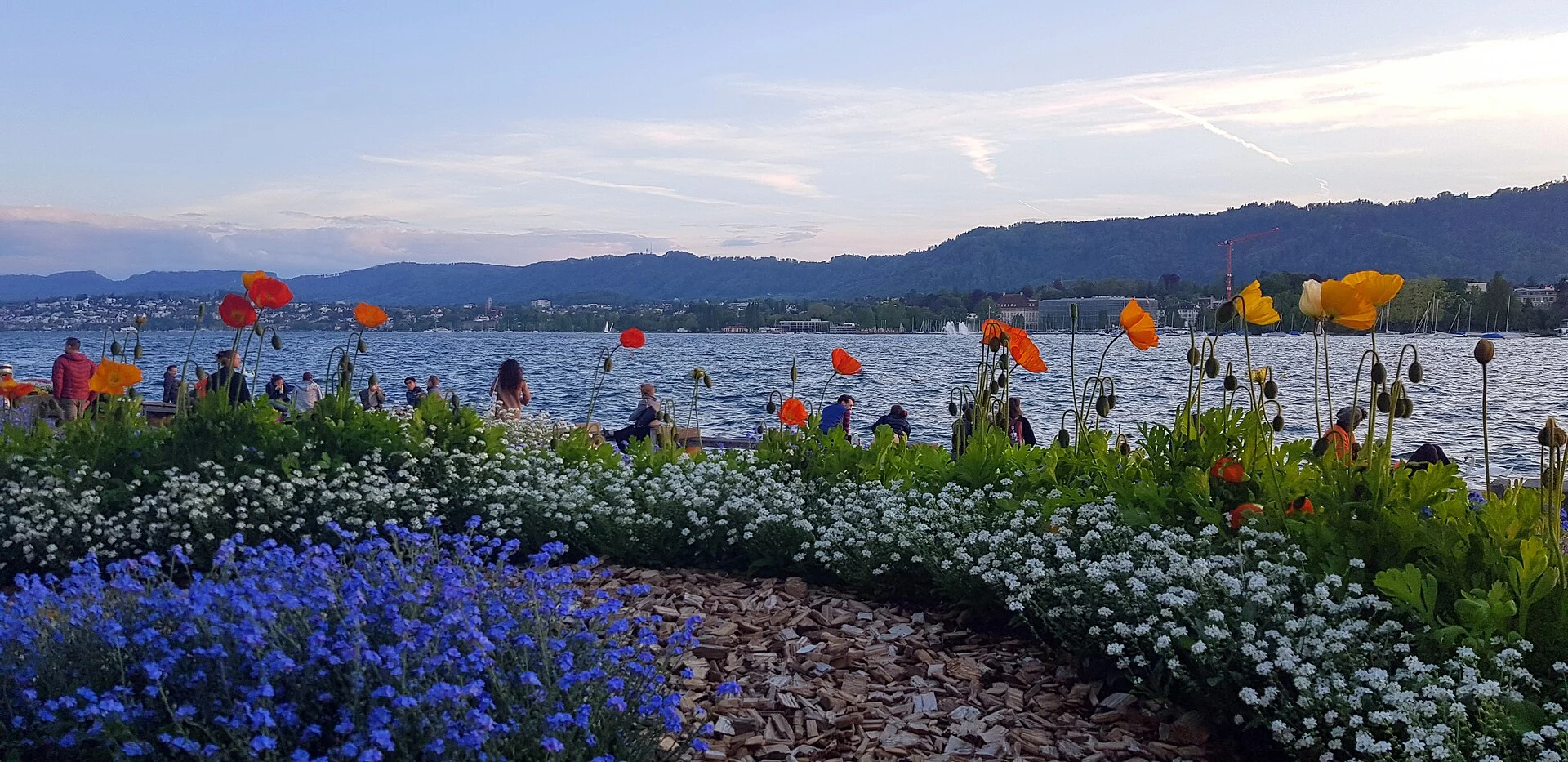
Use the wide, detail and context frames to study how different viewpoints organise the setting. The wide image shows flower beds at the lake edge. The detail records the floating Herzbaracke theatre and a passenger boat in 2009; it is historical imagery, not a current mooring or performance promise. The context is a Quaibrücke plaque recording bridge construction and widening dates, rather than a panoramic lake view. Water reflects the conditions of the photographed moment, and distant visibility changes with weather. Do not turn a clear horizon into a promise of mountain views on a future visit. The interactive scene records the tram junction and adjoining pavement and shops, rather than a continuous lakefront walk. Likewise, trams or pedestrians in a photograph describe a moment rather than today's services or a verified pedestrian crossing.
This chapter closes the main sequence, with the Opera House discovery positioned immediately before it. Look back over the five scales: station frontage, elevated outlook, twin-towered church, contrasting church silhouette and open lake-side city space. The discoveries added a lane, a civic building, a clock tower and a performance institution. Together they provide comparisons for understanding Zurich, while practical travel, indoor visits and event attendance remain separate plans. Finish by noticing how the open water changes the way the city holds the viewer's attention.
Real-travel note
Plan movement and indoor visits separately.
9 reviewed experiences
Explore along the route
Step into the places along this journey. Choose a view independently of the story chapters. Free previews do not count toward chapter progress. Return to the journey above to continue through its stops.
Hauptbahnhof: a city addressed to arrivals Short observation sequence
2016-08 · 5 connected local positions and return. Historic covered station entrance vestibule with decorated arches, captured August 2016; no platforms or current station-layout claim. Capture-date archive; current access and arrangements may differ.
Reviewed 2026-11-13 · Nearby viewpoint
Explore at your own pace; these views do not count toward chapter completion. Check each point's coverage note before navigating provider imagery. Availability may change.
Sources
- Hauptbahnhof — SBB
- Lindenhof — Zurich Tourism
- Grossmunster — Zurich Tourism
- Fraumunster — Zurich Tourism
- Bellevue — Zurich Tourism
- Augustinergasse — Zurich Tourism
- Rathaus — Zurich Tourism
- St Peter — Zurich Tourism
- Opera House — Zurich Tourism
- Hauptbahnhof facade, Alfred Escher monument and flower beds in Zurich — Balise42
- Arched windows and roof structure inside Zurich Hauptbahnhof main hall — Mike is Michi
- Limmat river and historic buildings near Zurich Hauptbahnhof — Andrew Bossi
- Old Town rooftops and Limmat river seen from Lindenhof hill — Jakub Hałun
- Outdoor chess players under the trees at Lindenhof — Ank Kumar
- Trees, benches and houses on Lindenhof hill — Jakub Hałun
- Grossmünster twin towers above the Limmat riverfront — Jakub Hałun
- Carved stone entrance portal of Grossmünster — Liridon
- Grossmünster and historic buildings along Limmatquai — DXR
- Fraumünster spire and Münsterbrücke above moored boats — Jakub Hałun
- Fraumünster and St Peter clock towers in evening light — Roland zh
- Fountain and Fraumünster at Münsterhof square — Roland zh
- Flower beds beside Lake Zurich at Bellevue — Armineaghayan
- Floating Herzbaracke theatre and passenger boat at Bellevue in 2009 — Roland zh
- Historic construction and widening dates on the Quaibrücke bridge plaque — Roland zh
- Oriel windows and colorful facades along Augustinergasse — JoachimKohler-HB
- Zurich Rathaus standing beside the Limmat river — Ank Kumar
- St. Peter church clock tower above leafy trees — Photones
- Classical facade of Zurich Opera House — Thomas Wolf, www.foto-tw.de


Your journey, remembered.
Explored 0 of 5 stops. Explore every stop to unlock your keepsake.
5 stops to your keepsakeExplore every stop to share or download your keepsake.
Plan separate Zurich visits
Compare five urban settings; arrange travel and indoor visits separately.
Official sources checked:
Editorial sequence
Hauptbahnhof, Lindenhof, Grossmünster, Fraumünster and Bellevue form the main sequence. Augustinergasse, Rathaus, St. Peter and Opera House are optional comparisons. Independent imagery verifies no continuous walk, tower ascent or step-free connections.
Visiting arrangements
Stills and local interactive imagery are independent. Check church interiors, tower ascents and Opera House performances separately; images establish no present opening or prices.