
Strasbourg: stone, squares and waterways
Read Strasbourg’s Grande-Île through five chapters and four optional discoveries.
Begin the visual journeyPlan a real visit to Strasbourg Old TownExplore 7 reviewed views along the routeGuided visual journey
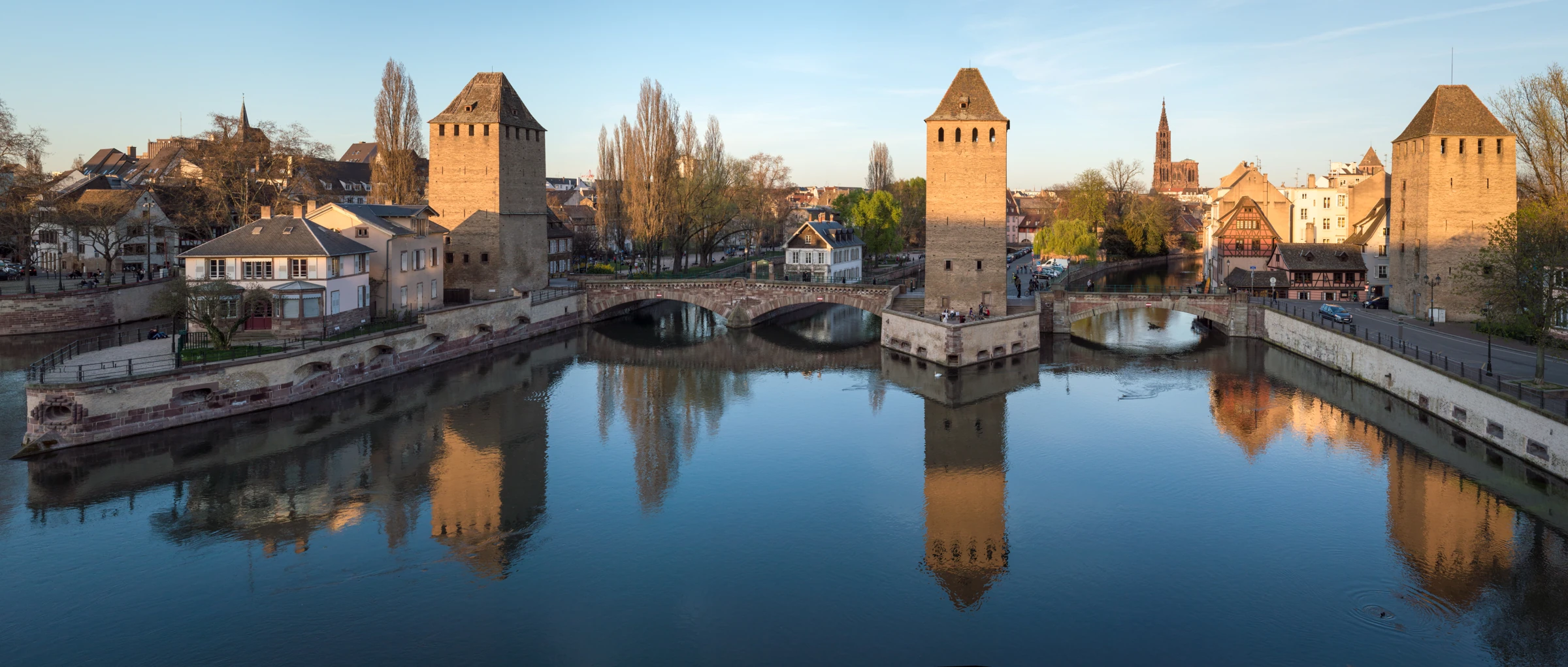
Ponts Couverts towers reflected in the river at sunset · Aloïs Peiffer · CC BY-SA 3.0 · Resized and converted to WebP
Reading mode
Place stories to read at your own pace
Compare three independent chapter photographs and an additional photo discovery along the route.
Chapter 1
Cathedral: stone made light
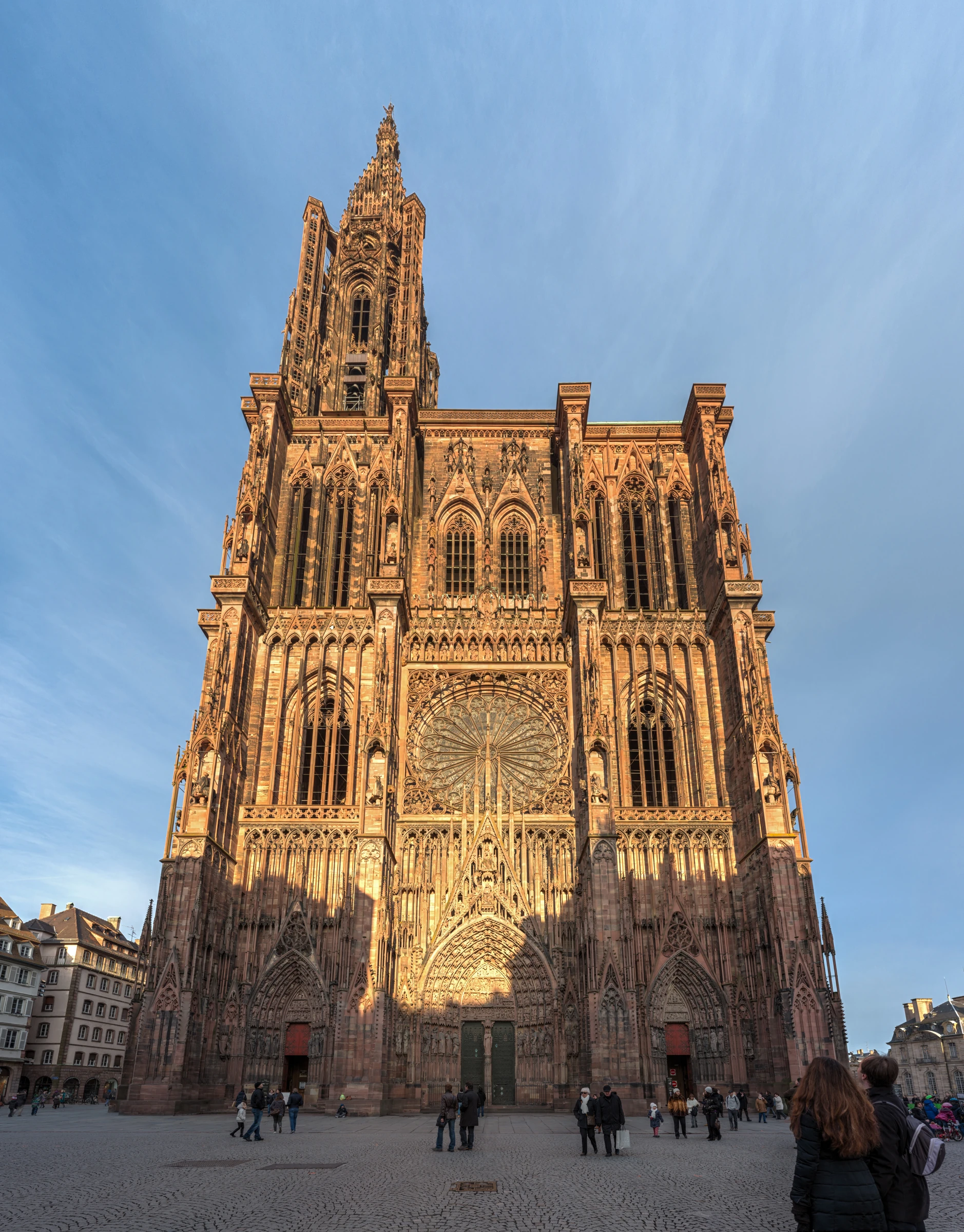
Begin below the cathedral rather than with its entire skyline. The façade draws the eye upward through entrances, galleries and open stonework before the single spire carries it beyond the neighbouring roofs. Strasbourg Tourist Office identifies the material as pink sandstone from the Vosges. That geographical connection is a useful starting point: changes in light can make one material look warm, grey or almost luminous. Colour in a photograph is also affected by exposure and weather, so compare shapes as well as surfaces.
The wide photograph gives the western front room to rise above the square. The two closer photographs turn to the south transept, where circular windows, arched openings and a clock create a different arrangement. They are independent photographs of related architecture, not successive frames of a camera walking around the building. Notice how a tightly framed wall can make ornament seem continuous while the more distant view reveals the gaps between decorated elements.
UNESCO describes the Grande-Île as a historic centre structured around the cathedral. This chapter makes that relationship a question of scale: how much ground and how many neighbouring buildings remain visible when the tower dominates the frame? The small figures below are useful measures, but their activities belong to the photographic occasion. A façade photograph does not establish entry arrangements or show the astronomical clock inside.
The optional Maison Kammerzell discovery brings the eye back to the height of a house before the sequence moves to Place Gutenberg. Carry the contrast between a singular vertical landmark and repeated domestic windows into that next chapter. This is an editorial transition between subjects. Any actual passage through the square, interior visit or tower ascent needs separate planning.
Real-travel note
Plan movement and indoor visits separately.
Compare independently captured photographs and viewpoints, each with its own date.
Chapter 2
Gutenberg: a monument within a square
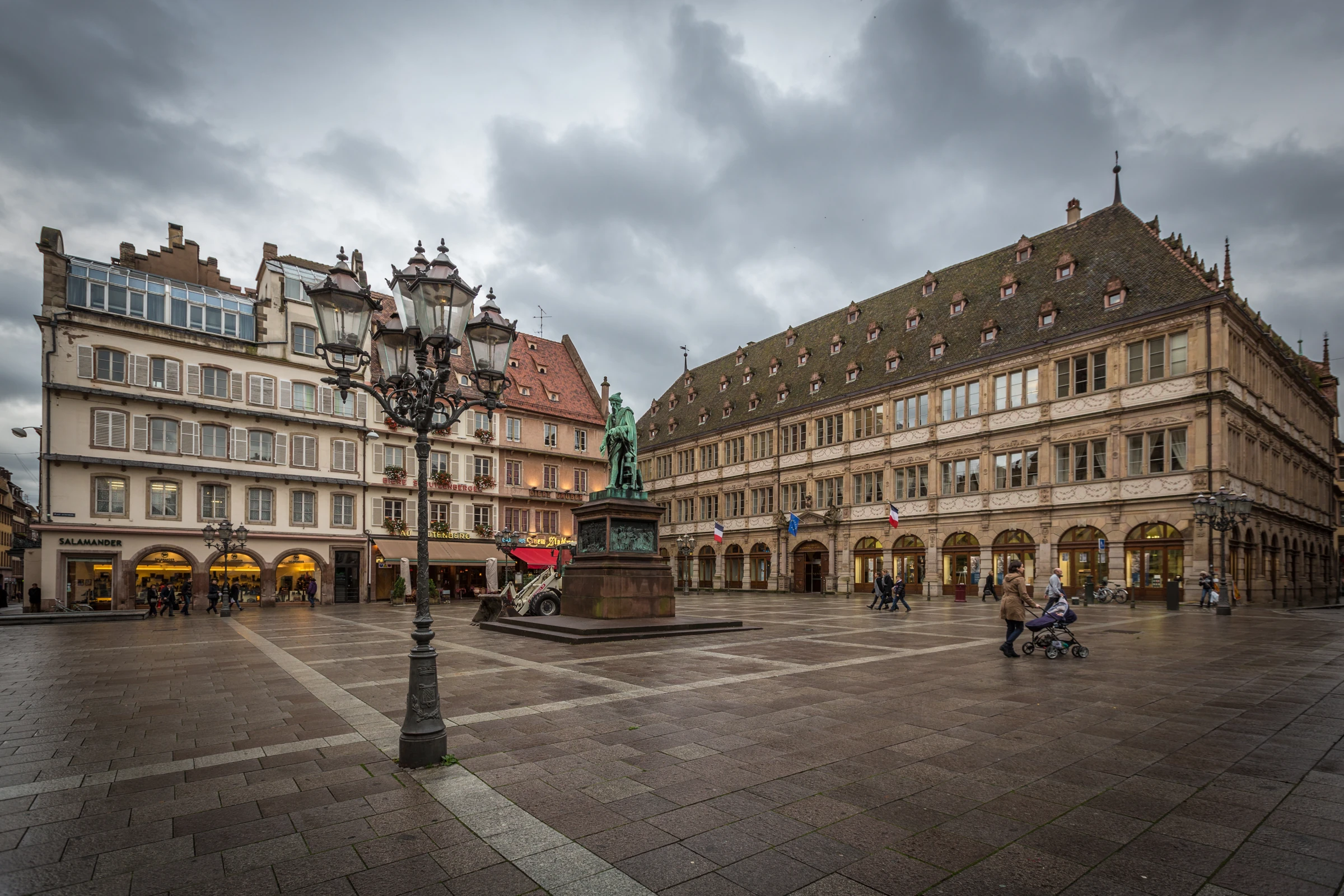
Place Gutenberg asks for a slower look at the ground around a monument. A statue may give a square its most recognisable subject, yet the surrounding façades establish the room in which that subject is seen. Start with the distance between the pedestal and the buildings behind it. In one photograph the monument appears tightly attached to a frontage; in another it stands apart against open paving. The difference is a consequence of camera position, not evidence that the square has changed its dimensions.
The wider image includes the square, its statue and neighbouring buildings under an overcast sky. Another view places the green figure against a long roofline and a rhythm of windows. The closer frame turns toward the pedestal and its relief. Read the relation between figure, base and viewer before trying to interpret every inscription. Lettering visible in a photograph may be incomplete, and this journey does not reconstruct texts that the image cannot clearly show.
UNESCO’s account places the historic centre within a medieval urban structure that later architecture continued to occupy. Use that broader context here without assigning one construction date to the entire square. Repeated windows and long cornices can lend visual unity to buildings with different histories. Shops, umbrellas, vehicles and visitors record separate moments rather than a current inventory of the place.
After the cathedral’s upward pull, the square offers a more horizontal way to read the city. The Palais Rohan discovery adds another comparison of formal façades before Saint-Thomas changes the religious and architectural subject. These chapters are linked by observation and editorial order. They do not verify a continuous route through specific streets, and the photographs establish no museum admission or present-day event.
Real-travel note
Plan movement and indoor visits separately.
Compare independently captured photographs and viewpoints, each with its own date.
Chapter 3
Saint-Thomas: a church at street scale
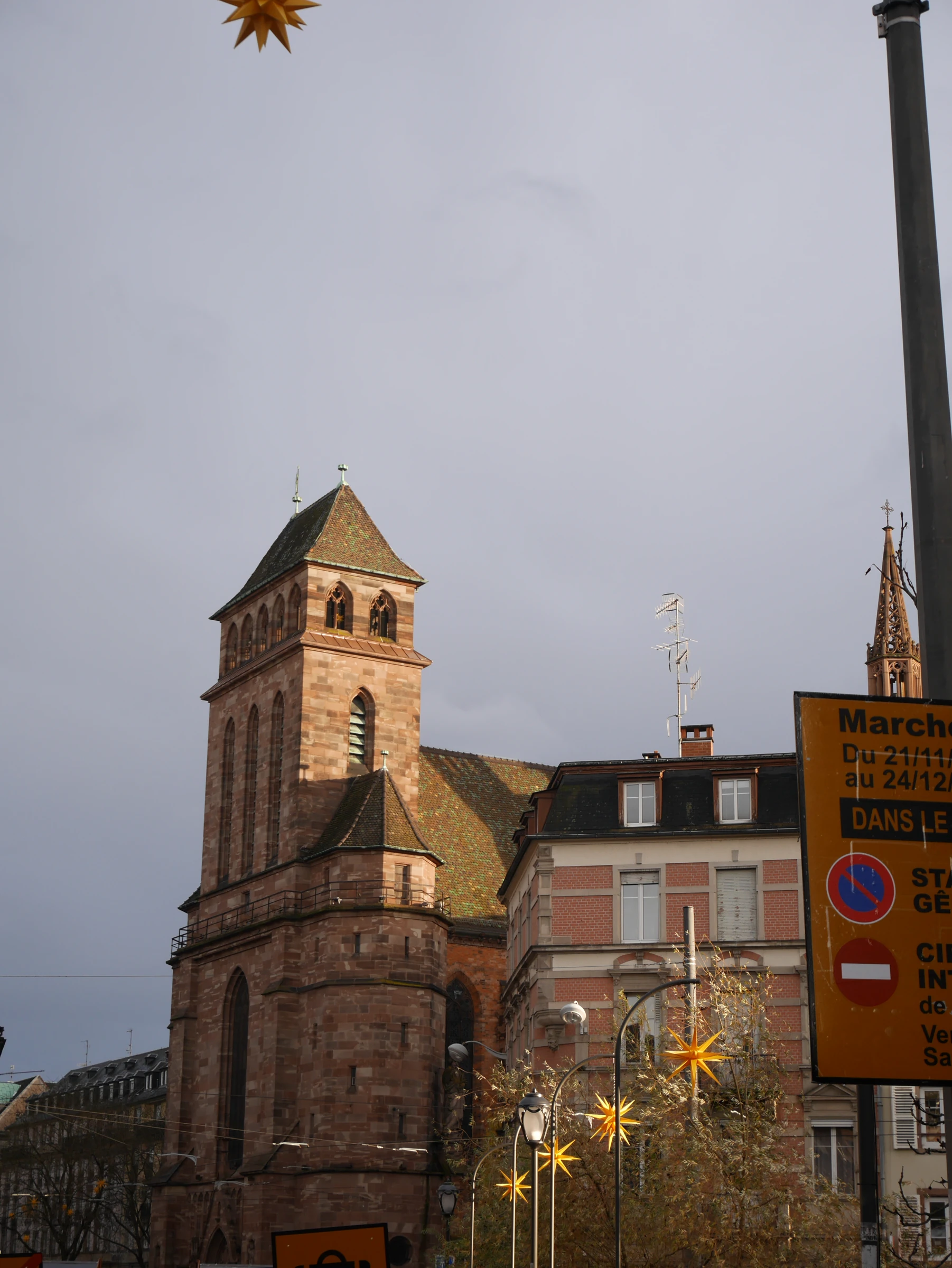
Saint-Thomas offers a useful counterpoint to the cathedral. Instead of letting the largest landmark stand for every religious building in Strasbourg, look at this church through its immediate edges: tower, roof, wall and the adjoining public space. The broad surfaces and heavy volumes read differently from the cathedral’s lace-like western front. Comparing those impressions is a visual exercise, not a claim that the two buildings share a single date or institutional history.
The first photograph looks upward toward the tower at dusk; another shows several exterior volumes together from ground level. The close view concentrates on plaques fixed to patterned masonry. These three photographs change both the lighting and the distance of observation. Pay attention to the way the stone courses continue around openings. A surface can be visually consistent while carrying additions made for different purposes at different times.
UNESCO describes French and Germanic influences as central to Strasbourg’s architectural identity. That citywide account supports comparison across the journey, but it does not identify the age or meaning of every visible feature at Saint-Thomas. The selected photographs remain exterior studies. They do not show the church’s internal arrangement, verify an organ performance or establish access during services. Reading the plaques in person would require a different level of proximity from the one these frames provide.
Before moving toward Petite France, compare the church’s roofline with the narrower domestic roofs that will follow. Both shape the strip of sky over the street, but one large volume and a collection of small buildings organise attention differently. Return once to the base of the tower and notice what the camera excludes. The transition to the waterfront is editorial; actual movement and church entry should be arranged independently.
Real-travel note
Plan movement and indoor visits separately.
Compare independently captured photographs and viewpoints, each with its own date.
Chapter 4
Petite France: buildings against moving water
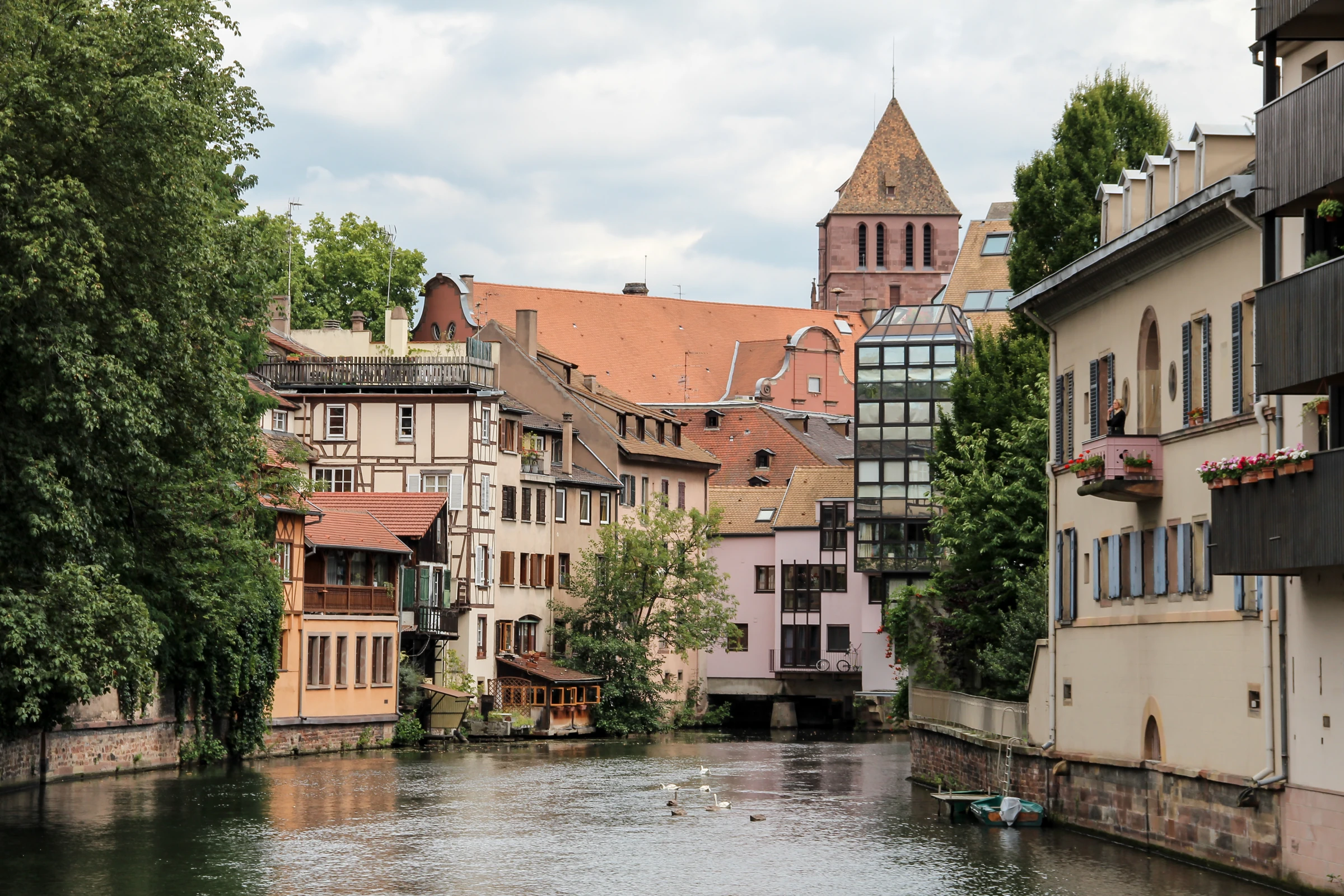
Water changes how Strasbourg can be seen. In Petite France, façades are read together with channels, bridges and reflections rather than solely from the street beneath them. The tourist office describes the district through five arms of the River Ill. That branching structure makes the relationship between land and water a better starting point than the idea of a single picturesque canal. A photograph captures only one portion of a more complicated system.
Begin with the broad waterside view. Look at the gap between buildings on opposite banks, then compare that opening with the narrow streets in earlier chapters. Water provides a foreground that people cannot occupy in the same way as a square. Reflections repeat some of the architecture while breaking its straight lines. Their appearance depends on the photographed weather and surface movement, so they are observations of an instant rather than permanent decoration.
The official description associates Rue du Bain-aux-Plantes with former tanners and explains the open roof spaces used for drying hides. Keep that historical account distinct from identifying a particular house in a photograph: visible timber framing alone does not prove a specific former use. Compare the proportions of roof, wall and water across the independent views, allowing camera angle and cropping to explain differences before imagining a change in the buildings themselves.
The optional Place Kléber discovery introduces a different kind of public opening before the sequence returns to the river defences at Ponts Couverts. No boat journey, bridge operation or uninterrupted quayside walk is included. The photographs and any separately labelled local panorama show dated conditions. For an actual visit, confirm passage and riverside access independently, and leave room for the city’s working waterways to interrupt a planned crossing.
Real-travel note
Plan movement and indoor visits separately.
Compare independently captured photographs and viewpoints, each with its own date.
Chapter 5
Ponts Couverts: the city’s water edge
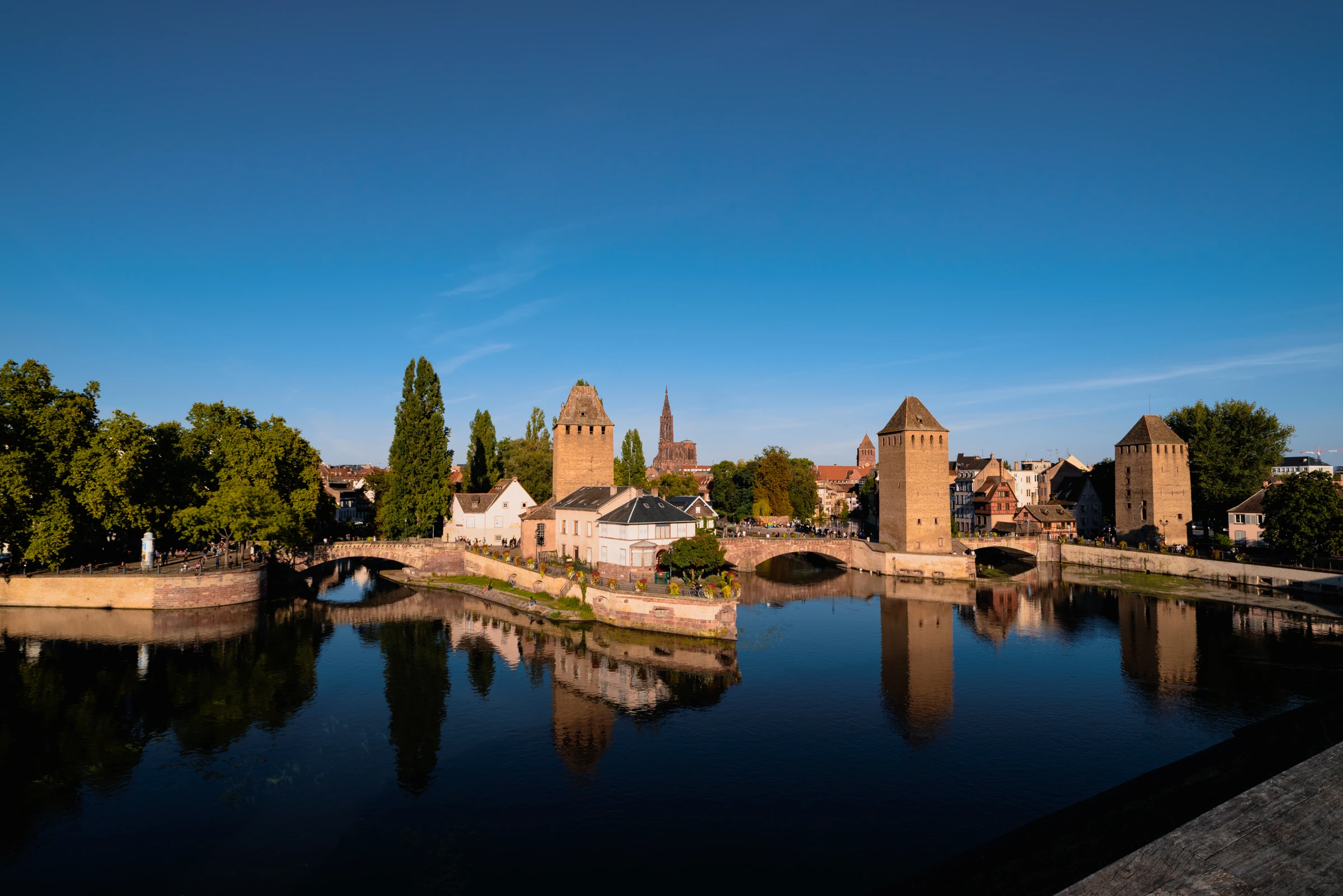
Close the main sequence where water, towers and bridges share the foreground. Ponts Couverts makes the city’s edge visible through a repeated rhythm of solid vertical forms and open channels. The tourist office identifies the guard towers as vestiges of the medieval wall. Read that statement alongside the photographs rather than treating every visible bridge surface or railing as medieval. A historic name can persist while the structures and uses around it change.
The wide panorama places several towers against the city and reflected sky. A second photograph gives a closer southern view of one tower and the adjacent crossing. The third opens the river setting again under strong light. Compare the amount of water in each composition before attending to the buildings. A low camera angle can make a tower seem isolated; a broader frame restores the bridges and banks that explain its place in an urban system.
The cathedral returns in the background of the wider views. After beginning beneath its façade, it can now be read as part of a skyline rather than as the entire subject. This shift is one of the journey’s central comparisons: the same landmark can establish orientation at very different scales. Reflections, shadows and small figures belong to each photographer’s separate occasion; they do not combine into a continuous panorama or a verified walking record.
The Barrage Vauban discovery adds a final comparison with another form of river defence. The official account explains the dam’s ability to obstruct the Ill and flood land south of the city. That historical function is distinct from present operations or access to its terrace. Finish by tracing the boundary between water and masonry, then let the image end where it actually ends. Crossings, museum visits and any real circuit of the old town require their own planning.
Real-travel note
Plan movement and indoor visits separately.
7 reviewed experiences
Explore along the route
Step into the places along this journey. Choose a view independently of the story chapters. Free previews do not count toward chapter progress. Return to the journey above to continue through its stops.
Cathedral: stone made light Short observation sequence
2009-09 · 2 connected local positions and return. Dated cathedral forecourt and western facade; independent local positions. Capture-date archive; current access and arrangements may differ.
Reviewed 2026-11-16 · Nearby viewpoint
Explore at your own pace; these views do not count toward chapter completion. Check each point's coverage note before navigating provider imagery. Availability may change.
Sources
- Strasbourg, Grande-Île and Neustadt — UNESCO World Heritage Centre
- The cathedral — Strasbourg Tourist Office
- The Petite France — Strasbourg Tourist Office
- Western facade and spire of Strasbourg Cathedral above the square — Diliff
- Circular windows and clock on the cathedral south transept — Txllxt TxllxT
- Stone ornament around the cathedral south transept clock — Txllxt TxllxT
- Gutenberg statue and buildings around the paved square — Photo Claude TRUONG-NGOC
- Gutenberg statue against the long building frontage — Txllxt TxllxT
- Gutenberg statue and relief on its pedestal — John Samuel
- Saint Thomas church tower at dusk — Moleskine
- Exterior volumes and towers of Saint Thomas church — Yair Haklai
- Plaques on the stone wall of Saint Thomas church — John Samuel
- River channel between buildings in Petite France — Dietmar Rabich
- Half-timbered houses at Place Benjamin Zix in Petite France — Photo Claude TRUONG-NGOC
- Lock structure and waterside buildings in Petite France — JoachimKohler-HB
- Ponts Couverts towers reflected in the river at sunset — Aloïs Peiffer
- Southern view of a Ponts Couverts tower and crossing — DXR
- Ponts Couverts towers beside the broad river surface — Flocci Nivis
- Timber facade of Maison Kammerzell beside the cathedral — Thomon
- Palais Rohan facing the Quai des Bateliers across the river — Coyau
- Arches of Barrage Vauban reflected in the river — Claude TRUONG-NGOC
- Aubette frontage and trees on Place Kleber — Txllxt TxllxT


Your journey, remembered.
Explored 0 of 5 stops. Explore every stop to unlock your keepsake.
5 stops to your keepsakeExplore every stop to share or download your keepsake.
Plan separate Strasbourg visits
Compare the old town through buildings and waterways; arrange movement and indoor visits separately.
Official sources checked:
Editorial sequence
Cathedral, Place Gutenberg, Saint-Thomas, Petite France and Ponts Couverts form five chapters, with Maison Kammerzell, Palais Rohan, Place Kléber and Barrage Vauban as optional discoveries. Sites use editorial transitions.
Visiting arrangements
Dated local imagery includes approaches, scaffolding at Saint-Thomas and no framed statue at Gutenberg. Photos establish no present opening, prices or step-free access.