
Seoul Bukchon: palaces, lanes and lived-in hanok
Move from Unhyeongung into the slopes of Bukchon through five story-led stops and ten licensed photographs. Optional historical street imagery is treated as context; this is a residential district, not a continuous virtual attraction.
Begin the visual journeyExplore 5 reviewed views along the routeGuided visual journey
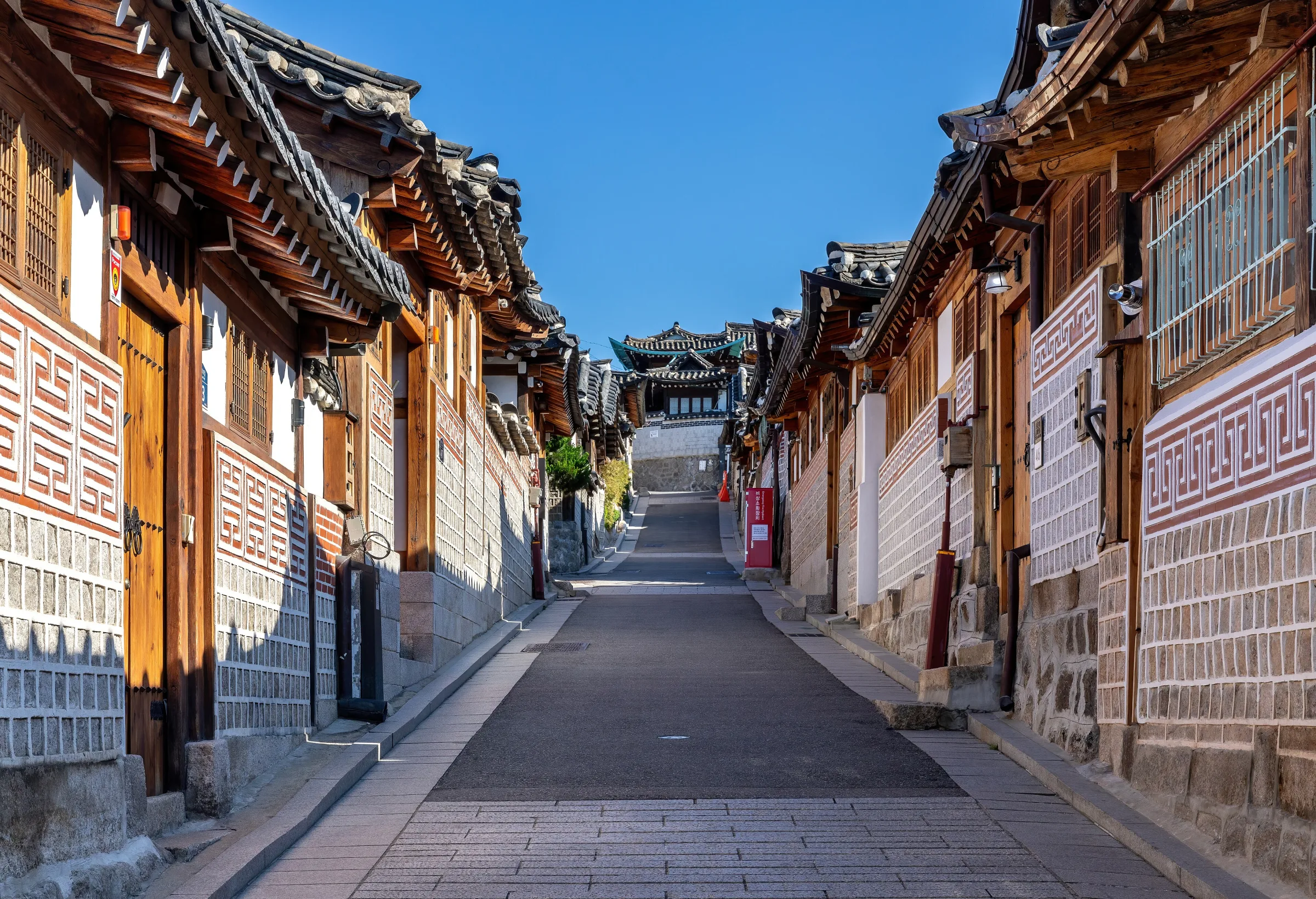
Hanok roofs rising along Bukchon-ro 11-gil under a blue sky · Basile Morin · CC BY-SA 4.0
Reading mode
Place stories to read at your own pace
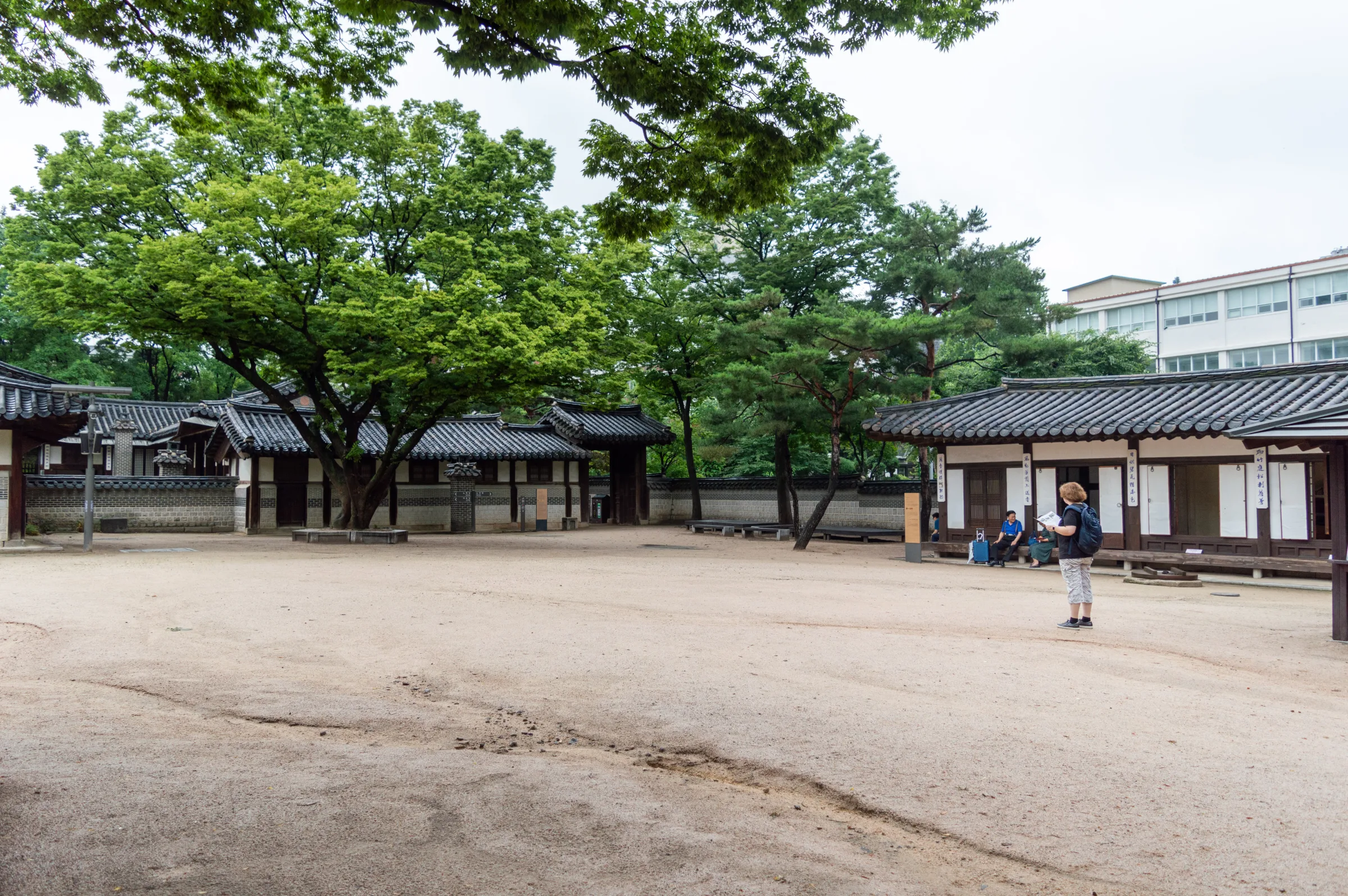
An open entrance view and a shaded inner court establish the former residence at two scales.
Chapter 1 · A royal residence at street level
Begin in the courtyards of Unhyeongung
Unhyeongung is a useful threshold because it begins with open ground rather than the famous compressed lanes. Tristan Surtel’s 2019 photograph looks across the entrance square toward low tiled roofs and the taller city around them. Jeon Han’s 2012 image moves inside to a broad shade tree, tiled walls and a quieter courtyard. The seven-year gap is visible evidence that a heritage place is maintained and experienced over time, not a frozen set.
The Seoul guided walking route uses Unhyeongung as its meeting point before moving north through Bukchon. That sequence matters: the former residence introduces courtyard proportions, roof edges and thresholds before similar elements appear in smaller residential plots. Yet the photographs cannot establish which rooms are open today, whether an event occupies the square, or how busy the approach will be.
Any optional street-level imagery here is only for outside orientation. It does not authorize palace entry or replace posted rules. Check current opening information, move quietly through enclosed courts and avoid blocking doorways for photographs. The two dated stills remain the primary evidence if third-party imagery is unavailable.
Real-travel note
Check current opening hours and event notices. Courtyards may close temporarily, and stone or packed surfaces can be slippery after rain.
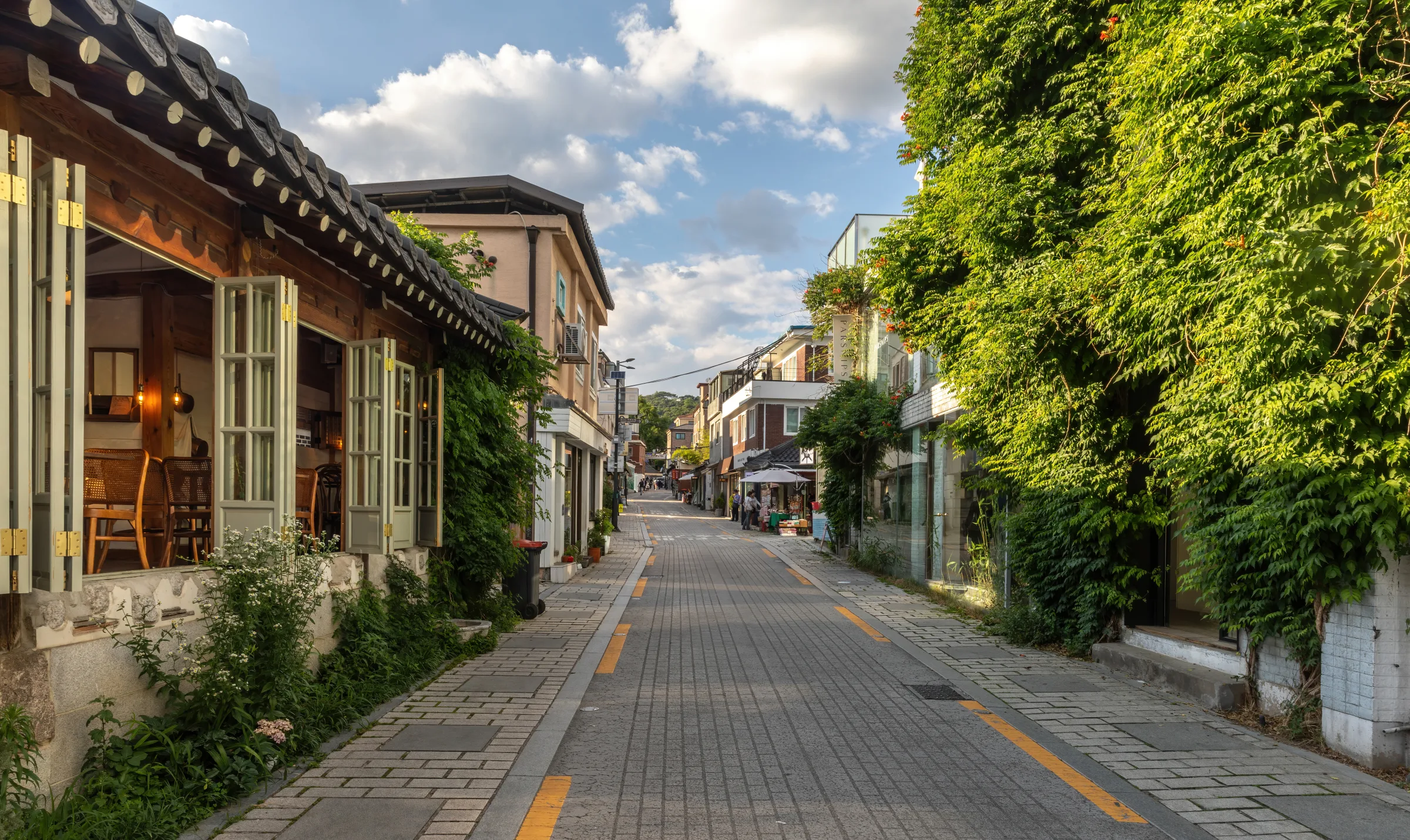
A planted working street and an identified culture-center courtyard distinguish public street from public facility.
Chapter 2 · The neighbourhood starts to work
Read Gyedong-gil beyond the preserved façade
Gyedong-gil is where the journey stops behaving like a monument checklist. Basile Morin’s 2024 photograph records climbing plants, open café windows, signs and the late-afternoon colour of an active street. Motoko C. K.’s 2026 photograph turns into the Bukchon Traditional Culture Center, where a compact courtyard and timber details make the organisation of a hanok easier to read.
Visit Seoul places the culture center early in the official walk, before the route reaches the best-known viewpoints. That ordering gives useful context, but it does not make every building along Gyedong-gil a public exhibit. Homes, workshops, cafés and institutions share the street. What looks like an inviting gate in a photograph may be private, closed or serving a different purpose when you arrive.
Use any verified street imagery to compare width, slope and sightlines, not to inspect residents. Keep entrances clear, lower your voice and ask before close photography of people or occupied interiors. The two stills deliberately show different kinds of access: one public street and one identified cultural facility.
Real-travel note
Gyedong-gil is a working neighbourhood street. Keep gates and shopfronts clear, and confirm the culture center’s current hours before entering.
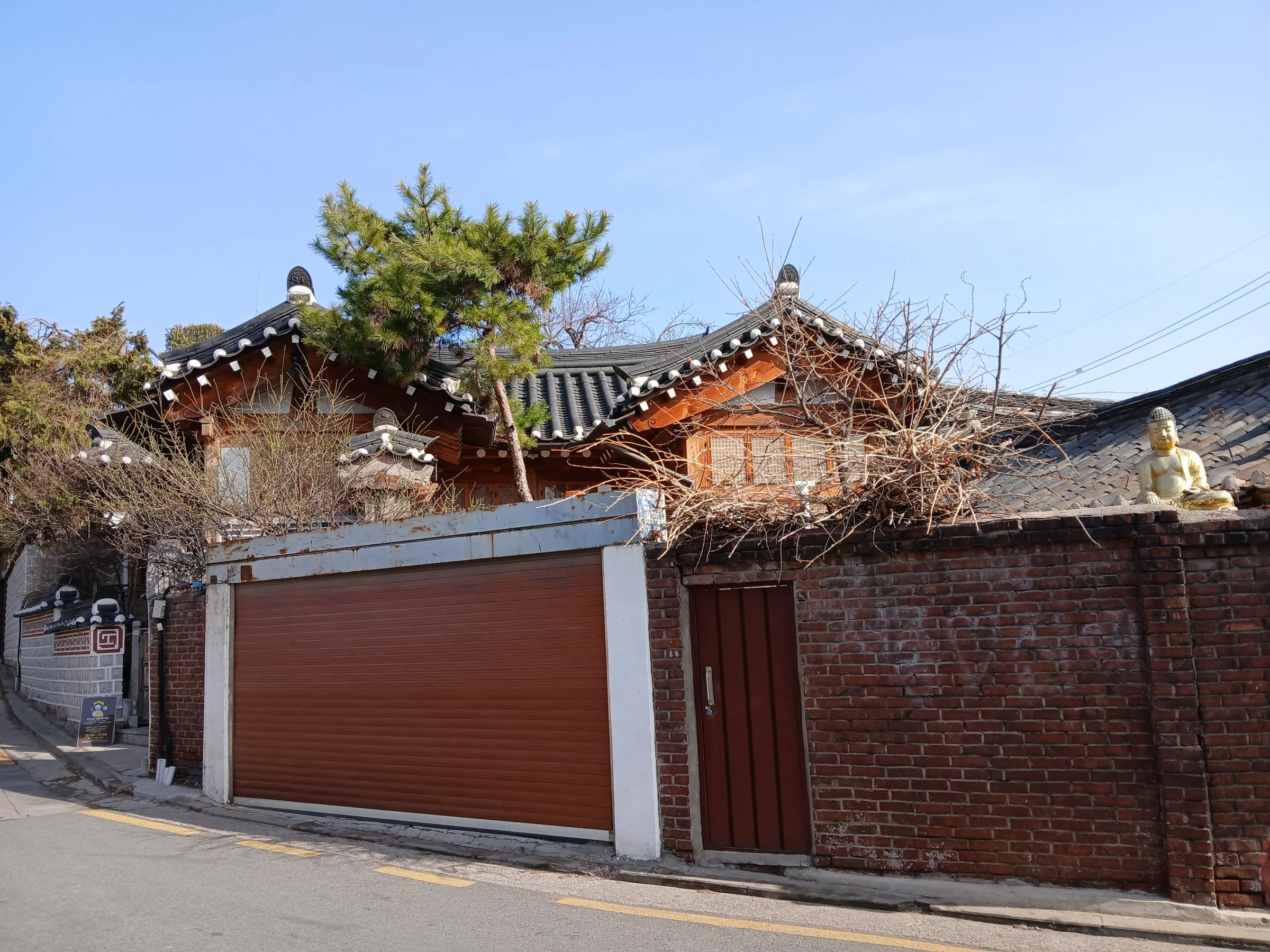
Two same-day frames focus on brick boundaries and rooflines rather than private thresholds.
Chapter 3 · A neighbourhood, not an open-air set
Slow down in the residential lanes
Repeated rooflines make this part of Bukchon visually legible, but the important boundary is social rather than architectural. Epicgenius made both photographs on 13 March 2025. One looks over a brick wall toward a hanok roof and small Buddha figure; the other sets low roofs and boundary walls against taller city buildings. They are complementary viewpoints, not a continuous filmed route.
Bukchon sits between major palace areas, yet hundreds of hanok here remain part of a lived neighbourhood. Official tourism material identifies it as an actual residential area, and Seoul's guide asks visitors to remain quiet for residents. WalkThere therefore does not frame a doorway as a destination, infer access from an open gate, or publish a path that encourages users to copy the exact camera position.
If a historical panorama resolves nearby, use it only to understand slope and street form. Current signs, wardens and restricted hours take priority. Visit in a small group, speak quietly, do not photograph through windows and move on rather than waiting for an empty lane.
Real-travel note
Treat every unmarked gate and threshold as private. Keep voices low, avoid tripods and queues, and follow current red-zone signs and wardens.
Day and blue-hour views show how light changes the famous roofscape; current resident restrictions still take priority.
Chapter 4 · The famous view has a clock
Compare Bukchon-ro 11-gil by day and blue hour
Bukchon-ro 11-gil is often compressed into one uphill photograph. Basile Morin’s two images resist that simplification: a blue-sky view made on the morning of 4 June 2024 shows roof planes climbing toward the ridge, while a long exposure from the previous evening changes the same street into bands of warm windows and deep blue sky. The pair demonstrates how dramatically light can alter the scene without claiming the street belongs to photographers.
The Seoul Metropolitan Government’s current tourist guide marks part of Bukchon as a red zone with visits restricted from 17:00 until 10:00 the following day, and warns that violations may be fined. That operational rule is time-sensitive. Recheck the latest district guidance before visiting rather than treating this page as live authority. The blue-hour photograph documents a past date; it is not an invitation to reproduce that timing now.
A verified 360° view can be useful here because turning around reveals slope, walls and the city beyond the iconic frame. It remains historical imagery and cannot override today’s restriction, crowd control or resident privacy. Stay brief, quiet and mobile.
Real-travel note
The published red-zone restriction is 17:00–10:00, but rules can change. Recheck current Jongno-gu or Seoul guidance before visiting.
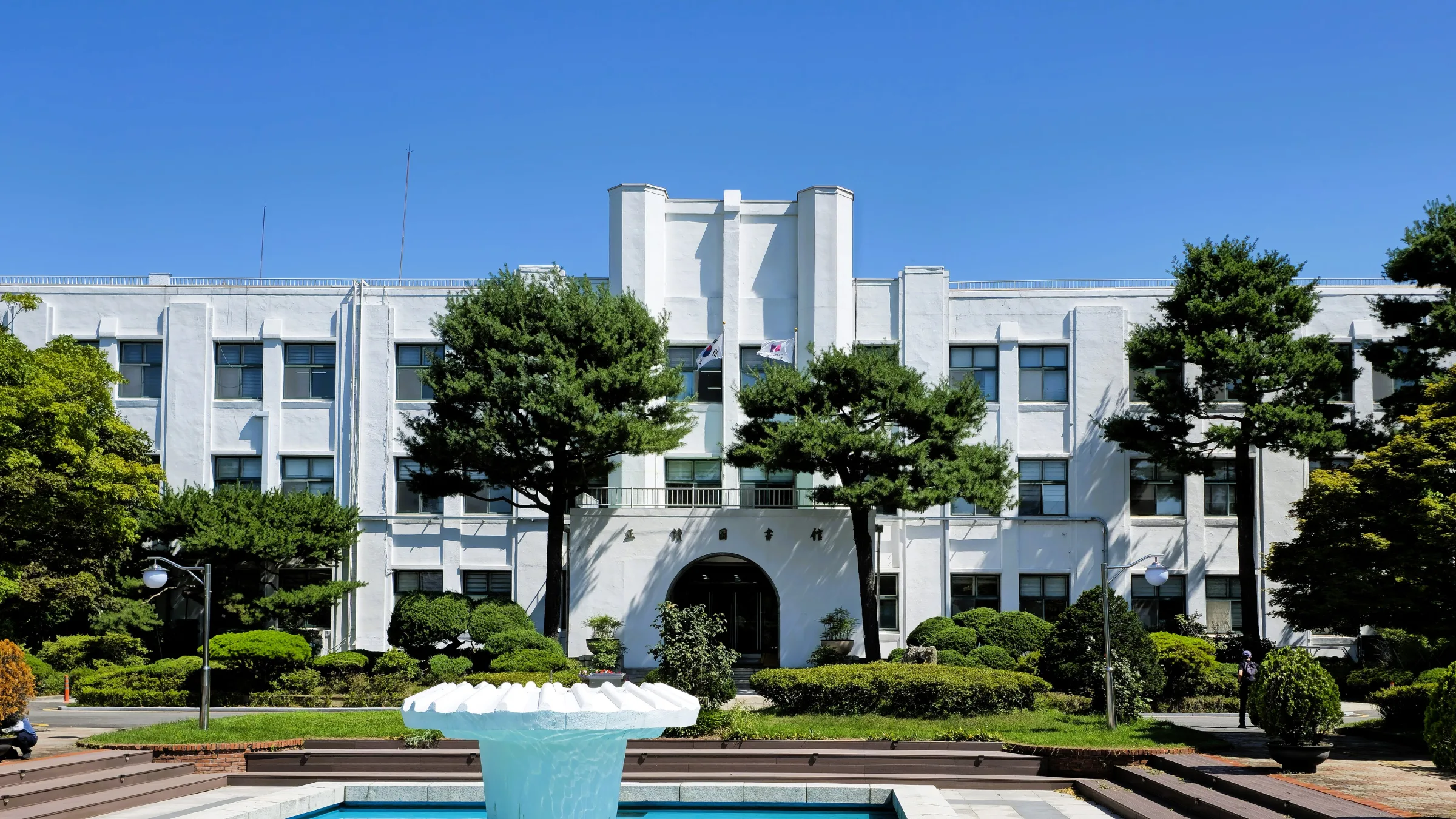
A recent broad view and an older autumn frame reveal the reused school campus over time.
Chapter 5 · From hanok lanes to a preserved campus
Finish among the buildings of Jeongdok Library
Jeongdok Library changes the rhythm at the end of the journey. EllalineSeoul’s 2025 photograph shows the former school buildings as a broad preserved campus. Integral’s 2008 autumn view introduces brick, trees and a quieter pedestrian foreground. Read together, they move the story away from a single architectural type and toward the ways central Seoul reuses historic urban fabric.
The library appears near the end of the official Bukchon walk, followed by Paik Inje’s House. WalkThere ends here because the photographs provide a clear, publicly identified place to pause without pretending the five chapters form a surveyed route. The grounds may host readers, students or events, and the building’s current opening arrangements belong to the library rather than to an old image.
Use the optional street view only to orient yourself at the edge of the site. It cannot establish interior access, available seating or a quiet atmosphere today. Check current notices, keep library approaches clear and let this last pair of photographs widen the meaning of Bukchon beyond the famous residential viewpoint.
Real-travel note
Confirm current library and grounds access. Respect readers and events, and do not assume every former school building is open to visitors.
5 reviewed experiences
Explore along the route
Step into the places along this journey. Choose a view independently of the story chapters. Free previews do not count toward chapter progress. Return to the journey above to continue through its stops.
Begin in the courtyards of Unhyeongung 360° look-around
The April 2018 look-around helps orient the palace edge; it cannot establish current courtyard access.
Reviewed 2026-10-10 · At the place
Explore at your own pace; these views do not count toward chapter completion. Check each point's coverage note before navigating provider imagery. Availability may change.
Sources
- Bukchon Hanok Village guided walking tour — Seoul Metropolitan Government
- 2025 Seoul Tourist Guide — Seoul Tourism Organization
- Bukchon Hanok Village — Korea Tourism Organization
- Unhyeongung square, Seoul.jpg — Wikimedia Commons
- Korea Seoul Unhyeongung Jongno 01 (7975194748).jpg — Wikimedia Commons
- Gyedong-gil street with climbing plants at golden hour in Seoul South Korea.jpg — Wikimedia Commons
- Bukchon Traditional Culture Center 20260409 06.jpg — Wikimedia Commons
- Bukchon Hanok Village Mar 2025 01.jpg — Wikimedia Commons
- Bukchon Hanok Village Mar 2025 02.jpg — Wikimedia Commons
- Bukchon-ro 11-gil street with hanok houses and blue sky in Bukchon Hanok Village Seoul.jpg — Wikimedia Commons
- Bukchon-ro 11-gil street with hanok houses at blue hour in Bukchon Hanok Village Seoul.jpg — Wikimedia Commons
- Jeongdok Library.jpg — Wikimedia Commons
- Jeongdok public library.jpg — Wikimedia Commons

.jpg)


Your journey, remembered.
Explored 0 of 5 stops. Explore every stop to unlock your keepsake.
5 stops to your keepsakeExplore every stop to share or download your keepsake.