
Riga Old Town: squares, churches and the river
Explore Riga through a rebuilt civic square, skyline churches, neighbouring houses and a castle beside the Daugava.
Begin the visual journeyPlan a real visit to Riga Old TownExplore 9 reviewed views along the routeGuided visual journey
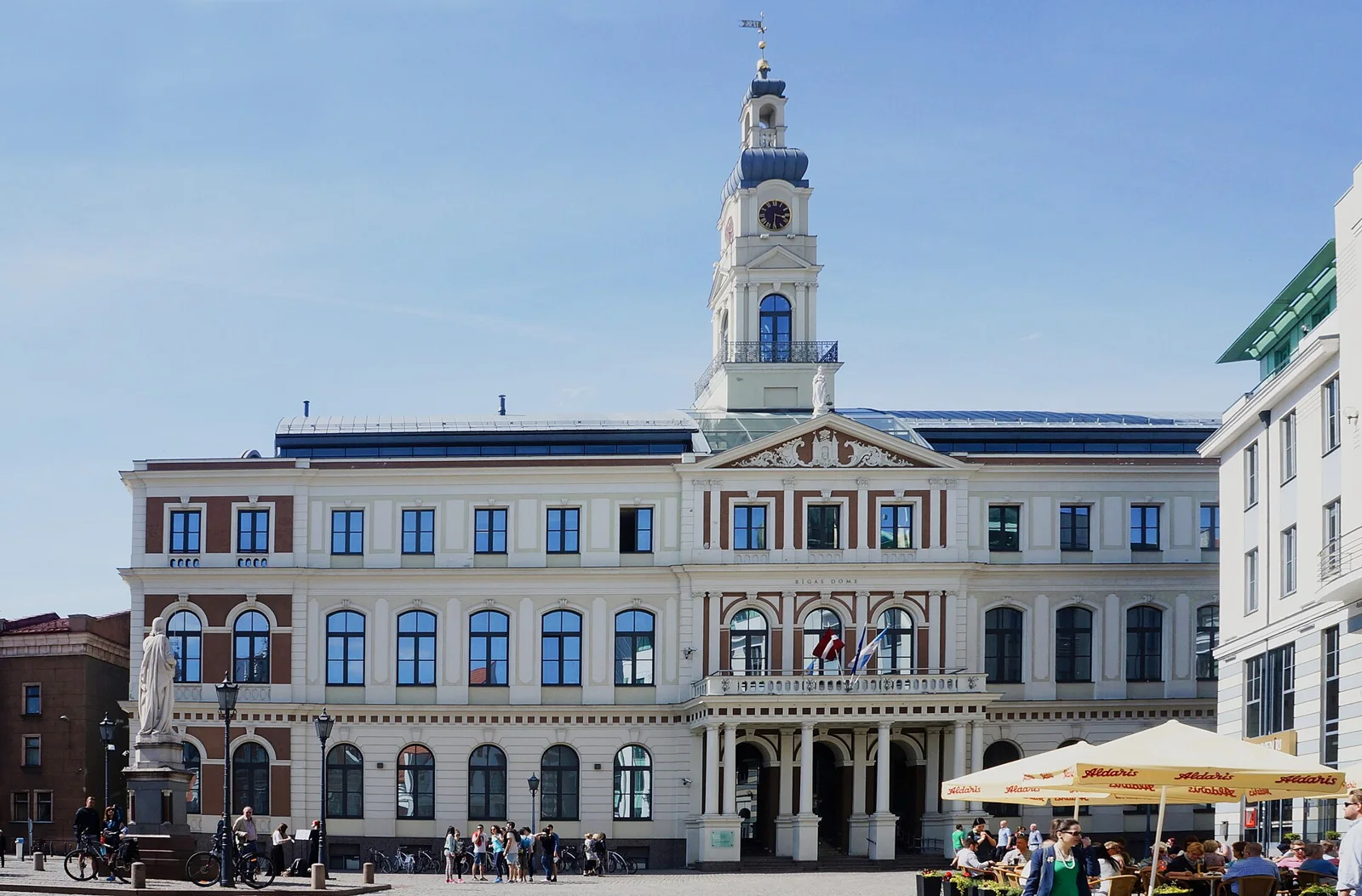
Riga Town Hall and its clock tower facing Town Hall Square · PIERRE ANDRE LECLERCQ · CC BY-SA 4.0 · Resized and converted to WebP
Reading mode
Place stories to read at your own pace
Compare independently captured photographs and viewpoints, each with its own date.
Chapter 1
Town Hall Square: rebuilding a civic centre
Town Hall Square offers an unusually clear place to begin reading Riga. Before concentrating on any single ornament, look at the open ground between the façades. The square allows a public building to be understood from a distance: its horizontal frontage, roof and central emphasis can appear together rather than arriving as fragments in a narrow street. Compare the Town Hall with the more decorated House of the Blackheads nearby. Their different ways of addressing the same public space make the square a useful introduction to civic identity and institutional display.
The historical qualification matters here. LiveRiga describes the square as rebuilt after the destruction of the Second World War. Its municipal sightseeing guide dates the rebuilt Town Hall to 2003. The appearance of an old urban room therefore should not be mistaken for uninterrupted survival of every wall. Reconstruction belongs to Riga’s history too. It expresses later decisions about what to recover, how to represent a lost centre and which forms should once again define a familiar place. The Blackheads discovery follows this question at the scale of one particularly expressive frontage.
Use the photographs to compare the building with its setting. In the wide frame, consider how much pavement is necessary to make the architecture feel public. In the closer view, inspect the rhythm of openings and the division between upper and lower surfaces. The context photograph may let neighbouring buildings compete for attention. These are independent records, not consecutive frames of one visit. Differences in light or people should remain differences between images rather than an invented account of movement through the square.
This chapter concerns the exterior setting. It includes no municipal interior, reception room or admission arrangement. The local interactive scene is another partial record of the surroundings, and its visible extent determines what can actually be explored. Before moving editorially toward St Peter’s, return to the open space itself. The most revealing feature may be the distance that lets several histories stand beside one another.
Real-travel note
Independent exterior scenes; plan interior visits and inter-site movement separately.
Compare independently captured photographs and viewpoints, each with its own date.
Chapter 2
St Peter’s: a spire within the streets
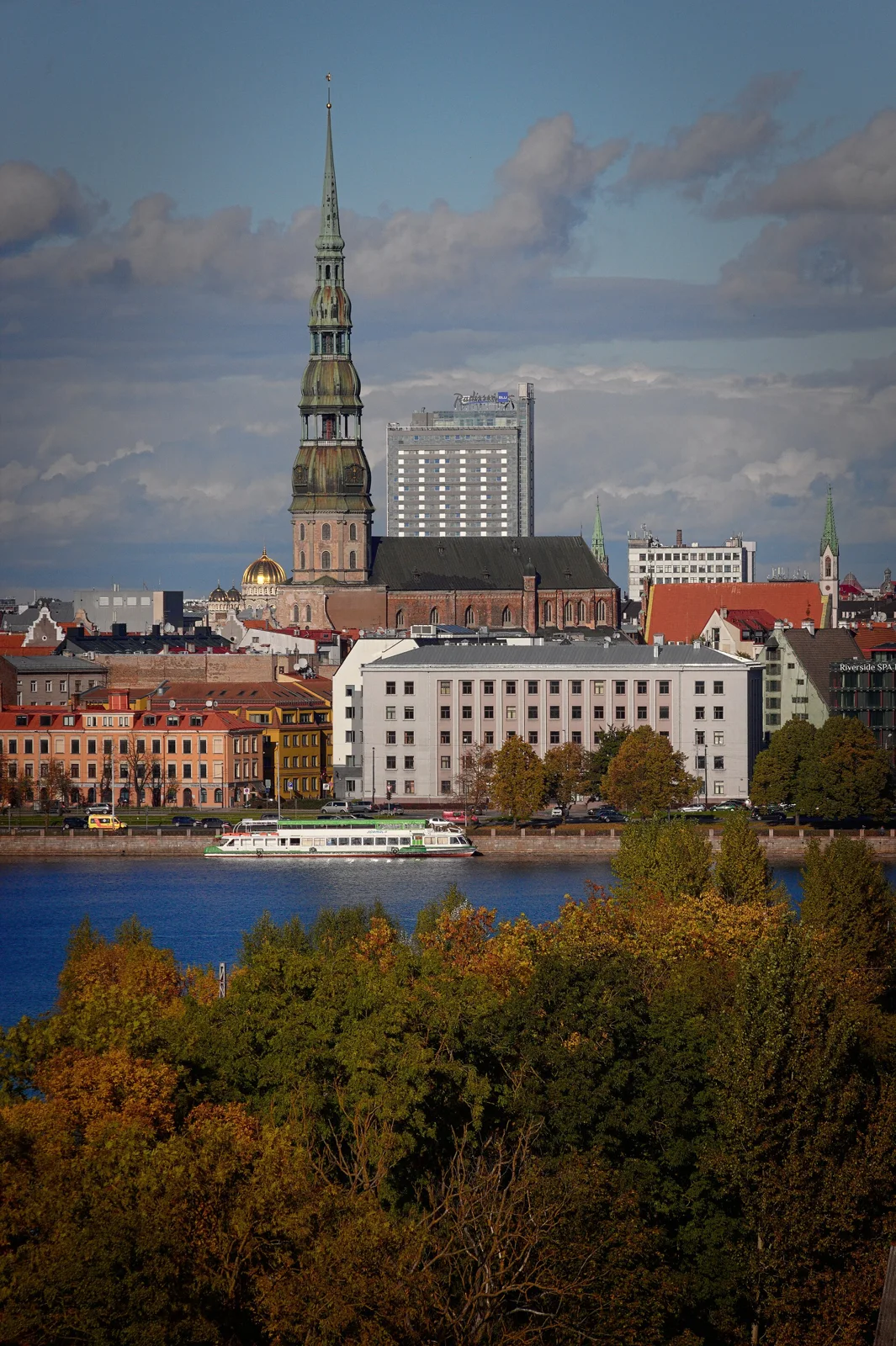
St Peter’s shifts attention upward. A church tower can become a landmark long before its lower walls or entrance are visible, and Riga’s skyline depends on precisely that separation of scales. Begin with the outline of the spire against the sky, then follow it downward toward the broader church body. Which neighbouring roofs interrupt the view? Where does the camera stop showing the street? A strong vertical form can make a photograph seem immediately legible while leaving much of the surrounding place outside the frame.
LiveRiga identifies St Peter’s among the historic centre’s principal churches. Its account of medieval Riga also distinguishes surviving buildings from later alterations and reconstruction. That distinction is useful here: recognising a historic church does not require treating every part of its present appearance as medieval fabric. Rather than relying on disputed height comparisons or a claim about the best city view, this chapter follows the visible relationship between tower, roof and street. The building can be understood as an urban landmark without turning its upper levels into a promised experience.
Compare the three photographs slowly. A wide composition helps locate the tower within a larger pattern of façades. The interior memorial detail changes attention to commemorative carving; it is an illustrative still rather than indoor interactive access. The context image restores some of the ordinary city around a celebrated monument. Observe how the edges of the frame determine whether the church appears isolated or embedded in other buildings. The optional Small Guild discovery introduces another institutional presence around Līvu Square; it is a separate editorial comparison rather than evidence of a continuously photographed connection.
The available interactive imagery remains local and independent. Exterior coverage does not include a tower ascent, religious interior, exhibition or concert, and it cannot establish admission from the appearance of a doorway. Any such visit requires separate arrangements with the venue. Finish by considering how a single spire helps orient the eye across different images. That visual connection is valuable even when the photographs record different dates, viewpoints and weather, and even when the ground between those viewpoints has not been checked as a route.
Real-travel note
Independent exterior scenes; plan interior visits and inter-site movement separately.
Compare independently captured photographs and viewpoints, each with its own date.
Chapter 3
Riga Cathedral: reading an ensemble
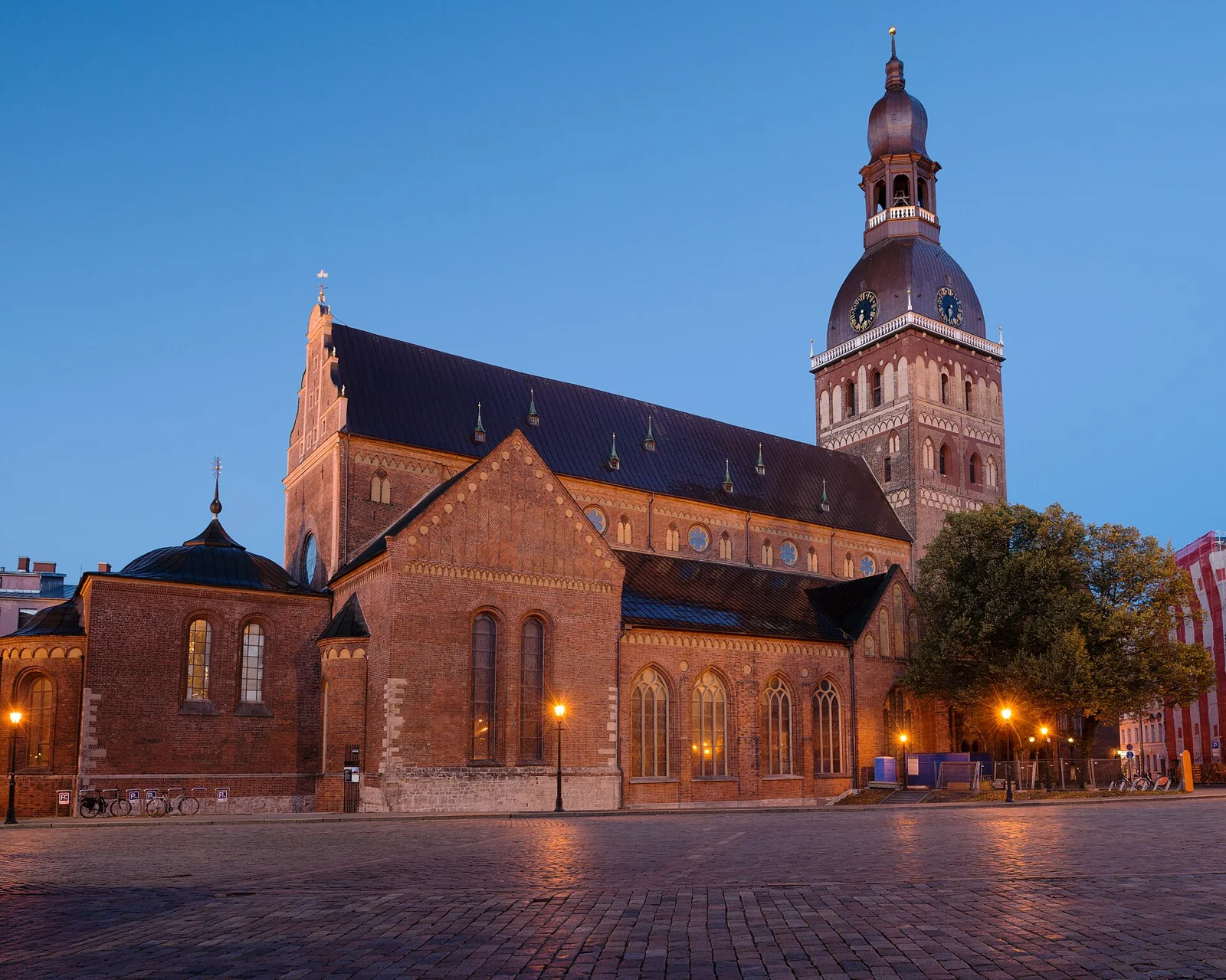
Riga Cathedral invites a slower reading of mass, outline and the space around a religious building. Where St Peter’s first draws the eye toward a slender landmark, the cathedral asks you to hold several volumes together. Start with the broad roof and wall surfaces, then notice how the tower changes their balance. The surrounding square gives these forms breathing room. A façade viewed close up may seem to fill the entire city; a wider photograph reveals how open space allows that same building to become an orientation point.
The cathedral’s own historical account records the laying of its foundation stone in 1211. This is a beginning, not a date that should be assigned indiscriminately to everything visible today. A large religious ensemble can accumulate changes in structure, appearance and use over many centuries. Reading the exterior with that possibility in mind is more productive than searching for a perfectly uniform medieval image. The historical reference establishes an anchor, while the photographs show a particular later appearance without individually dating its stones, roofs or windows.
Compare the exterior wide frame with the illustrative interior stained-glass detail and nave photograph for changes in scale. These indoor stills supply architectural context without providing indoor interactive access. Look for the relationship between a large interior volume and a small coloured panel, then return to the exterior silhouette. The square’s visible edges may explain the building’s role as much as an ornament does. Allow anything outside the frame to remain unknown. Neither a photograph nor a local panorama is a complete survey of the cathedral ensemble. The Swedish Gate discovery makes a deliberate detour in the editorial sequence, introducing an urban threshold before attention returns to the smaller domestic façades of the Three Brothers.
This chapter’s interactive encounter stays outside. The illustrative indoor stills include no actual cathedral admission, cloister visit, organ performance or museum experience. Those experiences have their own arrangements. The independent local scene also establishes no continuous or step-free approach from the preceding chapter. Return once more to the relationship between building and square: the setting lets a long and complicated institutional history be perceived as a clear architectural presence without erasing its layers.
Real-travel note
Independent exterior scenes; plan interior visits and inter-site movement separately.
Compare independently captured photographs and viewpoints, each with its own date.
Chapter 4
Three Brothers: difference within a group
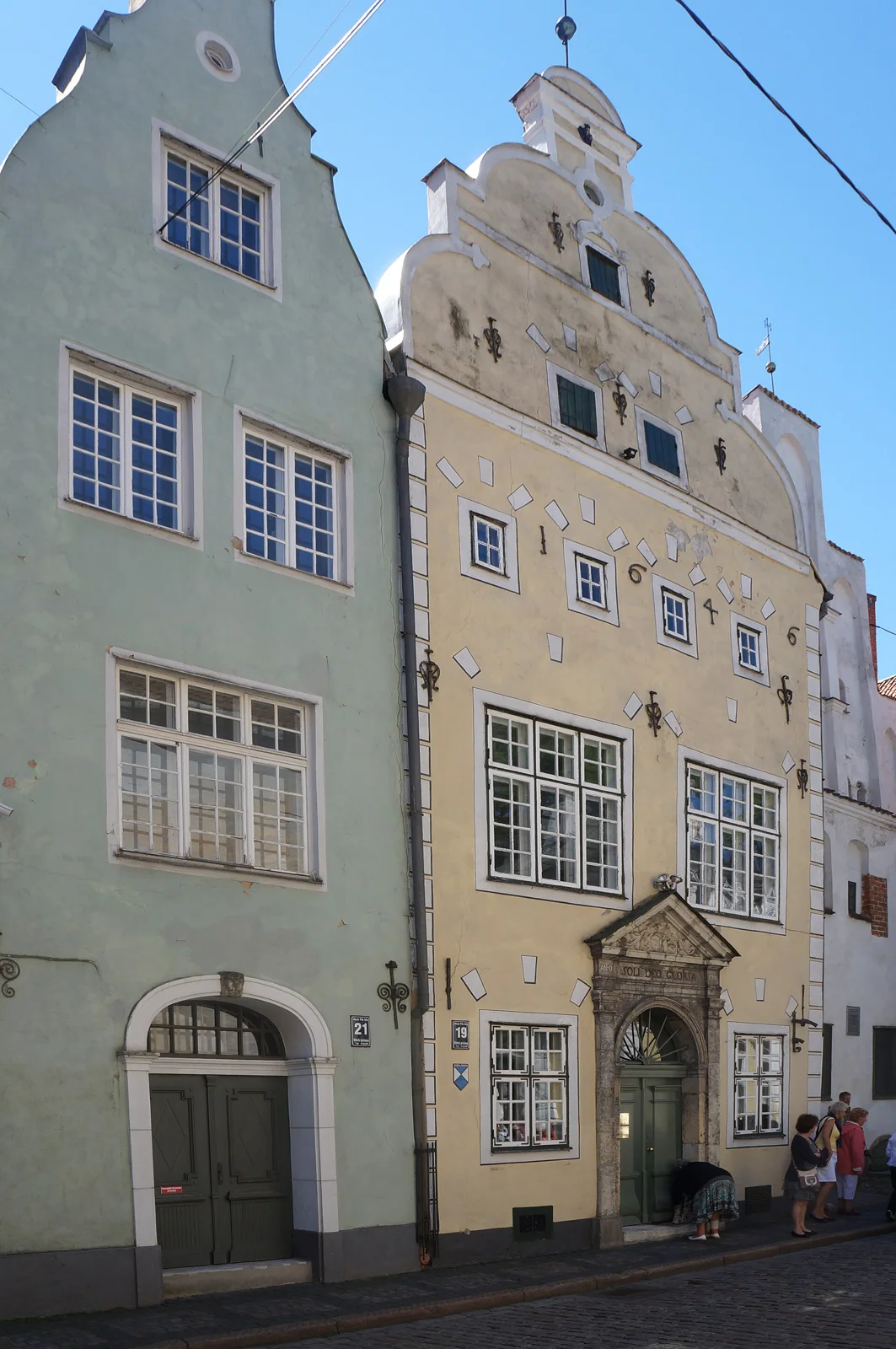
The Three Brothers bring the journey down from monumental silhouettes to the scale of neighbouring houses. Their value as a group lies partly in their differences. Compare the widths of the frontages, the outlines of the gables and the placement of windows. Three buildings standing close together create a compact exercise in looking: repetition helps you recognise the ensemble, while irregularities prevent it from becoming one anonymous façade. Notice where each frontage meets the next and where the roofline changes direction.
The European Commission’s heritage description places the houses between the fifteenth and seventeenth centuries. LiveRiga identifies the oldest house with the late fifteenth century and describes the complex’s association with working, trading and living. The familiar family story is a legend, not evidence that three actual brothers commissioned the buildings together. Keeping that distinction allows the name to remain memorable while the architecture retains its more complicated chronology. A small group of houses can preserve a history of changing urban life without having one simple origin story.
The photographs invite close comparison rather than a rush to identify the oldest element. A wide view explains adjacency, while a detail may highlight an opening or a change of surface. The context frame asks how the ensemble sits within a street whose width limits the viewing distance. Camera angle can exaggerate verticals or compress the space between façades. Avoid treating those effects as measured evidence of the buildings’ proportions. Colour and texture likewise cannot independently establish the date of a repair. Documentary history and visual observation answer different kinds of questions.
The Powder Tower discovery introduces a larger defensive volume as an optional northern detour before the final castle chapter. That relationship is editorial; the photographs do not verify passage between the sites. This chapter stays outside the houses and makes no promise about museum admission or access through their interiors. End by choosing one difference between the three frontages and one feature that unites them. Their shared street presence becomes more interesting when the individuality of each house remains visible.
Real-travel note
Independent exterior scenes; plan interior visits and inter-site movement separately.
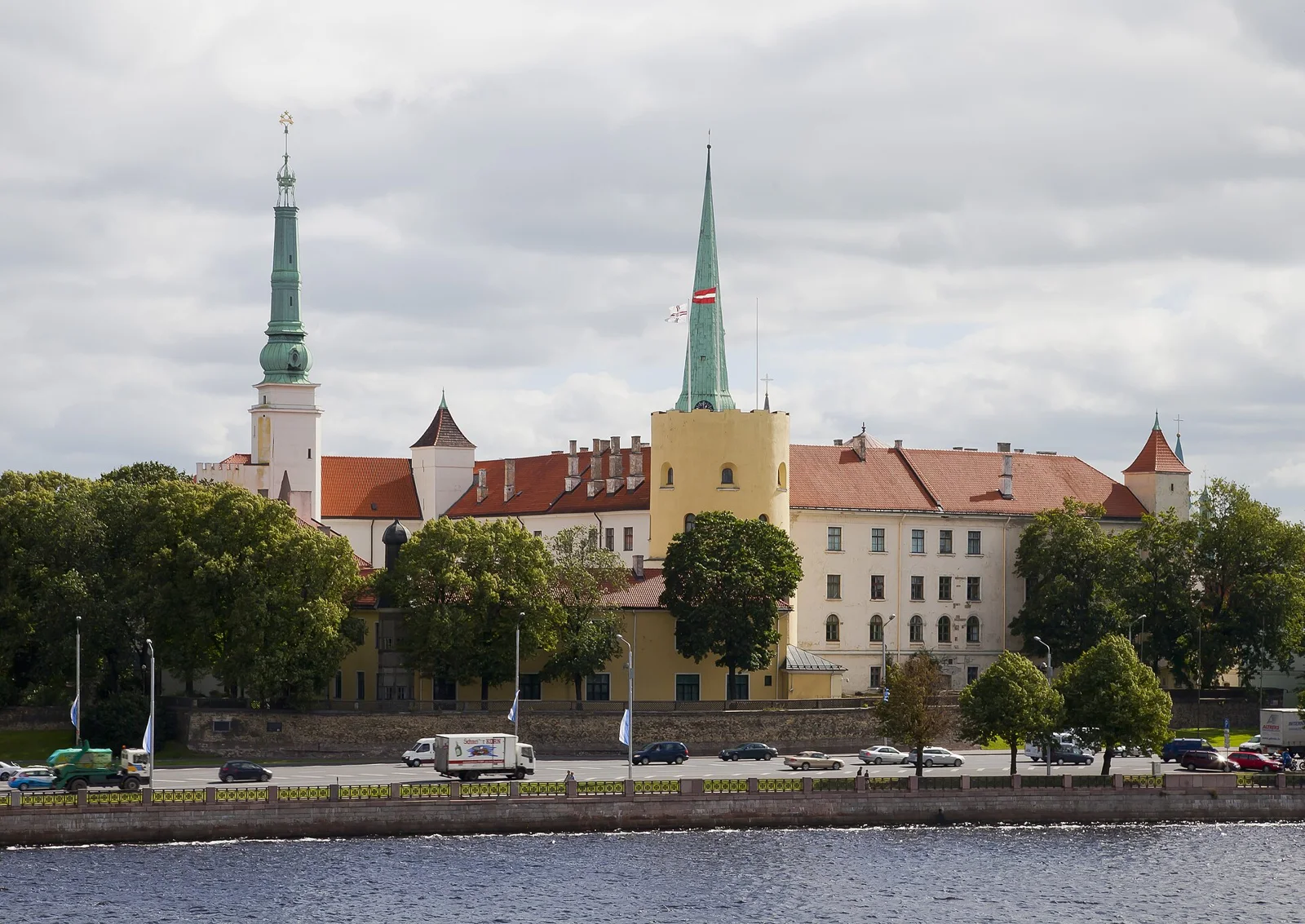
Compare independently captured photographs and viewpoints, each with its own date.
Chapter 5
Riga Castle: authority beside the river
Riga Castle closes the sequence with a change from closely packed domestic façades to a governing ensemble beside the Daugava. Begin by reading the breadth of the complex rather than searching immediately for a single emblem. Towers, rooflines and longer wall surfaces can establish different kinds of emphasis within one composition. The castle’s relationship with the river also changes its urban setting: an exterior seen across open space can feel very different from a building encountered in a narrow Old Town street.
The Latvian presidency’s historical account dates the start of construction on this site to 1330. It links that beginning with the aftermath of conflict between Riga and the Livonian Order. The same institutional account identifies the castle with the presidency established in 1922. These are distinct chapters of use, not a claim that medieval authority and the modern Latvian republic are interchangeable. Nor should the founding date be used to label the entire visible ensemble as fourteenth-century construction. Later change is part of the building’s meaning.
Compare the photographs for the way distance changes the impression of power. A wider frame may stress mass and location; a nearer image gives more weight to individual architectural surfaces. The context view can bring the castle back into the contemporary city. Notice which parts of the ensemble each image actually includes. A missing tower or hidden courtyard should remain outside the account rather than being mentally inserted as something the visitor has seen. The castle is both a historical subject and an institution whose working boundaries cannot be inferred from an attractive exterior.
The local interactive scene remains an outdoor fragment. It includes no presidential rooms, museum galleries, courtyard circuit or verified connection from the Three Brothers. Plan any interior visit directly with the relevant institution. Looking back across the five chapters, Riga emerges through several scales: a reconstructed civic square, a skyline church, a cathedral setting, a cluster of houses and a governing complex. Their differences give the Old Town depth. Let the final image preserve those differences rather than flattening the city into one timeless medieval view.
Real-travel note
Independent exterior scenes; plan interior visits and inter-site movement separately.
9 reviewed experiences
Explore along the route
Step into the places along this journey. Choose a view independently of the story chapters. Free previews do not count toward chapter progress. Return to the journey above to continue through its stops.
Town Hall Square: rebuilding a civic centre Short observation sequence
2025-08 · 3 connected local positions and return. Town Hall Square exterior and adjoining paved streets; landmark façades are not visible at every position. Capture-date archive; current access and arrangements may differ.
Reviewed 2026-11-09 · Nearby viewpoint
Explore at your own pace; these views do not count toward chapter completion. Check each point's coverage note before navigating provider imagery. Availability may change.
Sources
- Town Hall Square — LiveRiga
- Best Sights of Riga 2026 — LiveRiga
- St Peter’s Church — LiveRiga
- Riga Cathedral history — Riga Cathedral
- The Three Brothers — European Commission
- Three Brothers — LiveRiga
- Riga Castle — Chancery of the President of Latvia
- History — House of the Black Heads
- Medieval Riga: what survived — LiveRiga
- Swedish Gate — LiveRiga
- The Powder Tower — LiveRiga
- Riga Town Hall and its clock tower facing Town Hall Square — PIERRE ANDRE LECLERCQ
- Clock tower and facade of Riga Town Hall — Voytek S
- Riga Town Hall seen from an angle across the square — Nenea hartia
- St Peter’s Church spire rising above Riga rooftops — Kārlis Kalviškis
- Carved memorial inside St Peter’s Church — Patrik Kunec
- St Peter’s Church tower from the surrounding street — Suicasmo
- Riga Cathedral exterior at twilight — Ryzhkov Sergey
- Stained glass inside Riga Cathedral — Virtual-Pano
- Nave and vaulted ceiling inside Riga Cathedral — Diliff
- Historic gabled facades of the Three Brothers — PIERRE ANDRE LECLERCQ
- Brick doorway at number 17 on Mazā Pils iela — Diego Delso
- Visitors beside the Three Brothers on Mazā Pils iela — PIERRE ANDRE LECLERCQ
- Riga Castle viewed across the Daugava — Diego Delso
- White facade and flags at Riga Castle — Diego Delso
- Riga Castle and riverfront in evening light — Bjørn Erik Pedersen
- House of the Blackheads and St Peter’s spire at dusk — Diliff
- Small Guild exterior and its turret — Diego Delso
- Swedish Gate passage between Old Riga buildings — Ken Eckert
- Round brick Powder Tower beside the street — Żyrafał


Your journey, remembered.
Explored 0 of 5 stops. Explore every stop to unlock your keepsake.
5 stops to your keepsakeExplore every stop to share or download your keepsake.
Plan separate Riga visits
Read the Old Town through five urban settings; arrange inter-site travel and interior visits separately.
Official sources checked:
Independent imagery and editorial transitions
Five chapters and four discoveries form an editorial sequence. The Blackheads share Town Hall Square; the Small Guild branches toward Līvu Square; the Swedish Gate and Powder Tower are northern detours. This is no verified continuous walk. Local interactive scenes are independent, with potentially different dates and coverage. Check surfaces, stairs, crossings and temporary restrictions separately.
Illustrative photographs and actual admission
Interactive scenes cover local exterior surroundings, with no church interior, tower ascent, museum or presidential visit. The St Peter’s memorial detail and cathedral stained-glass and nave photographs are illustrative stills, not indoor interactive access. Images establish no present opening, price, admission or step-free passage. Confirm actual visits with the responsible institutions.