
George Town, Penang
Walk from the Esplanade and Fort Cornwallis through the Street of Harmony, Khoo Kongsi and Armenian Street to the public entrance of Chew Jetty.
Guided visual journey

Licensed documentary photograph (resized for web) · Supanut Arunoprayote · CC BY 4.0
Reading mode
Place stories to read at your own pace

Chapter 1 · The civic waterfront
The Esplanade and Fort Cornwallis
Begin on the Esplanade, the broad waterfront field also called Padang Kota Lama. Town Hall and City Hall face the grass; the sea is just beyond it. Penang Global Tourism begins its heritage trail here, where Captain Francis Light established a British settlement in 1786. The field later hosted parades, sport and public gatherings. It still feels like shared city space rather than the forecourt of a single monument.
Fort Cornwallis stands a short walk east, near the Queen Victoria Memorial Clock Tower. Named for Charles Cornwallis, it is a star-shaped East India Company fort facing the shore. Conservation work has included the former moat. The open field and enclosed fort tell different sides of the same waterfront story: a place for public life beside a place built for defence. You can see that relationship even if you never go through the fort gate.
The padang is a public park; the fort is a separate ticketed visit. If you want to explore the bastions and cannon, check the current opening notice before buying a ticket. If you would rather stay outside, take time with the lawn, civic buildings and shoreline before turning inland.
UNESCO inscribed Melaka and George Town together in 2008 as Historic Cities of the Straits of Malacca. The listing is not a single monument. It is a living port town. The next chapters leave the colonial waterfront and walk inland to the streets where that living mix is still ordinary.
Real-travel note
The padang is a public park. Fort Cornwallis is a ticketed enclosure. Official pages disagreed on 25 September 2026 about a midday closure and about prices. Recheck the gate notice before you pay.
Chapter 2 · Four faiths on one street
Street of Harmony
The official trail turns inland from the waterfront onto the Street of Harmony. Penang Global Tourism uses that English name for the stretch where four places of worship stand close together. On the map the road is Jalan Masjid Kapitan Keling, still also remembered as Pitt Street. George Town World Heritage Incorporated names this street, with Lebuh Cannon, as the place where the town’s religions remain visibly side by side.
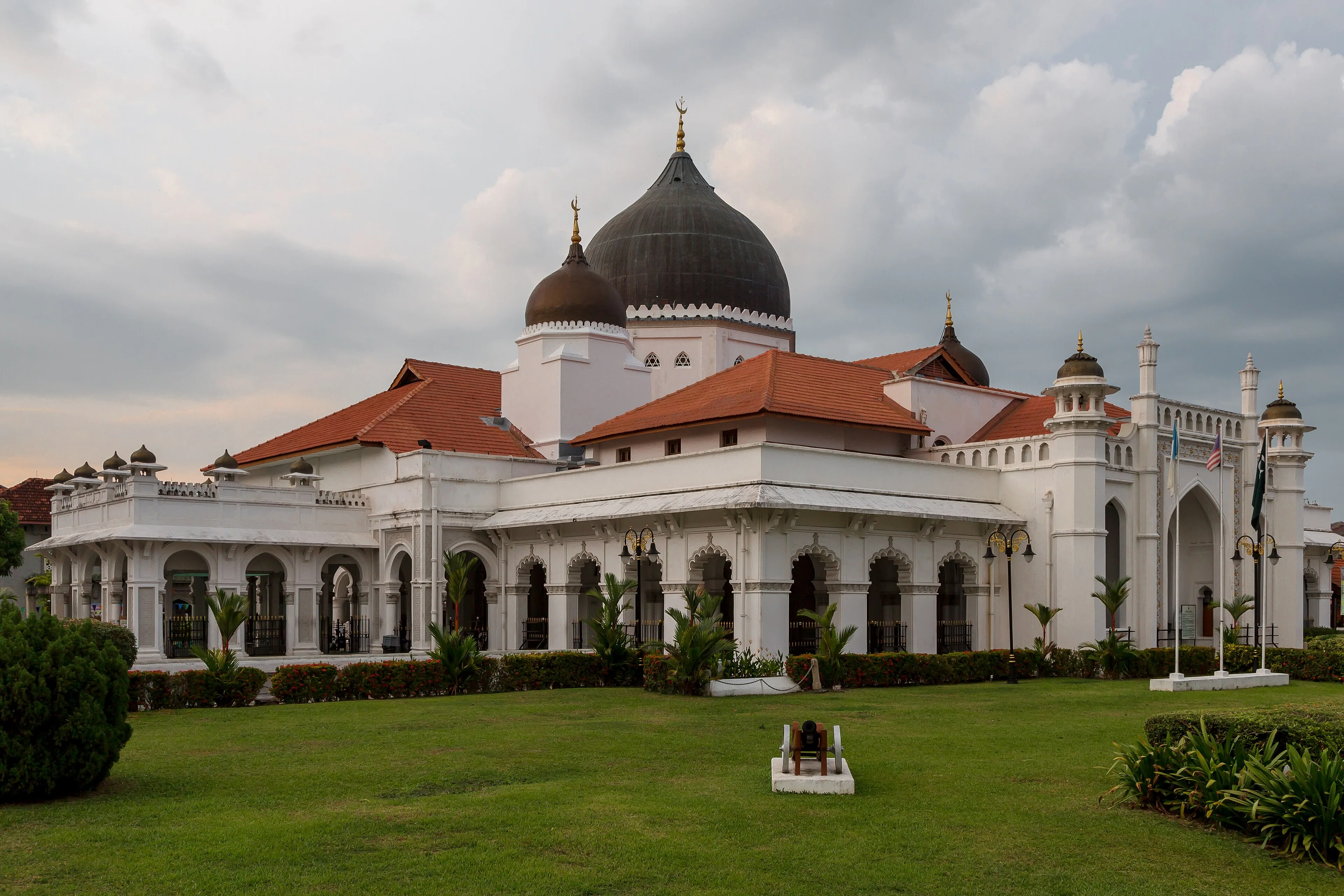
The four buildings the tourism page lists are St George’s Church, completed in 1818 and called Southeast Asia’s oldest Anglican church; the Goddess of Mercy Temple, described as Penang’s oldest Taoist temple; Sri Maha Mariamman Temple, called the state’s oldest Hindu temple, with a colourful entrance tower; and Kapitan Keling Mosque, built by Indian Muslim traders in the early nineteenth century. UNESCO’s statement for the joint listing is broader than any one street: Melaka and George Town show a living multi-cultural heritage in which religions and cultures met and coexisted. The street is a clear local expression of that claim. It is not a museum corridor invented for visitors.
The chapter photograph draws you toward Kapitan Keling Mosque, with its white arcades and dark dome. Back on the road, shopfronts, buses and a busy crossing sit between the places of worship. The optional 360° view opens at a nearby junction, so it shows the street rather than the mosque interior. These are places you approach as a visitor, not rooms you can enter by clicking through a panorama.
These are working religious places. The official trail notes that the mosque welcomes visitors and can offer robes for appropriate dress. Temple and church practice can change with prayer times, festivals and funerals. Do not treat worshippers as scenery. If a door is closed, walk on. The value of the street is that you can pass four living traditions in a few minutes, not that you are entitled to enter all of them on the same afternoon.
Real-travel note
This is a public street with working places of worship. Cover shoulders and legs if you enter the mosque or temples, follow any robe or shoe notice, and keep out of prayer. Recheck festival days before you go.
Chapter 3 · A clan house off the street
Leong San Tong Khoo Kongsi
Turn from the Street of Harmony toward Cannon Square. Leong San Tong Khoo Kongsi is easy to miss from the road: the ancestral hall stands back inside a courtyard. Penang Global Tourism dates the present building to 1906, when the Khoo clan was prospering. Within the compound are an ancestral hall, an opera stage, offices and a museum of clan history. You have to choose to step in; this is not a monument that reveals itself from the pavement.
Inside, the roofline is dense with colour and ornament, while stone steps lead up from the open court. The photograph shows this view from within the compound; it is not what a passer-by sees from the street. In person, the courtyard requires admission. Check the current hours and ticket price with Khoo Kongsi before making it the centrepiece of your day.
Clan houses are easy to misread as temples for tourists. They were, and in many cases still are, associations that held genealogy, dispute settlement, festival funding and help for new arrivals. The magnificence of the roof is evidence of a successful lineage, not a promise that the square is a theme park. Cannon Square is a pedestrian court. People live and work around it. Enter through the ticket office, keep to the visitor route, and do not slip into side houses.
The optional 360° view is also inside the courtyard, not out on Cannon Square. If you decide against a ticket when you visit, you can still explore the surrounding streets; do not mistake an online view of the hall for free entry on the ground.
Real-travel note
The courtyard is ticketed. On 25 September 2026 the official page listed 9:00am–5:00pm, closed on Chinese New Year’s Eve and Day, and RM 17 for foreign adults. Recheck before you go. Stay on the visitor route.
Chapter 4 · A named street, not a mural hunt
Armenian Street
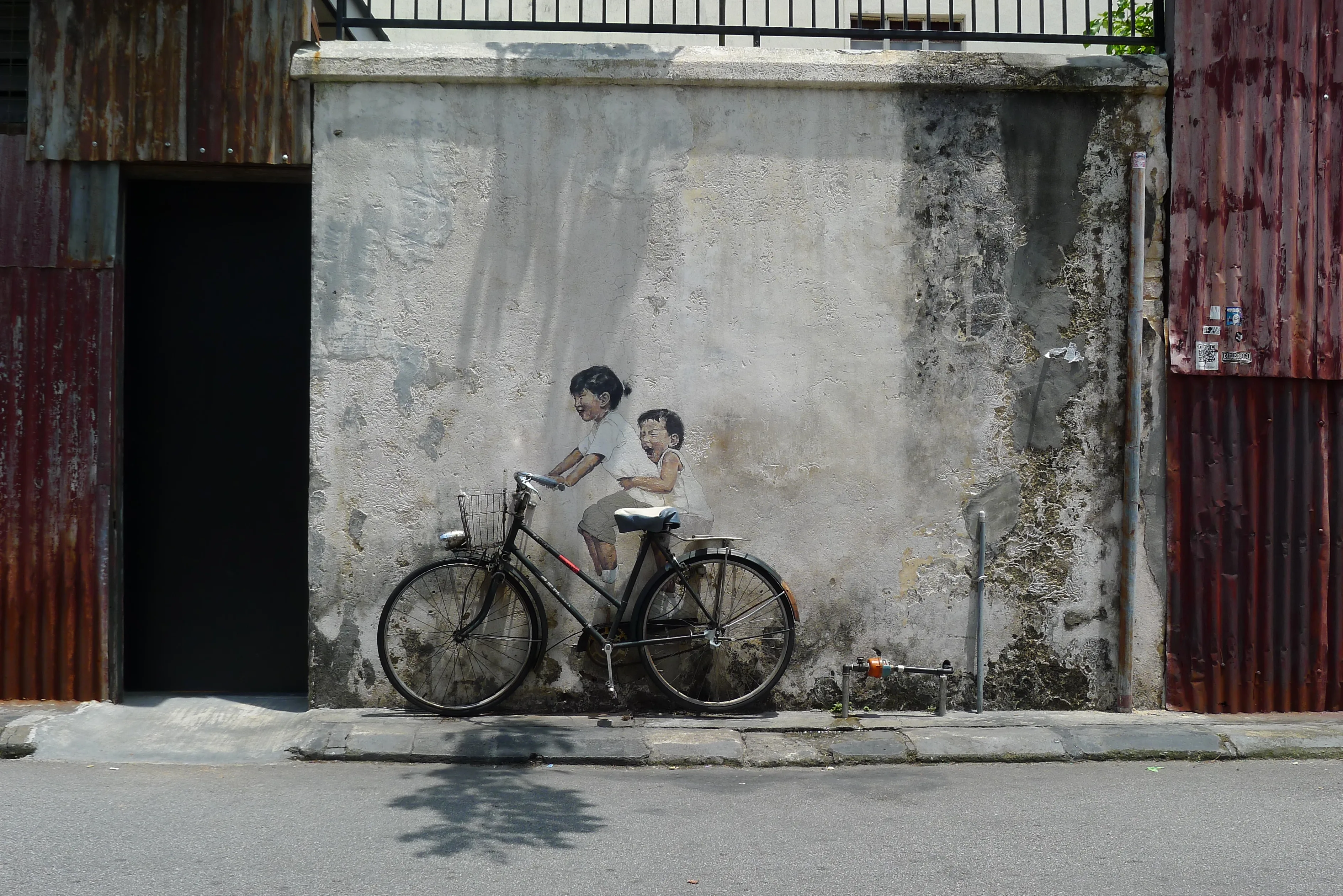
Armenian Street is one of the most photographed parts of George Town. Shophouses, cafés and workshops share the lane with street art, including Ernest Zacharevic’s “Kids on Bicycle”. The painted children reach for a real bicycle fixed against the wall. It is a playful sight, but the wall belongs to a working street, not a gallery set aside for visitors.
The mural is famous enough to draw queues. It is not the origin of the street. Armenian Street takes its name from an earlier Armenian presence in the port; the shophouses now hold a mix of residents, traders and visitors. GTWHI’s account of the World Heritage Site keeps returning to shophouses as homes as well as frontages. If you come only for the mural, you will miss the thing the listing actually protects: a living terrace street whose doors still open onto the lane.
In the optional 360° view, you see the shophouse fronts along the street rather than the mural wall. That is part of the point: the paintings are one layer of the neighbourhood, not its whole identity. Make room for people using the lane, and keep doorways and private courtyards private. The official trail also notes nearby iron-rod sculptures and other murals if you want to linger.
From here the walk is already pointing toward the water again. Gat Lebuh Armenian runs down to Weld Quay. The last chapter is a living jetty, not another painted wall.
Real-travel note
The lane is narrow and still used by residents and shops. Keep the carriageway clear, skip tripods at the mural if people are waiting, and do not photograph people in their doorways as scenery. Recheck festival crowds before you go.

Chapter 5 · A neighbourhood over water
Chew Jetty
The walk returns to the waterfront at Chew Jetty. Along Weld Quay, Chinese clan communities built timber houses over the water while working the port. Families still live here. Each clan jetty carries a surname; Chew Jetty is the one most familiar to visitors. This journey stops at its public entrance rather than continuing to the separate ferry museum.
The photograph looks in from Weld Quay: a welcome sign, scooters and the first timber buildings mark the public way. Beyond it, the boardwalk is also a residential lane. Laundry dries, deliveries arrive and neighbours sit outside their doors; shops and a temple share the path. The houses do not become exhibits because the jetty is famous.
The optional 360° view lets you look around the entrance plaza. It does not take you along the residential boardwalk. In person, follow only the public path and do not turn into an unsigned side jetty or a home. These are homes, not exhibits; an open door is not an invitation to enter. This is a neighbourhood, not a walk-through museum.
Expect heat, uneven boards and the possibility of sudden rain. Give residents room to pass and keep your voice low. When you have seen the public way, turn back toward Weld Quay. The ferry museum is another, separately ticketed stop if you want to continue exploring the waterfront.
Real-travel note
This is a lived-in settlement. Stay on the public boardwalk, do not enter homes, and do not photograph people at their doors. There is no verified indoor ticket time for the jetty itself. Recheck waterfront notices before you go.
Sources
- Melaka and George Town, Historic Cities of the Straits of Malacca — UNESCO World Heritage Centre
- About GTWHS (OUV) — George Town World Heritage Incorporated
- Places — George Town World Heritage Incorporated
- George Town Culture & Heritage Trail — Penang Global Tourism
- George Town UNESCO World Heritage Site — Penang Global Tourism
- Fort Cornwallis — Penang Global Tourism
- Contact Us — Leong San Tong Khoo Kongsi
- Padang Kota Lama / Esplanade Grounds — OpenStreetMap
- Jalan Masjid Kapitan Keling — OpenStreetMap
- Leong San Tong Khoo Kongsi ticket office — OpenStreetMap
- Little Children on a Bicycle mural, Lebuh Armenian — OpenStreetMap
- Chew Jetty public path — OpenStreetMap
- The Esplanade, George Town, Penang (2) — Wikimedia Commons
- Penang Malaysia Masjid-Kapitan-Keling-01 — Wikimedia Commons
- Khoo Kongsi (I) — Wikimedia Commons
- Penang - Little Children on a Bicycle — Wikimedia Commons
- Entrance to Chew Jetty in George Town, Penang — Wikimedia Commons
.jpg)

.jpg)


Your journey, remembered.
The keepsake unlocks when you reach this section.