
Nuremberg: squares, river and castle
Five chapters and four discoveries through Nuremberg old town.
Begin the visual journeyPlan a real visit to Nuremberg Old TownExplore 6 reviewed views along the routeGuided visual journey
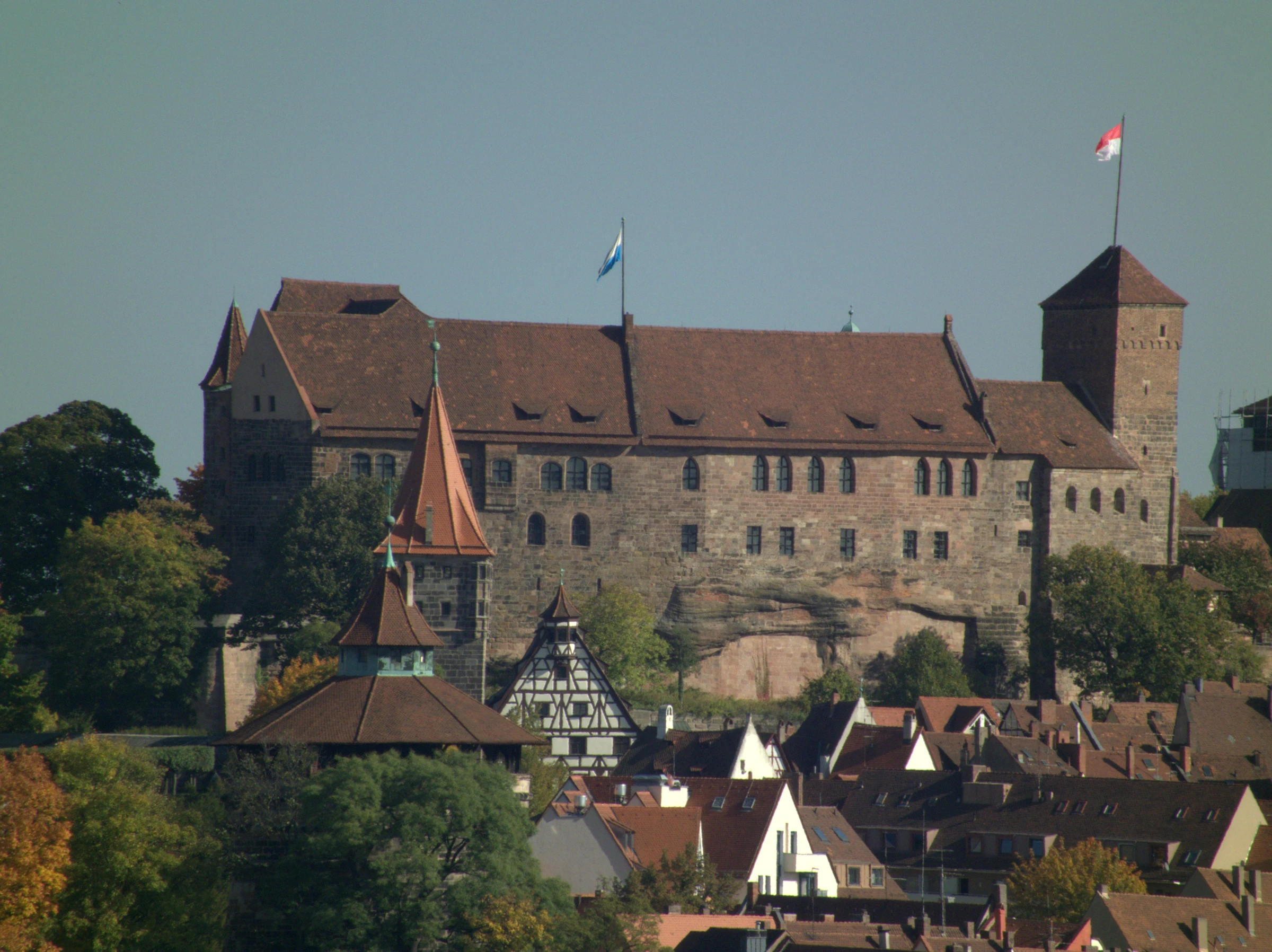
Imperial Castle palace above Nuremberg rooftops · DALIBRI · CC BY-SA 3.0 · Resized and converted to WebP
Reading mode
Place stories to read at your own pace
Compare three independent chapter photographs and an additional photo discovery along the route.
Chapter 1
Hauptmarkt: a square held by its edges
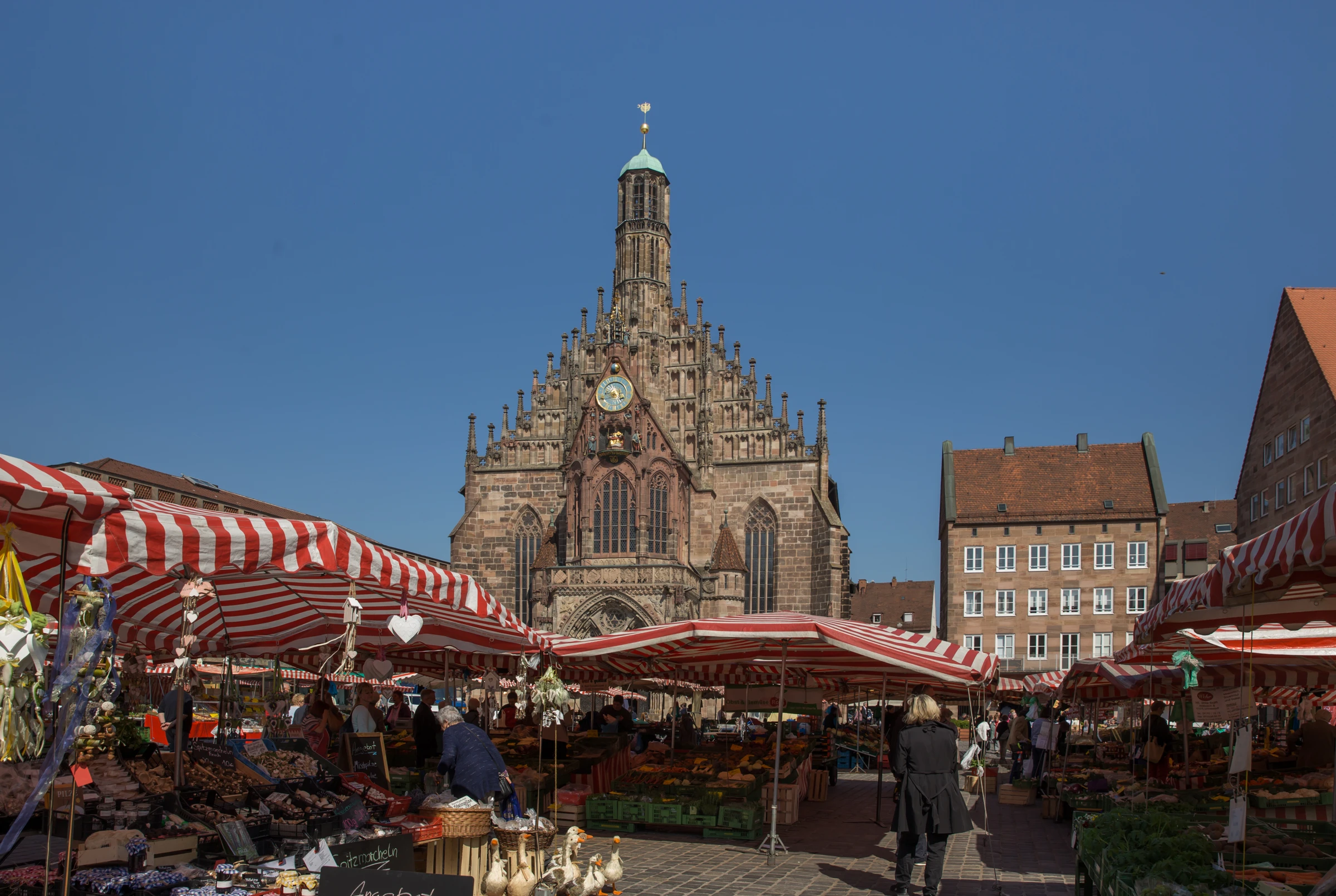
Begin with the space between buildings. Hauptmarkt is a useful first encounter with Nuremberg because a square allows several different scales to be read together: the ground beneath people, the frontages surrounding them and the taller landmarks that interrupt the roofline. Rather than trying to recognise every object immediately, follow one edge of the square until it reaches a corner. Notice how that corner changes the amount of sky visible above the buildings. The opening is as much a part of the composition as any decorated wall.
Three independent photographs accompany this chapter. The broad view includes Frauenkirche behind market stalls; the closer image studies produce beneath a striped awning, and the western context view includes church scaffolding. Compare the different subjects while keeping each photographer’s position and date in mind. A figure, stall or vehicle can help establish scale, but its presence belongs to a particular exposure. Markets and seasonal arrangements change the way the square can be crossed. These images do not combine into a record of one afternoon, and the gaps between their frames should remain gaps rather than an imagined sequence of footsteps.
The Beautiful Fountain is an optional discovery associated with this opening chapter. The tourist office describes its tall, ornamented form and its late medieval origins. Seen against surrounding façades, a freestanding vertical object creates a different kind of centre from a church façade attached to the edge of the square. Try comparing the outline first, then the finer decoration. This order makes it easier to understand the whole object before the eye becomes occupied with individual figures.
Carry that distinction between open ground and a strong vertical edge into the next chapter at Lorenzkirche. The change of subject is an editorial transition across the old town. It does not establish a continuous camera path, an accessible crossing or present visiting arrangements. Before leaving the photographs, look once more at the proportions of foreground and sky: the same square can appear spacious or enclosed when only the framing changes.
Real-travel note
Plan movement and indoor visits separately.
Compare independently captured photographs and viewpoints, each with its own date.
Chapter 2
Lorenzkirche: stone rising above the street
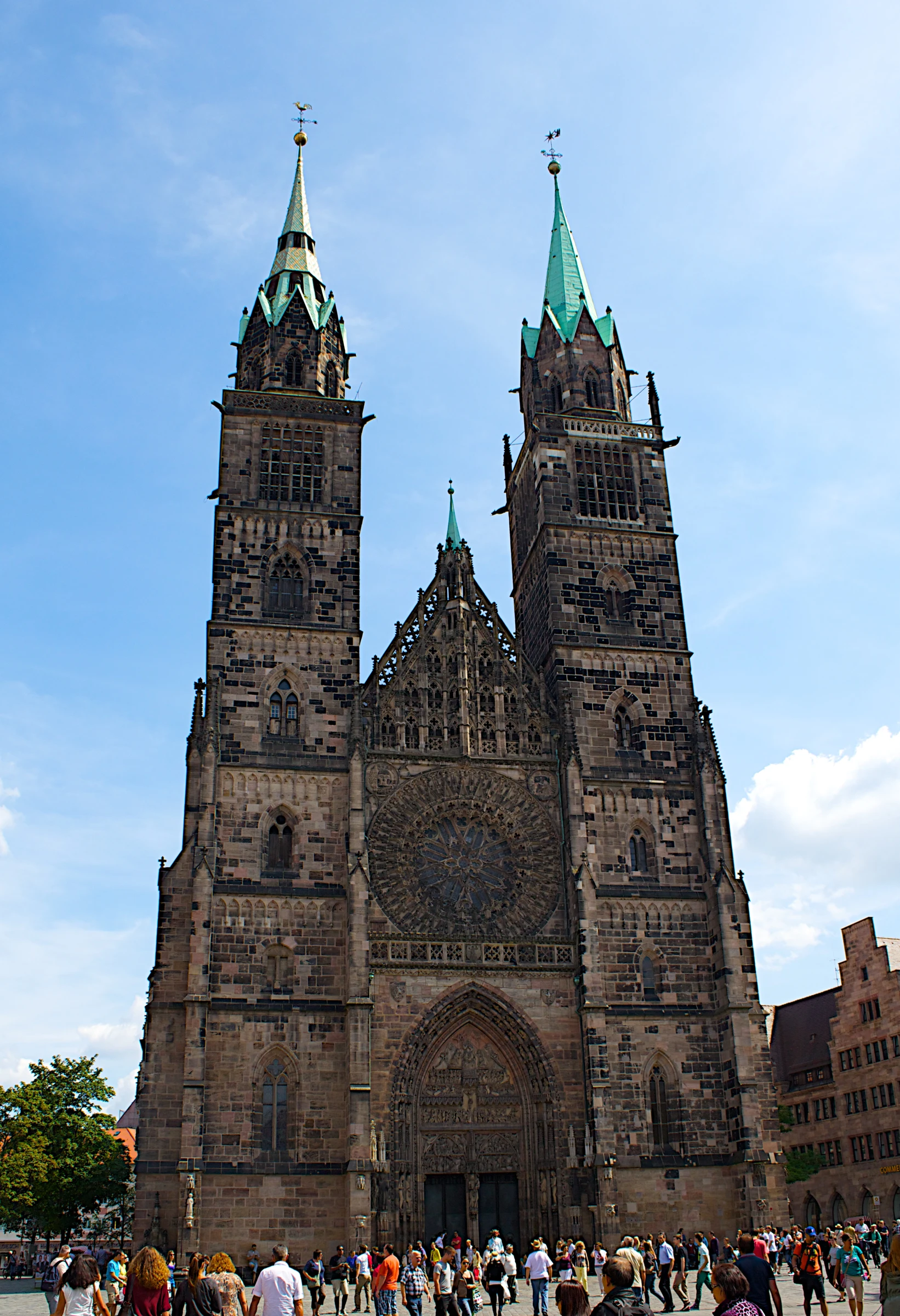
Look up from the street toward Lorenzkirche, then bring your eye back to the point where the building meets the ground. A large church can seem detached from everyday urban life when a photograph isolates its upper stonework. Including a strip of paving or a neighbouring frontage restores the scale of the encounter. The twin vertical accents and the large openings in the façade invite a different pace of looking from the wide space of Hauptmarkt. Start with the silhouette before following the smaller subdivisions within it.
Nuremberg’s tourist office places the beginning of construction around 1250 and distinguishes the original Gothic basilica from its later choir extension. That account gives the building a history of growth. It also cautions against treating every visible surface as the product of a single moment. The photographs here are exterior studies; they support comparison of mass, openings and decoration without providing an inventory of the artworks inside or a reconstruction of the church’s changing interior.
Use the three independently captured images to compare how distance changes the reading of stone. From farther away, repeated openings join into patterns. From nearer the wall, the edges of individual elements become more apparent and the overall outline may disappear beyond the frame. Shadows can sharpen a moulding or conceal it. Colour differences between images may reflect weather, processing and exposure, so shape offers a useful second point of comparison when the apparent warmth of the material changes.
The next main chapter turns from a building that rises above the street to a bridge that carries movement over water. Before that transition, pause on the narrow band where church and city meet. Any visitors shown belong to the photographic occasion; their presence does not establish current entry rules or service times. Look-around scenes, when separately verified, retain their own dates and local limits. Plan an interior visit independently, allowing the exterior comparison to stand as its own complete encounter.
Real-travel note
Plan movement and indoor visits separately.
Compare independently captured photographs and viewpoints, each with its own date.
Chapter 3
Fleischbrücke: a city seen across water
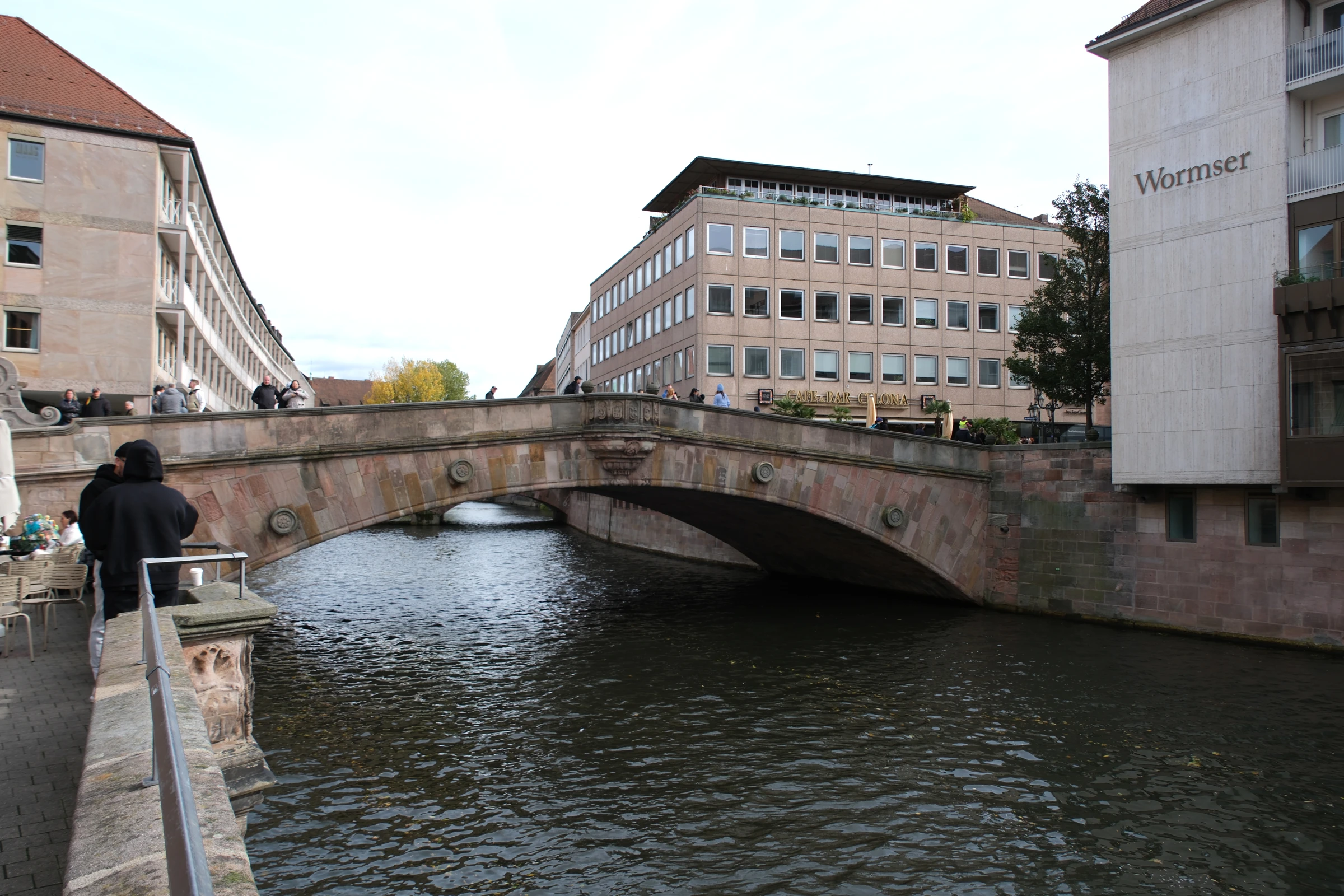
At Fleischbrücke, the river creates room to look sideways. A bridge can be read as a route across an obstacle, but from the water’s edge it also becomes an object with an underside, an outline and a relationship to the buildings behind it. Follow the line of the crossing, then look below it. The apparent depth of an arch depends on the direction of view; a nearly frontal image and an oblique one may make the same opening seem very different.
The Pegnitz gives this chapter its visual structure. Water introduces reflections and a foreground that cannot be occupied in the same way as a market square. Compare the straight lines of masonry with their interrupted counterparts on the surface. A reflection records light and movement at the instant of the exposure. It should not be treated as another permanent architectural element, even when a still photograph makes it appear almost as sharp as the buildings above.
The three photographs are separate encounters with the crossing and its setting. Read their credits and dates as part of the comparison. The closer frame studies the gateway with an ox sculpture at the bridge end, while a wider image restores the arch, banks and adjoining city. Neither alone describes every possible approach. Do not infer the bridge’s construction technique from a distant surface, or assume that every element in a historical setting has the same age. The purpose here is to examine visible relationships rather than supply an unsupported engineering survey.
The Heilig-Geist-Spital discovery adds another way in which Nuremberg’s architecture meets the river. Its building mass and openings offer a useful counterpoint to the crossing. Later, the Henkersteg discovery will introduce a different bridge silhouette. These are editorial comparisons among independent places and images. They do not certify a continuous riverside path, a boat passage or step-free access. Finish by looking at the banks where the frame ends, and let the next chapter change the scale from open water to a close street.
Real-travel note
Plan movement and indoor visits separately.
Compare independently captured photographs and viewpoints, each with its own date.
Chapter 4
Weißgerbergasse: houses at close quarters
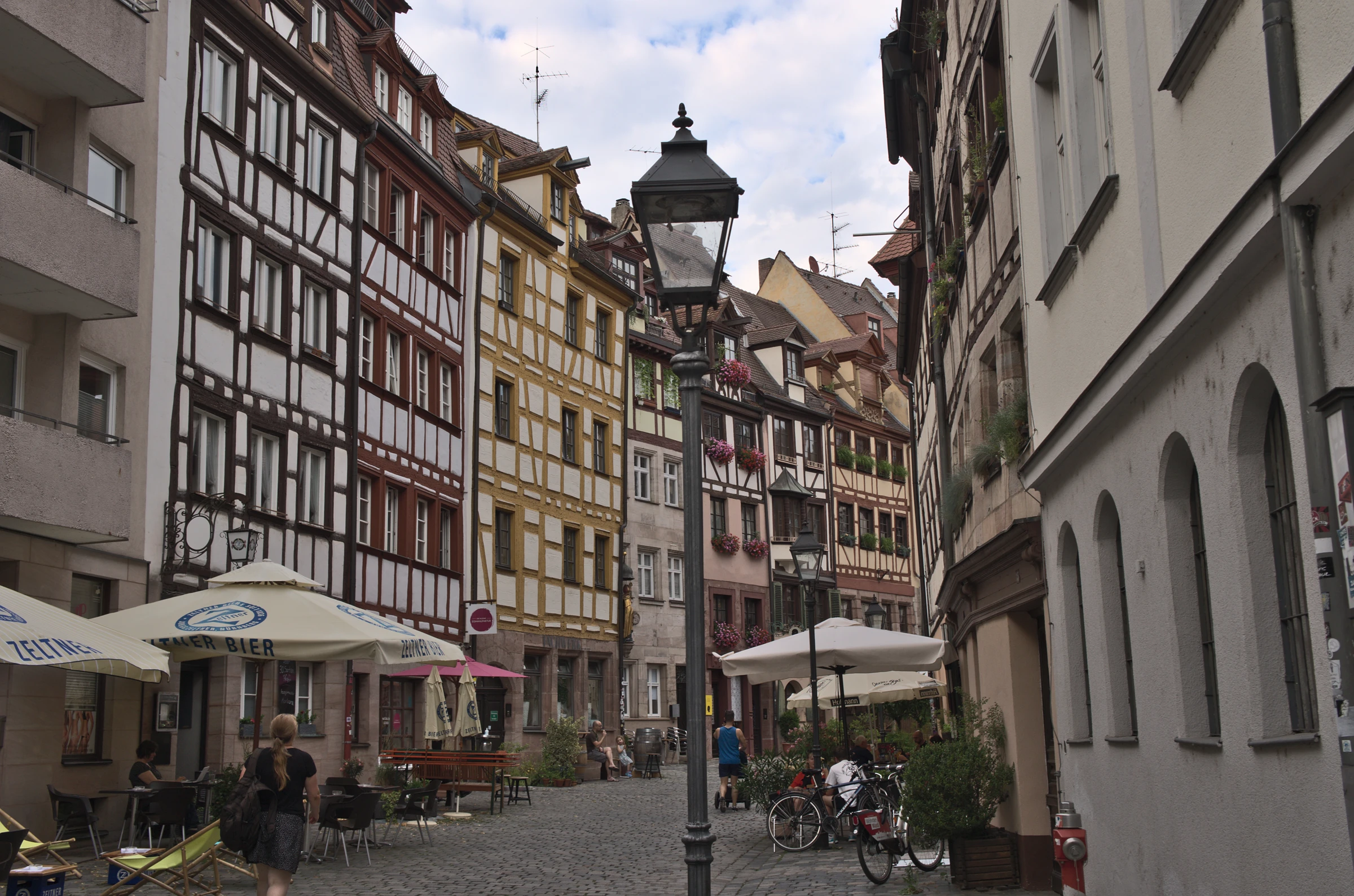
Weißgerbergasse brings the journey down to the width of a street. Where the market offered open ground and the river created distance, the houses here confront one another across a much narrower space. Look first at the way the street recedes. Doorways and windows become progressively smaller, while changes in the building line can hide the next section. The resulting rhythm is made by an ensemble of houses rather than by one isolated monument.
The tourist office connects the historical half-timbered town houses with wealth generated by the leather trade. That context explains the name and gives the façades a social history, but a visible timber pattern alone cannot establish the former use of an individual room. Compare the relationship between structural lines and the openings they surround. Upper floors, gables and roof edges occupy different portions of each image depending on how close the photographer stood to the opposite wall.
Three photographs allow the street to be considered at different distances. A broad view helps explain the succession of frontages; a closer one encourages attention to a smaller arrangement of windows and beams. Bright paint, deep shadows and reflected daylight can separate neighbouring surfaces dramatically. Those differences belong partly to the photographic conditions. Keep the whole street in mind when a decorative detail begins to dominate, and consider how much of the building has fallen outside the frame.
The optional Henkersteg discovery returns briefly to water before the journey turns toward the castle. It provides a comparison between enclosure made by facing houses and enclosure made by a bridge’s roof and supports. No shop, café or doorway visible in the photographs is presented as a current recommendation or guaranteed point of entry. The sequence gives time to look rather than a measured walking itinerary. Before moving on, trace the thin strip of sky above the lane and compare it with the much larger opening over Hauptmarkt at the beginning.
Real-travel note
Plan movement and indoor visits separately.
Compare three independent chapter photographs and an additional photo discovery along the route.
Chapter 5
Kaiserburg: the city meets its skyline
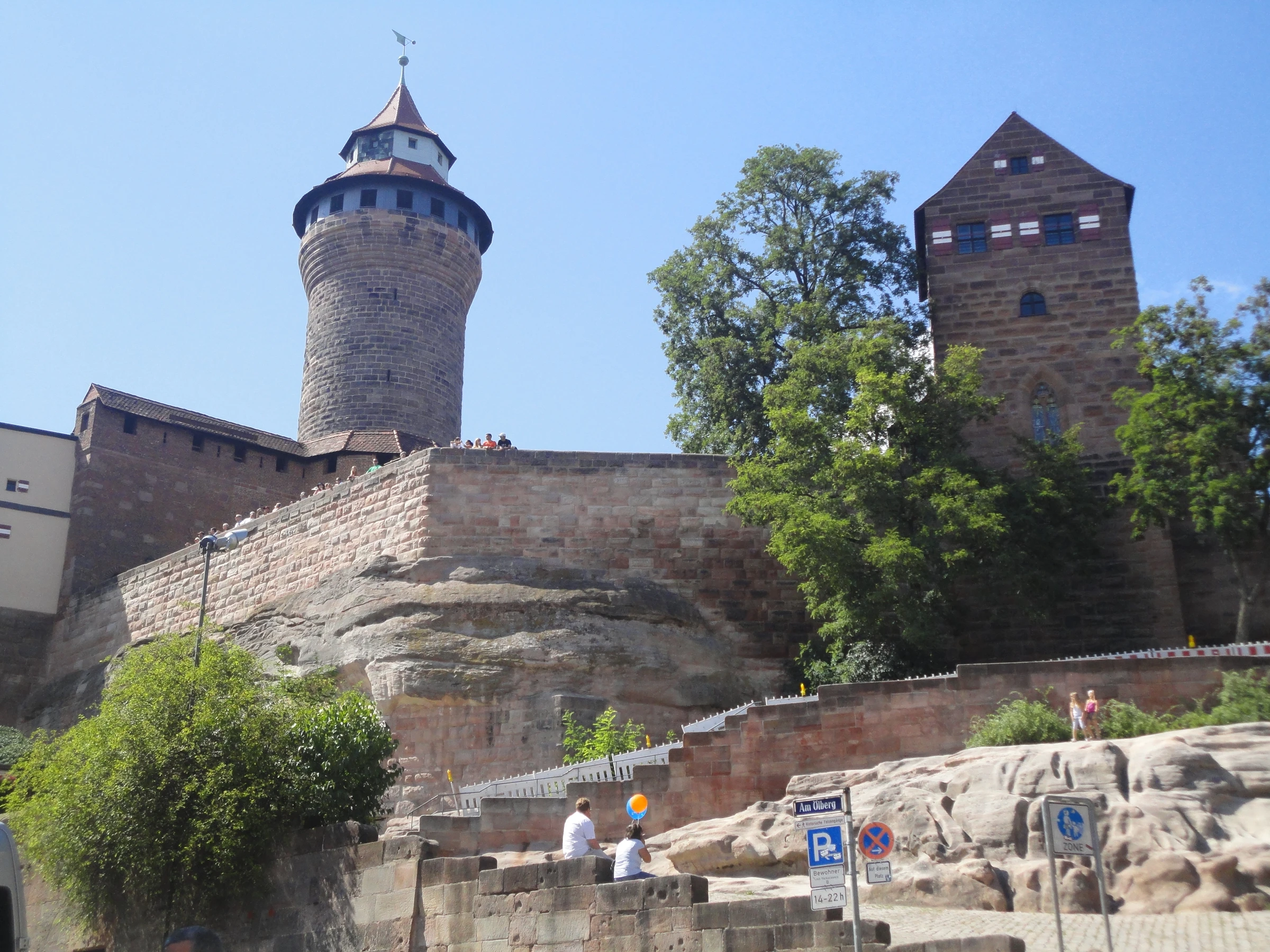
Finish at Kaiserburg by considering what happens when a city rises toward a fortified skyline. The castle occupies a rocky height above Nuremberg; the tourist office places it among the important fortified imperial palaces of the Holy Roman Empire. That setting matters before any individual tower is named. A change in ground level alters how walls overlap, how roofs conceal one another and how much of the city can enter the view beyond them.
Begin with the broadest photograph and find the relationship between built form and the land beneath it. Then compare the nearer images of towers, walls and exposed rock. A wall that reads as a simple line at a distance can become an arrangement of openings, joints and changes of plane. The castle is a complex of spaces rather than a single façade. Three independent photographs can suggest that complexity while still leaving most of it outside their frames. They are not evidence of an uninterrupted ascent through gates or courtyards.
The Dürer House discovery offers a final shift in scale near the castle district. A domestic building connected with an artist’s life gives a different kind of historical focus from a fortified imperial site. Compare its house-sized divisions with the larger masses of the castle. This is a visual relationship and an editorial ending, not a claim that one photograph includes the route between the two places. Museum entry, exhibitions and the details of an actual visit need separate planning.
Look back across the journey’s changes of space: open square, tall church, river crossing, narrow lane and elevated fortress. Each chapter uses photographs taken at its own time, alongside any independently verified local look-around fragments. Together they offer ways to read the old town without turning the spaces between images into an invented continuous walk. End on the edge between roofline and sky, where the city’s larger shape becomes visible again, and retain the difference between seeing a view and confirming a passage through it.
Real-travel note
Plan movement and indoor visits separately.
6 reviewed experiences
Explore along the route
Step into the places along this journey. Choose a view independently of the story chapters. Free previews do not count toward chapter progress. Return to the journey above to continue through its stops.
Hauptmarkt: a square held by its edges 360° look-around
2019-12 · Single 360° viewpoint. Christmas market stalls in Hauptmarkt, December 2019; one isolated panorama. Capture-date archive; current access and arrangements may differ.
Reviewed 2026-11-17 · Nearby viewpoint
Explore at your own pace; these views do not count toward chapter completion. Check each point's coverage note before navigating provider imagery. Availability may change.
Sources
- Places of interest in Nuremberg — Nuremberg Convention and Tourist Office
- Albrecht Dürer’s House — Nuremberg Municipal Museums
- Frauenkirche above striped market stalls on Hauptmarkt — Hubertl
- Fruit and vegetable stall under a red-and-white market awning — Hubertl
- Market stalls and surrounding façades on Hauptmarkt — Hubertl
- Twin towers and west façade of St. Lawrence Church — Lars Steffens
- Stone relief figures above the west portal of St. Lawrence Church — Gary Todd from Xinzheng, China
- Rose window and carved west entrance of St. Lawrence Church — Michael Wittwer
- Single stone arch of Fleischbrücke spanning the Pegnitz — DALIBRI
- Ox sculpture above the Fleischbrücke gateway — Fred Romero from Paris, France
- View along the Pegnitz from Fleischbrücke — Leonhard Lenz
- Timber-framed houses and a hanging street lamp on Weißgerbergasse — Robert von Oliva (naruciakk)
- Half-timbered corner house beside a leafy tree on Weißgerbergasse — Aarp65
- Cobblestone lane between colorful façades on Weißgerbergasse — Bärwinkel,Klaus
- Imperial Castle palace above Nuremberg rooftops — DALIBRI
- Sandstone castle wall and square tower above exposed rock — Schlaier
- Round Sinwell Tower and castle walls above the sandstone slope — A.Unnewehr
- Colorful Gothic spire of Schöner Brunnen above its iron fence — Tilman2007
- Holy Spirit Hospital arches reflected in the Pegnitz — W. Bulach
- Covered Henkersteg footbridge crossing the Pegnitz — Schlaier
- Albrecht Dürer House with its half-timbered upper storeys — Uoaei1


Your journey, remembered.
Explored 0 of 5 stops. Explore every stop to unlock your keepsake.
5 stops to your keepsakeExplore every stop to share or download your keepsake.
Plan separate Nuremberg visits
Compare the old town through buildings and river crossings; arrange movement and indoor visits separately.
Official sources checked:
Editorial sequence
Hauptmarkt, Lorenzkirche, Fleischbrücke, Weißgerbergasse and Kaiserburg form five chapters, with Beautiful Fountain, Heilig-Geist-Spital, Henkersteg and Dürer House as optional discoveries. Sites use editorial transitions.
Visiting arrangements
Photographs and local scenes retain their own capture dates. Confirm opening, entry and passage separately.