
Helsinki: harbour and city centre
Read Helsinki through Senate Square, the harbour, Uspenski, Esplanadi and Central Station, with four optional discoveries.
Begin the visual journeyPlan a real visit to Helsinki Harbour & CentreExplore 9 reviewed views along the routeGuided visual journey
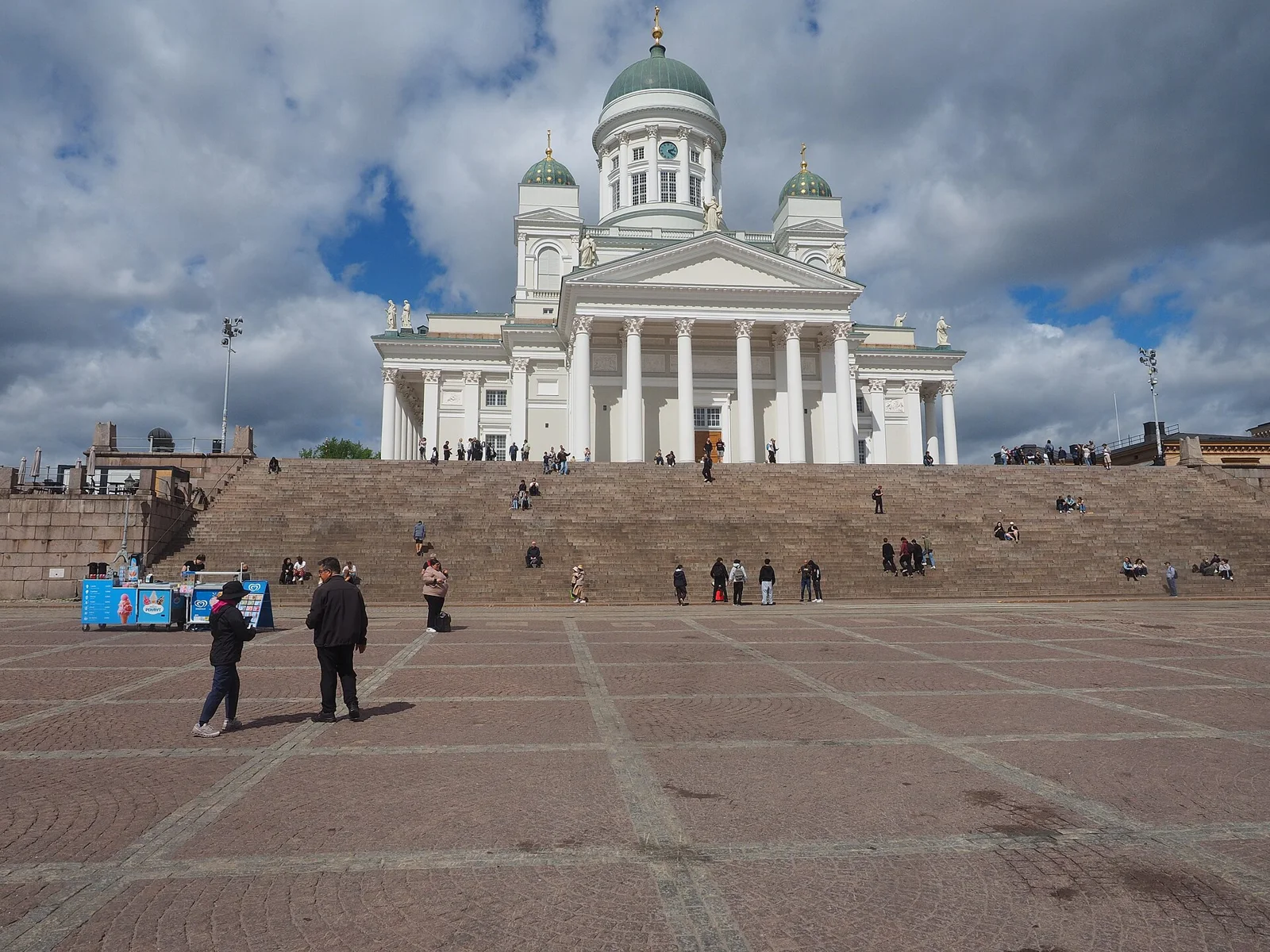
Senate Square and the white Helsinki Cathedral above its steps · JIP · CC BY-SA 4.0 · Resized and converted to WebP
Reading mode
Place stories to read at your own pace
Compare independently captured photographs and viewpoints, each with its own date.
Chapter 1
Senate Square: the capital as a composition
Begin with the space between the buildings. Senate Square gives Helsinki a carefully organised foreground: a broad open surface, strong architectural edges and the elevated white cathedral. Look across the composition before concentrating on any single façade. The difference between horizontal frontages and the rising church helps make the square legible even in a photograph. A monument can attract attention, while the surrounding buildings determine the shape of the public room.
The Finnish Government describes the square designed by Carl Ludvig Engel as following the ideals of classical architecture. The cathedral's own history places it within the Empire-style centre planned by Johan Albrecht Ehrenström and Engel. These institutional histories explain why the ensemble matters without requiring every visible detail to belong to one moment. The square is a useful place to distinguish a planning idea from the many individual buildings that give it form.
Study the wide image for proportions, then use the closer image and contextual photograph to question that first impression. Where does the ground seem to end? Which repeated windows hold the edges together? How do steps change the apparent height of the cathedral? Photographing a square from one side compresses some distances and enlarges others; the frame offers a position from which to look, rather than a complete plan. Shadows and people belong to the time of each independent photograph.
The optional cathedral discovery narrows the subject from the whole ensemble to the church building and its changing design. Return afterwards to the square's open centre: its emptiness is part of the composition, rather than merely an absence of architecture. This chapter begins an editorial sequence through Helsinki, with the harbour taking the next principal role. Arrange real movement and visits separately; the photographs do not document street crossings, a stair ascent or entry into the surrounding institutions.
Real-travel note
Plan actual movement and indoor visits separately.
Compare independently captured photographs and viewpoints, each with its own date.
Chapter 2
Market Square: the city meets its harbour
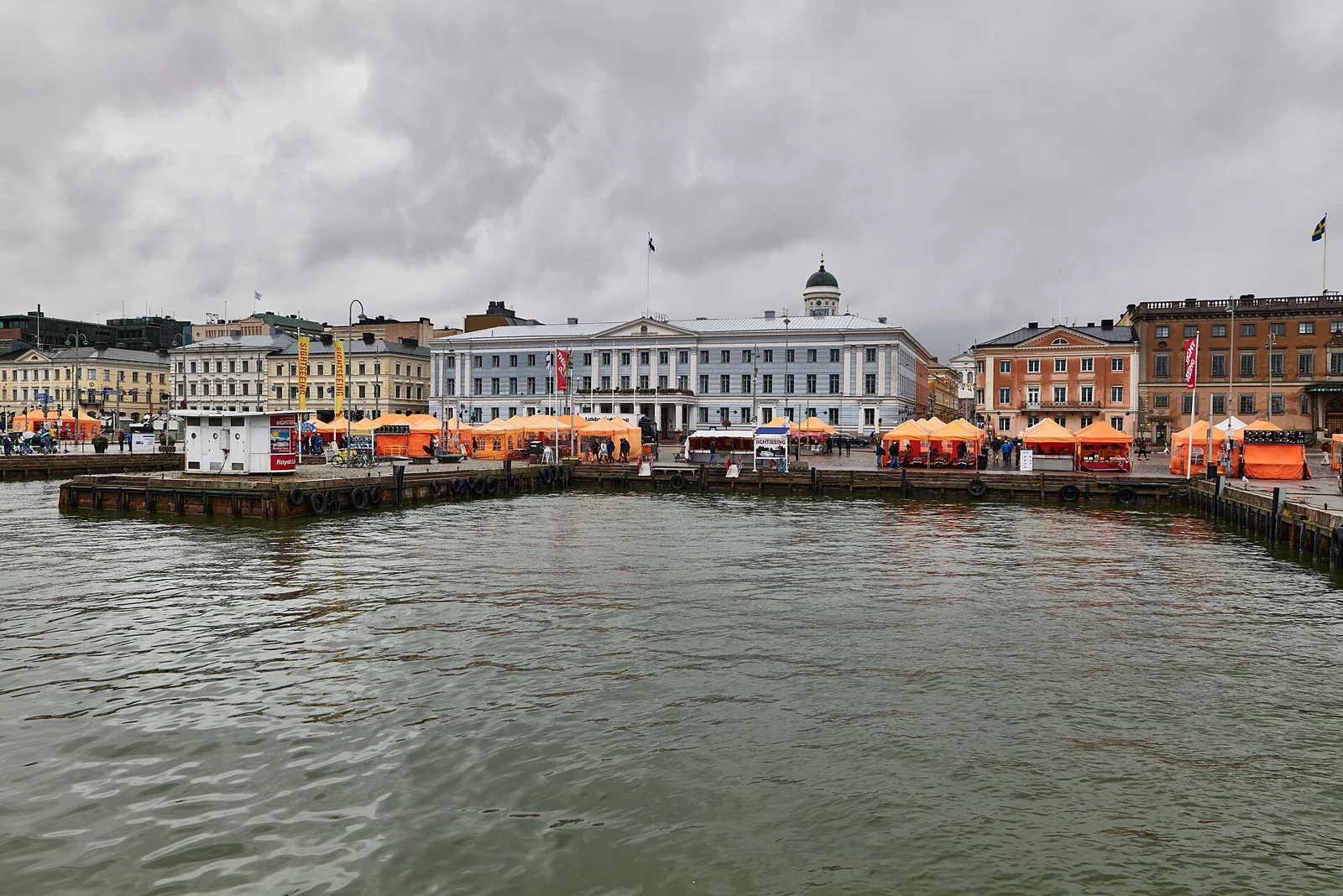
Market Square opens the city toward the South Harbour. Begin by looking for the boundary between working ground and water, then follow the buildings that give the waterfront a backdrop. A square used for trade has a different visual rhythm from Senate Square's formal composition. Temporary objects, boats and people can interrupt long views, making the space appear busy or quiet according to the photographed moment. The harbour remains the organising presence even when a frame concentrates on the land.
MyHelsinki locates Market Square at the South Harbour, at one end of Esplanade Park. That simple geographical relationship is more useful here than a list of things to buy. It connects three kinds of urban space: an open market, a waterfront and a planted central promenade. Their adjacency helps explain the city's arrangement, while the actual crossings and approaches require their own planning.
Compare the harbour-front view with the harbour-at-dusk photograph and the elevated context image, which includes boats. Look for repeated rooflines, the height of the waterfront façades and the amount of sky or water left around them. The dusk photograph compares boats, market stalls and illuminated waterfront buildings during the 2018 Baltic Herring Market; it records that historical event rather than current market arrangements. The elevated view changes the overlap of water, boats and urban edges. Weather and seasonal activity may differ across these independent images; they should not be read as successive moments in a single visit.
The Old Market Hall discovery adds a roofed form of commerce to this outdoor setting. Later, the Presidential Palace discovery compares the harbour's trading background with a building adapted for government. Neither comparison includes an indoor visit. Before continuing to Uspenski, consider how an ordinary working foreground can change the meaning of a monumental skyline. The chapter makes room for both without promising a current stall arrangement, boat service, purchase or continuous waterfront walk.
Real-travel note
Plan actual movement and indoor visits separately.
Compare independently captured photographs and viewpoints, each with its own date.
Chapter 3
Uspenski: brick and domes above Katajanokka
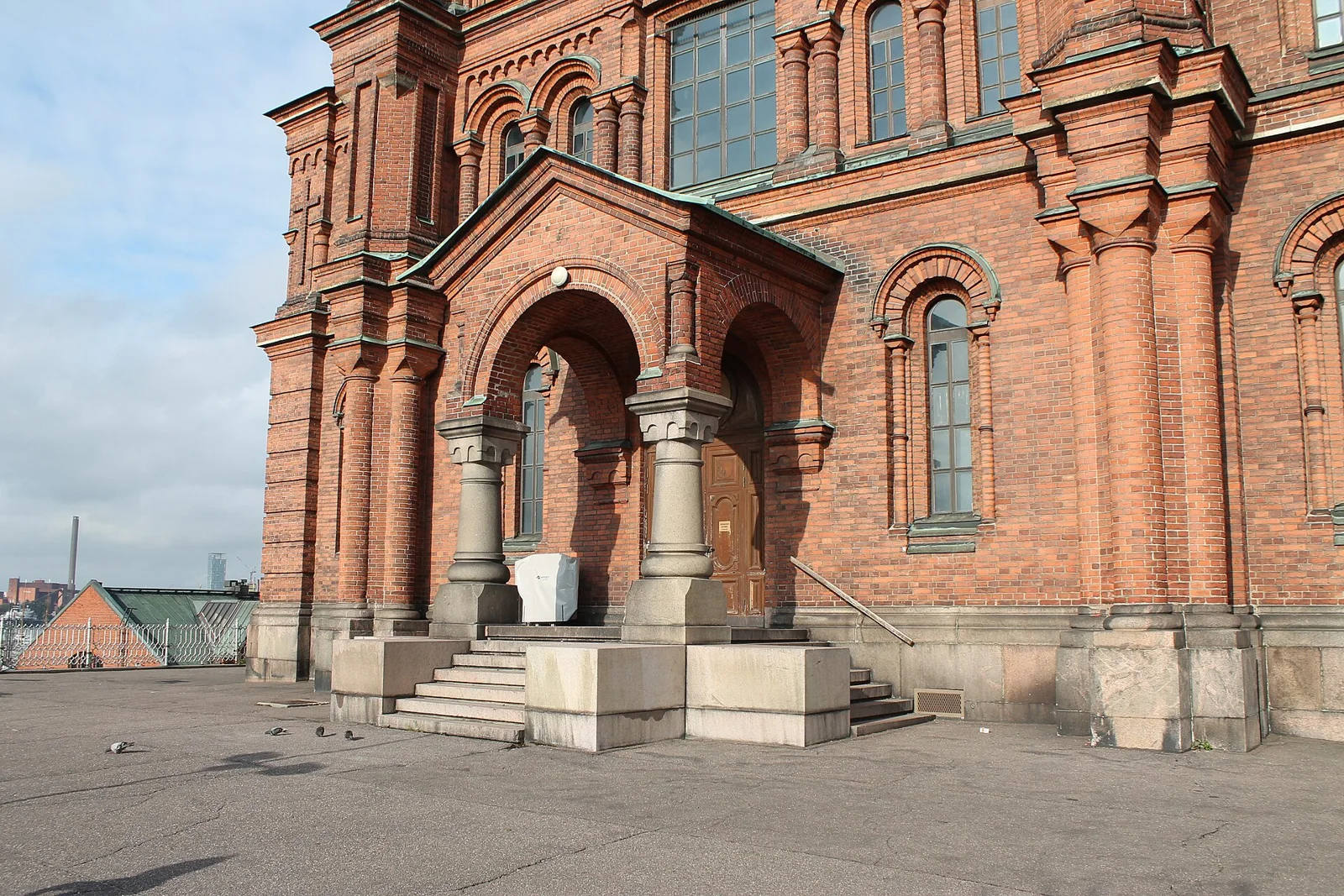
Uspenski changes the colour and height of Helsinki's harbour skyline. Its red brick and clustered domes invite a comparison with the pale cathedral above Senate Square. Begin with the building's outline, then attend to the ground beneath it. An elevated setting changes how walls and roofs overlap, and how much of a façade can be seen from below. The building has a strong presence without needing the same formal open foreground as Senate Square.
The Orthodox Parish of Helsinki records the cathedral's consecration on 25 October 1868. Its history identifies architect A. M. Gornostajev and explains that construction continued after his death under another architect. This gives the exterior an institutional and historical context. The building belongs to Orthodox worship; its similarity to another city landmark in the word “cathedral” should not erase the distinction between the two churches.
Use the three photographs to compare mass and surface. The first image concentrates on the entrance porch, while the detail photograph records a plaque on the wall. The context image supplies the more distant cathedral outline. These subjects make the difference between identifying a building, reading a small marker and understanding a skyline especially clear. Do not date an individual repair from colour alone: weather, distance and photographic processing all affect how masonry appears. Nor does a visible slope establish the condition or accessibility of an approach.
The optional Presidential Palace discovery follows this chapter as a different reading of the harbour's institutional architecture. Church and palace both carry histories of nineteenth-century Helsinki, yet they serve distinct purposes and occupy different terrain. The comparison is editorial, rather than a recorded descent between them. End by looking again at the skyline, noticing the balance between the central mass and its smaller roof forms. Real visits, worship arrangements and indoor admission require separate checks; exterior imagery supplies no promise of entry or current visitor conditions.
Real-travel note
Plan actual movement and indoor visits separately.
Compare independently captured photographs and viewpoints, each with its own date.
Chapter 4
Esplanadi: a green room between streets
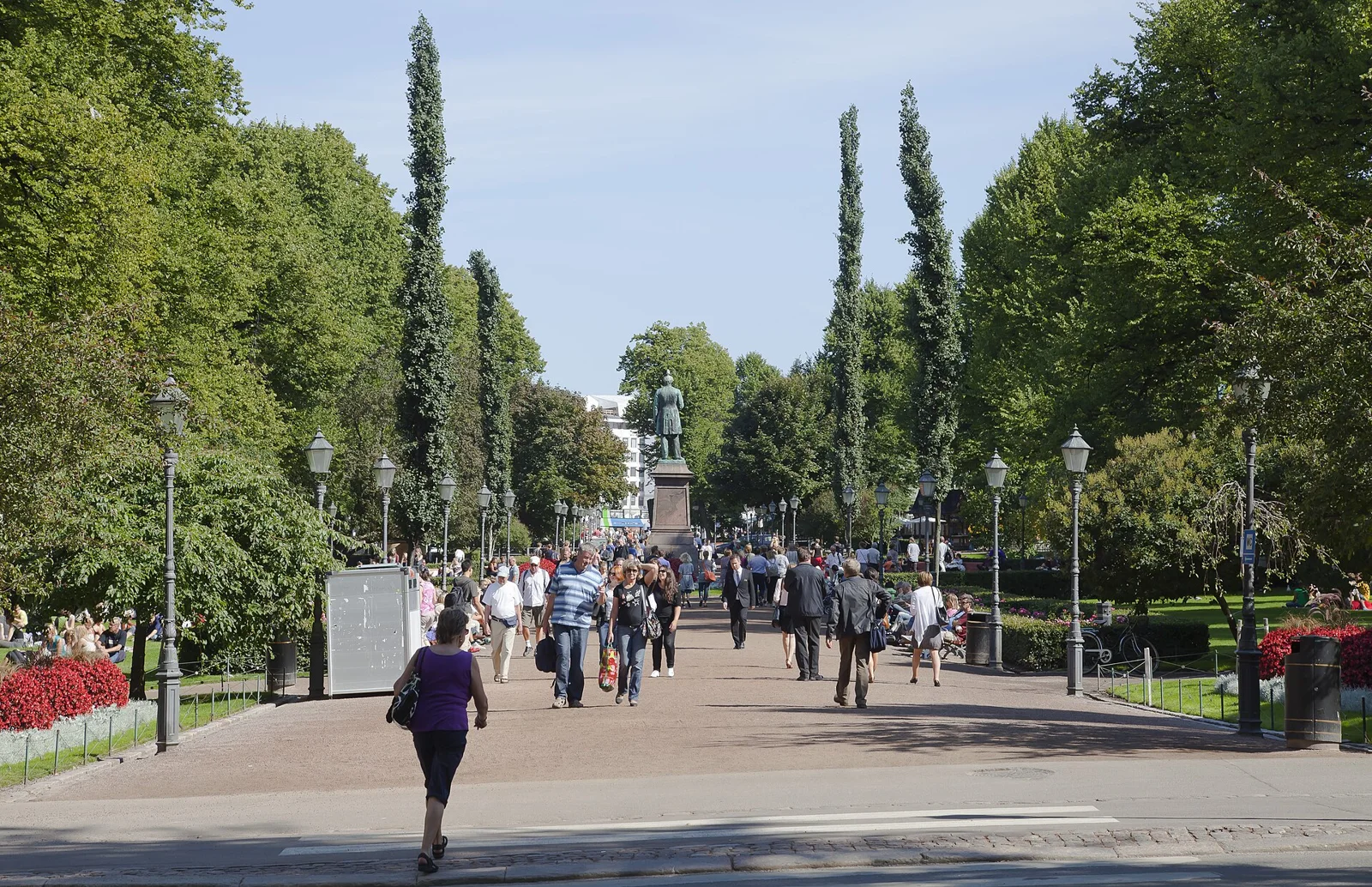
Esplanadi introduces a different way of making an urban room. Instead of stone façades enclosing an open square, rows of trees give the central space its rhythm. Look along the park before looking at individual monuments. Trunks, paths and planted areas organise depth, while the streets and buildings beyond remain part of the setting. The result can feel enclosed without being separated from the city around it.
The City of Helsinki describes rows of linden trees on both sides of Esplanade Park. Its account also dates the central monument to poet Johan Ludvig Runeberg to 1885 and identifies Kappeli at the Market Square end as a building from 1867. These are distinct elements within a planted public space. Their dates help anchor its history without making the whole park a preserved scene from one year.
Compare the wide, closer and contextual photographs for the changing balance between vegetation and architecture. A tree-lined view can hide the surrounding frontages; another angle can make the same park appear closely tied to the streets. Leaves, shadows and planting belong to particular seasons. A winter image and a summer image therefore offer different ways of reading the structure, rather than evidence of today's weather or a guaranteed garden display. Look for the parts of the composition that remain understandable across those changes.
The Ateneum discovery follows the park as an optional comparison with a building devoted to art. The editorial sequence then finishes at Central Station, where the question of public space becomes one of arrival and movement. Before leaving this chapter, notice the foreground immediately around the camera: a bench, path or patch of planting can alter the apparent scale of the entire view. Plan actual travel separately. These independent photographs and any local exterior scene do not verify a continuous promenade, performance schedule, café visit or step-free connection to the next chapter.
Real-travel note
Plan actual movement and indoor visits separately.
Compare independently captured photographs and viewpoints, each with its own date.
Chapter 5
Central Station: an entrance to the city
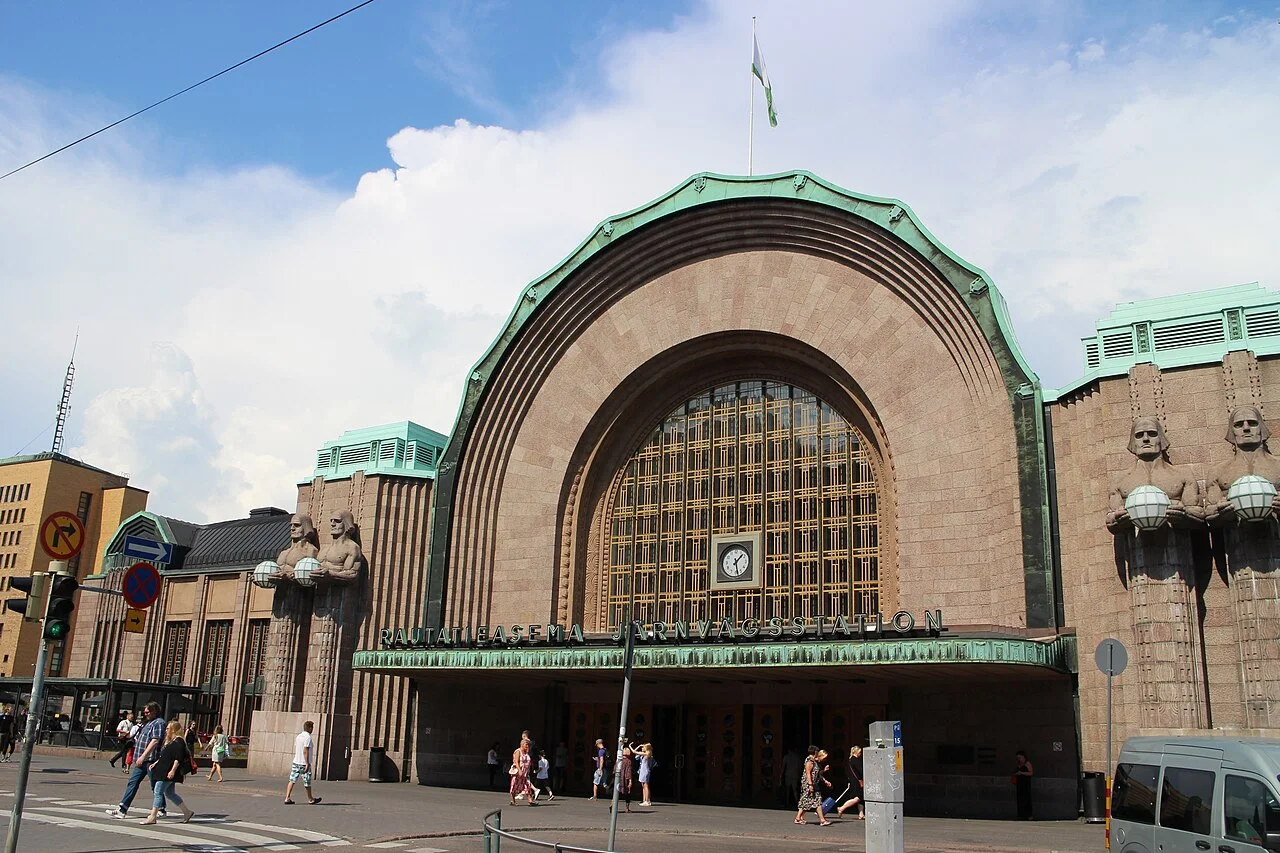
Finish with a building that gives arrival an architectural face. Helsinki Central Station combines a broad entrance composition with a tower that can be read at a larger urban scale. Look first at the relationship between the main opening and the solid surfaces around it. Then notice how sculpture, windows and changes in height prevent the frontage from becoming a single wall. The station is both a recognisable landmark and part of a working transport setting.
The station's own history records the inauguration of the new building on 5 March 1919, still unfinished. It identifies Eliel Saarinen as the architect. Keeping “inaugurated” distinct from “completely finished” respects that history and avoids turning a complex building process into one simplified date. It also places the station after the nineteenth-century institutions encountered earlier in this journey.
Compare the three photographs for different scales of attention. The wider image introduces the architectural whole; the closer study invites attention to a selected surface or feature; the context image restores surrounding urban space. A tower may anchor a skyline while a doorway organises a person's immediate approach. Those are complementary readings, and neither requires claiming that the selected photographs record every entrance or show the whole station complex. Traffic, signage and crowds are details of the photographed occasion.
The preceding Ateneum discovery creates a final comparison between cultural and transport institutions in the central city. Return to the station façade to see how each building addresses the public in a different way. This is the end of the editorial journey, rather than proof of a completed walk from the harbour. Tickets, timetables, platforms and travel assistance belong to actual journey planning. Exterior images provide a place to study architecture; they establish neither a train connection nor current access to a station interior.
Real-travel note
Plan actual movement and indoor visits separately.
9 reviewed experiences
Explore along the route
Step into the places along this journey. Choose a view independently of the story chapters. Free previews do not count toward chapter progress. Return to the journey above to continue through its stops.
Senate Square: the capital as a composition Short observation sequence
2023-04 · 5 connected local positions and return. Senate Square street-level exterior and cathedral-facing square; no cathedral interior. Capture-date archive; current access and arrangements may differ.
Reviewed 2026-11-12 · Nearby viewpoint
Explore at your own pace; these views do not count toward chapter completion. Check each point's coverage note before navigating provider imagery. Availability may change.
Sources
- Government Palace — Finnish Government
- Market Square — MyHelsinki
- History of Uspenski Cathedral — Orthodox Parish of Helsinki
- Esplanade Park — City of Helsinki
- History — Helsinki Central Railway Station
- History of Helsinki Cathedral — Helsinki Cathedral
- Quick Guide: Helsinki market halls — MyHelsinki
- Visit the Presidential Palace online — Office of the President of the Republic
- Ateneumin taidemuseo — Senate Properties
- Senate Square and the white Helsinki Cathedral above its steps — JIP
- Flowers and cafe seating on Senate Square beneath the Cathedral — JIP
- Broad paved Senate Square facing Helsinki Cathedral — JIP
- Market Square stalls and waterfront buildings viewed across the harbour — Leonhard Lenz
- Boats, market stalls and waterfront buildings during the 2018 Baltic Herring Market at dusk — Halt tone
- Market Square and moored passenger boats seen from above — Tuula Sipilä
- Brick entrance porch and arched windows of Uspenski Cathedral — John Samuel
- Inscribed plaque on the brick wall of Uspenski Cathedral — Óðinn
- Uspenski Cathedral rising behind waterfront streets — Slyronit
- Tree-lined promenade through Esplanadi park — Diego Delso
- Runeberg statue and visitors in Esplanadi park — Diego Delso
- Outdoor stage and benches in Esplanadi park — Fry72, Karel Frydrýšek
- Arched main entrance of Helsinki Central Station with lantern-bearing figures — Suicasmo
- Stone doorway with lanterns at Helsinki Central Station — Godot13
- Clock tower of Helsinki Central Station beside tram tracks — Ximonic (Simo Räsänen)
- Columns and green dome of Helsinki Cathedral — John Samuel
- Brick exterior of Helsinki Old Market Hall — Diego Delso
- Pale facade of the Presidential Palace in Helsinki — Ad Meskens
- Ateneum Art Museum facade behind flower planters — Suicasmo


Your journey, remembered.
Explored 0 of 5 stops. Explore every stop to unlock your keepsake.
5 stops to your keepsakeExplore every stop to share or download your keepsake.
Plan separate Helsinki visits
Compare five urban settings; arrange travel and indoor visits separately.
Official sources checked:
Editorial sequence
Senate Square, Market Square, Uspenski, Esplanadi and Central Station form the main sequence. Cathedral, Old Market Hall, Presidential Palace and Ateneum are optional comparisons. Independent imagery verifies no continuous walk or step-free connections.
Visiting arrangements
All nineteen selected stills are exterior views. Check churches, market hall, palace, museum and station interiors separately; images establish no present opening or prices.