
Bern: gates, clocks and the Aare
Explore Bern through its civic square, two old gates, Gothic minster and Aare river setting, with four optional discoveries.
Begin the visual journeyPlan a real visit to Bern Old TownExplore 7 reviewed views along the routeGuided visual journey
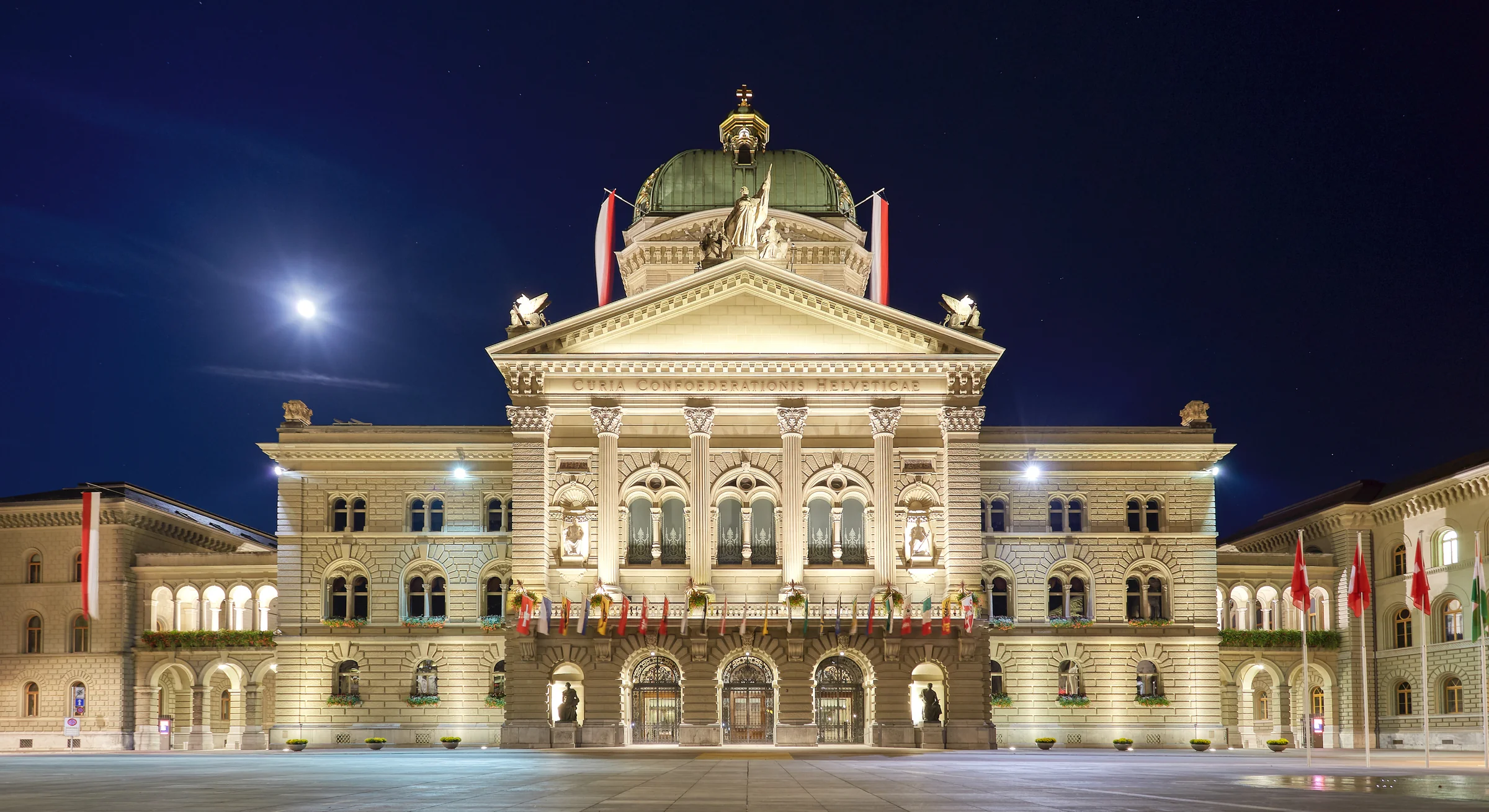
Swiss Parliament illuminated across Bundesplatz at night · Axel Tschentscher · CC BY-SA 4.0 · Resized and converted to WebP
Reading mode
Place stories to read at your own pace
The Bundeshaus discovery narrows the opening chapter's civic panorama to the parliament building. Bern Welcome describes parliamentary meetings beneath the dome and federal administration in the adjoining wings. This helps distinguish the central institutional image from the larger complex. Look at how the photographed frontage distributes emphasis: roofline, windows and entrance can guide attention differently when the surrounding square takes less space in the frame. Compare this image with Bundesplatz rather than treating the two subjects as identical. A façade can announce public purpose without revealing the rooms behind it. This discovery follows Bundesplatz and precedes Käfigturm in the editorial sequence. This discovery is presented through licensed photographs only, including an additional Bundeshaus image in the Bundesplatz gallery. There is no interactive scene, parliamentary sitting or established access inside. Confirm tours and admission arrangements with the parliament before an actual visit. Finally, consider how the building reads differently when viewed as a political institution, an architectural composition and one edge of a public square.
Chapter 1
Bundesplatz: space before the parliament
Begin with the space in front of the institution. Bundesplatz gives Bern a broad civic foreground, where the arrangement of buildings can be read before their individual decoration. The parliament building establishes one edge, while the buildings on the other sides help the square feel like a room. Compare the amount of open ground with the height of the surrounding frontages. The empty intervals are as important to this composition as the stone surfaces that frame them.
The City of Bern describes Federal Square as dating from the turn of the twentieth century, bounded by the federal buildings to the south and banking institutions to the east and west. This identifies a particular civic setting rather than a generic medieval market square. Its history also introduces a useful distinction for the whole journey: Bern's old town includes institutions and spaces formed in different periods. An old-town address does not give every visible feature the same age.
The wide photograph shows the illuminated parliament frontage across the plaza at night. The closer image looks down over the façade and square, while the context view includes fountains and surrounding streets. Study the three independent photographs for differences in emphasis. One may make the parliament the principal subject; another can give more attention to the ground or surrounding façades. Read only what each frame includes. Activity, flags, shadows and any water visible belong to the photographed moment. A fountain in operation would not establish today's operating schedule, and an open square would not guarantee unrestricted access during an event. Local interactive imagery is likewise a dated observation, possibly made beside a covered arcade rather than in the open centre.
The Bundeshaus discovery follows this chapter, narrowing attention from the civic setting to the parliament building itself. Käfigturm then introduces a much more compressed relationship between architecture and street. This is an editorial sequence rather than a recorded approach between the two places. Before continuing, identify the strongest horizontal line in the square and compare it with the dome or roofline above. Their balance explains how public architecture can announce itself without filling every part of the view. The interactive scene is a parliament-side exterior and archway.
Real-travel note
Plan movement and indoor visits separately.
Compare independently captured photographs and viewpoints, each with its own date.
Chapter 2
Käfigturm: a gate within the city
A gate normally suggests an edge. At Käfigturm, the useful question is how a former edge becomes part of the city around it. Begin with the opening through the tower and compare it with the height and width of the masonry above. The street directs attention toward that opening; adjoining frontages give the tower a setting that feels more enclosed than Bundesplatz. Read the contrast between an everyday urban passage and the strongly marked vertical landmark over it.
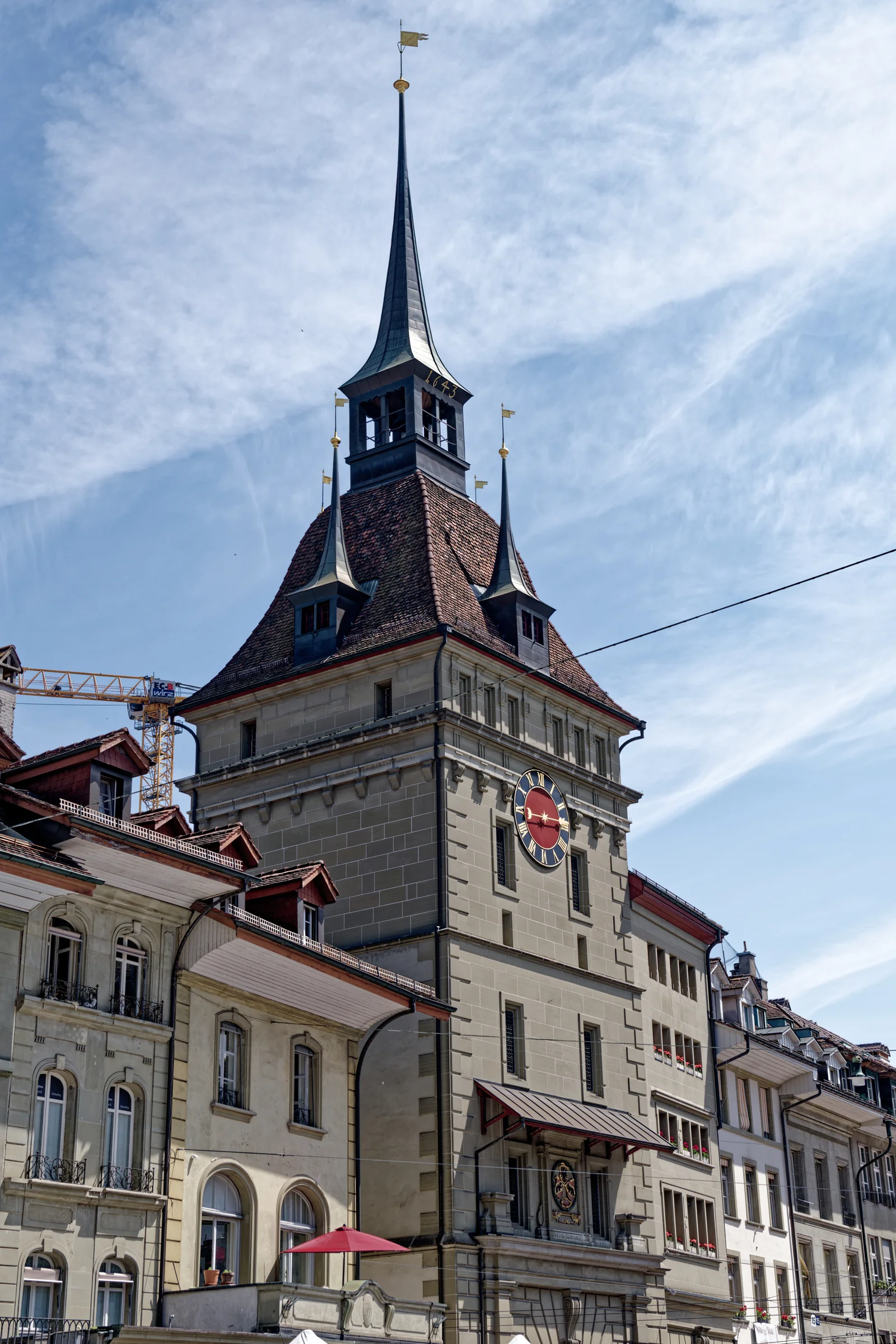
Bern Welcome identifies Käfigturm as a former city gate at the upper end of Marktgasse. Its account distinguishes the original defensive role, later imprisonment and the rebuilding ordered in the seventeenth century. It also identifies the building with political discussion through the Polit-Forum. Those successive uses make the tower more interesting than a single label can convey. The name recalls confinement, while the building's public meaning has changed. No doorway visible in a photograph, however, establishes access to an exhibition today.
The wide image studies the west exterior. The closer frame combines the clock with the Anna Seiler fountain statue, and the context places the tower among the Spitalgasse arcades. Compare the independent wide, detail and context frames as different studies of the tower's proportions and its relation to the street. A closer crop need not depict a tiny decorative detail; it may instead clarify the whole opening or one face of the tower. Avoid assuming that the opposite face looks identical. Traffic and people provide scale only for their captured moments. This chapter is presented through licensed photographs only. No interactive scene or continuous passage through the gate is included.
The Kornhaus discovery follows this chapter before Zytglogge becomes the next main subject. That ordering sets a former defensive building beside a former storehouse and then another city gate transformed by timekeeping. It is a comparison of civic functions rather than a verified walking itinerary. Return briefly to the opening at the base: the space that passes through a building can be as distinctive as its outline against the sky.
Real-travel note
Photographs only; plan an actual visit separately.
Compare independently captured photographs and viewpoints, each with its own date.
Chapter 3
Zytglogge: time above the street
Zytglogge is both a landmark and a way of organising attention along the street. Start with the whole tower, allowing the surrounding façades to establish its scale. Then compare the broad architecture with the smaller surfaces devoted to time. The clock brings an unusually intricate visual system into an urban setting that can be understood from much farther away. That difference between a distant marker and a close reading gives the chapter its central contrast.
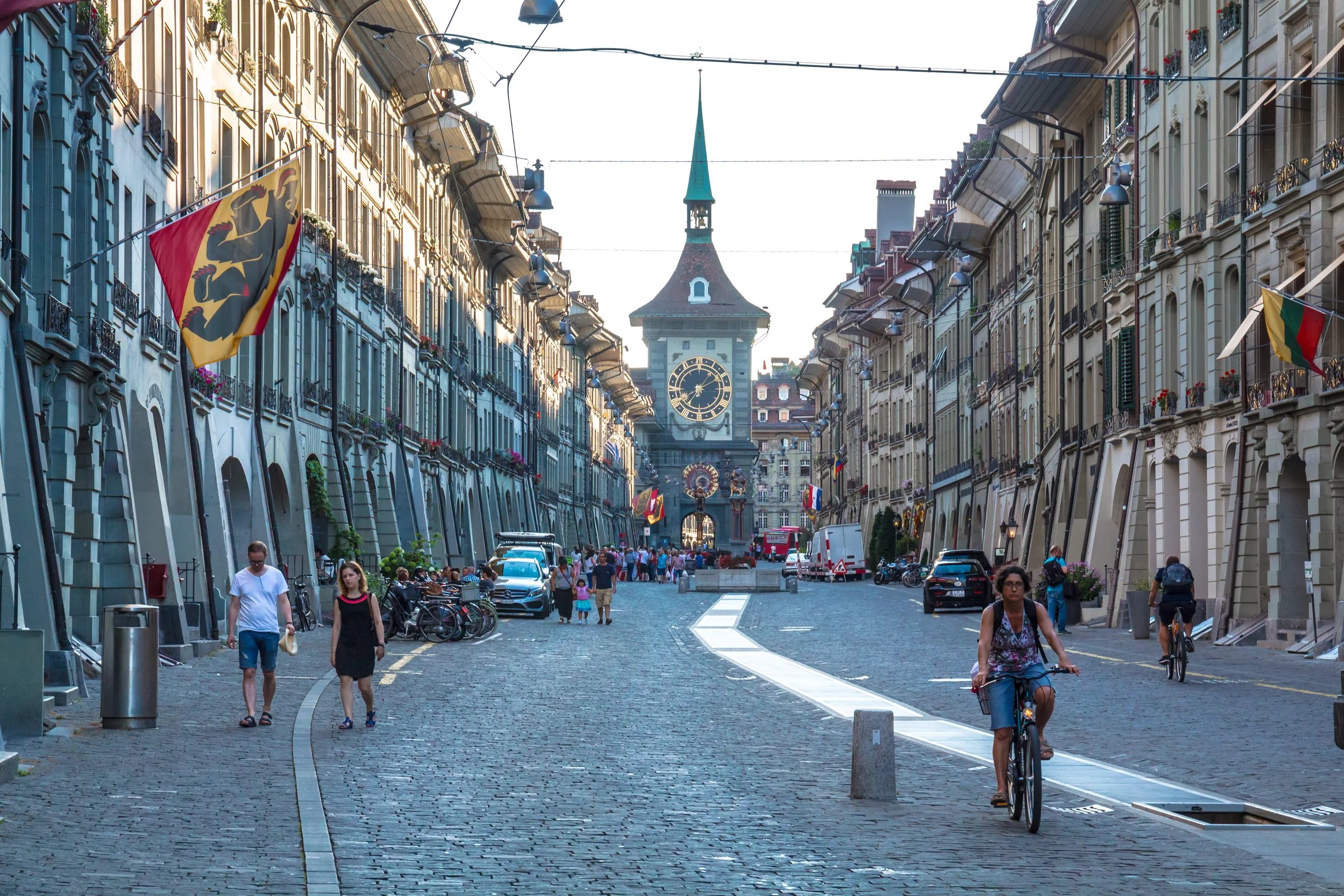
Bern Welcome describes the tower as a former city gate and highlights its astronomical calendar clock and mechanical figures, with the mechanism associated with 1530. Keep those elements distinct. A conventional clock face, an astronomical display and moving figures have different roles, and not every one appears on every side or in every photograph. Historical interpretation can explain the apparatus without pretending that a still image records its movement or sound. The mechanisms inside are a separate subject from the exterior presented here.
The wide and context photographs look along Kramgasse toward the tower. The detail frame concentrates on the astronomical dial and mechanical figures rather than the tower interior. Use the three photographs to compare architectural mass, visible clockwork displays and the street setting wherever each is actually included. The label detail describes a closer study, not a guarantee of readable numerals or isolated figures. Look for the visual hierarchy between the clock and the wall supporting it. Changing light may make one feature easier to read in one picture than another. The images are independent records, and neither their crowds nor their clocks establish the time of a single continuous visit. Local interactive coverage may approach from a street or arcade rather than offering every clock-bearing face.
The Rathaus discovery follows Zytglogge, adding a different civic institution before Bern Minster takes the main sequence toward religious architecture. Before continuing, consider why the tower remains recognisable even when the astronomical details are too small to distinguish. Its position, silhouette and street enclosure do part of the work. A real tower tour, including access to the machinery, requires separate arrangements; this chapter offers an exterior comparison.
Real-travel note
Plan movement and indoor visits separately.
Compare independently captured photographs and viewpoints, each with its own date.
Chapter 4
Bern Minster: stone rising above the roofs
Bern Minster changes the journey's vertical emphasis. The earlier towers concentrate attention within street corridors; the minster invites comparison between an extensive church body and the spire rising above it. Begin with the roofline and the building's relation to neighbouring roofs. Then look at the way openings, buttresses and architectural edges distribute weight across the visible façade. Gothic architecture can seem light at a distance while revealing considerable mass at closer range.
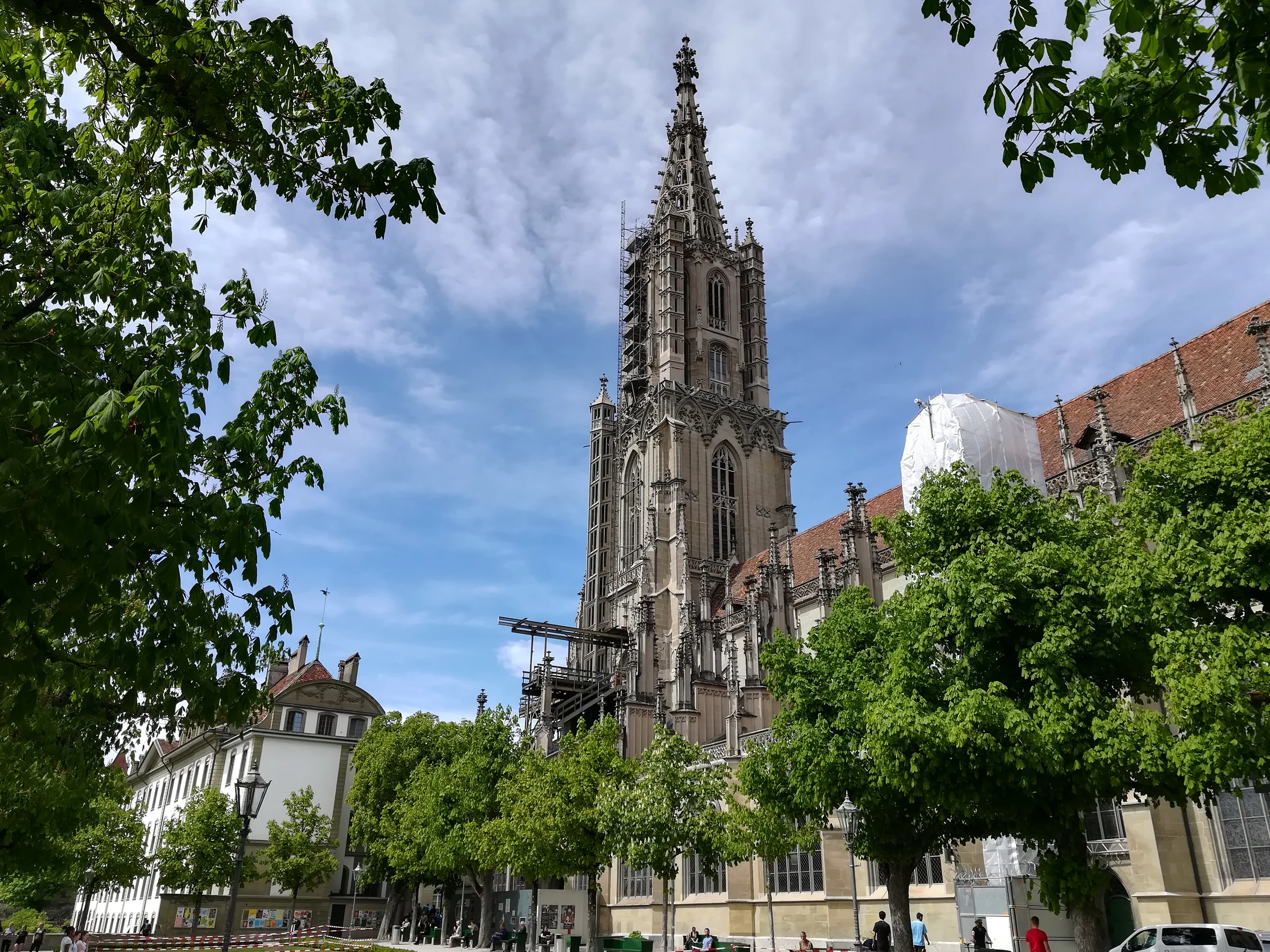
Switzerland Tourism records the laying of the foundation stone in 1421 and identifies the building as a work of Gothic architecture. A beginning date is useful historical context, not a date for every stone or the final outline of the tower. Buildings produced over generations invite a more patient reading than a single construction year suggests. The institution's account also distinguishes the portal and tower experience. Those subjects need separate evidence: an exterior view does not reproduce a climb or an interior encounter.
The wide photograph frames the tower with trees at Münsterplatz. The detail studies the exterior Last Judgment portal figures, while the context places the minster and terrace across the Aare. Compare the independent wide, detail and context photographs for the relationship between vertical lines and horizontal ground. A nearer image may still show a substantial portion of the church rather than an isolated sculpture. Read the actual crop before drawing conclusions about what has been selected. Where neighbouring buildings appear, they help explain the minster's scale; where they disappear, the church can feel more detached from the city. The local interactive scene may include an adjoining street, church square or covered edge. It does not establish access to the nave or tower, or a continuous step-free approach.
The BearPark discovery follows this chapter and precedes Nydegg, shifting attention from monumental masonry toward the river landscape and its managed animal habitat. The transition is editorial, so plan actual movement independently. Finish by tracing one continuous line within the church photograph, from its lower visible edge toward the tower or roof. Notice where the frame interrupts it: the photograph always offers a selected view of a much larger building. The interactive scene records side walls and adjacent arcades, without an interior visit.
Real-travel note
Plan movement and indoor visits separately.
Compare independently captured photographs and viewpoints, each with its own date.
Chapter 5
Nydegg: the old town meets the Aare
Nydegg brings Bern's architecture into conversation with the Aare. The subject is a district and river crossing setting rather than one isolated façade. Look at the relationship between roofs, bridge, banks and water wherever these elements enter the selected photographs. From a distance, the old town can appear as a compact arrangement on changing levels; nearer views return attention to individual buildings and the edges between public space and river landscape.
Bern Welcome's city account connects the Nydegg bridge and church with the lower end of the old town. That geographical reference helps orient the final chapter without making bridge, church and neighbourhood interchangeable names. A photograph may favour one of them while leaving the others outside its frame. The wider history of a city enclosed by the Aare belongs to a larger map; a local view can suggest that geography but cannot show the entire river loop at once.
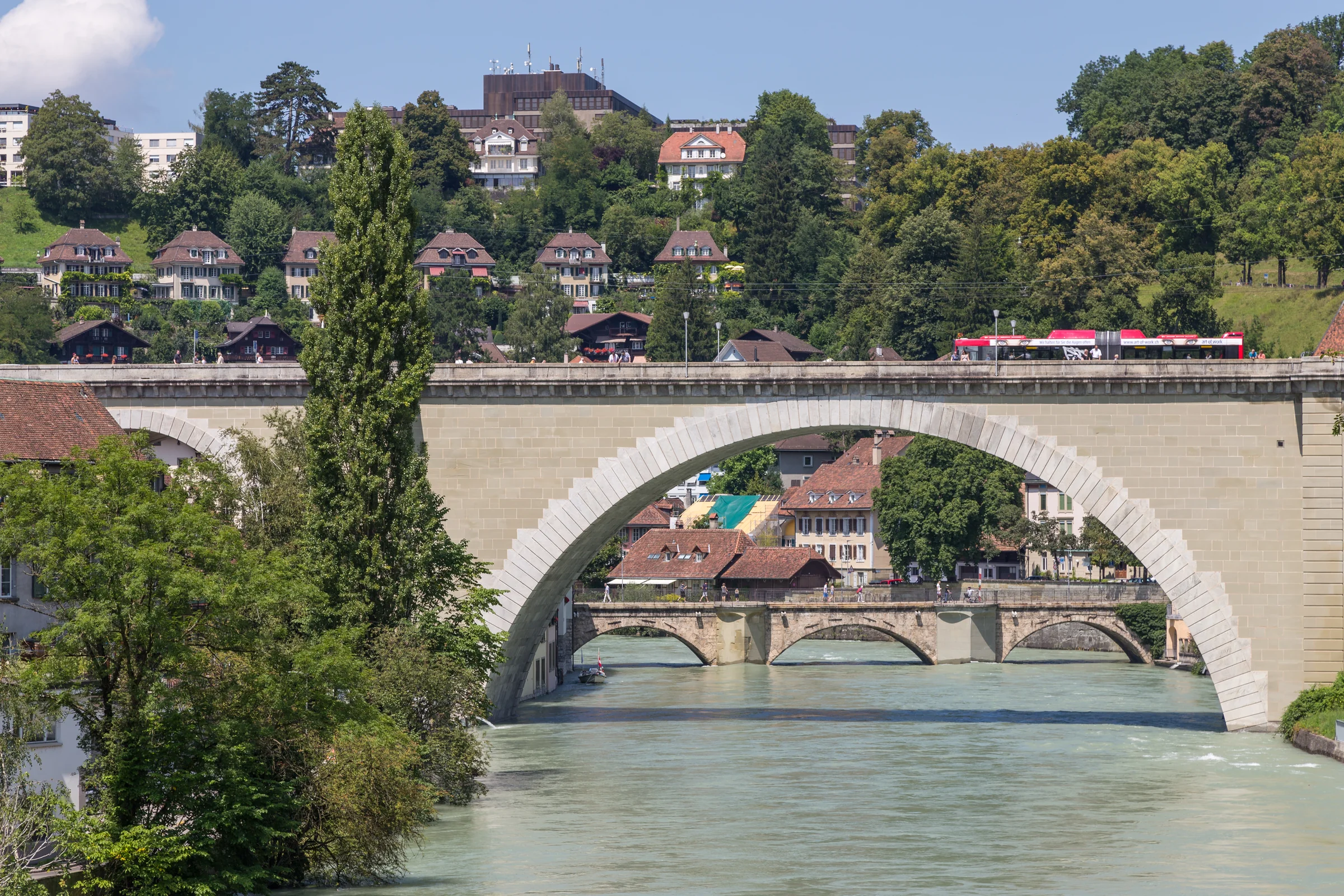
The wide image compares bridges over the Aare. The closer photograph looks along the pavement of Nydeggbrücke toward the old town, and the context shows Untertorbrücke from Nydeggbrücke. Compare the wide, detail and context photographs as independent observations. Ask where each locates the viewer relative to the water: near the bank, at bridge level, or farther away. A closer crop can still be a neighbourhood view; it need not isolate an architectural ornament. Water colour and vegetation vary with light, season and conditions at capture. They should not become promises about a future visit. Likewise, any visible bridge pavement offers evidence of that particular image, not a verified connection from the minster or a guarantee of current accessibility. Interactive imagery may include a nearby arcade or street as well as open river views.
The BearPark discovery appears immediately before this final chapter. It offers a distinct subject on the river, while Nydegg closes with the broader relationship between the city and its setting. Look back at the five scales: square, gate, clock tower, church and river district. The sequence has connected them through visual comparisons. Real crossings, riverside paths, building visits and animal visibility remain separate matters to check when planning a visit. The interactive scene is a lower neighbourhood street with houses rather than a bridge-top panorama.
Real-travel note
Plan movement and indoor visits separately.
7 reviewed experiences
Explore along the route
Step into the places along this journey. Choose a view independently of the story chapters. Free previews do not count toward chapter progress. Return to the journey above to continue through its stops.
Bundesplatz: space before the parliament Short observation sequence
2024-06 · 5 connected local positions and return. Parliament-side exterior and adjoining square approach; some positions face the connecting archway rather than the open Bundesplatz. Capture-date archive; current access and arrangements may differ.
Reviewed 2026-11-13 · Nearby viewpoint
Explore at your own pace; these views do not count toward chapter completion. Check each point's coverage note before navigating provider imagery. Availability may change.
Sources
- Federal Square: history — City of Bern
- Käfigturm — Bern Welcome
- Zytglogge — Bern Welcome
- Bern Minster — Switzerland Tourism
- Bern Walking Tour — Bern Welcome
- Parliament Building and Parliament Square — Bern Welcome
- Historic venues in Bern — Bern Welcome
- History of Bern Town Hall — Canton of Bern
- Bern and bears — Tierpark Bern
- Swiss Parliament illuminated across Bundesplatz at night — Axel Tschentscher
- Parliament facade and Bundesplatz fountains seen from above — Hadi
- Bundesplatz fountains and surrounding streets from above — Hadi
- Käfigturm seen from the west with its clock and spire — Tilman2007
- Käfigturm clock beside the Anna Seiler fountain statue — Tilman2007
- Spitalgasse arcades and Käfigturm in Bern — Thomas Woodtli from Zürich, Switzerland
- Zytglogge tower at the end of Kramgasse — Dmitry A. Mottl
- Zytglogge astronomical dial and mechanical figures — JoachimKohler-HB
- Kramgasse arcades leading towards Zytglogge — JoachimKohler-HB
- Bern Minster spire above the trees on Münsterplatz — H.Helmlechner
- Sculpted figures above the Bern Minster entrance portal — ArtProjection
- Bern Minster and terrace above the Aare — Wladyslaw
- Aare river with Nydeggbrücke and Untertorbrücke — JoachimKohler-HB
- Pedestrian pavement across Nydeggbrücke towards Bern Old Town — JoachimKohler-HB
- Untertorbrücke and riverside houses seen from Nydeggbrücke — Daniel Schwen
- Swiss Federal Palace exterior in Bern — Suicasmo
- Kornhaus facade on Kornhausplatz in Bern — Zinneke
- Bern Rathaus facade and outdoor staircase — Daniel Schwen
- Brown bear swimming in the BärenPark pool — Sumit Surai


Your journey, remembered.
Explored 0 of 5 stops. Explore every stop to unlock your keepsake.
5 stops to your keepsakeExplore every stop to share or download your keepsake.
Plan separate Bern visits
Compare five urban settings; arrange travel and indoor visits separately.
Official sources checked:
Editorial sequence
Bundesplatz, Käfigturm, Zytglogge, Bern Minster and Nydegg form the main sequence. Bundeshaus, Kornhaus, Rathaus and BearPark are optional comparisons. Independent imagery verifies no continuous walk, tower ascent or step-free connections.
Visiting arrangements
Stills and local interactive imagery are independent. Check building interiors, tower ascents and animal visibility separately; images establish no present opening or prices.